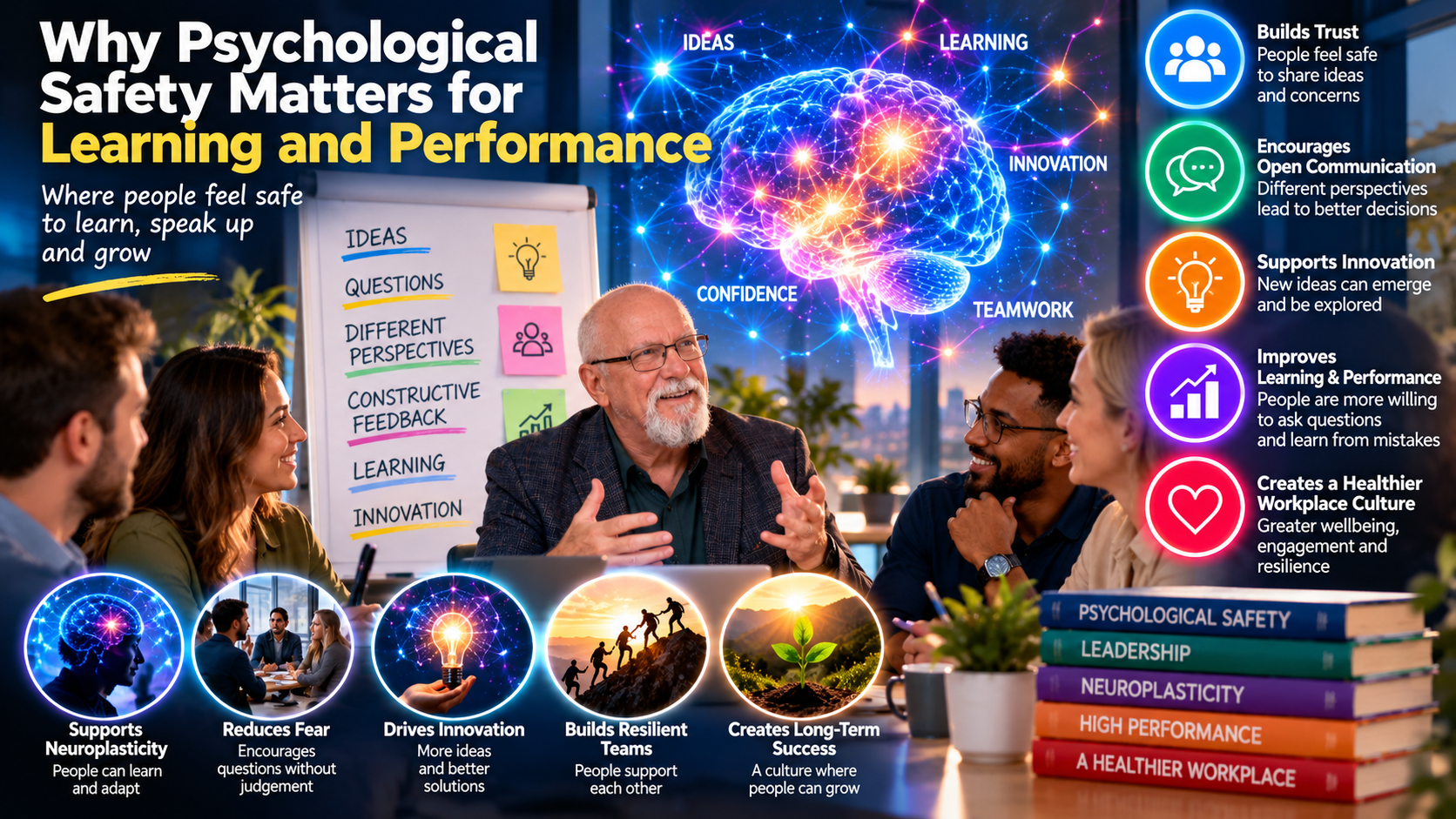
What if one of the biggest barriers to success in your organisation wasn’t a lack of talent, intelligence or ambition, but the fear of making mistakes?
Imagine sitting in a meeting with an idea that could improve the way your company operates.
You believe it has potential.
You have thought about the benefits.
And you are reasonably confident that it could make a difference.
But you remain silent.
Why?
Perhaps you are worried that your colleagues will think the idea is foolish.
Maybe your manager has dismissed suggestions in the past.
Or perhaps you have learned that questioning established practices is not particularly welcome.
Now imagine a different workplace.
One where people feel comfortable asking questions.
Where employees can acknowledge mistakes without automatically being humiliated.
Where leaders listen to different perspectives.
And where learning is valued alongside performance.
Which organisation is more likely to discover new ideas, identify problems and adapt to change?
This is where psychological safety in the workplace becomes important.
Psychological safety is not simply about being kind to employees.
It is about creating an environment where people feel able to contribute, learn and communicate openly.
And in a world where businesses must continually adapt to new technologies, changing markets and unfamiliar challenges, that can be a significant advantage.
1. What Is Psychological Safety?
Psychological safety is a concept closely associated with the work of Harvard Business School professor Amy Edmondson.
It describes a shared belief within a team that people can take interpersonal risks without unnecessary fear of embarrassment, humiliation or punishment.
These risks might include asking a question.
Admitting a mistake.
Requesting help.
Expressing uncertainty.
Or suggesting a different approach.
Psychological safety does not mean that everyone agrees.
It does not mean employees are protected from constructive criticism.
And it certainly does not mean that accountability disappears.
Instead, it means people can participate in honest discussions without feeling that every imperfect contribution threatens their reputation.
For example, imagine an employee who notices a potential problem with a project.
In a psychologically unsafe workplace, they may remain silent because they fear being blamed.
In a psychologically safer workplace, they may feel comfortable raising the concern.
That difference can have important consequences.
Psychological safety makes it easier for people to speak up when speaking up matters.
2. Why Fear Can Interfere With Learning
Fear is a natural human response to perceived threats.
Our brains contain interconnected systems involved in recognising danger, regulating emotion and responding to stressful situations.
The amygdala is one region involved in processing emotionally significant information, including potential threats.
Other regions, including areas of the prefrontal cortex, contribute to attention, decision-making and emotional regulation.
When people experience significant stress, their ability to concentrate, remember information or make complex decisions can sometimes be affected.
However, the relationship between stress and performance is complicated.
Not all stress is harmful.
Some challenging situations can increase alertness and motivation.
The difficulty arises when people experience persistent or excessive pressure, particularly when they feel they have little control.
In a workplace, fear of humiliation can discourage people from participating.
An employee may avoid asking for clarification even when they do not understand a task.
Someone may hide a mistake rather than seek assistance.
Another person may decide that sharing an idea is simply not worth the risk.
These behaviours can reduce opportunities for learning.
The issue is not that psychological safety somehow switches the brain into a special learning mode.
It is that a supportive environment can make people more willing to engage in behaviours that contribute to learning.
3. Psychological Safety and Neuroplasticity
Neuroplasticity is the brain’s ability to change its connections, structure and functions in response to experience, learning and other influences.
It is one of the biological foundations of learning.
When employees develop unfamiliar skills, practise new tasks or receive useful feedback, they engage processes associated with learning and adaptation.
But effective learning requires opportunities to participate.
Imagine someone attending a training session.
They don’t understand part of the explanation.
If they feel embarrassed about asking questions, they may remain confused.
If they feel comfortable requesting clarification, they have a better opportunity to understand the material.
Psychological safety can therefore support conditions in which learning is more likely to occur.
It does not directly guarantee increased neuroplasticity.
Nor does it mean a psychologically safe workplace automatically produces measurable changes in brain structure.
The connection is more practical.
People who feel able to ask questions, seek feedback and acknowledge uncertainty may have more opportunities to learn.
Neuroplasticity helps explain how experience can change the brain. Psychological safety can help create an environment where people are more willing to engage in learning experiences.
4. Why Employees Sometimes Hide Their Mistakes
Nobody enjoys making mistakes.
But in some organisations, the consequences of admitting an error can feel worse than the error itself.
Employees may fear criticism.
Public embarrassment.
Damage to their professional reputation.
Or disciplinary consequences.
As a result, they may attempt to conceal problems.
This can create additional risks.
A small mistake that could have been corrected early may develop into a more serious issue.
Important information may fail to reach decision-makers.
And organisations may lose opportunities to improve their processes.
Psychological safety encourages a more constructive response.
Instead of immediately asking:
“Who is responsible for this failure?”
Leaders might begin by asking:
“What happened, and what can we learn?”
This does not remove accountability.
Deliberate misconduct, repeated negligence and reasonable mistakes require different responses.
But distinguishing between them can help organisations learn without creating unnecessary fear.
5. Why Psychological Safety Matters for Business Performance
Every organisation depends on people sharing information.
Employees need to communicate concerns.
Teams need to coordinate activities.
Managers need accurate feedback.
And senior leaders need to understand what is happening throughout the business.
If people are afraid to speak openly, important information may remain hidden.
Psychological safety has been associated with team learning behaviours and other organisational outcomes.
Research suggests it can contribute to conditions that support collaboration and improvement.
However, psychological safety alone does not guarantee high performance.
Organisations also need clear goals, appropriate resources, relevant skills and effective management.
A team can feel psychologically safe while still lacking the training or systems required to perform well.
The most useful approach is therefore to combine psychological safety with accountability and clear expectations.
Employees should feel comfortable raising concerns while understanding their responsibilities.
This balance can help organisations create environments that support both learning and performance.
6. What Google’s Project Aristotle Revealed
One of the best-known discussions of psychological safety in business comes from Google’s Project Aristotle.
The project investigated what made some teams more effective than others.
Google’s findings highlighted psychological safety as an important characteristic associated with effective teams.
The research helped bring wider attention to the concept.
However, Project Aristotle should not be interpreted as proof that psychological safety is the only factor determining team success.
Team effectiveness is influenced by many variables.
These include organisational context, skills, resources, communication and the nature of the work.
Nevertheless, the project reinforced an important idea.
How people interact can matter as much as the individual abilities they bring to a team.
A group of talented employees may struggle if they cannot communicate openly.
Meanwhile, a team that shares information, learns from mistakes and supports constructive discussion may be better equipped to solve problems.
7. Why Psychological Safety Encourages Innovation
Innovation involves uncertainty.
New ideas do not always work.
Experiments can produce unexpected results.
And challenging established practices may involve professional risk.
Imagine an employee who believes a particular process could be improved.
They have noticed inefficiencies.
They have considered an alternative.
But they know their manager dislikes being questioned.
The employee may decide to remain silent.
The organisation loses the opportunity to consider the suggestion.
Now imagine a leader who actively invites constructive ideas.
Employees understand that suggestions will be evaluated fairly.
They know that reasonable disagreement is acceptable.
And they recognise that unsuccessful experiments can provide useful information.
This environment can encourage participation in innovation.
Of course, not every idea will be valuable.
And organisations need appropriate processes for assessing risks and allocating resources.
But innovation becomes more difficult when people are unwilling to share possibilities.
An organisation cannot benefit from ideas that employees are too afraid to express.
8. Psychological Safety and the Courage to Be a Beginner
One of the most overlooked aspects of workplace learning is the discomfort of not knowing something.
Experienced professionals may be reluctant to admit they need help.
Managers may feel pressure to have every answer.
And employees may avoid unfamiliar tasks because they fear appearing incompetent.
But learning requires us to encounter things we do not yet understand.
When I started learning piano at 54, I had to accept being a beginner.
There were unfamiliar notes.
New movements.
And plenty of opportunities to make mistakes.
I could not expect to play confidently before learning the basics.
The same principle applies in organisations.
Employees need opportunities to develop unfamiliar skills without being judged for not already possessing them.
This is particularly important when introducing new technology.
A company may adopt an artificial intelligence system or digital platform.
Some employees will become comfortable quickly.
Others may need additional time and support.
A psychologically safer learning environment encourages people to ask questions rather than hide their uncertainty.
9. Why Leaders Must Be Willing to Admit They Don’t Know Everything
Leadership is sometimes associated with certainty.
Employees expect managers to provide direction.
Senior executives are expected to make decisions.
And CEOs are often judged by their confidence.
But confidence does not require pretending to know everything.
A leader who refuses to acknowledge uncertainty may unintentionally discourage others from asking questions.
If senior management behaves as though admitting a knowledge gap is unacceptable, employees may adopt the same approach.
Leaders can demonstrate a different standard.
They can acknowledge when more information is needed.
Invite different perspectives.
And explain how decisions will be evaluated.
For example:
“That’s a good question. I don’t have the answer yet, but let’s investigate.”
This response demonstrates that uncertainty can be addressed constructively.
It also reinforces the idea that asking questions is part of responsible decision-making.
10. Why Psychological Safety Matters During Organisational Change
Change can create uncertainty.
A business may introduce new technology.
Restructure departments.
Change leadership.
Or adopt unfamiliar working practices.
Employees may wonder how these developments will affect their responsibilities.
Some may feel anxious about whether they have the skills required.
Others may disagree with aspects of the proposed changes.
If people do not feel comfortable expressing concerns, leaders may receive an incomplete picture of the challenges involved.
Psychological safety can help employees raise questions and share information.
This does not mean every concern can be resolved.
Some organisational changes involve difficult decisions.
And leaders may not be able to provide certainty about every outcome.
But honest communication can help people understand what is happening.
It can also provide opportunities to identify practical problems before they become more serious.
11. The Connection Between Psychological Safety and Employee Wellbeing
Workplace wellbeing is influenced by many factors.
Workload.
Job security.
Management behaviour.
Working conditions.
Relationships.
And access to support.
Psychological safety can contribute to the social environment in which employees work.
People who feel comfortable raising concerns may be better positioned to request assistance.
They may find it easier to discuss difficulties.
And they may feel more included in team activities.
However, psychological safety should not be treated as a complete solution to workplace stress.
An employee may feel comfortable speaking to their manager while still facing an unrealistic workload.
A team may communicate openly but lack sufficient staffing.
Organisations therefore need to address both interpersonal culture and structural working conditions.
Supporting wellbeing requires more than encouraging people to talk.
It also involves responding appropriately when they do.
12. Why Psychological Safety Is Important for People With Invisible Disabilities
Some employees live with disabilities or health conditions that are not immediately visible.
These may include neurological conditions, acquired brain injuries and other circumstances that affect everyday functioning.
A person may appear physically well while experiencing difficulties with concentration, memory, fatigue or sensory processing.
If the workplace culture discourages requests for support, employees may feel reluctant to discuss their needs.
They may worry about being judged.
Or fear that asking for an adjustment will affect how colleagues perceive them.
A psychologically safer workplace can make it easier to raise these concerns.
But psychological safety alone is not enough.
Employers must also consider accessibility, confidentiality, reasonable adjustments and relevant legal obligations.
In the UK, the Equality Act 2010 establishes duties relating to reasonable adjustments for qualifying disabilities.
A genuinely inclusive organisation combines respectful communication with practical action.
13. What Living With a Brain Injury Has Taught Me About Psychological Safety
My lived experience of brain injury has influenced how I think about confidence, communication and the importance of understanding individual differences.
One of the lessons I have come to appreciate is that not every difficulty is visible.
Someone may need additional time to process information.
They may become fatigued more quickly.
Or they may require a different approach to learning.
If people feel embarrassed about explaining these difficulties, they may struggle unnecessarily.
This is why I believe psychological safety matters.
It can help create environments where people feel able to say:
“I need a little more time.”
“Could you explain that differently?”
“I’m finding this difficult.”
Or:
“Would it be possible to approach this another way?”
These statements should not automatically be interpreted as signs of weakness.
They may be constructive attempts to find an effective way forward.
My interest in neuroresilience has reinforced the importance of recognising that resilience is not simply about pushing through difficulties.
Sometimes, resilience involves adapting the environment and seeking appropriate support.
14. How Managers Can Respond When Employees Make Mistakes
The way a manager responds to mistakes can influence whether employees feel comfortable reporting future problems.
Imagine an employee makes an error in a report.
The manager reacts angrily in front of colleagues.
The employee feels embarrassed.
Next time, they may hesitate before admitting a problem.
Now imagine a different response.
The manager discusses the mistake privately.
They establish what happened.
They consider whether instructions or processes were unclear.
And they identify what needs to change.
The employee remains accountable for their work.
But the conversation also creates an opportunity for learning.
This approach is not appropriate for every situation.
Serious misconduct or safety breaches may require formal action.
Nevertheless, reasonable mistakes can often be addressed constructively.
Leaders should aim to distinguish between human error, system problems and deliberate disregard for responsibilities.
15. Why Listening Is One of the Most Important Leadership Skills
Leaders are often evaluated by how effectively they communicate.
But listening can be just as important.
Employees notice whether their concerns receive attention.
They recognise when managers interrupt.
And they remember whether suggestions are dismissed without consideration.
Active listening involves giving someone appropriate attention and seeking to understand what they are communicating.
It may include asking clarifying questions.
Summarising key points.
And responding thoughtfully.
Listening does not mean agreeing with everything.
A leader may still need to reject a proposal.
But explaining the reasons respectfully can help employees feel that their contribution was considered.
Psychological safety is influenced not only by what leaders say.
It is also shaped by how they respond when someone else speaks.
16. Seven Signs Your Workplace May Lack Psychological Safety
Here are seven warning signs that may indicate a workplace needs to examine its culture.
1. Employees rarely ask questions
People may be reluctant to admit uncertainty.
2. Mistakes are frequently hidden
Staff may fear the consequences of reporting problems.
3. Meetings are dominated by a few voices
Some team members may not feel comfortable contributing.
4. Employees avoid disagreeing with managers
Different perspectives may be discouraged.
5. People hesitate to request support
Employees may worry about appearing incapable.
6. Feedback is treated as personal criticism
Constructive discussion becomes difficult.
7. Staff remain silent about unrealistic workloads
People may feel unable to raise concerns about their working conditions.
These signs do not prove that psychological safety is absent.
There may be several explanations for each behaviour.
But they can provide useful starting points for investigation.
17. Ten Practical Ways to Build Psychological Safety at Work
Creating psychological safety requires consistent behaviour rather than a single training session.
Here are ten practical approaches.
1. Encourage questions
Make it clear that requesting clarification is acceptable.
2. Listen without immediately dismissing concerns
Give employees opportunities to explain their perspectives.
3. Respond constructively to reasonable mistakes
Focus on understanding what happened and preventing recurrence.
4. Admit when you don’t know something
Demonstrate that learning applies to leaders too.
5. Invite contributions from quieter team members
Create opportunities for different people to participate without forcing public disclosure.
6. Provide respectful feedback
Discuss performance clearly without unnecessary humiliation.
7. Follow through on concerns
Employees are more likely to trust a process when they see appropriate action.
8. Support accessible communication
Consider written instructions, meeting summaries and other reasonable adjustments.
9. Balance psychological safety with accountability
Maintain clear expectations while encouraging honest discussion.
10. Review your own leadership behaviour
Consider how your reactions may influence whether employees feel comfortable speaking up.
These approaches work best when they become part of everyday management.
18. Why Psychological Safety Cannot Be Created Through a Policy Alone
An organisation might publish a statement saying:
“We encourage everyone to speak openly.”
But what happens when an employee raises a difficult concern?
Does management listen?
Is the issue investigated?
Or is the employee criticised for speaking up?
Workplace culture is shaped by repeated experiences.
Employees learn what is genuinely acceptable by observing how people behave.
A written policy can be useful.
Training can raise awareness.
But neither can replace consistent leadership behaviour.
If managers respond defensively whenever someone questions a decision, employees may conclude that open communication is not genuinely welcome.
Psychological safety therefore requires action.
It must be demonstrated through everyday interactions.
19. Psychological Safety and the Future of Work
Artificial intelligence, automation and digital transformation are changing workplaces.
Employees are being asked to learn unfamiliar skills.
Organisations are reconsidering established processes.
And leaders are navigating technologies whose long-term effects are still developing.
These changes make learning and adaptability increasingly important.
But employees may feel uncomfortable admitting that they do not understand new systems.
Some may fear that asking questions will make them appear outdated.
Others may worry that technology will eventually replace aspects of their work.
A psychologically safer environment can encourage open discussion about these concerns.
It can also help organisations identify where additional training is needed.
Technology may change the tools people use.
But the human need to feel respected and able to participate remains important.
20. How to Measure Psychological Safety in Your Organisation
Psychological safety can be difficult to evaluate because employees may hesitate to speak openly about workplace culture.
Anonymous surveys can sometimes provide useful information.
Questions might explore whether employees feel comfortable raising concerns, admitting mistakes or asking for help.
Organisations can also examine patterns in meetings, feedback processes and incident reporting.
However, survey results need careful interpretation.
A low number of reported problems does not necessarily mean that few problems exist.
It may indicate that employees are reluctant to report them.
Similarly, an increase in reported concerns may sometimes reflect greater willingness to speak up.
Leaders should consider multiple sources of information.
And employees should understand how feedback will be used.
The purpose should be to improve working conditions rather than identify or punish individuals who express concerns.
21. Why I Believe Psychological Safety Belongs in Every Leadership Conversation
Through Regain the Brain, I explore neuroplasticity, resilience, confidence and the human side of performance.
My lived experience of brain injury has encouraged me to think carefully about the conditions people need to learn and adapt.
I believe these lessons have relevance far beyond neurological recovery.
They apply to workplaces.
Education.
Leadership.
And everyday relationships.
When people feel unable to ask questions, opportunities for understanding may be lost.
When mistakes are met only with criticism, learning can become more difficult.
And when employees are afraid to explain their needs, organisations may overlook opportunities to provide meaningful support.
Psychological safety is not about removing every challenge.
It is about helping people engage with challenges without unnecessary interpersonal fear.
For CEOs and business leaders, that is an important distinction.
Final Thoughts: Great Teams Need More Than Talented People
Every organisation wants talented employees.
People who can solve problems.
Develop ideas.
Learn new skills.
And adapt to change.
But talent alone is not enough.
People also need opportunities to contribute.
They need to feel comfortable asking questions.
They need access to constructive feedback.
And they need to know that reasonable mistakes can be discussed without unnecessary humiliation.
Psychological safety can help create those conditions.
It supports the behaviours through which teams learn, communicate and improve.
Neuroplasticity reminds us that learning involves change.
Psychological safety reminds us that the environment in which learning takes place matters.
And resilient leadership involves understanding both.
For business leaders, the message is straightforward.
You do not need to have every answer.
You do need to create opportunities for people to ask better questions.
Because the most valuable idea in your organisation might already exist.
The real question is whether the person who has it feels safe enough to share it.
About Darren Jewell
Darren Jewell is a neuroresilience coach, inspirational speaker and founder of Regain the Brain.
Drawing on his lived experience of brain injury and his passion for neuroplasticity, Darren encourages individuals, leaders and organisations to explore resilience, adaptability, lifelong learning and the importance of understanding how people respond to challenges.
Through inspirational speaking, coaching and educational projects, he shares accessible insights into neuroscience, confidence and the human side of performance.
Bring Psychological Safety and Neuroresilience Into Your Organisation
Are you organising a corporate conference, leadership event, HR programme or workplace wellbeing initiative?
Darren’s inspirational talks explore neuroplasticity, resilience, confidence and the importance of creating environments where people can learn and adapt.
His message combines lived experience with accessible neuroscience and practical lessons for leadership.
Discover Darren’s inspirational speaking and neuroresilience coaching services at www.regainthebrain.com.
This article is intended for general educational purposes. Psychological safety is influenced by organisational circumstances and should be considered alongside appropriate employment practices, accessibility requirements and professional guidance.