What if everything you believed about your brain’s ability to learn, adapt and develop was only part of the story?
For generations, many people believed that the human brain reached a certain age and then became largely fixed.
We assumed that learning became increasingly difficult, that established habits were almost impossible to change and that our ability to develop new skills declined inevitably with age.
Modern neuroscience has challenged many of these assumptions.
Today, we understand that the human brain possesses a remarkable characteristic known as neuroplasticity — the ability to change and reorganise its connections in response to experience, learning and certain forms of injury.
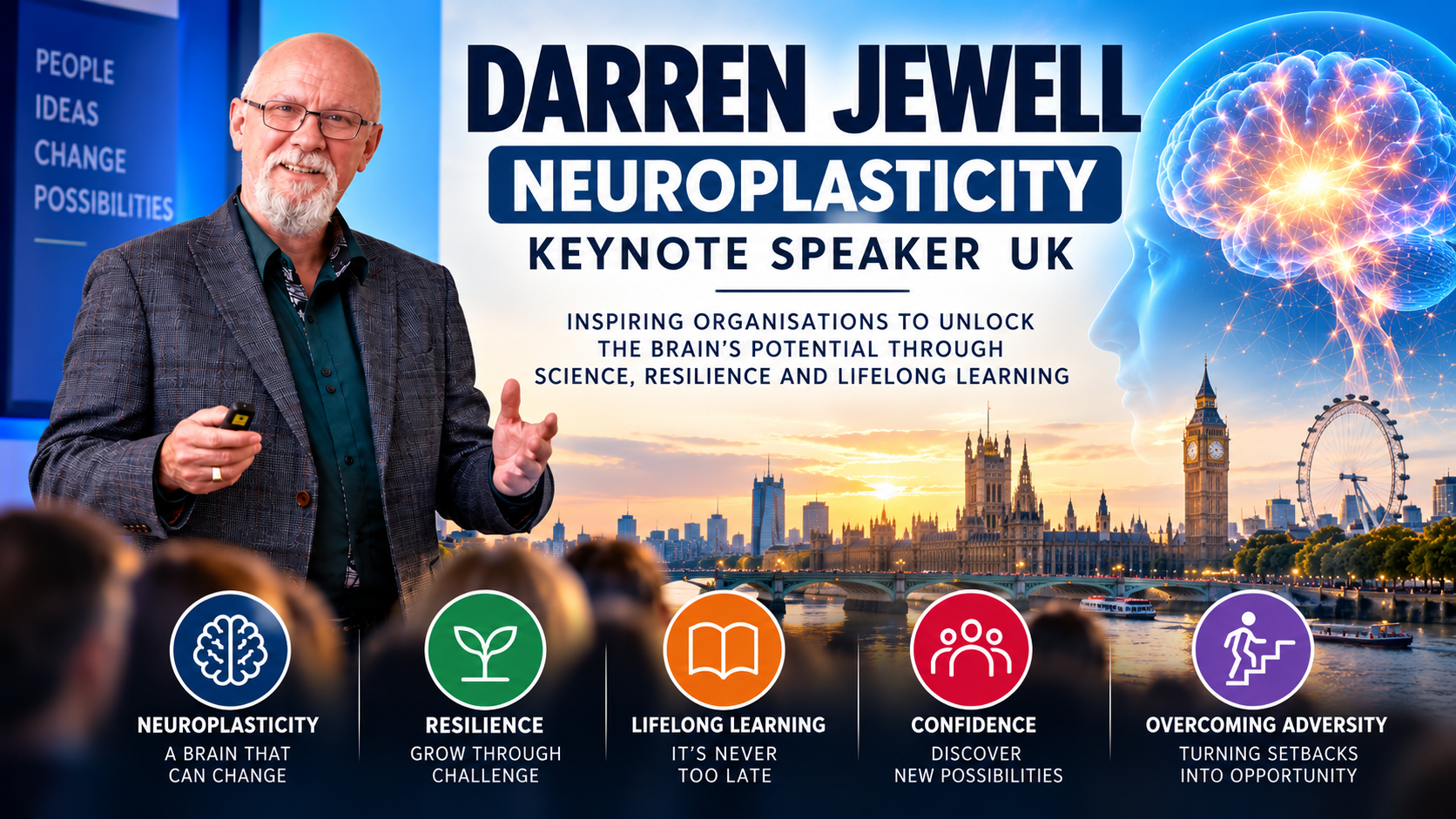
For Darren Jewell, neuroplasticity keynote speaker, neuroresilience coach and founder of Regain the Brain, this subject is much more than a scientific concept.
It is deeply personal.
Having experienced a brain injury, Darren has developed a passion for understanding how the brain works and inspiring others to recognise the possibilities associated with lifelong learning, resilience and adaptation.
His central message is both simple and powerful:
Your brain has the capacity to change throughout your life. Your age does not determine when you must stop learning.
What Is Neuroplasticity, and Why Does It Matter?
Neuroplasticity refers to the brain’s ability to adapt its structure, functions and neural connections in response to experiences and learning.
Our brains contain billions of neurons that communicate through complex networks.
When we learn something new, practise a skill or encounter unfamiliar situations, activity within these networks can change.
Repeated practice can strengthen certain connections, while other connections may become less active over time.
These processes contribute to how we develop skills, form memories and adapt to changing circumstances.
Neuroplasticity is involved in many everyday experiences, including learning to drive, playing a musical instrument, acquiring a language and developing new professional skills.
It also plays an important role in some forms of rehabilitation following neurological injury.
However, neuroplasticity does not mean that every injury can be reversed or that all limitations can be overcome through determination alone.
The brain’s ability to adapt depends on many factors, including the nature of an injury, age, health, environment, practice and access to appropriate support.
Nevertheless, the underlying scientific discovery is extraordinary.
The adult brain is not fixed. It remains responsive to experience throughout life.
Darren Jewell: Bringing Neuroplasticity to Life Through Personal Experience
Scientific explanations can help us understand how the brain works.
Personal stories can help us understand why that knowledge matters.
Darren Jewell brings these two perspectives together.
His experience of brain injury has shaped his understanding of resilience, adaptation and the importance of maintaining hope during challenging circumstances.
Brain injuries can affect individuals in many different ways.
Some people experience difficulties with memory, attention or concentration.
Others encounter challenges involving movement, fatigue, communication or emotional wellbeing.
Recovery and adaptation are rarely straightforward.
Progress can vary considerably between individuals, and the journey may involve unexpected setbacks.
Darren’s experiences have encouraged him to explore the science of neuroplasticity and its relevance to everyday life.
His approach is not about promising miraculous recoveries.
Instead, he encourages audiences to understand that the brain is dynamic and that learning, adaptation and personal development can remain meaningful throughout life.
As an inspirational speaker, he aims to make neuroscience accessible, relatable and relevant to people from different backgrounds.
Why Organisations Are Interested in Neuroplasticity
Businesses are operating in an environment of constant technological and organisational change.
Artificial intelligence, automation, digital transformation and evolving customer expectations are reshaping how people work.
Skills that were valuable a decade ago may need to be updated.
Employees are frequently expected to learn unfamiliar systems.
Leaders must adapt to changing circumstances.
And organisations increasingly recognise that continuous learning is essential for long-term success.
Neuroplasticity provides a scientific foundation for understanding why learning and adaptation remain possible throughout adulthood.
A keynote presentation on neuroplasticity can encourage organisations to reconsider how they approach employee development, leadership and workplace learning.
Rather than viewing ability as something fixed, people can begin recognising the value of practice, feedback and opportunities to develop new skills.
This does not mean that everyone learns at the same speed or that every challenge can be resolved through training.
It means that organisations can benefit from creating environments where learning is encouraged and supported.
Five Powerful Lessons Neuroplasticity Can Teach Us
1. Learning does not have an expiry date
One of the most encouraging discoveries in neuroscience is that adults retain the capacity to learn new skills.
Although some aspects of learning may change with age, the brain continues to adapt in response to experience.
This means that beginning a new activity later in life can still be rewarding.
Whether someone is 25, 55 or 75, there may be opportunities to develop new knowledge and abilities.
2. Repetition helps develop skills
When we practise an unfamiliar activity, the brain engages networks involved in attention, memory, movement and problem-solving.
With appropriate repetition and feedback, performance can improve.
This is one reason regular practice is important when learning a musical instrument, a language or a professional skill.
3. Challenges can encourage learning
Activities that require concentration and effort can provide opportunities for learning.
However, effective challenges need to be manageable.
Overwhelming stress, exhaustion and unrealistic expectations can interfere with learning.
Progress is often supported by balancing challenge with rest and appropriate guidance.
4. Mistakes are part of learning
Making mistakes does not necessarily mean that someone lacks ability.
Errors can provide information that helps us adjust our approach.
Constructive feedback, reflection and further practice can contribute to skill development.
This principle is particularly relevant to leadership, education and workplace training.
5. Curiosity encourages new experiences
Curiosity can motivate us to explore unfamiliar subjects and activities.
Learning something new may introduce different ways of thinking and opportunities for personal development.
It can also make life more interesting and enjoyable.
Learning Piano at 54: A Personal Example of Lifelong Learning
One of Darren’s personal examples of lifelong learning is his decision to begin learning the piano at 54.
For many adults, the idea of learning a musical instrument later in life can feel intimidating.
They may believe they are too old.
They may worry about making mistakes.
Or they may assume that musical ability must be developed during childhood.
Darren challenges these assumptions.
Learning the piano involves coordinating both hands, recognising musical patterns, remembering sequences and developing timing.
It requires patience, repetition and a willingness to be a beginner.
The experience demonstrates an important principle.
You do not need to master a new skill immediately to benefit from the learning process.
Each practice session provides an opportunity to develop familiarity and understanding.
For Darren, the piano represents something greater than music.
It represents curiosity, perseverance and the willingness to continue exploring what is possible.
You do not have to be brilliant at something to begin. Sometimes beginning is the most important achievement.
Neuroplasticity and Leadership Development
Effective leadership requires the ability to respond to unfamiliar situations, learn from experience and make decisions in changing environments.
Leaders who recognise that skills can be developed may be more willing to seek feedback, explore new approaches and support the growth of their teams.
Neuroplasticity can contribute to conversations about leadership by highlighting the importance of learning and experience.
For example, leaders can encourage development by creating opportunities for employees to practise new skills.
They can provide constructive feedback.
They can support people who are adapting to unfamiliar responsibilities.
And they can recognise that mistakes may be part of the learning process.
However, neuroplasticity should not be used to suggest that employees must constantly change without sufficient resources or support.
Successful organisational learning requires realistic expectations, effective management and a psychologically safe environment.
Darren’s speaking explores how an understanding of brain adaptability can encourage more constructive approaches to leadership and professional development.
The Connection Between Neuroplasticity and Resilience
Resilience is often described as the ability to recover from adversity.
But resilience can also involve adapting when circumstances cannot simply return to how they were before.
Neuroplasticity contributes to our capacity to learn new responses and develop skills.
For example, someone experiencing a major life change may need to learn unfamiliar routines or develop different approaches to everyday tasks.
A professional navigating a career transition may need to acquire new knowledge.
A business leader facing unexpected challenges may benefit from developing different problem-solving strategies.
These experiences involve learning and adaptation.
However, resilience also depends on factors such as relationships, physical health, psychological wellbeing and access to appropriate support.
Understanding neuroplasticity is one part of a broader picture.
Darren’s personal experience allows him to discuss these themes with an appreciation of both the possibilities and the difficulties associated with change.
Why Neuroplasticity Matters for Employee Wellbeing
Employee wellbeing has become an important priority for many organisations.
Workplace stress, uncertainty and demanding expectations can affect concentration, motivation and performance.
Learning about the brain can help employees understand some of the factors that influence attention, memory and behaviour.
A neuroplasticity keynote can also encourage conversations about sustainable learning practices.
These include allowing time for practice, providing useful feedback, supporting adequate rest and recognising individual differences.
It is important to remember that neuroplasticity is not a cure for workplace stress or burnout.
Healthy working conditions, reasonable workloads and appropriate support remain essential.
Nevertheless, understanding how the brain responds to experience can help organisations approach learning and development more thoughtfully.
What Can Audiences Expect from a Neuroplasticity Keynote?
A presentation about neuroplasticity should make neuroscience understandable without oversimplifying the science.
Darren’s approach brings together his personal experiences, accessible explanations and a passion for lifelong learning.
His key themes include:
- Understanding what neuroplasticity means and why it matters.
- Challenging misconceptions about ageing and learning.
- Exploring the relationship between learning, confidence and resilience.
- Recognising the importance of curiosity and new experiences.
- Encouraging practical steps towards lifelong learning.
- Reflecting on how people and organisations can adapt to change.
The aim is to encourage audiences to leave with a greater appreciation of the brain’s capacity for learning and a willingness to explore new possibilities.
Neuroplasticity Is Not Just for Scientists
When people hear the word neuroplasticity, they may imagine complicated research papers, brain scans and specialist medical terminology.
Yet the concept is relevant to everyday life.
Consider the last time you learned something unfamiliar.
Perhaps you used a new smartphone.
Learned a recipe.
Started a hobby.
Practised a language.
Or developed a new skill at work.
Each of these activities involves learning processes within the brain.
Understanding neuroplasticity can change how we view these experiences.
Rather than treating learning as something that belongs primarily to childhood, we can recognise it as an ongoing part of human life.
This is one of Darren’s strongest messages.
You do not need to become a neuroscientist to appreciate what your brain is capable of doing.
The Importance of Lifelong Learning in an Age of Artificial Intelligence
Artificial intelligence is transforming industries and changing the skills people need.
Some tasks are becoming automated, while new opportunities are emerging.
For individuals and organisations, this creates a growing need for adaptability.
Employees may need to develop digital skills.
Leaders may need to understand unfamiliar technologies.
And professionals may need to rethink how they approach established responsibilities.
Neuroplasticity reminds us that adults retain the ability to learn.
However, successful adaptation also requires accessible training, supportive workplaces and realistic opportunities to practise.
Darren’s message encourages people to approach technological change with curiosity while recognising that learning is a process rather than an instant transformation.
Regain the Brain: Inspiring People to Keep Learning
Regain the Brain was founded around Darren’s passion for brain health, resilience and lifelong learning.
His aim is to encourage people to explore new experiences and recognise that personal development can continue throughout life.
Learning does not always require formal education.
Sometimes it begins with cooking a meal you have never prepared.
Trying a musical instrument.
Learning a few words in another language.
Or exploring a subject that has always interested you.
These experiences can stimulate curiosity and provide opportunities to develop new skills.
For Darren, lifelong learning is not simply about becoming more productive.
It is about remaining engaged with life, discovering new interests and continuing to challenge assumptions about personal capability.
Book Darren Jewell as a Neuroplasticity Keynote Speaker in the UK
Are you organising a corporate conference, leadership event, employee wellbeing programme or educational gathering?
Darren Jewell brings a distinctive personal perspective to conversations about neuroplasticity, resilience and lifelong learning.
As an inspirational speaker, neuroresilience coach and founder of Regain the Brain, he combines lived experience of brain injury with a passion for making neuroscience accessible.
His message is relevant to businesses, educational organisations, professional associations and audiences interested in human potential.
Whether your event focuses on leadership, change, personal development or wellbeing, neuroplasticity offers a fascinating starting point for exploring how people learn and adapt.
The most exciting thing about your brain is not simply what it already knows. It is what you may still be capable of learning.
Discover more about Darren Jewell and Regain the Brain at www.regainthebrain.com.
Darren Jewell is an inspirational speaker, neuroresilience coach and founder of Regain the Brain. Drawing on his lived experience of brain injury, he advocates for greater awareness of neuroplasticity, resilience and lifelong learning.
This article is intended for educational purposes and does not replace professional medical or rehabilitation advice.