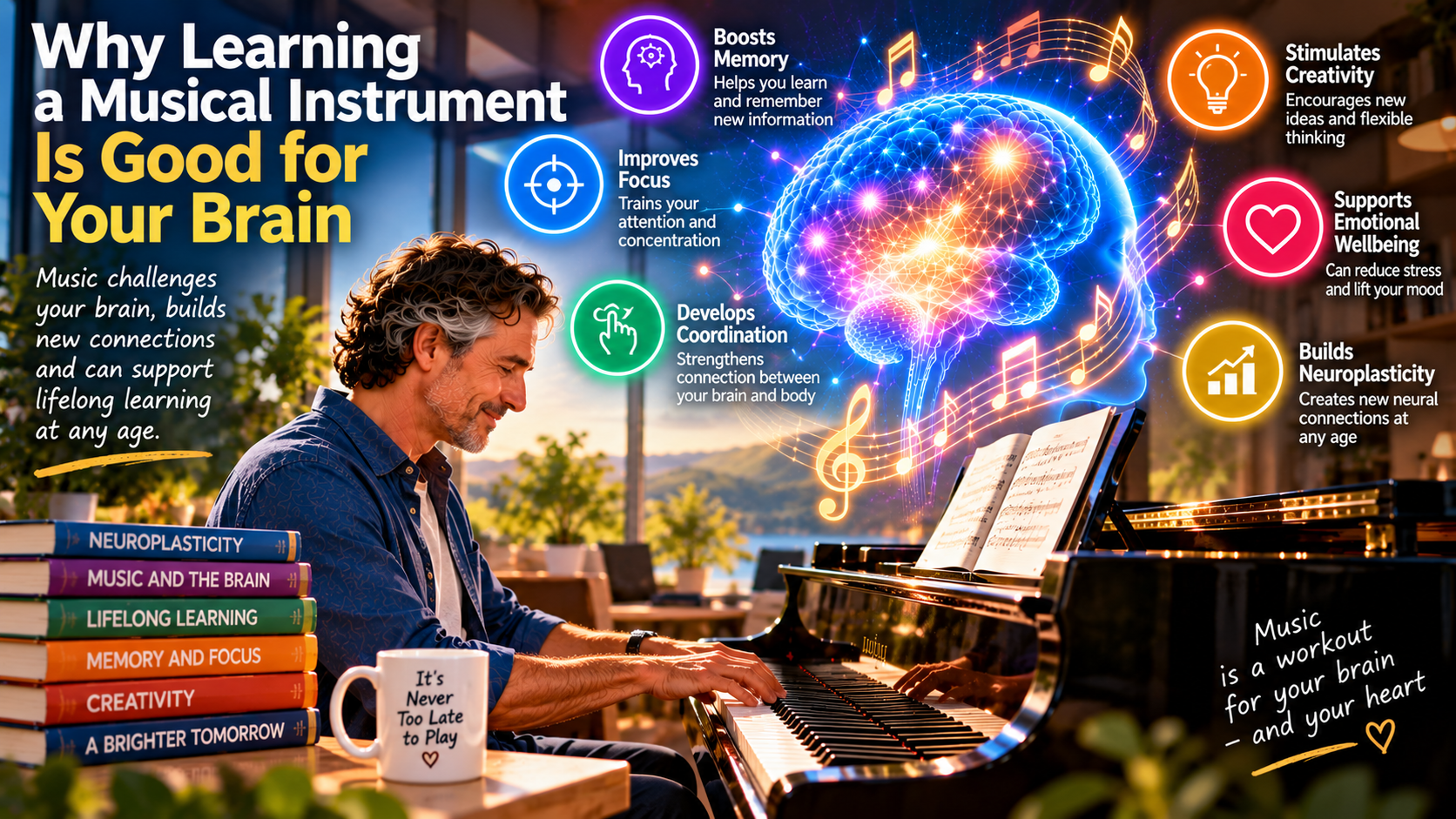
What if one of the most rewarding ways to challenge your brain was to learn something you’ve always wanted to do?
Perhaps you’ve dreamed of playing the piano.
Maybe you’ve always loved the sound of a guitar.
Or perhaps you’ve wondered what it would feel like to sit behind a drum kit and create your own rhythm.
For many people, learning a musical instrument is something they associate with childhood.
They imagine music lessons at school.
Practising scales.
Learning to read sheet music.
And gradually developing the confidence to perform.
But what happens if you never learned an instrument when you were young?
Does that mean you’ve missed your opportunity?
Absolutely not.
I started learning piano at 54.
And that experience has reinforced my fascination with the human brain, neuroplasticity and the possibilities of lifelong learning.
Learning music is not simply about producing beautiful sounds.
It involves attention, memory, coordination, listening, planning and repeated practice.
Researchers have investigated how musical training influences brain structure and function.
Some studies suggest that learning an instrument can be associated with changes in neural networks involved in auditory processing, movement and other cognitive functions.
But the science is more nuanced than headlines sometimes suggest.
Learning music does not automatically make someone more intelligent.
Nor has it been proven to prevent dementia or reverse neurological injury.
Nevertheless, it offers a rich and enjoyable learning experience.
And for many people, that alone is a wonderful reason to begin.
So, why is learning a musical instrument good for your brain?
Let’s explore what neuroscience tells us.
1. What Happens in Your Brain When You Play Music?
Playing a musical instrument involves the coordination of several brain systems.
Imagine sitting at a piano.
You look at the keys.
You listen to the sounds you produce.
You move your fingers.
You remember the notes you are trying to play.
And you adjust your movements when something doesn’t sound right.
These activities involve networks associated with movement, hearing, vision, attention and memory.
The motor cortex contributes to controlling voluntary movements.
The auditory cortex processes sound.
The cerebellum helps coordinate movement and timing.
And other brain regions contribute to planning, learning and monitoring performance.
These systems interact continuously during musical performance.
Even playing a simple melody can require the coordination of several different processes.
For beginners, this may demand considerable conscious attention.
With practice, some aspects of performance can become more familiar and efficient.
Playing music is not one isolated brain activity. It is a complex experience involving several interacting neural systems.
2. Music and Neuroplasticity: Can Learning an Instrument Change Your Brain?
Neuroplasticity is the brain’s ability to change its connections, structure and functions in response to experience, learning and other influences.
It is one of the biological foundations of learning.
When someone practises a musical instrument, they repeatedly engage networks involved in hearing, movement and memory.
Over time, this experience can contribute to learning-related changes.
Researchers have observed differences in certain brain structures and functions between musicians and non-musicians.
Some longitudinal studies have also investigated how musical training influences the developing brain.
However, interpreting these findings requires care.
People who choose to study music may differ from non-musicians in ways that existed before training began.
And not every observed brain difference is necessarily caused by playing an instrument.
Research involving adults is also varied.
Nevertheless, evidence supports the broader conclusion that musical learning can involve experience-dependent neuroplasticity.
This is one reason music is such an interesting subject for neuroscience.
It provides an opportunity to investigate how the brain responds to sustained, complex skill development.
3. Why Learning Music Challenges Your Memory
Memory plays an important role in musical learning.
You may need to remember the location of notes.
Recognise musical patterns.
Recall the sequence of a melody.
Or remember how a particular passage should sound.
Several types of memory can contribute.
Working memory helps us hold and manipulate information over short periods.
Long-term memory supports our knowledge of musical patterns and pieces we have practised.
Procedural learning contributes to the development of skilled movements.
For example, when I began learning piano, recognising notes and coordinating my fingers required conscious effort.
With practice, familiar patterns can become easier to recognise.
This is part of learning.
However, it is important to distinguish between improving musical memory and improving memory in every area of life.
Becoming better at remembering melodies does not necessarily mean someone will become better at remembering appointments or shopping lists.
The broader transfer of musical training to unrelated cognitive abilities remains an area of scientific debate.
But music certainly provides opportunities to practise memory within a meaningful activity.
4. How Playing an Instrument Develops Coordination
Musical performance often requires precise timing and movement.
A pianist may need to coordinate both hands while listening to the notes being produced.
A drummer may use their hands and feet to maintain different rhythms.
A guitarist must coordinate finger placement with strumming or picking.
These activities involve motor learning.
Motor learning refers to processes through which practice and experience improve the performance of movements.
At first, an unfamiliar movement can feel awkward.
You may need to think carefully about what to do.
Over time, repeated practice can make certain movements more efficient.
The nervous system adapts as skills develop.
This is one of the reasons beginners are encouraged to practise slowly and accurately.
Rushing through a difficult passage may reinforce mistakes.
Careful practice provides opportunities to develop more reliable movements.
For me, learning piano has been a reminder that coordination is something we can continue working on throughout adulthood.
5. Can Learning Piano Improve Concentration?
Playing piano requires attention.
You may need to focus on the notes in front of you.
Listen for mistakes.
Remember what comes next.
And coordinate your movements.
If your attention wanders, you may lose your place.
This makes music an activity that involves sustained engagement.
Some research has investigated whether musical training is associated with differences in attention and executive functioning.
Results vary.
Certain studies have reported benefits in particular tasks, while others have found limited or inconsistent evidence.
It would therefore be misleading to claim that learning piano guarantees better concentration in everyday life.
But it can provide meaningful opportunities to practise focusing on a specific activity.
For someone who spends much of the day responding to emails, messages and notifications, sitting down with an instrument may also offer a welcome change.
Instead of switching between several demands, you can devote time to one skill.
That experience can be enjoyable in its own right.
6. Why Music Can Be Good for Emotional Wellbeing
Music has a powerful relationship with emotion.
A familiar song can remind us of a particular moment.
A melody can make us feel nostalgic.
And a favourite piece of music may help us relax.
Playing an instrument can provide an additional form of engagement.
It allows us to participate actively in creating sound.
Some people find musical practice calming.
Others enjoy the satisfaction of mastering a difficult passage.
Music can also offer opportunities for self-expression.
Research suggests that music-based activities may support aspects of psychological wellbeing in certain contexts.
However, outcomes depend on the activity, the individual and the circumstances.
Learning an instrument should not be presented as a substitute for treatment of depression, anxiety or other mental health conditions.
For many people, the value of music lies in the enjoyment, meaning and personal satisfaction it provides.
And those are worthwhile benefits.
7. Why Learning an Instrument Can Build Confidence
When you begin learning an unfamiliar skill, you may initially feel uncertain.
You don’t know the correct technique.
You make mistakes.
And you may struggle with activities that experienced musicians perform easily.
But as you practise, small achievements can become visible.
You recognise a note more quickly.
You play a short melody.
You coordinate a movement that previously felt difficult.
These experiences can influence confidence.
Psychological research into self-efficacy suggests that successful experiences can strengthen beliefs about our ability to perform particular tasks.
This does not mean that musical practice automatically transforms confidence in every area of life.
But it can provide evidence that learning and improvement are possible.
For adults who have avoided unfamiliar activities because they fear failure, this can be particularly meaningful.
Sometimes, the most valuable part of learning an instrument is not the music you eventually play. It is discovering that you are capable of learning something you once thought was beyond you.
8. What Starting Piano at 54 Taught Me About Being a Beginner
When I decided to learn piano at 54, I was not trying to become a professional musician.
I wanted to explore something new.
I wanted to challenge myself.
And I was curious about what the experience might teach me.
Starting later in life can feel intimidating.
You may compare yourself with people who have played since childhood.
You might wonder whether your fingers will ever move quickly enough.
Or whether you’ll be able to remember the notes.
But being a beginner is not a disadvantage that needs to be hidden.
It is simply the starting point of learning.
My experience has reinforced the importance of patience.
Some things take repetition.
Others require a different approach.
And sometimes, the most satisfying moments are the small achievements that would mean very little to an experienced musician.
I don’t need to measure my progress against someone who has played for forty years.
The value lies in my own learning experience.
And that is a message I believe applies far beyond music.
9. Can You Learn a Musical Instrument After 50?
Yes.
Adults can learn musical instruments throughout life.
However, learning experiences may differ depending on age, health, previous experience and individual circumstances.
Some aspects of motor learning and cognitive processing can change with age.
Hearing, vision and physical comfort may also influence which instruments or techniques are appropriate.
But older adults often bring useful qualities to learning.
They may have greater patience.
Clear personal motivation.
And experience of developing other skills.
The most important thing is to choose an approach that suits your needs.
You may prefer individual lessons.
Online tutorials.
A structured course.
Or informal practice.
There is no requirement to become an expert.
Learning music can remain rewarding even when progress is gradual.
10. What About Learning an Instrument in Your 60s, 70s or 80s?
The opportunity to learn does not disappear at a particular age.
People continue acquiring skills in later adulthood.
A person in their sixties may decide to learn guitar.
Someone in their seventies might begin keyboard lessons.
Another person may explore percussion or singing.
The most appropriate activity depends on personal interest and ability.
For someone with arthritis, a particular instrument may require adaptation.
A person with hearing difficulties may benefit from suitable equipment or teaching approaches.
And someone with a neurological condition may need additional support.
The goal is not to ignore these considerations.
It is to find an enjoyable and accessible way to participate.
Music can provide opportunities for creativity, learning and social engagement throughout life.
11. Can Musical Training Help Protect Against Cognitive Decline?
This is a question that attracts considerable attention.
Some observational studies have found associations between musical engagement and aspects of cognitive performance in older adults.
Researchers have also investigated whether musical training contributes to cognitive reserve.
Cognitive reserve is a concept used to describe differences in how people cope with age-related brain changes or neurological disease.
However, observational associations do not prove that musical training causes protection against cognitive decline.
People who participate in music may differ in education, health, social circumstances and other factors.
Intervention studies are also varied.
It has not been established that learning an instrument prevents dementia.
That distinction is important.
Music can be a valuable activity without needing to be presented as a guaranteed medical intervention.
If you enjoy learning music, there are plenty of reasons to continue.
But claims about dementia prevention should be treated cautiously.
12. Music and Brain Injury Rehabilitation
Music has attracted interest in neurological rehabilitation.
Some rehabilitation approaches use rhythm, movement or musical activities to support specific goals.
For example, rhythmic auditory stimulation has been studied in relation to gait rehabilitation in certain neurological conditions.
Music-based approaches have also been investigated for communication, movement and emotional wellbeing.
However, these interventions are not the same as simply learning an instrument at home.
Clinical music therapy and specialised rehabilitation programmes are delivered by appropriately trained professionals.
Their effectiveness depends on the condition, the intervention and the individual.
For people living with brain injury, musical activities may be enjoyable and meaningful.
But they should not be promoted as guaranteed treatments for neurological impairment.
Professional advice may be important when adapting activities to fatigue, sensory difficulties or movement limitations.
13. Why Music and Brain Injury Are Personally Important to Me
My lived experience of brain injury has shaped my interest in neuroplasticity, learning and resilience.
I understand that neurological challenges can affect how people approach everyday activities.
Things that appear straightforward to others may require considerable effort.
And progress can be unpredictable.
This is one reason I find learning piano so meaningful.
It provides an opportunity to explore a skill through practice, curiosity and patience.
But I do not believe learning an instrument should be presented as a universal solution for brain injury recovery.
Every person’s circumstances are different.
For some, playing music may be accessible and enjoyable.
For others, it may be difficult or inappropriate without support.
The broader lesson is about recognising the value of meaningful learning experiences.
Whether someone chooses music, art, language or another activity, the opportunity to participate can matter.
14. Why Making Mistakes Is Essential When Learning Music
One of the most frustrating parts of learning an instrument is making mistakes.
You press the wrong key.
Miss a note.
Lose the rhythm.
Or forget what comes next.
But mistakes can provide useful information.
They reveal where additional practice may be needed.
They can help identify techniques that are not working.
And they offer opportunities to adjust.
Effective learning often involves feedback and correction.
This does not mean deliberately repeating mistakes.
It means using them constructively.
For example, if a section of music repeatedly causes difficulty, you might slow down.
Practise each hand separately.
Or divide the passage into smaller sections.
The goal is to make practice more effective.
This principle applies to many other skills.
Learning a language.
Developing a professional ability.
Or exploring unfamiliar technology.
Mistakes do not automatically mean you lack ability.
They may simply indicate that you are still learning.
15. How Often Should You Practise a Musical Instrument?
There is no single practice schedule that works for everyone.
The appropriate amount depends on your goals, ability, health and available time.
For beginners, shorter, focused sessions may be more manageable than occasional exhausting sessions.
For example, someone might begin with ten or fifteen minutes of practice.
They could concentrate on a small number of skills.
As they become more comfortable, they may gradually adjust their routine.
The quality of practice matters.
Paying attention to technique.
Using feedback.
And working on manageable challenges can help support learning.
Rest is also important.
Physical discomfort, fatigue or pain should not be ignored.
For people with neurological conditions, practice may need to be adapted carefully.
Consistency can be useful, but progress should never come at the expense of health or wellbeing.
16. Which Musical Instrument Is Best for Brain Health?
People sometimes ask whether piano, guitar, violin or drums are better for the brain.
There is no strong scientific basis for claiming that one instrument is universally superior for overall brain health.
Different instruments involve different skills.
Piano requires coordination between both hands and attention to pitch and timing.
Guitar involves finger positioning, rhythm and auditory feedback.
Drums place considerable emphasis on timing and coordination.
Wind instruments involve breath control alongside musical performance.
The most suitable instrument is often the one that interests you and is accessible for your circumstances.
Enjoyment matters because it can encourage continued participation.
An instrument you love may be more motivating than one chosen solely because of a claim about cognitive benefits.
17. Seven Reasons to Start Learning a Musical Instrument
If you’ve been considering learning music, here are seven reasons it might be worth exploring.
1. It provides a meaningful learning challenge
You can develop unfamiliar knowledge and skills.
2. It involves several cognitive processes
Musical performance engages attention, memory, listening and coordination.
3. It encourages patience
Progress often requires repeated practice.
4. It offers opportunities for creativity
You can explore melodies, rhythms and musical expression.
5. It can provide enjoyment
Making music can be personally rewarding.
6. It may create social opportunities
Lessons, groups and informal performances can help people connect.
7. It reminds you that learning can continue throughout life
You don’t have to begin in childhood to enjoy developing a musical skill.
These are meaningful reasons to participate without relying on exaggerated claims about brain health.
18. My Seven-Day Musical Learning Challenge
If you’ve always wanted to learn an instrument, I would like to invite you to try a simple challenge.
You do not need to purchase expensive equipment immediately.
The goal is simply to explore.
Day 1: Choose an instrument that interests you.
Day 2: Learn about its basic features and how it produces sound.
Day 3: Explore a beginner lesson or demonstration.
Day 4: Practise one simple movement, note or rhythm.
Day 5: Repeat the activity and notice what feels more familiar.
Day 6: Try a slightly different exercise or short musical pattern.
Day 7: Reflect on the experience and decide whether you would like to continue.
You may discover that music becomes a lasting interest.
Or you may simply enjoy trying something unfamiliar.
Either outcome is worthwhile.
The purpose is not to transform your brain in seven days.
It is to discover whether music could become a meaningful part of your life.
19. What Music Teaches Us About Resilience
Learning an instrument involves more than remembering notes.
It can also teach us about patience, persistence and realistic expectations.
You will encounter difficulties.
Some pieces will feel beyond your ability.
Progress may be slower than you hoped.
And there may be days when practice feels frustrating.
But learning provides opportunities to respond constructively.
You can adjust your approach.
Ask for help.
Practise a smaller section.
Or take a break and return later.
These are useful habits in many areas of life.
However, resilience does not mean pushing through every difficulty regardless of the consequences.
Sometimes, adapting your goals is the most appropriate response.
For me, music is a reminder that personal growth does not require perfection.
It requires a willingness to engage with the learning process.
20. Why I Believe It’s Never Too Late to Begin
One of the most common reasons people avoid unfamiliar activities is the belief that they should have started earlier.
They imagine how much better they might be if they had begun as children.
Perhaps that is true.
Someone who has practised an instrument for decades may possess skills that a beginner does not.
But that comparison misses something important.
The question is not whether you could have started earlier.
It is whether you would enjoy starting now.
At 54, I could have focused on all the years I hadn’t played piano.
Instead, I decided to explore the opportunity in front of me.
And that decision has reinforced a message I believe is relevant to people of every age.
You don’t need to recover the years you didn’t spend learning.
You can begin with the time you have today.
Final Thoughts: Your Brain Is Still Capable of Learning Something Beautiful
Learning a musical instrument is a fascinating experience.
It involves movement, memory, listening, attention and repeated practice.
Neuroscience suggests that musical training can be associated with changes in brain structure and function.
But we should be careful not to exaggerate what these findings mean.
Playing an instrument does not guarantee improvements in general intelligence.
It has not been proven to prevent dementia.
And it is not a universal treatment for neurological injury.
Yet the experience can still be extraordinarily valuable.
Music offers opportunities for enjoyment.
Creativity.
Personal achievement.
Social connection.
And lifelong learning.
When I began learning piano at 54, I wasn’t trying to prove that I could become an expert.
I simply wanted to discover something new.
And perhaps that is the most important lesson.
We do not have to become brilliant at everything we attempt.
Sometimes, the value lies in the curiosity, effort and enjoyment of learning.
You may never perform in a concert hall.
You may never become a professional musician.
But you can still experience the satisfaction of learning to create music.
And perhaps the most beautiful thing about beginning an instrument later in life is that you are not simply learning to play notes.
You are reminding yourself that learning can remain part of your story.
About Darren Jewell
Darren Jewell is a neuroresilience coach, inspirational speaker and founder of Regain the Brain.
Drawing on his lived experience of brain injury and his passion for neuroplasticity, Darren encourages individuals, leaders and organisations to embrace lifelong learning, develop resilience and remain open to unfamiliar possibilities.
His personal journey includes beginning to learn piano at 54, reflecting his belief that curiosity and learning can remain meaningful throughout adulthood.
Through inspirational speaking, coaching and educational projects, Darren shares accessible insights into neuroscience, adaptability and personal development.
Inspire Your Audience to Keep Learning
Are you organising a corporate conference, leadership event or wellbeing programme?
Darren’s inspirational talks explore neuroplasticity, resilience, confidence and the value of lifelong learning.
His message encourages audiences to challenge limiting assumptions, recognise meaningful progress and discover new possibilities.
Discover Darren’s inspirational speaking and neuroresilience coaching services at www.regainthebrain.com.
This article is intended for general educational purposes and does not replace medical advice. Musical learning should not be considered a proven treatment for neurological conditions or a guaranteed method of preventing cognitive decline.