What if the greatest obstacle to achieving your potential isn’t your ability, but your belief about what you can still achieve?
Throughout life, we encounter challenges that test our confidence, resilience and willingness to adapt.
Some challenges arrive gradually. Others change our lives in an instant.
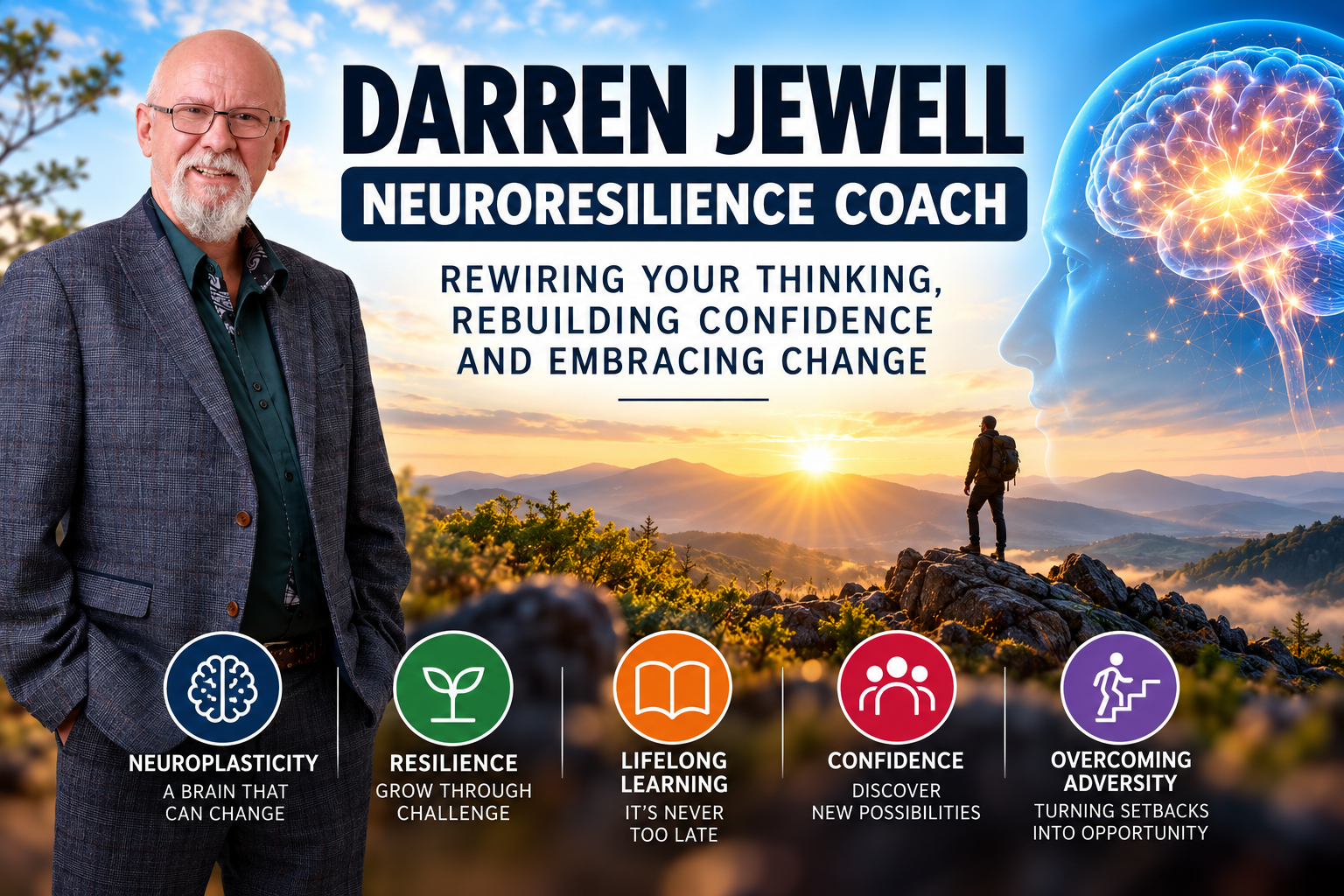
For Darren Jewell, neuroresilience coach, inspirational speaker and founder of Regain the Brain, understanding how the brain responds to adversity has become both a personal journey and a professional mission.
Having experienced a brain injury, Darren understands that resilience is not simply about pushing through difficult circumstances. It is about discovering new approaches, adapting to change and recognising that progress remains possible even when life takes an unexpected direction.
At the heart of his work lies a powerful message:
Your brain is capable of learning and adapting throughout your life, and your future does not have to be defined entirely by your past.
What Is Neuroresilience?
Neuroresilience is a term used to describe resilience through the lens of brain function, adaptability and the ways people respond to challenges.
It brings together ideas from neuroscience, neuroplasticity, psychology and personal development.
Traditional discussions about resilience often focus on mental toughness, perseverance and the ability to recover from setbacks.
Neuroresilience adds another perspective.
It encourages us to consider how the brain responds to experience, how repeated behaviours can shape neural pathways and how learning new approaches may help us navigate difficult situations.
The brain is not a static organ.
It changes in response to experience, practice and learning.
This remarkable ability is known as neuroplasticity.
Understanding neuroplasticity does not mean that every difficulty can be overcome through determination alone. However, it can provide a valuable foundation for developing new skills, strengthening confidence and approaching challenges with greater flexibility.
Darren Jewell: A Personal Journey into Neuroresilience
There is a significant difference between discussing resilience as a concept and experiencing circumstances that require you to develop it.
For Darren Jewell, brain injury brought challenges that changed his understanding of everyday life.
Experiences that many people take for granted can become more complicated when the brain is affected by injury.
Confidence can be shaken.
Familiar routines may require new approaches.
Progress can sometimes feel frustratingly slow.
Yet these experiences can also change how we understand personal growth.
Darren’s journey has encouraged him to explore how the brain learns, adapts and responds to new experiences.
Rather than viewing resilience as a fixed personality trait, he sees it as something that can be supported and developed through learning, reflection, practice and appropriate support.
His lived experience now informs his approach to neuroresilience coaching and inspirational speaking.
He encourages people to recognise their existing strengths while remaining open to developing new ones.
Resilience is not about becoming the person you were yesterday. Sometimes it is about discovering the person you can become tomorrow.
How Neuroplasticity Supports Learning and Adaptation
Neuroplasticity describes the brain’s ability to change its structure and function in response to experiences, learning and certain forms of injury.
When we practise a new skill, networks of neurons become involved in processing information, coordinating movements and developing familiarity.
With repetition and appropriate feedback, some of these neural connections can become more efficient.
Consider someone learning to play the piano.
Initially, reading music, coordinating both hands and maintaining rhythm may feel overwhelming.
However, through repeated practice, movements and patterns can gradually become more familiar.
This is one example of how learning involves changes in the brain.
The same broad principles are relevant when we develop communication skills, learn a new language or practise different approaches to problem-solving.
Importantly, neuroplasticity continues into adulthood.
Although learning and recovery vary considerably between individuals, age alone does not mean that meaningful learning must stop.
This is a central message in Darren’s work.
Rebuilding Confidence After Adversity
One of the most difficult consequences of a major setback can be the loss of confidence.
When something changes our abilities, circumstances or sense of identity, we may begin questioning what we are capable of achieving.
Thoughts such as these can become familiar:
What if I fail?
What if I am no longer capable?
Am I too old to start again?
What if things never improve?
These questions are understandable, particularly after significant life changes.
However, they do not always provide an accurate picture of our future possibilities.
Darren encourages people to explore confidence through small, meaningful actions.
Rather than focusing exclusively on distant achievements, he emphasises recognising progress along the way.
Learning one new skill, completing an unfamiliar task or approaching a difficult situation differently can provide evidence of personal capability.
Confidence does not always appear before action.
Sometimes it develops because we have taken action.
Why Neuroresilience Matters in the Workplace
Modern workplaces are changing rapidly.
Artificial intelligence, digital transformation, evolving leadership expectations and economic uncertainty mean employees are frequently required to adapt.
Technical knowledge remains important, but organisations also benefit from people who can learn, collaborate and respond constructively to change.
Neuroresilience offers a useful framework for exploring these capabilities.
1. Adapting to change
Change can create uncertainty, particularly when familiar systems and routines are disrupted.
Encouraging learning and providing appropriate support can help employees develop confidence when approaching new responsibilities.
2. Developing a learning mindset
Employees who believe they can develop their skills may be more willing to engage with training, feedback and unfamiliar challenges.
A culture of continuous learning can benefit both individuals and organisations.
3. Building confidence after setbacks
Mistakes and setbacks are part of professional life.
Supportive leadership can help people reflect on what happened, identify lessons and approach future challenges constructively.
4. Encouraging curiosity and creativity
Exploring unfamiliar ideas can encourage different ways of thinking.
Organisations that value curiosity may create more opportunities for innovation and problem-solving.
5. Supporting sustainable resilience
Resilience should never be used as an excuse to expect people to tolerate unhealthy working conditions.
Genuine workplace resilience requires realistic expectations, psychological safety, adequate resources and supportive leadership.
These factors matter alongside individual coping skills.
Lifelong Learning: A Practical Way to Challenge Your Brain
One of Darren’s strongest beliefs is that we should continue learning throughout our lives.
Not because we must constantly achieve more, but because curiosity and discovery can enrich our everyday experiences.
Learning does not need to involve formal qualifications or expensive courses.
It can begin with something remarkably simple.
Cooking a meal you have never attempted before.
Learning a few phrases in another language.
Trying a new musical instrument.
Exploring a different walking route.
Learning how to use unfamiliar technology.
Taking up photography, painting or another creative activity.
Each experience offers an opportunity to practise attention, memory, coordination or problem-solving.
Darren began learning the piano at 54, demonstrating his willingness to become a beginner again.
His message is straightforward:
You are never too old to be curious, and you do not need to be an expert to enjoy learning something new.
The objective is not perfection.
It is participation, discovery and continued personal development.
Can We Change the Way We Think?
Our thoughts, habits and responses are influenced by previous experiences.
Over time, familiar ways of thinking can become automatic.
For example, someone who has experienced repeated setbacks may begin approaching unfamiliar situations with hesitation.
Another person may have developed a habit of avoiding activities they believe they cannot perform successfully.
Changing these patterns is not always easy.
However, psychological approaches, reflection, supportive relationships and repeated practice can help people develop different responses.
The brain’s capacity for adaptation contributes to our ability to learn new behaviours.
This does not mean that every thought can simply be switched off or that positive thinking alone can resolve complex challenges.
It means that learning and change remain possible, often with time, patience and appropriate support.
Neuroresilience Coaching for Leaders and High Achievers
Business leaders, executives and high achievers frequently operate in demanding environments.
Their responsibilities may involve complex decisions, uncertainty, competing priorities and pressure to perform.
These demands can make it difficult to acknowledge personal challenges or seek support.
Darren’s approach to neuroresilience encourages leaders to consider how they respond to change and how their beliefs about learning and ability influence their actions.
Important themes include:
- Developing greater awareness of personal responses to setbacks.
- Building confidence when navigating unfamiliar situations.
- Remaining open to learning and constructive feedback.
- Recognising the value of rest, recovery and sustainable performance.
- Challenging assumptions about age and personal capability.
- Encouraging curiosity and adaptability within teams.
By combining personal experience with accessible explanations of neuroplasticity, Darren aims to make conversations about resilience both relatable and practical.
Small Changes Can Lead to Meaningful Progress
One of the most encouraging lessons from studying neuroplasticity is that learning often develops through repetition.
We do not necessarily need to make dramatic changes to begin developing a new skill.
Small, consistent actions can be valuable.
Consider someone who wants to learn another language.
They might begin by practising five new words each day.
Someone interested in improving their musical abilities could start with ten minutes of piano practice.
A person hoping to become more confident with technology might learn one unfamiliar feature each week.
These actions may appear modest, but they provide opportunities for practice and progress.
Consistency matters, although rest, individual circumstances and the quality of practice are important too.
The aim is not to turn every moment into a productivity exercise.
It is to recognise that meaningful learning can begin with manageable steps.
Why Darren Jewell Founded Regain the Brain
Regain the Brain reflects Darren’s belief that greater understanding of the brain can encourage people to approach life with curiosity, resilience and hope.
Through inspirational speaking, neuroresilience coaching and educational content, his aim is to help people explore what learning and adaptation can mean for their lives.
His work focuses on several connected themes:
Neuroplasticity: Understanding the brain’s capacity to adapt and learn.
Neuroresilience: Exploring how people respond to challenges and develop adaptive skills.
Lifelong learning: Encouraging curiosity and new experiences at every age.
Confidence: Recognising progress and developing belief in personal capability.
Overcoming adversity: Finding meaningful ways forward when circumstances change.
These ideas are relevant not only to people who have experienced brain injuries, but also to leaders, professionals, educators and anyone navigating change.
Your Brain, Your Journey, Your Possibilities
No two people experience adversity in exactly the same way.
What feels manageable to one person may be extremely challenging for another.
That is why meaningful resilience begins with recognising individual circumstances rather than comparing progress with someone else’s journey.
Darren’s message is not that every obstacle can be removed.
It is that we should remain curious about what might still be possible.
Sometimes growth involves developing an entirely new skill.
Sometimes it involves changing an approach that no longer works.
Sometimes it involves accepting support or recognising that progress looks different from what we originally imagined.
And sometimes the most significant achievement is simply finding the courage to try again.
You cannot always control what happens to you, but with the right support and opportunities, you may discover new ways to respond, adapt and grow.
Work with Darren Jewell — Neuroresilience Coach and Inspirational Speaker
Are you a business leader, professional or event organiser interested in exploring resilience, neuroplasticity and lifelong learning?
Darren Jewell brings lived experience, an interest in neuroscience and a passion for encouraging personal development to his work.
Through Regain the Brain, he aims to inspire people to challenge limiting assumptions, develop curiosity and recognise the value of continued learning.
Whether you are organising a corporate event, exploring leadership development or looking for a fresh perspective on personal resilience, Darren’s approach offers a meaningful starting point.
Because your brain’s story is still being written — and there may be more chapters ahead than you imagine.
Discover more at www.regainthebrain.com.
Darren Jewell is a neuroresilience coach, inspirational speaker and founder of Regain the Brain. Drawing on his lived experience of brain injury, he promotes neuroplasticity awareness, lifelong learning and resilience as foundations for continued personal development.
This article is educational and does not replace individual medical, psychological or rehabilitation advice.