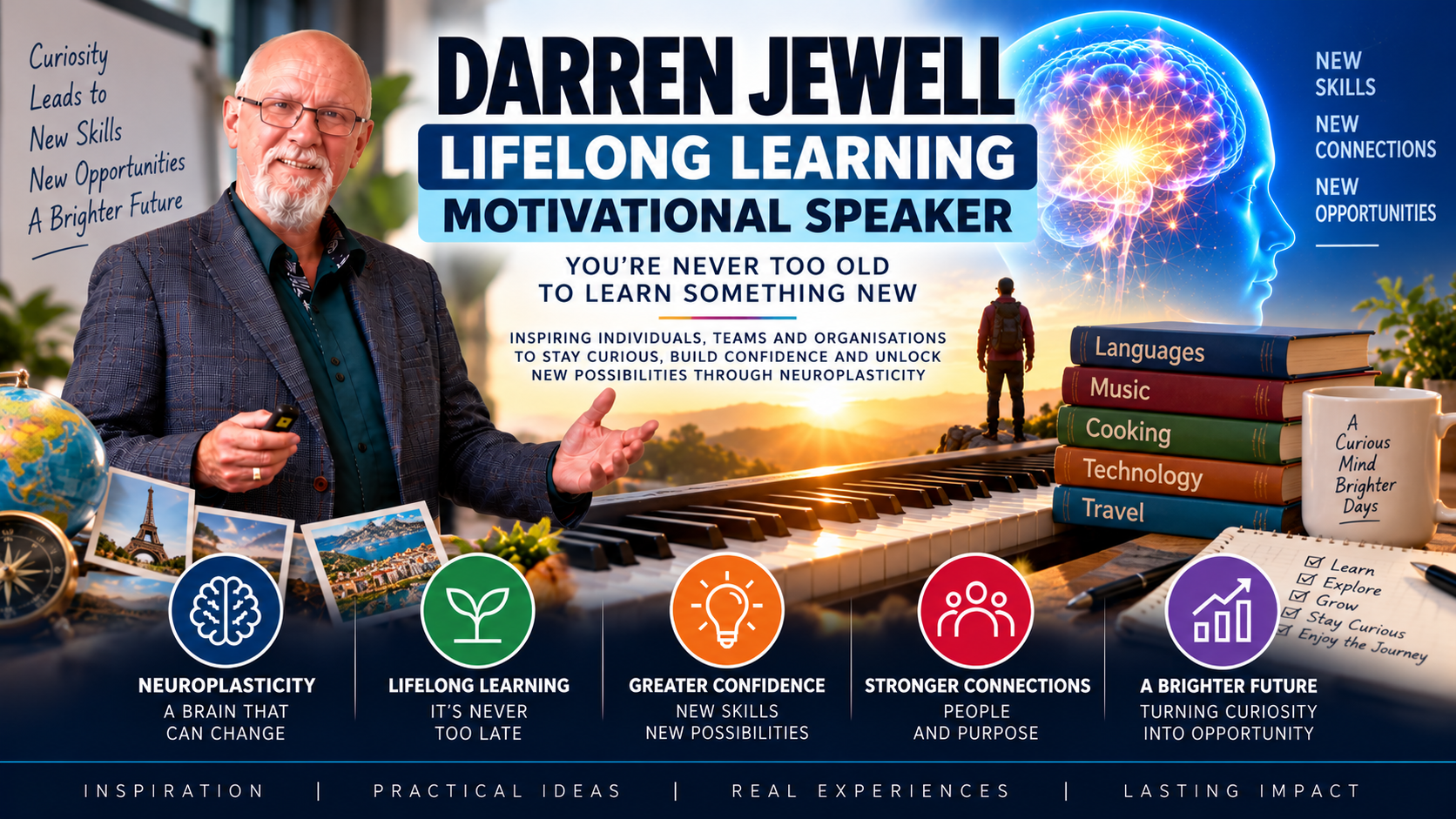
When was the last time you did something for the very first time?
Think about that question for a moment.
Not something you have done hundreds of times before. Not another familiar task in your daily routine.
Something completely new.
Something that made you think differently, challenged your abilities or required you to become a beginner again.
Perhaps you learned a few words in another language.
Perhaps you attempted a recipe you had never cooked before.
Or perhaps you tried playing a musical instrument for the first time.
For Darren Jewell, lifelong learning motivational speaker, neuroresilience coach and founder of Regain the Brain, this question represents something much greater than simply acquiring another skill.
It represents curiosity, courage and the extraordinary ability of the human brain to continue learning throughout life.
Having experienced a brain injury, Darren understands that learning, confidence and adaptation can take on entirely new meanings when life changes unexpectedly.
His mission is to encourage people of every age to recognise that their opportunities for learning and discovery are far from over.
You are never too old to learn something new. But sometimes you have to be brave enough to become a beginner again.
Why Do So Many Adults Stop Learning New Things?
As children, learning is part of everyday life.
We learn to walk, speak, read, write and understand the world around us.
We ask questions constantly.
We experiment.
We make mistakes.
And we rarely expect to master something immediately.
But something interesting can happen as we grow older.
We begin to associate learning with achievement.
We worry about getting things wrong.
We become more conscious of what other people might think.
And sometimes we convince ourselves that certain opportunities have passed us by.
We tell ourselves:
I’m too old to learn that.
I’ve never been good at languages.
I don’t have a musical bone in my body.
Technology is for younger people.
What’s the point of starting now?
These assumptions can become barriers that prevent us from discovering new interests and abilities.
Darren believes we should challenge them.
Not because everyone can become an expert at everything they attempt, but because learning itself can be rewarding.
The greatest obstacle to learning something new is sometimes the belief that we should already know how to do it.
Darren Jewell: A Lifelong Learning Motivational Speaker with a Personal Mission
Darren’s passion for lifelong learning is closely connected to his experience of brain injury.
A brain injury can change how someone processes information, remembers details, concentrates or performs familiar activities.
Tasks that once seemed straightforward may require additional effort or different strategies.
These experiences can challenge confidence and change how a person thinks about their abilities.
For Darren, living with the consequences of brain injury has encouraged a deeper interest in how the brain learns and adapts.
His work through Regain the Brain reflects a belief that personal development should not be restricted by age or previous experiences.
He encourages people to remain curious, explore unfamiliar activities and recognise the value of small achievements.
His message is not about pretending that neurological challenges can always be overcome through determination.
It is about recognising that learning, adaptation and personal growth can remain meaningful even when circumstances change.
Learning Piano at 54: Why I Decided to Become a Beginner Again
At 54, Darren decided to begin learning the piano.
For some people, this might seem like a relatively ordinary decision.
But it represents an important philosophy.
Why should learning a musical instrument be something we associate primarily with childhood?
Why should reaching a particular age mean abandoning the possibility of developing a new skill?
Learning the piano involves far more than pressing the correct keys.
It requires concentration.
Coordination.
Memory.
Timing.
Listening.
And repeated practice.
At the beginning, even simple exercises can feel unfamiliar.
Both hands may need to perform different movements.
Reading musical notation can require considerable attention.
And progress may be slower than expected.
But that is part of learning.
Darren did not begin because he expected to become a concert pianist.
He began because he wanted to learn.
Because he wanted to challenge himself.
And because he believes curiosity should remain part of our lives regardless of age.
You don’t need to be brilliant at something to enjoy learning it. Sometimes the greatest achievement is simply having the courage to start.
The Science Behind Lifelong Learning: Understanding Neuroplasticity
One of the most fascinating discoveries in modern neuroscience is that the adult brain retains the ability to change.
This characteristic is known as neuroplasticity.
Neuroplasticity refers to the brain’s ability to modify and reorganise its connections in response to learning, experience and certain forms of injury.
When we practise a new skill, networks of neurons become involved in processing unfamiliar information.
With repetition and appropriate feedback, changes within these networks can contribute to improved performance.
For example, learning to play a musical instrument involves multiple brain systems associated with movement, hearing, memory and attention.
Learning a language involves processing unfamiliar sounds, vocabulary and grammatical patterns.
Cooking a new recipe may involve planning, sequencing, coordination and problem-solving.
These activities engage different cognitive processes and provide opportunities for learning.
Importantly, neuroplasticity continues throughout adulthood.
Although some aspects of learning may change as we age, the brain does not simply lose its capacity to adapt.
This is one reason Darren is passionate about encouraging lifelong learning.
However, neuroplasticity does not mean that every neurological difficulty can be reversed or that all learning abilities remain unchanged with age.
It means that the brain continues responding to experience throughout life.
Seven Reasons to Keep Learning Throughout Your Life
1. Learning encourages curiosity
Curiosity motivates us to explore unfamiliar ideas and experiences.
It encourages us to ask questions, investigate possibilities and develop a broader understanding of the world.
Remaining curious can help make everyday life more interesting.
2. Learning can build confidence
Developing an unfamiliar skill can provide a sense of achievement.
Something that initially seems difficult may gradually become more manageable through practice.
Recognising this progress can help people develop greater confidence in their ability to learn.
3. Learning challenges familiar routines
Routine can be useful.
It helps us complete everyday tasks efficiently.
However, exploring unfamiliar activities can introduce different ways of thinking and opportunities for discovery.
4. Learning can create social connections
Joining a class, learning a language or participating in a creative activity can bring people together.
Shared interests can encourage conversations, friendships and a sense of belonging.
5. Learning supports personal development
New knowledge and skills can influence how we approach challenges.
They may also introduce interests or opportunities we had never previously considered.
6. Learning can be enjoyable
Not every activity needs to lead to a qualification, promotion or measurable achievement.
Sometimes the pleasure of discovering something new is reason enough to begin.
7. Learning reminds us that growth is not restricted by age
People continue developing skills and knowledge throughout adulthood.
The pace and nature of learning may change, but meaningful opportunities remain.
Your age tells people how long you have been alive. It does not tell them everything you are still capable of learning.
You Don’t Need to Go Back to School to Become a Lifelong Learner
One of the misconceptions surrounding lifelong learning is that it requires formal education.
People imagine returning to university, completing qualifications or attending lengthy training courses.
These can be valuable experiences.
But learning can also happen in ordinary moments.
Consider something as simple as cooking a meal you have never prepared before.
You might need to read unfamiliar instructions.
Measure ingredients.
Plan the sequence of tasks.
Adjust your approach if something does not go according to plan.
And remember what worked for the next time.
That experience involves several cognitive processes.
Similarly, learning a few words in another language can challenge memory and attention.
Trying photography may involve developing visual awareness and technical skills.
Exploring new technology may require problem-solving and patience.
Darren encourages people to recognise these everyday opportunities.
You do not need expensive equipment or formal qualifications to begin learning something new.
Sometimes all you need is curiosity.
Why Lifelong Learning Matters in the Workplace
The modern workplace is changing rapidly.
Artificial intelligence, automation and digital technology are transforming established industries.
Employees are increasingly required to develop unfamiliar skills.
Leaders must adapt to new responsibilities.
And organisations need people who remain willing to learn.
Lifelong learning is therefore not simply a personal interest.
It can also be an important professional capability.
Businesses that encourage continuous development may be better positioned to respond to changing requirements.
However, organisations must do more than tell employees to remain adaptable.
They need to provide training, resources, feedback and realistic opportunities for learning.
Darren’s message encourages leaders to recognise the value of developing people at every career stage.
An experienced employee should not be considered incapable of learning new technology simply because they have worked in a particular way for many years.
Similarly, a younger employee may need guidance and support when developing unfamiliar leadership skills.
Learning is relevant to everyone.
Why Business Leaders Should Be Willing to Become Beginners
Successful leaders are often accustomed to being knowledgeable.
They make decisions.
Provide direction.
And are expected to understand complex situations.
But leadership does not require knowing everything.
In rapidly changing environments, the willingness to learn can be particularly valuable.
A leader who openly acknowledges that they are unfamiliar with a new technology may encourage others to ask questions.
A manager who seeks feedback can demonstrate that professional development continues regardless of seniority.
And an executive who remains curious may be more willing to explore innovative approaches.
Darren believes the willingness to become a beginner is an important quality.
It reminds us that learning is not evidence of inadequacy.
It is evidence of openness to development.
The most effective leaders are not necessarily those who know the most. They are often those who remain willing to learn.
Lifelong Learning and Resilience: How Are They Connected?
Resilience involves responding to adversity, adapting to change and finding constructive ways to move forward.
Learning can contribute to this process.
When circumstances change, people may need to develop unfamiliar skills or approaches.
Someone changing careers may need to acquire new professional knowledge.
A person experiencing a major life event may need to develop different routines.
An organisation adopting new technology may need to rethink established processes.
These experiences can involve uncertainty and frustration.
However, recognising that learning takes time can encourage patience and realistic expectations.
Darren’s experience of brain injury has shaped his appreciation of adaptation.
He understands that progress is not always predictable and that people may need different forms of support.
His message encourages audiences to recognise that resilience is not simply about returning to how things were.
Sometimes it involves learning how to move forward differently.
Five Simple Ways to Start Learning Something New Today
If you have been thinking about trying something unfamiliar, you do not need to make a dramatic commitment.
Begin with something manageable.
1. Learn five words in another language.
Choose a language that interests you and practise a few everyday expressions.
2. Cook a recipe you have never attempted.
Explore a different cuisine or learn a new cooking technique.
3. Try a musical instrument.
You do not need to own an expensive instrument to begin exploring music.
4. Learn one new digital skill.
Discover an unfamiliar feature on your phone, computer or favourite application.
5. Explore a subject you know very little about.
Read an article, watch an educational documentary or attend a local talk.
The objective is not to master everything immediately.
It is to rediscover the enjoyment of learning.
Why Learning Something New Can Change How We See Ourselves
One of the most interesting aspects of learning is how it can influence our sense of identity.
People sometimes define themselves by what they believe they cannot do.
They say they are not creative.
Not musical.
Not academic.
Or not good with technology.
But these descriptions may reflect limited experience rather than permanent inability.
Trying something unfamiliar can challenge those assumptions.
Someone who believes they cannot draw may discover that they enjoy painting.
Someone who has never studied a language may find pleasure in learning simple conversations.
And someone who assumes they are too old to learn music may discover the satisfaction of playing their first melody.
Darren believes these experiences can be particularly meaningful.
They remind us that our abilities and interests are not necessarily fixed.
We may still have opportunities to discover different aspects of ourselves.
Lifelong Learning After Brain Injury
Learning after a brain injury can involve particular challenges.
Memory, concentration, fatigue, information processing and other abilities may be affected.
The experience varies considerably between individuals.
For some people, learning may require different strategies, additional time or specialist support.
Neuroplasticity can contribute to certain aspects of recovery and adaptation, but outcomes cannot be guaranteed.
Darren’s lived experience encourages him to approach the subject with both hope and realism.
He recognises that meaningful progress may look different for each person.
For someone living with neurological challenges, learning a new skill may require careful pacing and adjustments.
The value of the experience should not be judged solely by speed or comparison with others.
Personal development can remain meaningful even when the process differs from what was originally expected.
Regain the Brain: Inspiring a World of Lifelong Learners
Through Regain the Brain, Darren promotes the importance of neuroplasticity, resilience and lifelong learning.
His mission is to encourage people to remain curious and explore opportunities for personal development.
He believes that learning should be something we celebrate throughout life.
Not simply when we are young.
Not only when we need a qualification.
And not exclusively when it helps our careers.
Learning can bring enjoyment, confidence, social connection and new experiences.
It can also encourage us to reconsider assumptions about our abilities.
For Darren, this philosophy is closely connected to his personal journey.
His experience of brain injury has influenced his understanding of adversity.
His interest in neuroplasticity has encouraged him to explore how the brain learns.
And his decision to begin learning piano at 54 demonstrates his willingness to put lifelong learning into practice.
What Can Audiences Expect from a Lifelong Learning Motivational Speaker?
An inspirational presentation about lifelong learning should encourage audiences to reconsider their assumptions about age, ability and personal development.
Darren’s speaking themes include:
- Understanding the brain’s ability to learn and adapt.
- Challenging misconceptions about ageing and learning.
- Exploring the relationship between neuroplasticity and new experiences.
- Recognising the value of becoming a beginner.
- Building confidence through manageable achievements.
- Encouraging curiosity in personal and professional life.
- Understanding how learning and resilience can complement one another.
- Inspiring people to explore unfamiliar activities.
These messages can resonate with business leaders, employees, educators, community groups and people navigating significant life changes.
Book Darren Jewell as a Lifelong Learning Motivational Speaker
Are you organising a corporate conference, educational event, leadership programme, employee wellbeing day or community gathering?
Darren Jewell brings a personal perspective to conversations about lifelong learning, neuroplasticity and resilience.
As an inspirational speaker, neuroresilience coach and founder of Regain the Brain, he draws on his lived experience of brain injury and his passion for continued learning.
His message encourages audiences to remain curious, challenge assumptions about age and recognise the possibilities associated with learning new skills.
Whether speaking to senior executives, educators, employees or community organisations, Darren aims to inspire people to approach life with curiosity and an openness to discovery.
And perhaps the most important question he leaves audiences with is this:
When was the last time you did something for the very first time — and what will you choose to learn next?
Discover more about Darren Jewell and his inspirational speaking at www.regainthebrain.com.
Darren Jewell is an inspirational speaker, neuroresilience coach and founder of Regain the Brain. Drawing on his lived experience of brain injury, he promotes neuroplasticity, resilience and lifelong learning as important elements of personal development.
This article is intended for educational and inspirational purposes and does not replace professional medical or rehabilitation advice.