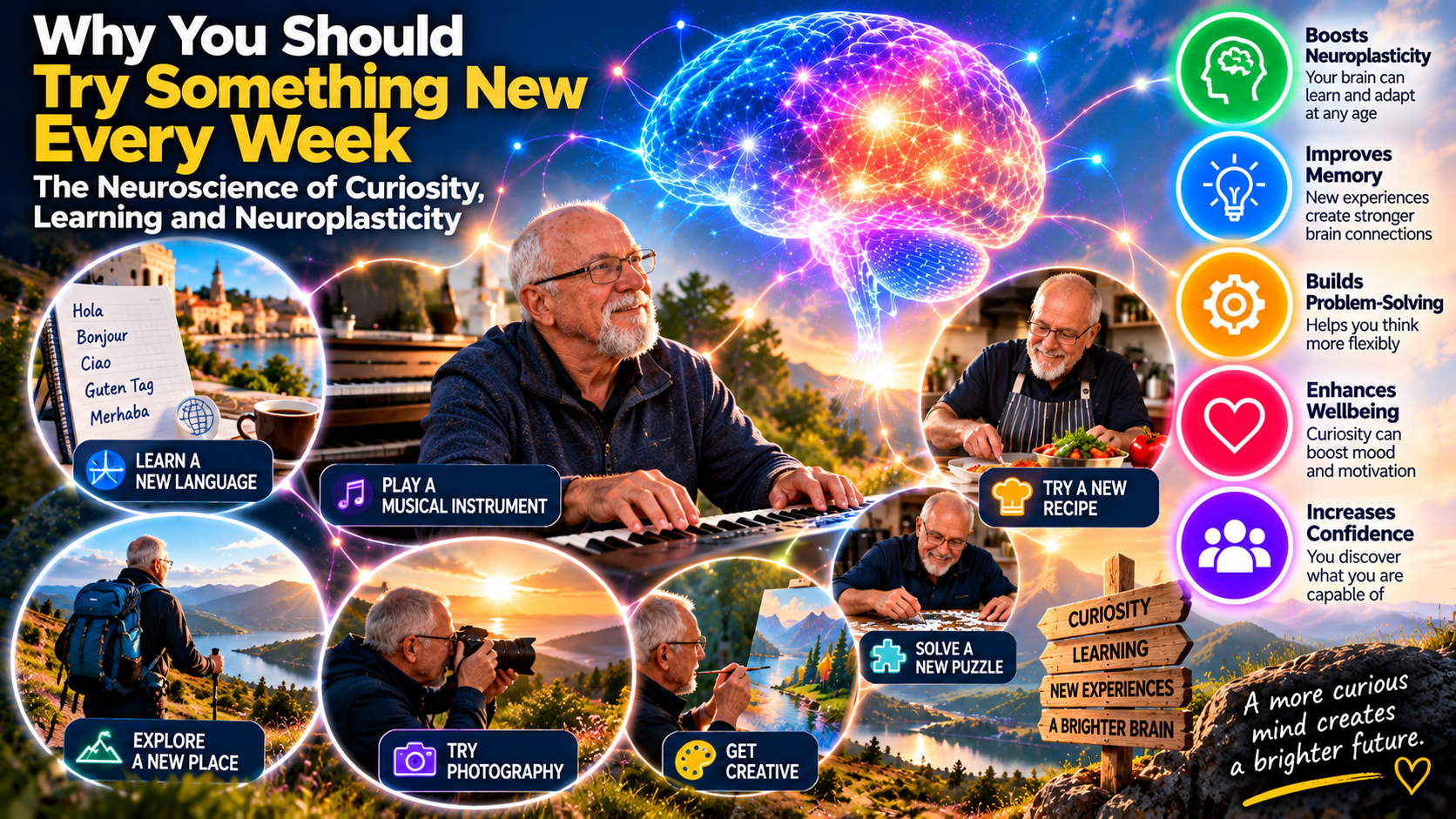
When was the last time you did something for the very first time?
Not something you were already good at.
Not something you had practised for years.
But something completely unfamiliar.
Perhaps you tried cooking a dish from another country.
Learned a few words in a new language.
Took a different route on your morning walk.
Or attempted to play a musical instrument.
How did it feel?
Exciting?
Uncomfortable?
Frustrating?
Perhaps a little of all three.
As we grow older, our lives can become increasingly predictable.
We develop routines.
We become comfortable with familiar activities.
And we often spend more time doing things we already know how to do than exploring things we have never tried.
There is nothing wrong with routine. Familiar habits can make life easier and more manageable.
But what happens when we deliberately introduce something new into our lives?
Could trying a new activity every week encourage learning?
Could it help us become more adaptable?
And what might it teach us about the remarkable capacity of the human brain?
Through my lived experience of brain injury, my interest in neuroplasticity and my decision to start learning piano at 54, I have developed a deep appreciation for the importance of remaining curious.
I believe that learning should not end when we leave school, complete a qualification or reach a particular age.
And neuroscience gives us some fascinating reasons to continue exploring.
Let’s discover why trying something new every week could become one of the most enjoyable habits you develop.
1. Why Our Brains Become Comfortable With Familiarity
Think about your typical day.
You may wake up at approximately the same time.
Prepare a familiar breakfast.
Travel along the same route.
Complete similar tasks.
And spend your evening doing activities you already enjoy.
Much of this routine happens almost automatically.
That is because repeated experience allows us to become more efficient at familiar activities.
We no longer need to think carefully about every individual step.
For example, when you first learned to drive, you probably had to concentrate intensely.
You needed to remember where the pedals were, how to change gears and when to check your mirrors.
With experience, many of those actions became more familiar.
This ability to learn from repetition is extremely useful.
But familiarity can also mean we encounter fewer situations that require us to develop unfamiliar skills.
Trying something new introduces a different kind of challenge.
It encourages us to pay attention, explore and learn.
Routine helps us navigate everyday life. Novelty provides opportunities to discover something beyond it.
2. What Is Neuroplasticity?
Neuroplasticity refers to the brain’s ability to change its connections, structure and functions in response to experience, learning and other influences.
It is one of the biological foundations of learning.
When we practise an unfamiliar skill, the nervous system can undergo changes associated with that experience.
For example, learning to play piano involves coordinating movements, recognising notes and remembering musical patterns.
Learning a language involves developing familiarity with unfamiliar sounds, words and grammatical structures.
And learning a new physical skill may involve changes in motor control and coordination.
However, neuroplasticity is sometimes exaggerated.
It does not mean that every new activity produces dramatic improvements in intelligence.
Nor does it mean that learning something unfamiliar automatically prevents dementia or repairs neurological damage.
The important message is that the brain remains responsive to experience throughout life.
We can continue learning, even when we are no longer young.
And that gives us plenty of reasons to remain curious.
3. Why Novelty Captures Our Attention
Have you ever noticed how quickly you become aware of something unexpected?
Perhaps you walk along a familiar street and notice that a new shop has opened.
Or you hear an unfamiliar sound while sitting in a quiet room.
Our brains continually evaluate information from the environment.
Unexpected or novel experiences can attract attention because they may contain information worth investigating.
Researchers have studied how novelty relates to attention, learning and memory.
Brain systems involving the hippocampus and regions associated with motivation and reward contribute to aspects of these processes.
However, not every unfamiliar experience improves learning.
If something is overwhelming, confusing or stressful, it may be difficult to engage with it effectively.
The most useful challenges are often those that are manageable and meaningful.
Novelty can encourage attention.
But attention, practice and appropriate feedback are also important for learning.
4. What Does Dopamine Have to Do With Curiosity?
Dopamine is a neurotransmitter involved in several brain functions, including motivation, learning and reward processing.
Researchers have investigated its role in how people respond to novelty and unexpected outcomes.
When we encounter something unfamiliar, we may become motivated to explore it.
For example, imagine discovering an interesting new subject.
You might begin asking questions.
Reading articles.
Watching educational videos.
Or experimenting with an activity.
Curiosity can encourage further exploration.
However, dopamine should not be described as a simple happiness chemical.
Its functions are more complex.
And it would be misleading to suggest that trying something new automatically produces a beneficial dopamine boost.
The practical lesson is that curiosity and motivation can work together to encourage learning.
When something captures our interest, we may become more willing to spend time understanding it.
5. Why Trying New Things Can Challenge Your Memory
Learning something unfamiliar often involves memory.
Imagine cooking a recipe you have never attempted before.
You may need to remember the ingredients.
Follow instructions.
Keep track of the order of preparation.
And recall what you have already completed.
Or imagine learning a few words in Italian.
You might practise pronunciation.
Associate unfamiliar words with their meanings.
And attempt to remember them later.
These activities engage memory processes.
However, practising a particular memory task does not necessarily improve every aspect of memory.
Remembering the ingredients for a recipe is different from remembering appointments or conversations.
Research into cognitive training has repeatedly demonstrated the importance of distinguishing between improvement in a practised task and broader changes in everyday cognitive functioning.
Nevertheless, learning unfamiliar information can be an enjoyable way to engage with memory.
And that is a worthwhile reason to explore new experiences.
6. Why New Experiences Can Encourage Cognitive Flexibility
Cognitive flexibility refers to the ability to adjust our thinking or behaviour when circumstances change.
It is an important aspect of executive functioning.
Imagine you have always cooked meals using familiar ingredients.
One day, you decide to prepare a dish from another culture.
You may encounter unfamiliar techniques.
Different flavours.
And instructions that require you to change your usual approach.
You need to adapt.
Similarly, learning to use unfamiliar technology may challenge your existing habits.
You may need to discover new controls.
Understand different processes.
And adjust when something doesn’t work as expected.
These experiences provide opportunities to practise adapting to unfamiliar demands.
But we should be careful not to assume that trying one new activity produces measurable improvements in general cognitive flexibility.
The relationship between learning particular skills and broader cognitive abilities remains an important research question.
What we can say is that unfamiliar activities give us opportunities to practise responding to new situations.
7. Why Being a Beginner Can Be Good for Your Confidence
People sometimes avoid unfamiliar activities because they dislike being beginners.
They worry about making mistakes.
Looking foolish.
Or discovering that something is more difficult than expected.
This is particularly common when we have become experienced in other areas of life.
A successful business leader may feel uncomfortable learning a skill they know nothing about.
Someone who has spent years developing professional expertise may dislike being unable to complete a simple beginner task.
But being a beginner is a normal part of learning.
You cannot expect to know everything before you start.
One useful approach is to focus on progress rather than immediate mastery.
For example, learning to play a short melody may initially seem difficult.
After practice, you may become more familiar with the notes.
That experience can provide evidence that learning is taking place.
Confidence often develops through manageable experiences rather than appearing before we begin.
8. Why I Started Learning Piano at 54
When I started learning piano at 54, I was entering unfamiliar territory.
I wasn’t expecting to become an accomplished pianist overnight.
I simply wanted to learn something new.
There were notes to recognise.
Movements to coordinate.
And unfamiliar musical patterns to understand.
Some things came more easily than others.
But that was part of the experience.
What interested me was not simply whether I could play a particular piece of music.
It was the process of learning itself.
The experience reinforced something I believe strongly.
You do not need to be young to become a beginner.
And you do not need to become an expert to benefit from the enjoyment of learning.
Sometimes, the most meaningful part of trying something unfamiliar is discovering that you are still willing to explore.
9. Why Age Shouldn’t Stop You From Learning
There is a common assumption that learning is primarily for younger people.
We associate education with schools, colleges and universities.
Later in life, we may focus more on using existing skills than developing new ones.
But learning does not have an expiry date.
Adults can continue acquiring knowledge and developing abilities throughout life.
Age can influence certain aspects of cognition and physical performance.
Health, motivation, prior experience and access to learning opportunities also matter.
However, there is no universal age at which meaningful learning becomes impossible.
Someone in their fifties may begin learning an instrument.
A person in their sixties might explore a language.
Someone in their seventies could discover an interest in photography.
The goal does not have to be professional achievement.
It can simply be enjoyment, curiosity or personal development.
10. Can Trying New Activities Improve Your Mood?
New experiences can sometimes be enjoyable and rewarding.
They may provide a sense of anticipation.
Offer opportunities for social interaction.
Or create a feeling of achievement.
For example, attending a pottery class might introduce you to a creative activity.
Trying a new walking route may provide an enjoyable change of scenery.
And learning a recipe could result in a meal you are proud to share.
These experiences may contribute positively to wellbeing.
However, unfamiliar activities are not always enjoyable.
They can also create frustration, anxiety or fatigue.
The effects depend on personal interests, circumstances and the level of challenge.
The aim should not be to force yourself to do something new simply because novelty is considered beneficial.
Instead, choose activities that are meaningful and appropriate for you.
11. Why Trying Something New Can Help Us Discover Hidden Interests
Many of us have interests we have never explored.
Perhaps you have always wondered what it would be like to paint.
Or learn photography.
Or understand astronomy.
But you have never taken the first step.
Sometimes, we assume we will not enjoy an activity before we have experienced it.
Trying something new provides information.
You may discover that you love it.
You may realise it is not for you.
Or you may find that you enjoy one aspect of the activity more than another.
All of these outcomes can be useful.
The purpose is not to turn every experiment into a lifelong hobby.
It is to remain open to discovering what interests you.
12. What Living With Brain Injury Has Taught Me About Learning
My lived experience of brain injury has influenced the way I think about learning and adaptation.
When circumstances change unexpectedly, familiar activities may become more difficult.
Confidence can be affected.
And expectations may need adjusting.
This has encouraged me to recognise that learning is not always about achieving more.
Sometimes, it involves finding different ways to approach familiar tasks.
Or exploring activities that suit changed circumstances.
It is also important to acknowledge that neurological conditions can affect attention, memory, energy and sensory processing.
Trying something new may require careful pacing.
A person experiencing cognitive fatigue may need shorter sessions.
Someone with movement difficulties may require adapted equipment.
And others may need support or professional guidance.
Neuroplasticity should never be used to suggest that people can overcome every neurological difficulty simply by trying harder.
For me, the value of learning lies partly in recognising what is meaningful and possible for the individual.
13. Why Small Challenges May Be Better Than Overwhelming Ones
When people decide to learn something new, they sometimes set enormous goals.
Learn a language in a month.
Become an accomplished musician.
Master a complicated software programme.
Or completely transform their lifestyle.
These ambitions can become overwhelming.
A more manageable approach is to begin with a small challenge.
Learn five words in a new language.
Try one unfamiliar recipe.
Spend ten minutes exploring a new hobby.
Or practise a simple musical pattern.
Smaller activities may be easier to fit into everyday life.
They also provide opportunities to evaluate whether the activity suits you.
For people living with fatigue or health challenges, even shorter sessions may be appropriate.
The goal is not to achieve as much as possible in the shortest time.
It is to create opportunities for meaningful engagement.
14. Why Repetition Still Matters
Trying something new is valuable.
But novelty alone does not guarantee learning.
Imagine learning three words in a new language.
You practise them once.
Then never use them again.
You may forget them.
Now imagine returning to those words over several days.
You practise pronunciation.
Use them in simple sentences.
And attempt to recall them without looking.
Repeated practice can support learning and retention.
This is an important distinction.
Trying something new introduces unfamiliar information.
But developing a skill often requires continued engagement.
A weekly challenge can therefore involve both novelty and repetition.
You might begin learning a language one week and continue practising it while exploring another activity the following week.
15. Why Mistakes Are Part of Learning
When you attempt something unfamiliar, mistakes are likely.
You might use the wrong ingredient.
Pronounce a word incorrectly.
Miss a musical note.
Or misunderstand instructions.
These experiences can be frustrating.
But mistakes can also provide feedback.
They reveal differences between what we intended and what actually happened.
Learning processes allow us to adjust our behaviour based on such information.
However, mistakes are most useful when we can understand them and practise a better approach.
Repeated failure without appropriate support may simply create frustration.
The aim is not to celebrate every mistake.
It is to respond constructively.
Ask what happened.
Consider what might help.
And decide whether to try again.
16. Why Learning With Other People Can Make New Experiences More Enjoyable
Trying something new does not have to be a solitary activity.
You might attend a class with a friend.
Join a walking group.
Learn a language with a partner.
Or participate in a community workshop.
Shared activities provide opportunities for conversation and connection.
They may also offer encouragement.
For example, a beginner music class allows participants to learn alongside others who are also unfamiliar with the activity.
This can make mistakes feel less intimidating.
However, group activities are not suitable for everyone.
Some people prefer learning independently.
Others may experience social anxiety, fatigue or accessibility barriers.
Both individual and group learning can be meaningful.
The important thing is choosing an approach that suits you.
17. How Technology Makes Trying New Things Easier
Technology has created many opportunities for learning.
You can explore unfamiliar subjects through online courses.
Learn basic phrases using language-learning applications.
Follow cooking tutorials.
Or practise creative skills with digital tools.
Some activities can be completed from home.
This may be particularly useful for people with mobility difficulties or limited access to local classes.
Through my own projects, including Speak & Rewire and Regain Arcade, I have become interested in how digital experiences can encourage curiosity and participation.
A language-learning activity can introduce unfamiliar vocabulary.
A puzzle game can provide a new challenge.
And an accessible digital game may allow someone to explore a different activity at their own pace.
These tools are not guaranteed treatments for neurological conditions.
But they can offer enjoyable opportunities for learning and engagement.
18. Why Business Leaders Should Try Something New
Trying unfamiliar activities is not only relevant to personal development.
It can also provide useful experiences for leaders.
Business leaders often become highly experienced in particular industries.
They develop established approaches.
Build professional routines.
And rely on knowledge acquired over many years.
But changing markets and technologies require continued learning.
A leader who explores unfamiliar subjects may become more aware of the challenges involved in developing new skills.
They may also become more comfortable asking questions.
For example, learning a new digital tool can remind a manager what employees experience when they are asked to adapt to unfamiliar systems.
Trying a creative activity may encourage different ways of thinking.
However, leaders should not assume that recreational hobbies automatically improve business performance.
The value may lie in curiosity, perspective and the experience of being a learner.
19. Thirty New Things You Could Try
If you would like some inspiration, here are thirty ideas.
- Learn five words in a new language.
- Cook a recipe from another country.
- Take a different walking route.
- Try a beginner photography activity.
- Listen to an unfamiliar style of music.
- Learn a simple piano melody.
- Visit a local museum.
- Try drawing or sketching.
- Read about a subject you know little about.
- Explore a new type of puzzle.
- Learn a basic gardening technique.
- Try a different form of suitable exercise.
- Watch an educational documentary.
- Learn how to identify a bird or plant.
- Explore a new digital application.
- Try a beginner craft activity.
- Learn a simple breathing or relaxation technique.
- Visit a place in your local area you have never explored.
- Learn a few basic phrases in sign language.
- Try writing a short poem.
- Explore a new board game.
- Learn a simple magic trick.
- Try a new healthy ingredient.
- Listen to a podcast about an unfamiliar subject.
- Learn a basic computer shortcut.
- Try a different creative writing exercise.
- Explore a new musical rhythm.
- Learn something about another culture.
- Try a new accessible digital game.
- Ask someone to teach you a skill they enjoy.
Not every activity will suit everyone.
Choose options that are safe, enjoyable and appropriate for your circumstances.
20. A Twelve-Week Try Something New Challenge
If you would like to turn curiosity into a regular habit, here is a twelve-week challenge.
| Week | Challenge | What You Might Explore |
|---|---|---|
| 1 | Learn five words in a new language | Vocabulary and pronunciation |
| 2 | Cook an unfamiliar recipe | Sequencing and new techniques |
| 3 | Try a different walking route | Navigation and observation |
| 4 | Learn a simple musical rhythm | Timing and coordination |
| 5 | Explore a new puzzle | Planning and problem-solving |
| 6 | Try a creative activity | Expression and experimentation |
| 7 | Learn something about astronomy | Curiosity and new knowledge |
| 8 | Explore a digital learning tool | Technology and unfamiliar skills |
| 9 | Try a new social activity | Conversation and connection |
| 10 | Learn a practical household skill | Following instructions and practice |
| 11 | Explore an unfamiliar book or subject | Reading and comprehension |
| 12 | Revisit your favourite activity | Reflection and continued learning |
You can adapt the schedule.
You might spend five minutes on an activity.
Or choose something more substantial.
The important thing is to approach the challenge with curiosity rather than pressure.
21. How to Make Trying Something New a Weekly Habit
A good intention is not always enough to create a lasting habit.
Life becomes busy.
Responsibilities take priority.
And unfamiliar activities can easily be postponed.
Here are several ways to make the process easier.
Choose a regular time
You might set aside a little time each weekend.
Keep the activity manageable
A new experience does not need to take several hours.
Prepare in advance
Have the materials or instructions ready.
Choose activities you genuinely want to explore
Interest can make participation more enjoyable.
Allow flexibility
If you are tired or unwell, adapt the challenge or postpone it.
Reflect on the experience
Consider what you enjoyed and whether you would like to continue.
Avoid turning curiosity into another obligation
The aim is exploration, not perfection.
22. Why Trying New Things Can Change How We See Ourselves
Sometimes, our beliefs about ourselves become restrictive.
We say things such as:
“I’m not creative.”
“I’m terrible with technology.”
“I’m too old to learn.”
“Music isn’t for me.”
Or, “I’ve never been good at languages.”
These beliefs may be influenced by previous experiences.
But they are not always accurate descriptions of what we might be able to learn.
Trying something unfamiliar provides an opportunity to test our assumptions.
You may discover that an activity is more enjoyable than expected.
Or that you can make progress with appropriate practice.
Of course, not every attempt will lead to success.
And some activities may remain difficult or unsuitable.
But exploration can help us develop a more informed understanding of our interests and abilities.
Rather than defining ourselves exclusively by what we have done before, we can remain open to discovering something different.
23. The Difference Between Personal Growth and Constant Self-Improvement
There is an important distinction between curiosity and the pressure to improve constantly.
Modern life often encourages us to become more productive.
More efficient.
More successful.
And better at everything.
But trying something new does not need to become another performance target.
You do not have to measure every activity.
You do not need to compete with others.
And you do not have to turn every hobby into a professional skill.
Sometimes, learning can simply be enjoyable.
You might try painting and discover that you are not particularly skilled.
But perhaps you enjoy the process.
That is enough.
You may learn a few words in another language without becoming fluent.
That can still be meaningful.
Personal growth is not always about achieving more. Sometimes, it is about experiencing more.
24. Why Curiosity Matters During Difficult Times
When life becomes difficult, unfamiliar experiences can feel intimidating.
A person recovering from illness may have limited energy.
Someone facing redundancy may feel uncertain about their future.
And a person living with brain injury may experience challenges that affect confidence.
In these circumstances, trying something new should not become an expectation.
Sometimes, rest and stability are more important.
But when circumstances allow, small experiences may provide opportunities to explore interests and reconnect with activities that feel meaningful.
For example, someone might begin listening to a different style of music.
Try a gentle creative activity.
Or explore a new subject through a short educational video.
These experiences do not remove the underlying challenges.
But they may provide moments of enjoyment and discovery.
For me, this is an important aspect of neuroresilience.
Recognising difficulties while remaining open to meaningful possibilities.
25. What Trying Something New Every Week Has to Do With Resilience
Resilience is often described as the ability to respond to adversity.
But it is not simply a matter of determination.
It is influenced by personal resources, circumstances, relationships and available support.
Trying unfamiliar activities may provide opportunities to practise certain skills relevant to adaptation.
For example, you may encounter a challenge.
Recognise that your first approach is not working.
Seek information.
And try a different strategy.
These experiences can provide useful lessons.
However, there is no guarantee that learning a hobby will make someone resilient to major life challenges.
Resilience is much more complex.
The value of unfamiliar activities lies in the opportunities they provide for learning, flexibility and personal discovery.
26. Why I Believe Lifelong Learning Is One of Life’s Greatest Opportunities
Through Regain the Brain, I encourage people to remain curious about the human brain.
I am fascinated by neuroplasticity.
By learning.
And by the ways people adapt to unfamiliar circumstances.
My lived experience of brain injury has influenced this interest.
And starting to learn piano at 54 reinforced my belief that age does not have to define the end of our curiosity.
I don’t believe everyone needs to learn piano.
Or study neuroscience.
Or create digital games.
But I do believe that many of us have interests we have never explored.
Things we have wondered about.
Skills we have considered learning.
And experiences we have postponed because we assumed the opportunity had passed.
Perhaps it hasn’t.
Perhaps the first step is simply giving ourselves permission to begin.
Final Thoughts: What Could You Discover in the Next Seven Days?
We often imagine that meaningful change requires dramatic decisions.
A new career.
A major qualification.
Or a complete transformation of our lifestyle.
But sometimes, personal development begins with something much smaller.
Trying a recipe.
Learning a word.
Picking up a musical instrument.
Or exploring a subject that makes us curious.
Neuroscience reminds us that the brain remains capable of learning throughout life.
Psychology helps us understand how curiosity, motivation and experience influence our behaviour.
And everyday life provides countless opportunities to discover something unfamiliar.
You do not need to become an expert.
You do not need to impress anyone.
And you do not need to turn every new experience into an achievement.
Sometimes, the value is simply in being willing to try.
When I started learning piano at 54, I wasn’t attempting to become a professional musician.
I was exploring a possibility.
And that possibility became part of my continuing journey of learning.
So, I would like to leave you with a question.
What is one thing you have never tried that you could explore this week?
It doesn’t have to be difficult.
It doesn’t have to cost money.
And it doesn’t have to take much time.
But it might introduce you to an interest you never knew you had.
Because we don’t stop being capable of learning simply because we get older.
And sometimes, the most interesting chapter begins when we decide to try something new.
About Darren Jewell
Darren Jewell is a neuroresilience coach, inspirational speaker and founder of Regain the Brain.
Drawing on his lived experience of brain injury and his passion for neuroplasticity, Darren encourages individuals, leaders and organisations to explore resilience, adaptability, confidence and lifelong learning.
His projects include Regain Arcade, a collection of accessible digital games, and Speak & Rewire, a language-learning initiative designed to encourage curiosity and engagement.
Darren also began learning piano at 54, reflecting his belief that meaningful learning can remain part of life at any age.
Inspire Your Audience to Keep Learning and Growing
Are you organising a corporate conference, leadership event, workplace wellbeing programme or community gathering?
Darren’s inspirational talks explore neuroplasticity, resilience, confidence and the importance of remaining open to new experiences.
His message combines lived experience with accessible neuroscience and practical lessons about adaptability and personal development.
Discover Darren’s inspirational speaking and neuroresilience coaching services at www.regainthebrain.com.
This article provides general educational information and does not replace medical or psychological advice. People living with neurological conditions, disabilities or significant fatigue should adapt activities to their circumstances and seek appropriate professional guidance when needed.