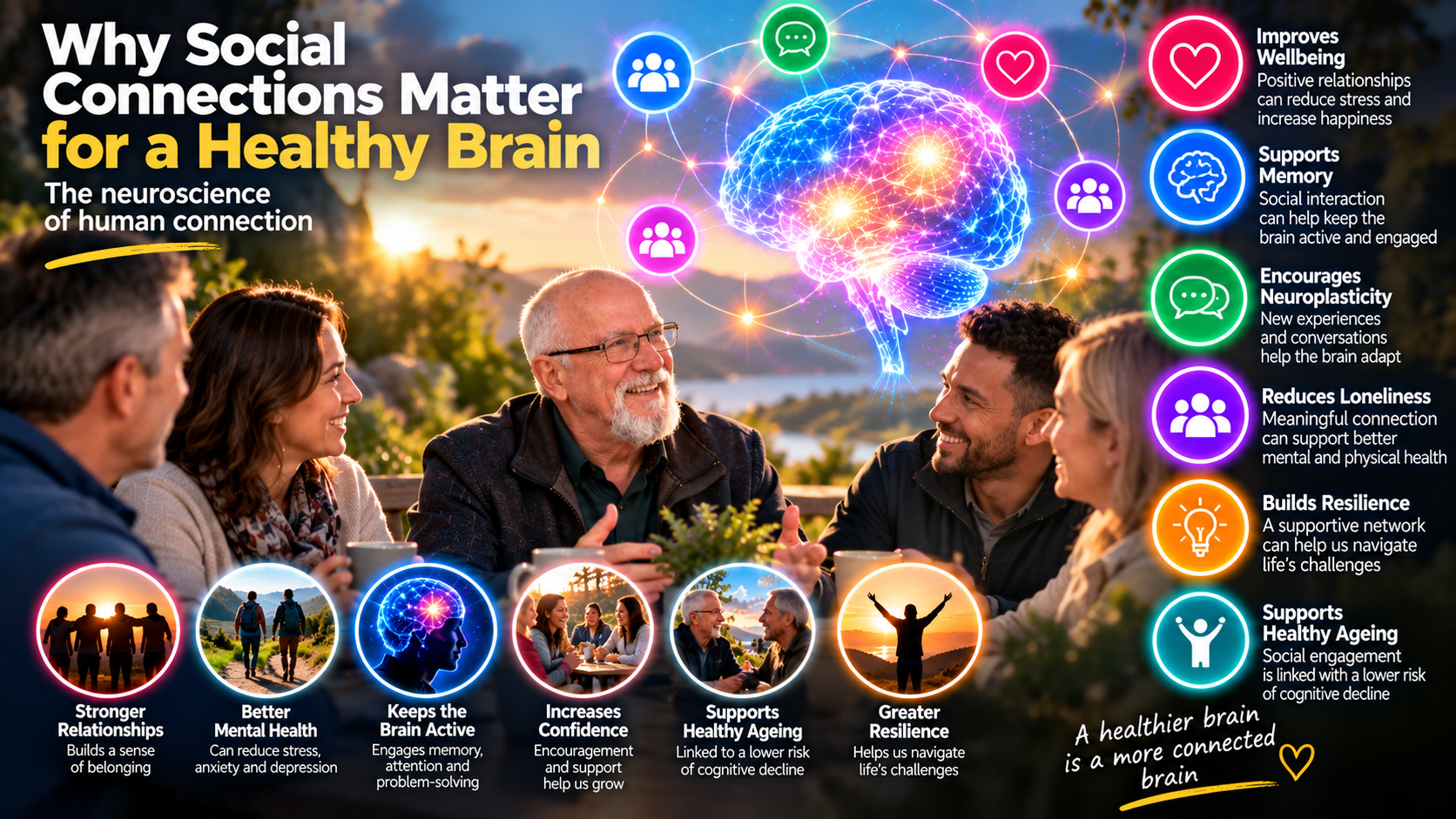
What if one of the most important things you could do for your brain wasn’t learning a new skill, solving a puzzle or playing a brain-training game, but simply spending meaningful time with another person?
We often think about brain health in terms of activities.
Learning a language.
Playing a musical instrument.
Taking regular exercise.
Eating a balanced diet.
Or challenging ourselves with unfamiliar experiences.
These can all form part of a brain-friendly lifestyle.
But there is another important aspect of brain health that we sometimes overlook.
Human connection.
The conversations we have.
The friendships we develop.
The relationships we maintain.
And the sense of belonging we experience when we feel understood and valued.
Human beings are social creatures.
Throughout our lives, relationships influence how we experience the world.
They can provide emotional support during difficult times.
Encourage us to explore unfamiliar opportunities.
And help us maintain a sense of identity and purpose.
But could social connections also influence the health of our brains?
Research suggests that social relationships are associated with important aspects of cognitive health, emotional wellbeing and healthy ageing.
At the same time, loneliness and social isolation have been linked with poorer health outcomes.
However, the relationship is complex.
Having lots of friends does not automatically protect someone from cognitive decline.
And being alone does not necessarily mean someone is lonely.
The quality of our relationships, our individual circumstances and our personal preferences all matter.
Through my lived experience of brain injury, I have come to appreciate the importance of understanding, support and meaningful human connection.
So, what does neuroscience tell us about the relationship between social connections and brain health?
Let’s explore.
1. Why the Human Brain Is Social
Our brains help us navigate an extraordinarily complex social world.
We recognise faces.
Interpret expressions.
Understand language.
Remember people.
And respond to the emotions and intentions of others.
These abilities involve multiple interconnected brain systems.
For example, regions within the temporal lobes contribute to aspects of face and voice recognition.
Other networks are involved in language, emotional processing, memory and social understanding.
When we have a conversation, our brains perform numerous tasks.
We listen to words.
Interpret their meaning.
Remember what has already been said.
Consider how to respond.
And adjust our behaviour based on the other person’s reactions.
Much of this happens without us consciously analysing every step.
Social interaction is therefore a complex experience involving several cognitive processes.
However, this does not mean that every conversation provides measurable improvements in brain health.
It means that interacting with other people can engage many of the systems we use to understand and respond to the world.
2. What Happens in Your Brain During a Conversation?
Think about the last meaningful conversation you had.
Perhaps you spoke with a friend.
Discussed an idea with a colleague.
Or shared a memory with a family member.
During that conversation, you may have used several cognitive abilities.
Attention: You focused on what the other person was saying.
Memory: You remembered information relevant to the discussion.
Language: You interpreted words and formulated responses.
Emotional processing: You considered the feelings being expressed.
Executive functioning: You organised your thoughts and decided when to speak.
Social understanding: You interpreted tone, expressions and context.
These processes interact dynamically.
For example, if someone tells you a story about a difficult experience, you may need to remember details while also recognising their emotional significance.
If they ask for advice, you may need to consider different possibilities.
This is one reason meaningful conversations can feel mentally engaging.
They involve much more than simply exchanging words.
3. Social Connections and Neuroplasticity
Neuroplasticity refers to the brain’s ability to change its connections, structure and functions in response to experience, learning and other influences.
It contributes to learning throughout life.
Social experiences can provide opportunities for learning.
We discover unfamiliar perspectives.
Practise communication skills.
Learn about other people’s experiences.
And sometimes reconsider our own assumptions.
For example, imagine meeting someone from a different cultural background.
You may learn new words.
Discover unfamiliar traditions.
Or develop a different understanding of a particular subject.
These experiences can contribute to learning.
However, it is important not to exaggerate the relationship.
Having a conversation does not automatically mean that new neurons are being created.
Nor can we assume that social interaction directly repairs neurological damage.
Neuroplasticity is a complex biological process influenced by many factors.
Social engagement is one of the experiences that may contribute to learning and adaptation.
The brain remains responsive to experience throughout life, and relationships provide many opportunities for meaningful experiences.
4. Why Social Connections Matter for Emotional Wellbeing
Relationships can provide emotional support.
When life becomes difficult, talking to someone we trust may help us feel understood.
A friend might listen without judging.
A family member may offer practical assistance.
Or a colleague might provide encouragement during a challenging project.
Social support has been associated with better emotional wellbeing in many studies.
But not every relationship is supportive.
Some relationships create stress, conflict or uncertainty.
This is why the quality of our connections matters.
A small number of meaningful relationships may be more valuable than a large network of superficial interactions.
People also differ in how much social contact they prefer.
Some enjoy frequent gatherings.
Others feel more comfortable with occasional conversations or smaller groups.
There is no universal number of friends required for good mental health.
The important consideration is whether our relationships provide connection, respect and appropriate support.
5. What Is the Difference Between Loneliness and Social Isolation?
Loneliness and social isolation are often discussed together.
But they are not the same thing.
Loneliness is the subjective feeling that our social relationships are not meeting our needs.
Someone can feel lonely even when surrounded by other people.
Social isolation generally refers to having relatively little social contact or few social relationships.
A person may live alone and have limited contact with others without necessarily feeling lonely.
For example, someone who enjoys solitude may feel content spending considerable time independently.
Another person may have a busy social calendar but still feel emotionally disconnected.
Understanding this distinction is important.
The goal should not be to encourage everyone to socialise constantly.
It should be to help people develop relationships and opportunities for connection that suit their individual needs.
6. How Loneliness May Affect Brain Health
Researchers have investigated the relationship between loneliness and cognitive health.
Some observational studies have found associations between loneliness and poorer cognitive outcomes.
Other research has examined links with depression, sleep, stress and physical health.
However, association does not prove causation.
Loneliness may contribute to health difficulties through several pathways.
But declining health or cognitive changes may also make social participation more difficult.
For example, someone experiencing memory problems may begin avoiding social situations.
This could increase feelings of loneliness.
Similarly, depression may influence both social engagement and cognitive functioning.
Researchers therefore need to consider multiple interacting factors.
The evidence suggests that loneliness deserves attention as a public health concern.
But it would be misleading to claim that loneliness inevitably damages the brain or causes dementia.
7. Can Social Connections Reduce the Risk of Dementia?
This is an important area of research.
Several observational studies have reported associations between social engagement and a lower risk of dementia.
Researchers have proposed possible explanations involving cognitive stimulation, emotional wellbeing, physical activity and access to support.
However, the evidence is not straightforward.
People who remain socially active may also differ in education, health, mobility and other circumstances.
Early cognitive changes can sometimes lead people to withdraw socially before dementia is diagnosed.
This makes it difficult to determine the direction of cause and effect.
Social participation is one potentially valuable component of healthy ageing.
But it cannot guarantee protection against dementia.
A broader approach to brain health also includes physical activity, cardiovascular health, hearing care, appropriate medical treatment and other relevant factors.
Relationships matter.
But they are not a substitute for comprehensive healthcare.
8. Why Friendships Become Especially Important as We Age
Our social circumstances often change as we grow older.
Children may leave home.
People retire.
Friends move away.
And health changes may affect mobility or independence.
These transitions can alter the opportunities we have for social interaction.
For some people, retirement provides more time to develop friendships and pursue interests.
For others, leaving work means losing regular contact with colleagues.
Maintaining relationships may therefore require more deliberate effort.
This could involve joining a community group.
Keeping in touch with former colleagues.
Participating in a hobby.
Or arranging regular conversations with friends.
However, meaningful connection does not always require large social gatherings.
A weekly telephone call may be important.
So might spending time with a neighbour.
The most useful approach depends on the individual.
9. Why Shared Activities Can Strengthen Relationships
Relationships often develop through shared experiences.
Think about joining a walking group.
Learning a language with someone.
Attending a music class.
Or participating in a community project.
These activities provide opportunities to interact while working towards a shared goal.
They may also introduce people to others with similar interests.
For example, someone who enjoys music might join a local choir.
A person interested in technology may attend a community workshop.
And someone who wants to become more physically active might explore a suitable walking group.
Shared activities can combine social connection with learning or movement.
But they should remain enjoyable and appropriate to the person’s circumstances.
The goal is not to turn every social interaction into a brain-training exercise.
Sometimes, the value lies simply in enjoying another person’s company.
10. Why Social Support Matters After Brain Injury
Brain injury can affect social relationships in many ways.
Some people experience changes in communication.
Others may struggle with fatigue, concentration or emotional regulation.
Activities that once felt straightforward may become more demanding.
For example, a busy gathering may involve multiple conversations, background noise and constant changes in attention.
Someone living with cognitive fatigue may find this overwhelming.
Another person may feel anxious about forgetting information or struggling to follow a discussion.
These difficulties can sometimes lead to social withdrawal.
Friends and family members may not always understand what has changed.
This is why appropriate support and awareness are important.
Social connection should not become another source of pressure.
People living with brain injury may need flexibility, patience and understanding.
11. The Emotional Impact of Feeling Misunderstood
One of the most difficult aspects of some neurological conditions is that the symptoms are not always visible.
A person may look physically well while experiencing difficulties with memory, attention or fatigue.
Other people may assume that recovery is complete.
They might expect the person to participate in activities exactly as they did before.
Or misunderstand why certain situations have become difficult.
This can create frustration.
Someone may begin feeling that their experiences are not recognised.
Over time, they may become reluctant to explain their needs.
A supportive relationship can make a meaningful difference.
Sometimes, the most helpful response is not to offer advice.
It is simply to listen.
To acknowledge that the person’s experience is real.
And to ask what would make participation easier.
Understanding can be one of the most valuable forms of social support.
12. What My Experience of Brain Injury Has Taught Me About Connection
My lived experience of brain injury has influenced how I understand resilience, confidence and human relationships.
It has encouraged me to recognise that people may be facing difficulties others cannot see.
Someone might appear comfortable in conversation while managing significant cognitive or emotional challenges.
Another person may need additional time or support to participate.
These experiences have shaped my interest in neuroresilience.
I believe resilience is not simply an individual characteristic.
It can also be influenced by the support and understanding available to us.
When people feel respected, they may find it easier to communicate their needs.
When they feel judged, they may withdraw.
This is why I believe human connection deserves greater attention in discussions about brain health.
We often focus on what individuals can do to improve their wellbeing.
But the environments and relationships around them matter too.
13. Why Meaningful Conversations Can Build Confidence
Confidence is influenced by experience.
When someone feels comfortable contributing to a conversation, they may become more willing to participate again.
Positive social experiences can provide opportunities to practise communication and develop familiarity.
For example, someone who feels anxious about speaking in groups might begin with a conversation involving one trusted person.
Over time, they may decide to participate in a small gathering.
However, confidence-building should be adapted to individual needs.
Some people experience social anxiety or neurological difficulties that require professional support.
And no one should be pressured into overwhelming situations simply because socialising is considered beneficial.
The aim is to create manageable opportunities for participation.
Not to force people beyond their limits.
14. Why Technology Can Help People Stay Connected
Technology has changed the way we maintain relationships.
Video calls.
Messaging apps.
Online communities.
And social media platforms can provide opportunities to communicate across distances.
For someone who cannot travel easily, a video call may make it possible to remain connected with family.
A person living in a rural area may find online communities particularly valuable.
And someone with a specialist interest may discover others who share their enthusiasm.
Technology can therefore help overcome certain barriers.
However, online interactions vary in quality.
Some provide meaningful support.
Others may contribute to stress, comparison or misinformation.
Digital communication should not automatically be treated as inferior or superior to face-to-face contact.
What matters is whether it provides meaningful connection for the individual.
15. Can Online Communities Support People Living With Brain Injury?
Online communities may offer valuable opportunities for people with shared experiences to connect.
Someone living with brain injury may find it helpful to speak with others who understand particular challenges.
They may exchange practical ideas.
Discuss experiences.
Or simply feel less isolated.
However, online communities also have limitations.
Advice from other members may not be medically appropriate.
Personal experiences vary.
And some information may be inaccurate.
It is important to distinguish between emotional support and professional healthcare advice.
Privacy should also be considered when sharing personal information online.
Used thoughtfully, online communities can complement other forms of support.
16. Why Social Connection Matters in the Workplace
Workplaces are important social environments.
Many people spend a significant proportion of their lives interacting with colleagues.
Positive working relationships can support collaboration, communication and wellbeing.
Employees may benefit from feeling included and respected.
They may find it easier to ask questions.
Share ideas.
And request assistance when needed.
However, workplace social connection should not be confused with compulsory socialising.
Not everyone enjoys large team events.
Some employees prefer quieter interactions.
Others may have disabilities, caring responsibilities or personal circumstances that affect participation.
Inclusive organisations recognise these differences.
They provide opportunities for meaningful connection without assuming everyone has the same social preferences.
17. Psychological Safety and Human Connection
Psychological safety refers to a shared belief that people can take interpersonal risks within a team without unnecessary fear of humiliation or punishment.
It can influence whether employees feel comfortable asking questions, admitting mistakes or expressing concerns.
Trust and respectful communication are important elements of this environment.
For example, a manager who listens carefully to an employee’s concerns may help create a more supportive working relationship.
A team that responds constructively to reasonable mistakes may encourage open communication.
However, psychological safety does not mean avoiding difficult conversations.
Accountability and clear expectations remain important.
The goal is to create a culture where people can communicate honestly and respectfully.
This can support both social connection and organisational learning.
18. Why Kindness Can Make a Difference
Small acts of kindness can have meaningful social effects.
Checking on a friend.
Offering assistance.
Listening without interrupting.
Or including someone who might otherwise feel overlooked.
These actions may help strengthen relationships.
They can communicate that someone matters.
However, kindness should not be treated as a guaranteed way to improve another person’s mental health.
People have different needs.
Sometimes, practical assistance is more useful than encouragement.
At other times, respecting someone’s need for privacy or rest may be the kindest response.
The most meaningful support often begins with understanding what the other person actually needs.
19. What About People Who Prefer Being Alone?
Not everyone wants frequent social interaction.
Some people enjoy solitude.
They may find it relaxing.
Or prefer spending time reading, creating, learning or reflecting.
Solitude is not automatically harmful.
It can be a meaningful and enjoyable part of life.
The important distinction is between chosen solitude and unwanted loneliness.
Someone who feels content spending time alone may not need additional social activities.
Another person may want more connection but face barriers that make it difficult.
Brain health advice should respect these differences.
We should avoid suggesting that people must become more outgoing to remain healthy.
The aim is to support meaningful relationships and personal wellbeing.
20. Ten Practical Ways to Build Meaningful Social Connections
If you would like to strengthen your social connections, here are ten ideas to consider.
1. Reconnect with an old friend
Send a message or arrange a conversation.
2. Make time for regular contact
A short weekly call can help maintain a relationship.
3. Explore a shared interest
Consider a group focused on music, books, languages or another activity you enjoy.
4. Volunteer if it suits your circumstances
Community activities can provide opportunities to meet people and contribute.
5. Spend time with family
Meaningful interaction does not always require a special event.
6. Join an appropriate online community
Look for respectful groups with shared interests or experiences.
7. Practise listening
Show interest in other people’s perspectives.
8. Consider accessible activities
Choose social opportunities that suit your energy, mobility and communication needs.
9. Respect your own limits
Meaningful connection should not require constant social activity.
10. Seek support if loneliness is affecting your wellbeing
A GP, counsellor or appropriate support organisation may be able to help.
These ideas are not requirements.
Choose activities that feel realistic and meaningful to you.
21. A Seven-Day Human Connection Challenge
If you would like to explore how social connection fits into your life, consider this gentle seven-day challenge.
The goal is not to meet as many people as possible.
It is to create opportunities for meaningful interaction.
Day 1: Send a message
Contact someone you haven’t spoken to recently.
Day 2: Have a conversation
Spend a little time talking with someone you trust.
Day 3: Share an interest
Discuss a book, song, hobby or subject you enjoy.
Day 4: Practise listening
Give someone your attention without immediately offering advice.
Day 5: Express appreciation
Thank someone for something meaningful.
Day 6: Explore a community opportunity
Look into a local or online activity that interests you.
Day 7: Reflect
Consider which interactions felt enjoyable or supportive.
You can adapt the challenge to your needs.
A message may be easier than a telephone call.
A brief conversation may be preferable to a long gathering.
And some days, rest may be more appropriate.
The aim is connection, not pressure.
22. Why Social Connection Should Be Part of Brain Health Conversations
When discussing brain health, we often focus on individual habits.
Exercise.
Nutrition.
Sleep.
Learning.
And cognitive activities.
These are important subjects.
But relationships deserve attention too.
Social connection can influence emotional wellbeing, opportunities for learning and access to practical support.
Loneliness and social isolation have also been associated with poorer health outcomes.
However, we should avoid presenting relationships as a guaranteed form of disease prevention.
Brain health is influenced by many interacting factors.
No single habit can eliminate every risk.
The most useful approach is to recognise social connection as one part of a broader picture.
23. Why Communities Have a Role to Play
Social connection is not solely an individual responsibility.
Communities can influence whether people have opportunities to participate.
Accessible public spaces.
Community groups.
Transport services.
Inclusive activities.
And appropriate support for people with disabilities can all make a difference.
For someone with mobility difficulties, attending a community event may depend on accessible transport.
A person with cognitive fatigue may need quieter environments or shorter activities.
Someone with communication difficulties may benefit from additional patience.
These considerations remind us that inclusion requires practical action.
Encouraging people to socialise is not enough if barriers prevent them from participating.
24. What I Hope People Take Away From This Article
Through Regain the Brain, I encourage people to remain curious about the brain and its remarkable capacity for learning and adaptation.
But I also believe we should remember the human side of neuroscience.
We are not simply collections of neurons.
We are people with experiences, relationships, emotions and aspirations.
Our connections with others can influence how we experience life’s challenges.
They may provide encouragement when confidence is low.
Understanding when circumstances change.
And opportunities to discover new interests.
For someone living with brain injury, feeling understood can be particularly important.
Not every challenge can be solved through a conversation.
But a supportive relationship can sometimes make a difficult experience feel less isolating.
Final Thoughts: A Healthy Brain Is Part of a Connected Life
We often search for activities that might support our brains.
A new language.
A musical instrument.
A puzzle.
Or a brain-training game.
These activities can be enjoyable and meaningful.
But perhaps we should also consider the value of something more familiar.
A conversation.
A friendship.
A shared experience.
Or simply knowing that someone understands us.
Neuroscience shows that social interaction involves complex processes associated with language, attention, memory and emotion.
Research also suggests that social relationships are relevant to wellbeing and healthy ageing.
But there is no universal formula for the perfect social life.
Some people enjoy large groups.
Others prefer a small circle of trusted friends.
And some find meaningful connection through online communities or occasional conversations.
What matters is not the number of people we know.
It is whether our relationships provide the connection and support we need.
Through my lived experience of brain injury, I have come to appreciate that resilience is not always something we develop alone.
Sometimes, it is supported by the people who listen.
The people who understand.
And the people who remind us that our experiences matter.
Because looking after our brains isn’t only about what we learn or practise.
It can also be about the people we connect with along the way.
And sometimes, one meaningful conversation can make a difficult day feel a little easier.
About Darren Jewell
Darren Jewell is a neuroresilience coach, inspirational speaker and founder of Regain the Brain.
Drawing on his lived experience of brain injury and his passion for neuroplasticity, Darren encourages individuals, leaders and organisations to explore resilience, adaptability, brain health and lifelong learning.
Through inspirational speaking, coaching and educational projects, he shares accessible insights into neuroscience, confidence and the importance of understanding invisible challenges.
Inspire Your Audience Through Neuroscience and Human Connection
Are you organising a corporate conference, leadership event, workplace wellbeing programme or community gathering?
Darren’s inspirational talks explore neuroplasticity, resilience, confidence and the importance of creating environments where people feel understood and supported.
His message combines lived experience with accessible neuroscience and practical lessons about human connection, leadership and personal development.
Discover Darren’s inspirational speaking and neuroresilience coaching services at www.regainthebrain.com.
This article provides general educational information and does not replace medical or psychological advice. People experiencing persistent loneliness, depression or other mental health difficulties should seek appropriate professional support.