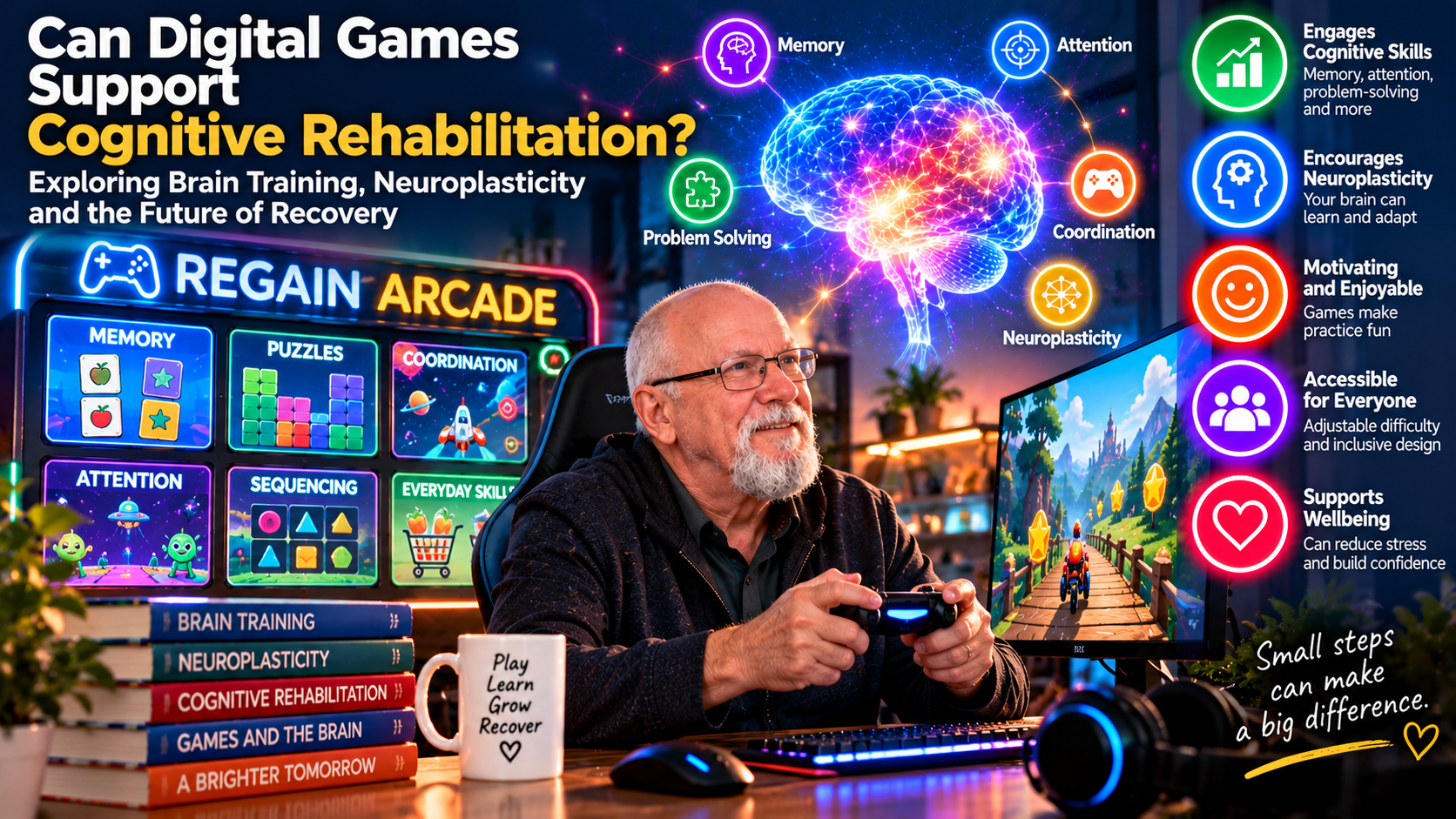
What if something as familiar as playing a computer game could become part of a meaningful approach to cognitive rehabilitation?
When people think about computer games, they often imagine entertainment.
Arcade machines.
Puzzle games.
Racing games.
Or spending time trying to beat a previous high score.
For years, video games have been associated with leisure, competition and fun.
But what if we looked at them differently?
What if a simple matching game could provide opportunities to practise attention?
What if remembering a sequence of colours encouraged someone to engage their working memory?
Or what if a gentle coordination game offered an accessible way to practise timing and movement?
These questions have attracted interest from researchers investigating digital cognitive training and neurological rehabilitation.
Through my own lived experience of brain injury and my fascination with neuroplasticity, I have become increasingly interested in how technology might make learning and cognitive activities more accessible.
That interest contributed to my development of Regain Arcade, a collection of digital games that encourages people to explore different cognitive challenges through play.
However, there is an important distinction between a game that provides an enjoyable cognitive challenge and a clinically validated rehabilitation treatment.
Not every brain-training game improves everyday cognitive functioning.
And no computer game can guarantee recovery from a neurological injury.
Nevertheless, digital games offer some interesting possibilities.
So, can digital games support cognitive rehabilitation?
Let’s explore the neuroscience, the research, the potential benefits and the limitations.
1. What Is Cognitive Rehabilitation?
Cognitive rehabilitation refers to approaches designed to help people manage or improve difficulties involving cognitive functions.
These may include:
- Attention and concentration.
- Memory.
- Planning and organisation.
- Problem-solving.
- Information processing.
- Executive functioning.
- Certain aspects of communication.
Cognitive rehabilitation may be recommended following conditions such as acquired brain injury, stroke or other neurological disorders.
The approach depends on the person’s individual difficulties, goals and circumstances.
For some people, rehabilitation focuses on improving performance in specific tasks.
For others, the emphasis is on compensatory strategies.
These might include using reminders, creating routines or adapting the environment.
Rehabilitation may also involve helping people participate more effectively in everyday activities.
For example, someone experiencing memory difficulties might work with a professional to develop strategies for remembering appointments.
Another person may practise managing distractions while completing a meaningful task.
The goal is not simply to perform well on a cognitive test.
It is to support functioning and participation in everyday life.
This distinction becomes particularly important when discussing digital games.
2. Why Are Researchers Interested in Digital Games?
Digital games have several features that make them interesting for cognitive research.
They can provide repeated practice.
Offer immediate feedback.
Adjust difficulty.
And present tasks in an engaging format.
For example, a memory game might ask someone to remember where matching cards are located.
A sequencing game could require a player to repeat a pattern.
A puzzle game might involve planning several moves ahead.
These activities engage different cognitive processes.
Researchers have investigated whether practising such tasks can improve performance and whether those improvements extend beyond the game itself.
The results are mixed.
Some studies report improvements in particular trained abilities.
Others find limited benefits outside the activities being practised.
The effectiveness of digital cognitive training can depend on the programme, population, duration and outcomes being measured.
Digital games are therefore a promising area of investigation, but they should not be treated as universally effective rehabilitation tools.
3. What Does Neuroplasticity Have to Do With Brain-Training Games?
Neuroplasticity is the brain’s ability to change its connections, structure and functions in response to experience, learning and other influences.
It is one of the biological foundations of learning.
When someone repeatedly practises a task, they may become more skilled at performing it.
For example, imagine playing a pattern-recognition game for the first time.
Initially, you might find it difficult to identify the correct sequence.
After several attempts, you may begin recognising patterns more quickly.
Your performance improves through experience.
Learning-related changes in neural processing may contribute to this improvement.
However, becoming better at a game does not automatically mean that your overall cognitive ability has improved.
This is one of the central challenges in brain-training research.
Neuroplasticity helps explain how practice can change performance, but it does not guarantee that practising one task will improve every aspect of brain function.
4. The Difference Between Getting Better at a Game and Improving Everyday Life
Imagine someone plays a memory game every day.
After several weeks, their score improves.
They remember more card locations.
They complete levels more quickly.
And they make fewer mistakes.
That is evidence that their performance on the game has improved.
But does it mean they will remember appointments more easily?
Will they become better at following conversations?
Or find it easier to remember where they placed their keys?
Not necessarily.
Researchers often distinguish between near transfer and far transfer.
Near transfer refers to improvements in tasks similar to those practised.
Far transfer refers to improvements in more distant or unrelated activities.
Evidence for near transfer is generally more consistent than evidence for broad far transfer.
This is why claims about brain-training games need to be evaluated carefully.
A game may provide a useful challenge without producing measurable improvements in everyday functioning.
For rehabilitation, the most meaningful question is often whether an intervention helps someone achieve practical goals.
5. Can Digital Games Help With Memory?
Memory is one of the most common areas targeted by brain-training games.
Different games may involve remembering:
- Sequences.
- Locations.
- Images.
- Words.
- Instructions.
- Patterns.
These tasks can engage aspects of short-term memory and working memory.
For example, a game similar to Simon asks players to remember and repeat an increasingly long sequence of colours or sounds.
A matching-card game requires players to remember the locations of previously revealed cards.
These activities can provide opportunities to practise specific memory tasks.
But memory is not a single ability.
Remembering a sequence of lights differs from remembering a conversation or managing appointments.
Research does not establish that playing memory games reliably improves all forms of memory.
For someone living with brain injury, practical memory strategies may be more useful than attempting to improve scores on an unrelated game.
Digital activities may still have a place within a broader, individually appropriate approach.
6. Can Puzzle Games Improve Problem-Solving?
Puzzle games often require players to identify patterns, consider alternatives and plan their actions.
Think about a game in which you must move objects to create a clear path.
Or one where you need to connect pieces in the correct order.
These tasks can involve planning, reasoning and flexible thinking.
However, the skills required vary considerably between games.
A simple matching puzzle may place different demands on cognition than a complex strategy game.
Repeated practice can improve familiarity with the rules and strategies of a particular game.
Whether this translates into broader improvements in problem-solving remains less certain.
Nevertheless, puzzles can be enjoyable activities that encourage active engagement.
For many people, that may be a worthwhile reason to play.
7. What About Games That Challenge Attention?
Attention is essential for many everyday activities.
Reading.
Following instructions.
Participating in conversations.
And completing tasks without becoming distracted.
Some digital games require players to focus on particular information while ignoring irrelevant stimuli.
For example, a target-selection game might ask players to identify a specific shape among several others.
Another game might involve responding to changes on the screen.
These tasks can challenge selective attention, sustained attention or reaction time.
Researchers have investigated attention-training programmes in different populations.
Some interventions have produced improvements in specific attention measures.
However, results are not consistent across all studies.
For people living with neurological conditions, attention difficulties may also be influenced by fatigue, sensory processing and other factors.
Games should therefore be selected carefully.
An activity that is appropriately challenging for one person may be overwhelming for another.
8. Why Coordination Games Are Interesting
Some games involve movement and timing.
Players may need to press a button at the right moment.
Move a cursor towards a target.
Or coordinate actions across the screen.
These activities engage motor and perceptual processes.
For example, a gentle balloon-popping game might encourage visual tracking and hand-eye coordination.
A simple target game could involve timing and controlled movement.
Researchers have investigated game-based approaches to motor rehabilitation, particularly in certain stroke rehabilitation settings.
However, motor rehabilitation is different from general cognitive training.
The clinical usefulness of a game depends on the condition, task and intervention.
For people with movement difficulties, accessibility is particularly important.
Controls may need to be simplified.
Game speed may need adjustment.
And activities should avoid causing pain, excessive fatigue or distress.
9. Why Enjoyment Matters in Rehabilitation
Rehabilitation can require repeated practice.
And repetition is not always enjoyable.
Some exercises may feel difficult or frustrating.
People may also experience fatigue or reduced motivation.
Games can introduce elements that make an activity more engaging.
These might include:
- Clear goals.
- Immediate feedback.
- Visible progress.
- Adjustable challenges.
- Enjoyable graphics and sounds.
For some individuals, these features may encourage participation.
However, enjoyment alone does not establish clinical effectiveness.
A game can be entertaining without improving rehabilitation outcomes.
And a person may enjoy a game while still finding it cognitively exhausting.
The most useful digital activities balance engagement with individual needs and appropriate goals.
10. The Importance of Accessibility in Brain-Training Games
Accessibility is particularly important when designing games for people living with neurological conditions.
A player may experience difficulties involving:
- Fine motor control.
- Vision.
- Hearing.
- Attention.
- Information processing.
- Cognitive fatigue.
- Sensory sensitivity.
A game that is easy for one person may be inaccessible to another.
This is why adjustable settings can make a meaningful difference.
For example, a game might allow players to slow down the action.
Disable sound effects.
Increase text size.
Or play without strict time limits.
Clear instructions are also important.
People should not need to navigate complicated menus before they can begin.
Accessibility should not be treated as an optional extra.
It should be considered throughout the design process.
11. Why I Created Regain Arcade
My interest in creating digital games comes from a combination of lived experience, curiosity and a fascination with neuroplasticity.
Through Regain the Brain, I have explored how learning and technology can provide opportunities for people to engage with unfamiliar challenges.
This led me to develop Regain Arcade.
The idea was to create a collection of games that could be enjoyable while encouraging players to use different skills.
Memory.
Attention.
Problem-solving.
Coordination.
And planning.
I also wanted the experience to feel welcoming.
Not everyone wants to participate in a complicated or highly competitive game.
Some people prefer something gentle.
Others enjoy a greater challenge.
And some may need accessibility options that allow them to play at their own pace.
Regain Arcade is intended to encourage participation and curiosity.
However, it is important to be clear about what it is.
Regain Arcade is a collection of accessible cognitive games, not a clinically validated treatment for brain injury or a replacement for professional rehabilitation.
I believe that distinction is essential.
People deserve encouragement that is grounded in evidence rather than exaggerated promises.
12. Examples of Cognitive Activities in Regain Arcade
Different games can encourage players to engage with different tasks.
Here are several examples of the kinds of activities I have explored through Regain Arcade.
Memory and sequencing games
Games such as Simon-style sequence challenges involve remembering and repeating patterns.
These activities can engage working memory and attention.
Hidden-object games
Searching for objects within an image involves visual scanning and attention.
Players may need to distinguish relevant information from background details.
Puzzle games
Games involving patterns, shapes or sequences can encourage planning and problem-solving.
Gentle coordination games
Activities such as balloon popping or target selection can involve visual tracking and controlled movement.
Everyday task games
Games inspired by shopping lists, recipes or gardening can introduce familiar activities into a digital environment.
These may involve sequencing, attention or remembering instructions.
Each activity has its own demands.
But it is important not to assume that performing well in a game automatically improves the corresponding real-world ability.
The value of the activity should be considered in relation to the player’s goals and experience.
13. Why Gentle Games May Be More Appropriate for Some Players
Many traditional arcade games are designed around speed.
Players must react quickly.
Avoid obstacles.
And compete against a timer.
This can be enjoyable for some people.
But it may be unsuitable for others.
Someone living with cognitive fatigue may find fast-paced gameplay exhausting.
A person with movement difficulties may struggle with demanding controls.
And someone with sensory sensitivity may find flashing effects or loud sounds uncomfortable.
Gentler games can provide alternatives.
They may allow players to take their time.
Repeat activities.
And pause when needed.
However, even gentle games can become tiring.
The appropriate level of challenge varies between individuals.
Players should be encouraged to recognise their limits and adapt their participation accordingly.
14. Can Games Support People Living With Functional Neurological Disorder?
Functional neurological disorder, often called FND, involves neurological symptoms associated with changes in nervous system functioning rather than the structural damage typically seen in some other neurological conditions.
Symptoms can include movement difficulties, sensory changes, seizures and other neurological experiences.
The condition is complex and requires appropriate clinical assessment.
Some people living with FND may enjoy accessible digital games.
Games could provide opportunities for leisure, engagement or practising particular activities.
However, there is insufficient evidence to claim that general-purpose brain-training games treat FND.
Activities may also need adapting to individual symptoms.
For example, someone who experiences visual sensitivity may need to avoid flashing effects.
Another person may need slower controls or shorter sessions.
Treatment for FND should be guided by appropriately qualified healthcare professionals.
Digital games should not be presented as a substitute for specialist care.
15. Can Digital Games Help People Recovering From Stroke?
Digital rehabilitation technologies have been studied in stroke recovery.
Some programmes use virtual reality, interactive movement tasks or game-based exercises.
The aim may be to support particular rehabilitation goals.
For example, a game-based system might encourage repeated arm movements.
Another intervention may involve balance or walking activities.
Research suggests that certain technology-assisted approaches can be useful in selected rehabilitation settings.
However, effectiveness depends on the intervention and the outcomes being measured.
Not all digital games have the same evidence base.
A commercial puzzle game is not equivalent to a clinically designed rehabilitation system.
People recovering from stroke should follow personalised guidance from their rehabilitation team.
16. Why Digital Games Should Complement Rather Than Replace Rehabilitation
Professional cognitive rehabilitation involves much more than repeated cognitive exercises.
A rehabilitation programme may include assessment.
Goal-setting.
Practical strategies.
Environmental adaptations.
Psychological support.
And work on meaningful everyday activities.
Digital games may sometimes complement these approaches.
They could provide opportunities for practice or engagement between professional sessions.
But they should not replace clinical assessment or personalised treatment.
For example, someone who struggles to remember medication may benefit more from an effective reminder system than from improving their score in a memory game.
Similarly, someone experiencing severe fatigue may need help managing their daily routine rather than additional cognitive demands.
The appropriate intervention depends on the individual’s circumstances.
17. The Risk of Making Unrealistic Claims About Brain Training
Brain-training products are sometimes marketed with dramatic promises.
Improve your intelligence.
Reverse cognitive decline.
Prevent dementia.
Or repair your brain.
These claims can be particularly appealing to people experiencing neurological difficulties.
But they require strong scientific evidence.
Improving performance on a game is not proof of broad cognitive improvement.
And neuroplasticity does not mean every activity produces clinically meaningful benefits.
People living with brain injury or other neurological conditions deserve accurate information.
They should not feel that recovery depends on purchasing or playing a particular game.
Nor should they blame themselves if an activity does not improve their symptoms.
Digital games can be enjoyable and potentially useful in specific contexts without being presented as miracle treatments.
18. How Artificial Intelligence Could Change Cognitive Games
Artificial intelligence may create new opportunities for digital cognitive activities.
For example, AI systems could potentially adjust difficulty based on how someone performs.
They might identify when a player is repeatedly struggling with a particular task.
Or suggest a different activity based on preferences.
AI could also help developers create more varied game content.
However, there are important considerations.
An AI system cannot automatically determine a person’s neurological condition from their game performance.
Nor should it be used to make clinical decisions without appropriate validation and oversight.
Privacy, accessibility, transparency and safety are important.
For projects such as Regain Arcade, AI may eventually provide useful tools for personalising the playing experience.
But any claims about rehabilitation benefits would still need proper research.
19. Could Virtual Reality Become Part of Cognitive Rehabilitation?
Virtual reality creates simulated environments in which people can interact with digital experiences.
Researchers have investigated its potential in neurological rehabilitation.
For example, virtual environments may allow someone to practise tasks that resemble everyday situations.
A simulated shopping activity could involve remembering items.
A virtual environment might encourage navigation or attention.
And interactive movement tasks may support certain rehabilitation goals.
However, virtual reality is not suitable for everyone.
Some people experience dizziness, nausea or discomfort.
Others may find immersive environments overwhelming.
Accessibility and individual assessment are important.
Research continues to investigate which approaches are effective and for whom.
20. Why Measuring Real-World Outcomes Matters
Imagine a digital rehabilitation programme produces impressive improvements in game scores.
That might appear encouraging.
But researchers need to ask a further question.
Do those improvements make a meaningful difference in everyday life?
Can someone manage a task more independently?
Participate more effectively in a conversation?
Or complete an activity that matters to them?
These outcomes are often more important than the game score itself.
Researchers may use standardised assessments, functional measures and patient-reported outcomes to evaluate interventions.
The strongest evidence comes from appropriately designed studies that examine meaningful results.
This is an important principle for anyone developing digital cognitive tools.
A game should not be described as clinically effective simply because players improve with practice.
21. Seven Things to Look for in an Accessible Brain Game
If you are choosing a digital game for yourself or someone else, consider the following.
1. Clear instructions
The game should explain what to do without unnecessary complexity.
2. Adjustable difficulty
Players should be able to choose an appropriate level of challenge.
3. Flexible timing
Strict time limits may not suit everyone.
4. Comfortable visual design
Avoid unnecessary flashing, excessive movement or difficult-to-read text.
5. Sound controls
Players should be able to adjust or disable audio where possible.
6. Opportunities to pause
Rest and fatigue management may be important.
7. Realistic claims
Be cautious of products promising dramatic improvements in intelligence or neurological recovery.
A good game should respect the needs and abilities of its players.
22. A Seven-Day Digital Brain Challenge
If you enjoy digital games, you might like to explore different types of activities over a week.
This is intended as a recreational challenge, not a rehabilitation programme.
Day 1: Memory
Try a simple matching-card game.
Day 2: Attention
Explore a hidden-object activity.
Day 3: Problem-solving
Choose a gentle puzzle game.
Day 4: Coordination
Try a game involving controlled movement or target selection.
Day 5: Sequencing
Explore a pattern or rhythm game.
Day 6: Everyday activities
Try a digital activity inspired by shopping, cooking or another familiar task.
Day 7: Reflection
Consider which activities you enjoyed and which felt too demanding.
You do not need to complete every day.
And there is no requirement to improve your score.
If you experience fatigue, discomfort or symptom worsening, stop and seek appropriate guidance if needed.
The aim is simply to explore different activities and notice what suits you.
23. What the Future Might Hold for Regain Arcade
Technology continues to develop.
And I believe there are interesting opportunities to make digital activities more accessible and enjoyable.
For Regain Arcade, future possibilities could include more adjustable difficulty settings.
Additional accessibility options.
New games involving different cognitive challenges.
And personalised playing experiences.
There may also be opportunities to explore collaboration with researchers or rehabilitation professionals.
Such collaboration would be important if the project were ever to investigate clinical outcomes.
For now, my goal is to create enjoyable activities that encourage participation, curiosity and learning.
I want people to feel welcome.
To have opportunities to try different games.
And to recognise that enjoyment and accessibility matter.
Not every meaningful activity needs to be a medical treatment.
Sometimes, providing someone with an enjoyable and accessible experience is valuable in its own right.
24. What Living With Brain Injury Has Taught Me About Technology and Hope
My lived experience of brain injury has shaped my interest in how technology might support people facing neurological challenges.
I understand the importance of realistic expectations.
Recovery is individual.
Some difficulties may improve.
Others may persist.
And progress does not always follow a predictable path.
This is why I believe technology should be developed with care.
People deserve tools that respect their circumstances.
They deserve accurate information.
And they deserve opportunities to participate without feeling judged by their performance.
Neuroplasticity is a fascinating area of science.
But it should not become a marketing promise that every digital activity can repair the brain.
For me, the value of Regain Arcade begins with something more straightforward.
Making cognitive activities enjoyable and accessible.
Encouraging curiosity.
And providing opportunities for people to engage with different challenges at their own pace.
Final Thoughts: Can Playing Games Be Part of a Brain-Friendly Future?
Digital games are no longer simply a form of entertainment.
They have become an interesting area of research involving learning, cognition, movement and neurological rehabilitation.
Some specialised game-based interventions may support particular rehabilitation goals.
And recreational games can provide enjoyable opportunities to engage attention, memory, planning and coordination.
But we must distinguish between practising a game and achieving meaningful improvements in everyday life.
Not every brain-training product has been clinically validated.
And digital games cannot replace personalised rehabilitation.
Through Regain Arcade, I want to explore what happens when technology, curiosity and accessibility come together.
My aim is not to promise that a game can cure neurological injury.
It is to encourage people to discover enjoyable activities that suit their interests and abilities.
Because sometimes, the first step towards engaging with something unfamiliar is simply making it approachable.
You don’t have to achieve the highest score.
You don’t have to complete every level.
And you don’t have to compete with anyone else.
Sometimes, the value lies in having the opportunity to participate.
To explore.
To learn.
And, perhaps most importantly, to enjoy the experience.
About Darren Jewell
Darren Jewell is a neuroresilience coach, inspirational speaker and founder of Regain the Brain.
Drawing on his lived experience of brain injury and his passion for neuroplasticity, Darren explores how learning, resilience and technology can contribute to meaningful experiences.
He is also developing Regain Arcade, a collection of accessible digital games designed to encourage cognitive engagement through enjoyable activities.
Through inspirational speaking, coaching and educational projects, Darren encourages individuals and organisations to explore adaptability, lifelong learning and the importance of creating inclusive opportunities.
Discover Regain the Brain
Are you interested in neuroplasticity, accessible technology, brain health or the future of digital cognitive activities?
Explore Darren’s work through Regain the Brain, including educational articles, inspirational speaking and projects such as Regain Arcade.
Visit www.regainthebrain.com to discover more.
This article provides general educational information and does not replace medical advice, neurological assessment or professional rehabilitation. Regain Arcade is not presented as a clinically validated treatment for brain injury, FND, stroke or other neurological conditions.