What happens when the mindset that helped you achieve success is no longer enough to navigate the challenges ahead?
Success often requires determination, discipline and the willingness to overcome obstacles.
But even the most accomplished leaders can encounter circumstances that challenge their confidence, identity and belief in their own abilities.
A business setback.
An unexpected career change.
A period of uncertainty.
Or a personal experience that fundamentally changes how they see the world.
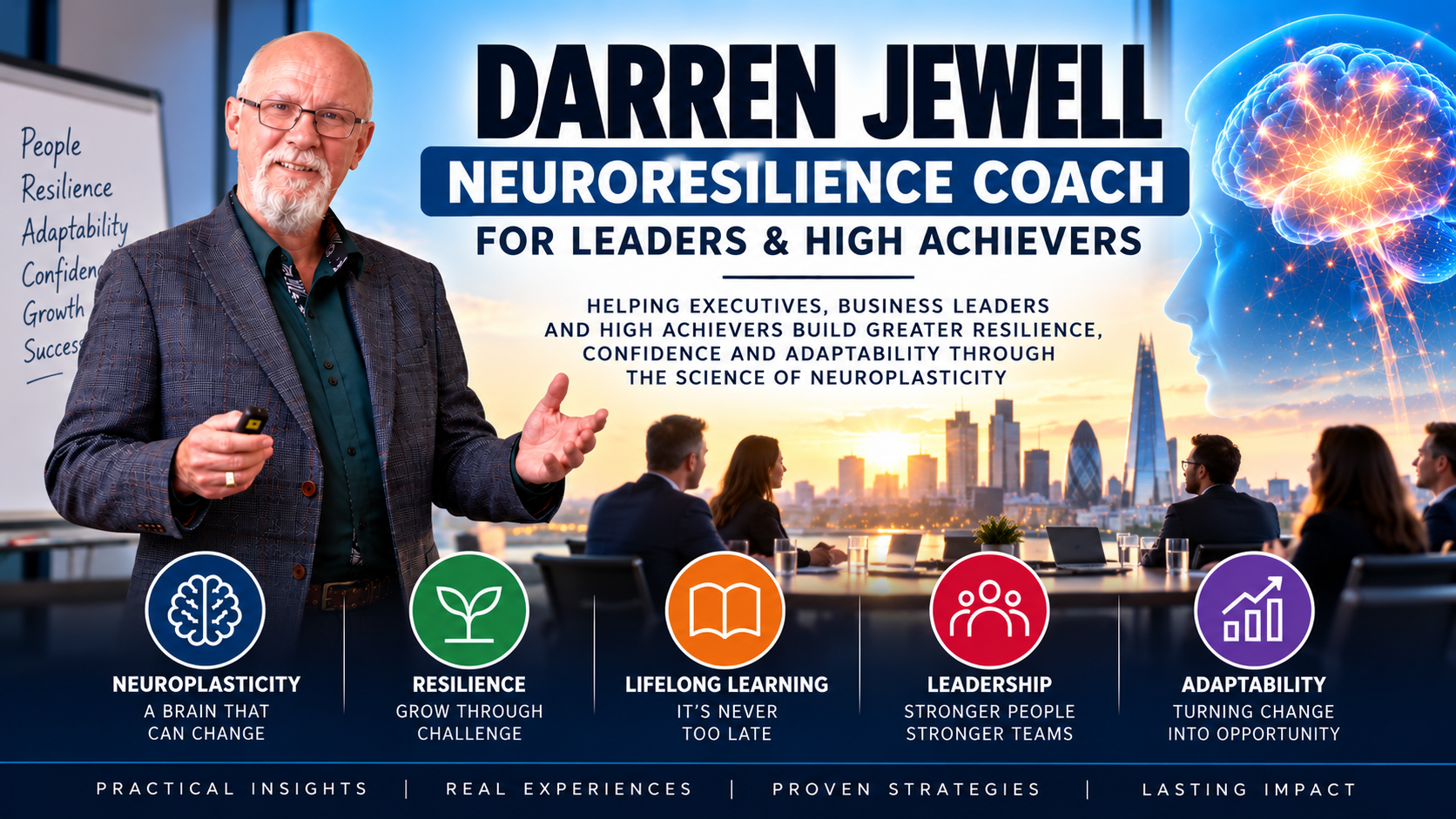
For Darren Jewell, neuroresilience coach, inspirational speaker and founder of Regain the Brain, resilience is not simply about pushing harder when life becomes difficult.
It is about understanding how we respond to challenges, recognising the brain’s capacity for adaptation and developing the confidence to approach situations differently.
Drawing on his lived experience of brain injury and his passion for neuroplasticity, Darren encourages leaders and high achievers to reconsider what resilience really means.
Because sometimes the greatest demonstration of strength is not continuing in the same direction, but recognising when a different approach is needed.
What Is a Neuroresilience Coach?
A neuroresilience coach helps people explore resilience, adaptability and personal development through an understanding of how the brain responds to experience and learning.
The approach draws on concepts associated with neuroscience, neuroplasticity, psychology and behavioural change.
Neuroplasticity refers to the brain’s ability to reorganise and modify its connections in response to learning, experience and certain forms of injury.
This ability contributes to how we develop skills, form habits and adapt to unfamiliar circumstances.
Neuroresilience coaching uses these ideas as a foundation for conversations about confidence, learning, adaptability and responses to setbacks.
It is important to recognise that neuroresilience coaching is an emerging, broadly used description rather than a single standardised clinical discipline.
It does not replace psychological therapy, medical treatment or neurological rehabilitation.
Instead, its value lies in helping individuals reflect on their approaches to challenges and explore practical opportunities for personal development.
Darren Jewell: A Neuroresilience Coach Shaped by Lived Experience
There is a significant difference between understanding adversity intellectually and experiencing circumstances that change your life.
Darren’s experience of brain injury has influenced how he thinks about resilience, confidence and the importance of adaptability.
A brain injury can affect familiar abilities and routines.
Tasks that previously required little conscious effort may become more demanding.
Confidence can be challenged.
And progress may involve unexpected difficulties.
These experiences can encourage a person to reconsider their assumptions about ability, identity and personal development.
For Darren, they have also contributed to a growing interest in how the brain learns and adapts.
His work through Regain the Brain reflects a belief that resilience should not be measured solely by an individual’s ability to endure difficult circumstances.
Sometimes resilience means accepting support.
Sometimes it involves developing a different strategy.
And sometimes it requires recognising that the path ahead may look different from the one originally imagined.
Resilience is not about becoming invulnerable. It is about learning how to respond constructively when life does not go according to plan.
Why High Achievers Can Struggle with Change
High achievers are often accustomed to solving problems.
They set goals, develop strategies and work towards measurable outcomes.
These qualities can contribute to professional success.
However, they can also create challenges when circumstances are beyond an individual’s immediate control.
A leader who has always relied on determination may find it difficult to accept that a problem requires patience.
An executive accustomed to making decisions may struggle when the future is uncertain.
An entrepreneur who associates personal identity with business success may experience a loss of confidence following a setback.
These reactions are understandable.
The strategies that help people succeed in one environment are not necessarily effective in every situation.
Developing resilience may therefore involve expanding our range of responses.
Rather than automatically working harder, a person may need to reconsider priorities, seek advice or develop a new skill.
Neuroresilience coaching encourages this kind of reflection.
The Connection Between Neuroplasticity and Personal Development
One of the most encouraging discoveries in neuroscience is that the adult brain remains capable of change.
For many years, people commonly believed that the brain became relatively fixed after childhood.
Research has demonstrated that learning and experience continue to influence neural connections throughout adulthood.
This process is known as neuroplasticity.
When we practise a new skill, the brain engages networks involved in processing information, memory, attention and behaviour.
Repeated practice, particularly when combined with useful feedback, can contribute to changes in these networks.
This is relevant to learning new technologies, developing communication skills and acquiring unfamiliar professional abilities.
However, neuroplasticity does not mean that every limitation can be overcome or that all habits can be changed simply through positive thinking.
Meaningful behavioural change can depend on many factors, including environment, health, motivation, resources and appropriate support.
The practical lesson is that personal development remains possible throughout life.
Five Areas Where Neuroresilience Coaching Can Support Personal Growth
1. Rebuilding confidence after setbacks
Professional setbacks can challenge an individual’s belief in their abilities.
A failed business venture, redundancy or unexpected career change may cause someone to question their previous achievements.
Rebuilding confidence can involve recognising existing strengths, setting manageable goals and developing new experiences of success.
Small achievements can provide valuable evidence of capability.
2. Developing greater adaptability
Adaptability involves being willing to reconsider established approaches when circumstances change.
This can be particularly important for leaders working in rapidly evolving industries.
Rather than treating unfamiliar situations as threats, individuals can learn to approach them with curiosity and a willingness to seek new information.
3. Challenging limiting assumptions
People sometimes develop beliefs about what they can or cannot achieve.
These beliefs may be influenced by previous experiences, criticism or setbacks.
For example, someone may assume they are too old to learn a new technology or too inexperienced to develop a leadership skill.
Reflecting on these assumptions can create opportunities to explore different possibilities.
4. Encouraging lifelong learning
Learning unfamiliar skills can challenge established routines and provide opportunities for personal development.
This may involve professional training, creative activities, languages or technology.
The objective is not constant productivity.
It is maintaining curiosity and recognising that learning can remain rewarding throughout life.
5. Developing sustainable approaches to resilience
Resilience should not be confused with working continuously or ignoring signs of exhaustion.
Sustainable resilience requires appropriate boundaries, recovery, supportive relationships and realistic expectations.
For leaders and high achievers, recognising the importance of rest and support can be an essential part of long-term effectiveness.
Why Rebuilding Confidence Matters for Leaders
Confidence influences how leaders communicate, make decisions and respond to uncertainty.
When confidence is shaken, even experienced professionals may begin questioning their judgement.
They may hesitate to make decisions.
Avoid unfamiliar opportunities.
Or become overly concerned about making mistakes.
Darren’s perspective on confidence is shaped by his understanding of personal adversity.
He recognises that confidence does not always return immediately after a difficult experience.
It may develop gradually through practice, reflection and manageable achievements.
For leaders, this can mean focusing on what can be learned rather than expecting immediate certainty.
A confident leader does not need to know everything.
They need to remain willing to learn, seek advice and make thoughtful decisions.
Neuroresilience and Leadership in the Age of Artificial Intelligence
Artificial intelligence is changing the way organisations operate.
New tools are transforming established processes, creating opportunities and raising questions about the future of work.
For executives and business leaders, this can create considerable pressure.
They may need to make decisions about technologies they are still learning to understand.
They may also need to support employees who are concerned about changing responsibilities.
In this environment, adaptability and continuous learning become increasingly important.
Neuroplasticity provides a useful reminder that adults retain the capacity to acquire new skills.
However, successful learning requires appropriate training, practice and support.
Darren encourages leaders to recognise that being unfamiliar with a technology does not automatically mean being incapable of learning it.
You do not need to know everything about the future to begin preparing for it. You need to remain willing to learn.
The Importance of Being a Beginner Again
One of the most powerful ways to challenge assumptions about learning is to try something completely unfamiliar.
For Darren, learning to play the piano at 54 became a personal example of this philosophy.
Beginning a musical instrument later in life requires patience.
Reading music, coordinating movements and developing timing can initially feel difficult.
Progress depends on practice and a willingness to make mistakes.
Yet the experience can also be rewarding.
For someone accustomed to professional achievement, becoming a beginner can offer a different perspective.
It reminds us that competence develops over time.
It encourages humility.
And it provides opportunities to experience the satisfaction of learning.
Darren believes these lessons can be relevant to leadership.
Executives who remain willing to learn may be better positioned to respond to unfamiliar challenges than those who feel they must always appear knowledgeable.
The Difference Between Resilience and Simply Pushing Through
In many professional environments, resilience is associated with perseverance.
People are encouraged to keep going, work harder and overcome obstacles.
Determination can be valuable.
However, continuing without reconsidering an ineffective approach can sometimes create additional difficulties.
A leader facing an unsustainable workload may need to delegate responsibilities.
An entrepreneur experiencing repeated setbacks may need to revise a business strategy.
A professional struggling with confidence may benefit from support rather than increased pressure.
Resilience involves recognising when persistence is useful and when adaptation is necessary.
This distinction is central to Darren’s philosophy.
Sometimes moving forward requires the courage to change direction.
How Neuroresilience Can Influence Workplace Culture
Although neuroresilience coaching often focuses on individual development, its principles can also inform conversations about organisational culture.
Leaders influence how employees respond to challenges.
When managers encourage curiosity, provide constructive feedback and acknowledge uncertainty, they can help create environments that support learning.
By contrast, workplaces that punish reasonable mistakes or discourage questions may limit opportunities for development.
A learning-oriented culture recognises that employees bring different experiences and abilities.
It provides appropriate training.
Encourages collaboration.
And values constructive problem-solving.
Neuroresilience offers a perspective on why adaptability matters, while recognising that organisational systems and leadership practices are equally important.
Why Personal Experience Matters in Coaching and Inspirational Speaking
People often connect more deeply with ideas when they are supported by meaningful personal experiences.
Darren’s lived experience of brain injury gives him a perspective on uncertainty, confidence and adaptation.
His message is not that professional setbacks are equivalent to neurological injury.
They are fundamentally different experiences.
However, some broader themes can resonate across different circumstances.
The importance of patience.
The value of support.
The need to adapt.
And the recognition that personal progress does not always follow a predictable path.
By connecting these themes with an interest in neuroscience, Darren aims to encourage reflection and constructive conversations.
Regain the Brain: A Philosophy of Continued Growth
Through Regain the Brain, Darren promotes neuroplasticity awareness, resilience and lifelong learning.
His philosophy encourages people to remain curious about their abilities and explore new experiences.
Learning does not need to involve formal qualifications.
It can begin with something simple.
Cooking a meal you have never prepared before.
Learning a few words in another language.
Trying a musical instrument.
Exploring unfamiliar technology.
Or developing a creative interest.
These experiences can provide opportunities to practise attention, memory, coordination and problem-solving.
They can also bring enjoyment and a sense of achievement.
For Darren, the most important message is that learning remains a meaningful part of life at every age.
What Makes Darren Jewell’s Approach Different?
Darren brings together three perspectives that shape his work.
Lived experience of adversity: His personal experience of brain injury informs his understanding of resilience, confidence and adaptation.
An interest in neuroscience: His focus on neuroplasticity encourages people to appreciate the brain’s capacity for learning and change.
A commitment to lifelong learning: His own experiences, including beginning piano at 54, demonstrate a willingness to remain curious and embrace unfamiliar challenges.
These perspectives create a foundation for conversations about personal development that are both encouraging and realistic.
His aim is not to promise instant transformation.
It is to encourage people to recognise that progress can begin with small, meaningful steps.
Work with Darren Jewell — Neuroresilience Coach and Inspirational Speaker
Are you a CEO, business leader, entrepreneur or high-achieving professional navigating change, rebuilding confidence or exploring new opportunities for personal development?
Darren Jewell brings a personal perspective to conversations about resilience, neuroplasticity and lifelong learning.
As the founder of Regain the Brain, he encourages individuals and organisations to reconsider assumptions about ability, adaptability and personal growth.
His work is particularly relevant to leaders who want to develop a greater understanding of resilience and create environments where learning is valued.
Whether through coaching conversations, inspirational speaking or educational content, Darren’s central message remains consistent.
Your previous achievements demonstrate what you have already accomplished. They do not define the limits of what you may still be capable of learning.
Discover more about Darren Jewell and Regain the Brain at www.regainthebrain.com.
Darren Jewell is a neuroresilience coach, inspirational speaker and founder of Regain the Brain. Drawing on his lived experience of brain injury, he advocates for greater awareness of neuroplasticity, resilience and lifelong learning.
Neuroresilience coaching is not a substitute for medical care, psychological therapy or neurological rehabilitation.