What happens when the life you knew changes, and the future you imagined suddenly looks very different?
For many people, adversity arrives without warning.
One moment, life feels familiar. The next, everything can change.
A brain injury can affect far more than someone’s physical or cognitive abilities. It can influence their confidence, independence, relationships, ambitions and sense of identity.
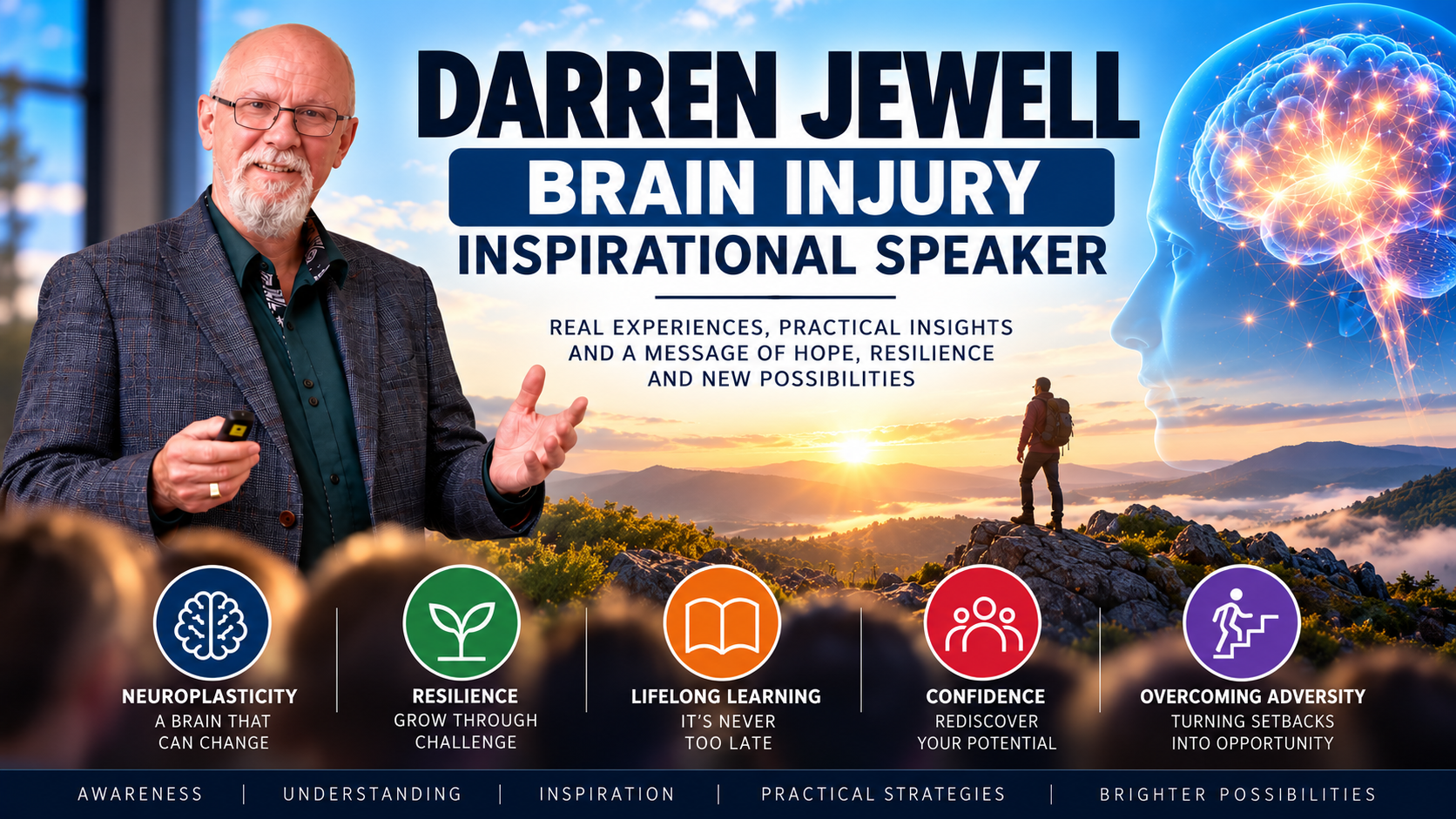
For Darren Jewell, brain injury inspirational speaker, neuroresilience coach and founder of Regain the Brain, the experience of living with a brain injury has shaped his understanding of resilience, learning and the extraordinary complexity of the human brain.
His message is not about pretending that adversity is easy.
It is about recognising that even when circumstances change dramatically, there may still be opportunities to learn, adapt and find meaning in new experiences.
A brain injury can change your life, but it does not erase your value, your identity or every possibility for your future.
When Life Changes After a Brain Injury
Most of us develop routines that give our lives a sense of familiarity.
We know how to complete everyday tasks.
We understand our responsibilities.
We make plans for the future based on what we believe we can achieve.
But a brain injury can disrupt that familiarity.
Activities that once seemed straightforward may suddenly require additional concentration, patience or support.
Some individuals experience challenges with memory, attention or processing information.
Others may encounter difficulties with movement, communication, fatigue or emotional regulation.
And some effects of brain injury are invisible to the people around us.
This can make the experience particularly challenging.
Someone may appear physically well while managing significant difficulties that others cannot easily recognise.
Darren’s lived experience has given him a personal appreciation of how important understanding, patience and appropriate support can be.
It has also influenced his belief that resilience should never be measured solely by how quickly someone returns to their previous abilities.
Sometimes progress means discovering a different way forward.
Darren Jewell: Turning Personal Experience into a Message of Hope
There is something powerful about hearing from someone who understands adversity through lived experience.
Statistics can explain the prevalence of brain injuries.
Medical research can help us understand their effects.
But personal stories can reveal the human experience behind the science.
Darren’s journey has encouraged him to explore how people respond to life-changing challenges and how an understanding of the brain can influence our approach to learning and adaptation.
As an inspirational speaker, he brings together his experiences with an interest in neuroplasticity, resilience and lifelong learning.
His message is grounded in an important distinction.
Being resilient does not mean being unaffected by adversity.
It does not mean remaining positive every moment.
And it certainly does not mean refusing help.
Resilience can mean acknowledging that life is difficult while continuing to explore what might still be possible.
For Darren, this philosophy extends beyond brain injury.
It is relevant to anyone experiencing change, uncertainty, setbacks or a loss of confidence.
The Hidden Challenges of Brain Injury
One of the most important subjects in brain injury awareness is the difference between visible and invisible challenges.
A person may look well but experience significant cognitive fatigue.
They may struggle to concentrate in noisy environments.
They may find it difficult to process several pieces of information simultaneously.
Or they may need additional time to complete activities that previously felt effortless.
These experiences can be misunderstood.
Friends, colleagues and even family members may assume that someone has recovered because there are no obvious physical signs of injury.
However, brain injury can affect individuals in highly individual ways.
The consequences may fluctuate from day to day.
Darren believes greater public understanding of brain injury is essential.
Awareness can encourage more compassionate conversations, reduce misconceptions and help organisations consider how they support people living with neurological challenges.
An inspirational speaker with lived experience can help audiences appreciate the importance of looking beyond appearances.
Understanding Neuroplasticity After Brain Injury
One of the most fascinating areas of neuroscience is neuroplasticity.
Neuroplasticity refers to the brain’s ability to change and reorganise its connections in response to experience, learning and certain forms of injury.
Following a brain injury, the brain may undergo changes as part of recovery and adaptation.
Rehabilitation can sometimes help people strengthen existing abilities, develop compensatory strategies or learn different ways of performing tasks.
However, recovery varies considerably.
The type, location and severity of an injury can influence outcomes, alongside many other factors.
Neuroplasticity is not a guarantee of complete recovery.
Nor does it mean that every neurological difficulty can be overcome through determination or practice alone.
Nevertheless, understanding the brain’s capacity for adaptation can provide an important perspective on learning and rehabilitation.
For Darren, neuroplasticity has become a central theme in his work.
He wants people to understand that the brain is not simply a fixed collection of abilities.
It is a complex, dynamic organ that continues to respond to experience throughout life.
Why Rebuilding Confidence Matters
One of the most difficult consequences of a life-changing experience can be losing confidence in abilities that once felt familiar.
After a brain injury, someone may begin questioning whether they can return to work, participate in activities they previously enjoyed or learn unfamiliar skills.
These concerns are understandable.
When life changes unexpectedly, confidence can be affected alongside physical or cognitive abilities.
Rebuilding confidence is not necessarily about returning immediately to previous levels of performance.
It may involve setting manageable goals, recognising progress and receiving appropriate encouragement.
Small achievements can become particularly meaningful.
Completing an unfamiliar activity.
Developing a new routine.
Learning a skill.
Or simply attempting something that previously felt intimidating.
Darren’s approach to neuroresilience places importance on recognising these moments.
Confidence does not always return in one dramatic moment. Sometimes it develops through many small experiences that remind us what we can still do.
Why Lifelong Learning Is Central to Darren’s Message
One of Darren’s strongest beliefs is that learning should never stop.
He encourages people to remain curious, regardless of age or circumstances.
This philosophy is closely connected to his interest in neuroplasticity.
Learning unfamiliar skills involves the brain processing information, coordinating actions and developing new patterns through practice.
Whether someone is studying a language, learning to cook or exploring a creative hobby, the experience can provide opportunities for personal development.
Darren began learning the piano at 54.
For him, this was not simply about playing music.
It represented a willingness to challenge assumptions about age and learning.
Many adults avoid unfamiliar activities because they worry about making mistakes.
They may believe they have missed the opportunity to develop certain skills.
Or they may feel uncomfortable becoming beginners again.
Darren encourages a different perspective.
Being a beginner is not a weakness.
It is often the starting point of discovery.
You do not have to be good at something before you begin. You begin because you want to learn.
Five Lessons About Resilience That Brain Injury Can Teach Us
1. Progress is not always linear
Personal development and recovery rarely follow a perfectly predictable path.
There may be periods of improvement, unexpected setbacks and times when progress feels difficult to recognise.
Understanding this can help us approach challenges with greater patience.
2. Small achievements deserve recognition
When facing significant challenges, it can be easy to focus exclusively on distant goals.
However, recognising smaller achievements can help people appreciate the progress they are making.
3. Asking for help is a strength
Resilience does not require complete independence.
Support from healthcare professionals, family members, friends and colleagues can play an important role in navigating difficult circumstances.
4. Our abilities do not define our entire identity
Changes in physical or cognitive abilities can affect how someone sees themselves.
Yet personal identity also includes relationships, values, interests, experiences and contributions to others.
A person’s worth is never determined solely by their productivity or performance.
5. Learning can continue in different ways
A life-changing experience may require someone to approach familiar activities differently.
Developing new strategies, exploring interests and adapting routines can all involve meaningful learning.
These lessons extend beyond brain injury and can resonate with people facing many different forms of adversity.
Why Businesses Should Understand Brain Injury and Neurodiversity
Brain injury awareness is relevant to employers and business leaders.
Some employees may return to work following neurological injuries.
Others may be living with long-term effects that are not immediately visible.
Understanding the potential consequences of brain injury can help organisations create more supportive environments.
This may involve considering adjustments to workloads, communication methods, working hours or the physical environment.
It can also mean encouraging open conversations and recognising that individual needs vary.
Acquired brain injury is not itself synonymous with neurodiversity, although discussions about cognitive differences and inclusive workplaces can overlap.
The most important principle is that organisations should avoid making assumptions about someone’s abilities based on appearance.
Darren’s personal perspective can help encourage conversations about empathy, inclusion and the importance of recognising individual circumstances.
The Difference Between Motivation and Meaningful Inspiration
Motivation is often associated with energy, enthusiasm and determination.
These qualities can be valuable.
However, Darren believes meaningful inspiration should go deeper.
It should encourage people to reflect on their own circumstances and consider what they might approach differently.
An inspirational presentation does not need to suggest that everyone can achieve anything they desire.
That would ignore the realities of disability, health conditions and individual circumstances.
Instead, it can encourage audiences to recognise opportunities within their own situations.
For one person, that might mean pursuing a new professional ambition.
For another, it might mean learning a new hobby.
For someone navigating a significant health challenge, it might mean finding a manageable way to participate in an activity they enjoy.
The goal is not to compare achievements.
It is to recognise the value of each person’s journey.
Inspirational Speaking for Brain Injury Charities and Healthcare Events
Charities, rehabilitation organisations, healthcare conferences and community groups often seek speakers who can help audiences connect with the lived experience of neurological conditions.
Personal stories can provide valuable perspectives for professionals, families, carers and people affected by brain injury.
Darren’s speaking themes include:
- Living with the challenges of brain injury.
- Understanding the importance of resilience and adaptation.
- Exploring neuroplasticity and lifelong learning.
- Rebuilding confidence following adversity.
- Recognising invisible challenges.
- Encouraging greater empathy and understanding.
- Finding opportunities for personal development after life-changing experiences.
These subjects can help support conversations about brain injury awareness and the importance of treating every individual’s experience with respect.
From Brain Injury to Neuroresilience Coaching
Darren’s experiences have also shaped his interest in neuroresilience coaching.
Neuroresilience explores resilience through an understanding of brain adaptability, learning and responses to challenging experiences.
For business leaders and professionals, this can provide a useful perspective on navigating change.
Workplace challenges are not equivalent to the experience of a neurological injury.
However, some broader lessons about patience, adaptability, support and learning can be relevant in different settings.
Darren encourages individuals to consider how they approach setbacks and how developing new skills may contribute to confidence.
His work aims to make the relationship between neuroscience and personal development more accessible.
Regain the Brain: A Mission to Inspire Lifelong Learning
Regain the Brain reflects Darren’s belief that curiosity and learning can remain valuable throughout life.
His mission is to encourage people to explore new experiences and develop a greater appreciation of the brain’s ability to adapt.
Learning does not need to involve a formal qualification.
It might mean preparing a meal you have never cooked before.
Learning five words in a new language.
Trying a musical instrument.
Exploring a new creative activity.
Or becoming familiar with unfamiliar technology.
These experiences can provide opportunities to practise attention, memory, coordination and problem-solving.
They can also bring enjoyment, confidence and a sense of discovery.
Darren wants people to recognise that learning is not something we complete.
It is something we can continue exploring throughout our lives.
Your Story Is More Than What Has Happened to You
One of the most difficult aspects of adversity is the feeling that a particular event has come to define our identity.
A brain injury can become a major part of someone’s life story.
But it is not necessarily the whole story.
People remain individuals with interests, relationships, values, ambitions and experiences.
Some aspects of life may change permanently.
Others may develop in unexpected directions.
And some possibilities may emerge that were never previously considered.
Darren’s message encourages audiences to recognise this complexity.
We cannot always choose the challenges we face, but we can continue exploring ways to live meaningful lives within our circumstances.
That is not a promise that every difficulty will disappear.
It is an invitation to remain curious about the future.
Book Darren Jewell as a Brain Injury Inspirational Speaker
Are you organising a brain injury awareness event, healthcare conference, charity gathering, corporate wellbeing programme or inspirational speaking event?
Darren Jewell brings a personal perspective shaped by his lived experience of brain injury and his interest in neuroplasticity, resilience and lifelong learning.
As the founder of Regain the Brain and a neuroresilience coach, he aims to encourage audiences to think differently about adversity, confidence and personal development.
His message is particularly relevant to organisations seeking a speaker who can connect the human experience of brain injury with broader conversations about learning and adaptability.
Whether speaking to business leaders, healthcare professionals, community organisations or individuals navigating difficult circumstances, Darren’s central belief remains consistent.
Life may not always follow the path we expected, but there can still be opportunities to learn, connect, contribute and discover new possibilities.
Find out more about Darren Jewell and Regain the Brain at www.regainthebrain.com.
Darren Jewell is an inspirational speaker, neuroresilience coach and founder of Regain the Brain. Drawing on his lived experience of brain injury, he promotes greater awareness of neuroplasticity, resilience and the value of lifelong learning.
This article is intended for educational and inspirational purposes and does not replace professional medical or rehabilitation advice.