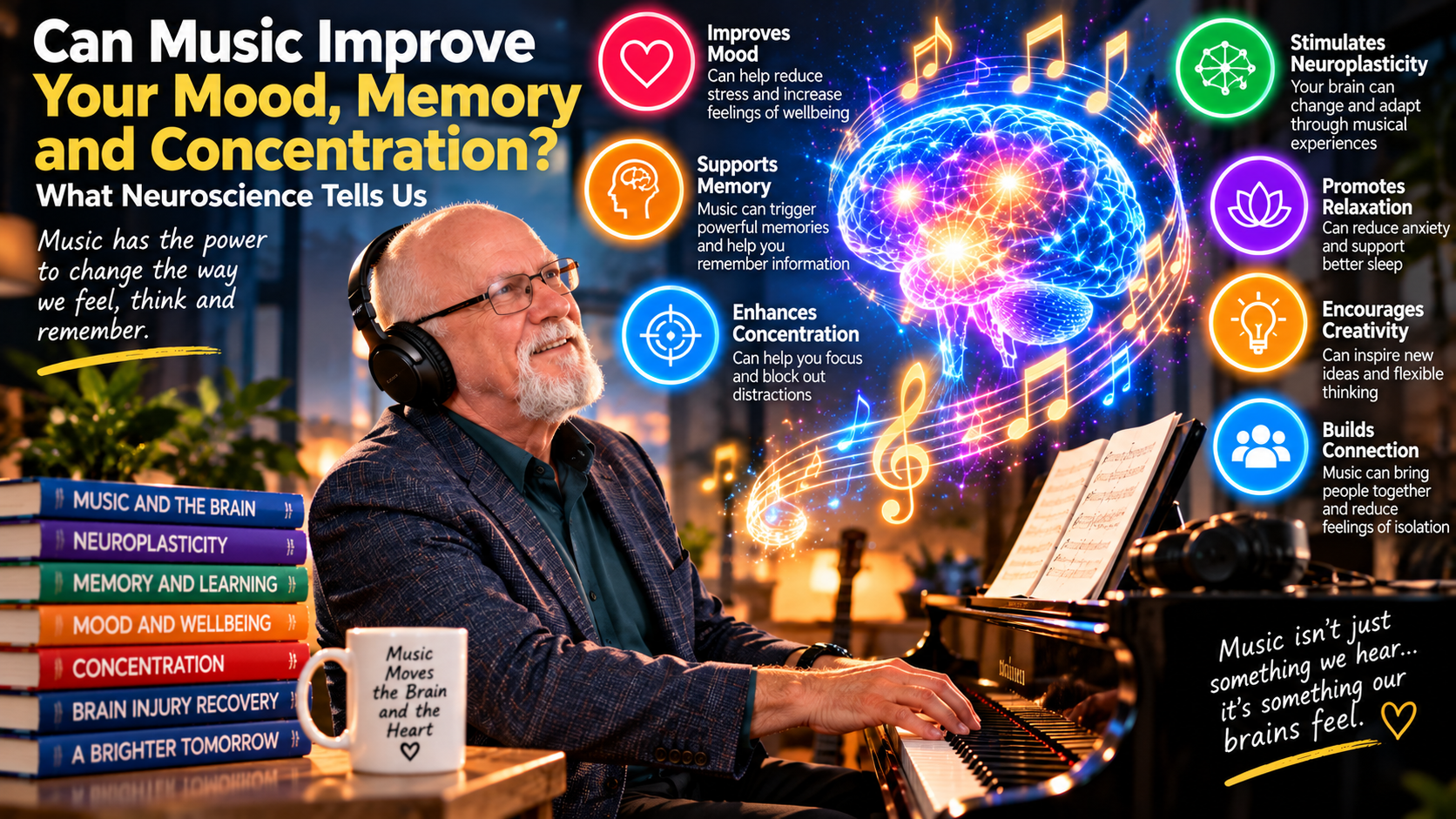
Have you ever heard a song that instantly transported you back to a particular moment in your life?
Perhaps it reminded you of your childhood.
A holiday.
Someone you love.
Or an experience you haven’t thought about for years.
You might remember where you were, who you were with and how you felt.
All because of a few familiar notes.
Music has an extraordinary ability to become connected with our memories and emotions.
A particular melody can make us smile.
Another might bring tears to our eyes.
Some songs encourage us to move, while others help us relax.
But music is more than entertainment.
It is also a fascinating subject for neuroscience.
Researchers have spent decades investigating how the brain processes music and how musical experiences relate to emotion, memory, attention and learning.
This raises some interesting questions.
Can listening to music improve your mood?
Does music help you remember information?
Can it make you more productive?
And what does neuroplasticity have to do with the way we experience music?
As someone who lives with the effects of brain injury and who started learning piano at 54, I find these questions particularly interesting.
Music combines enjoyment with learning, emotion and personal experience.
But we need to distinguish between what scientific research suggests and what popular headlines sometimes promise.
Music is not a miracle treatment for every neurological or psychological difficulty.
Nor does listening to a particular song automatically improve intelligence or memory.
Nevertheless, it can play a meaningful role in everyday life.
Let’s explore why.
1. What Happens in Your Brain When You Listen to Music?
When you listen to music, your brain processes much more than sound.
Different neural systems contribute to recognising pitch, rhythm, melody and musical patterns.
The auditory cortex plays an important role in processing sound.
Other brain networks contribute to attention, memory, movement and emotional responses.
For example, when you recognise a familiar melody, memory-related processes are involved.
When a song makes you feel happy or nostalgic, networks associated with emotion contribute to that experience.
And when you instinctively tap your foot to a rhythm, systems involved in timing and movement become relevant.
These processes interact.
The brain does not contain one single area responsible for every aspect of music.
Instead, musical experiences involve communication between multiple regions and networks.
This helps explain why music can feel so rich and emotionally meaningful.
Listening to music is not simply a passive experience. It involves complex processing across the brain.
2. Can Music Really Improve Your Mood?
For many people, music is closely connected with emotional wellbeing.
We often choose songs based on how we feel.
When we are happy, we might listen to energetic music.
When we feel stressed, we may prefer something gentle.
And when we are sad, we sometimes choose music that reflects our emotions.
Research suggests that listening to music can influence mood and emotional experiences.
However, the effects vary considerably.
The type of music matters.
So does personal preference.
Our memories, cultural background and circumstances can also influence how we respond.
A song that makes one person feel relaxed might make someone else feel uncomfortable.
This is why there is no universally perfect playlist for emotional wellbeing.
The most useful music is often music that feels meaningful or appropriate to the individual.
3. Why Music Can Make Us Feel Happy
Pleasurable musical experiences have been associated with activity in brain systems involved in reward and motivation.
Research has examined how enjoyable music relates to dopamine signalling within these systems.
Dopamine is a neurotransmitter involved in several functions, including motivation, learning and reward processing.
It is sometimes described as a pleasure chemical.
But that description is overly simplistic.
Dopamine does not act as a universal happiness switch.
Its role depends on the brain circuits and circumstances involved.
Nevertheless, studies of pleasurable music have provided fascinating insights into how the brain responds to experiences we enjoy.
This may help explain why listening to a favourite song can feel rewarding.
But emotional responses to music are influenced by much more than one neurotransmitter.
They involve expectations, memories, attention and personal meaning.
4. Why Certain Songs Bring Back Powerful Memories
Music can become strongly associated with autobiographical memories.
These are memories connected with our own lives.
For example, you might hear a song that was playing during an important celebration.
Years later, hearing the same melody may remind you of that event.
You might remember the people who were present.
The atmosphere.
And the emotions you experienced.
This happens partly because memory is influenced by associations.
Experiences involving music, emotion and personal significance can become connected.
When we encounter a familiar cue, it may help retrieve related memories.
Researchers have investigated music-evoked autobiographical memories and their relationship with brain networks involved in memory and emotion.
However, music does not guarantee accurate recollection.
Memories can change over time.
And emotional vividness is not the same as perfect accuracy.
Even so, the relationship between music and personal memory is one of the most fascinating aspects of musical experience.
5. Can Listening to Music Improve Your Memory?
This question deserves a careful answer.
Music can sometimes support memory in particular situations.
For example, rhythm and melody may help people remember structured information.
Think about how many of us learned the alphabet through a song.
The melody provides a familiar sequence.
It can make the information easier to rehearse.
Music may also provide useful cues for recalling particular experiences.
However, these effects do not mean that listening to music improves every type of memory.
A person who remembers song lyrics easily may still struggle to remember a shopping list.
And listening to background music while studying can sometimes interfere with learning.
The relationship between music and memory depends on the task, the person and the musical environment.
Music can support certain forms of remembering, but it is not a guaranteed method of improving general memory.
6. What Is the Mozart Effect?
You may have heard the claim that listening to Mozart makes people more intelligent.
This idea became popular following research in the 1990s.
An early study reported a temporary improvement in a particular spatial reasoning task after participants listened to Mozart.
The findings attracted considerable public attention.
Over time, the idea became exaggerated.
Some people began claiming that classical music could increase intelligence.
Others suggested that playing Mozart to babies would make them smarter.
However, subsequent research has produced mixed findings.
The original effect was limited and did not demonstrate a lasting increase in general intelligence.
Researchers have also considered whether mood and arousal might help explain some observed differences.
Today, the idea that simply listening to Mozart permanently boosts intelligence is not supported by strong evidence.
This is a useful reminder that neuroscience headlines can sometimes move far beyond the original research.
Music is valuable without needing to make us instantly smarter.
7. Can Music Improve Concentration?
Many people enjoy listening to music while working.
Some prefer instrumental music.
Others enjoy familiar songs.
And some find that music makes concentration more difficult.
Research suggests that the effects of background music depend on several factors.
These include the complexity of the task.
The type of music.
Volume.
Personal preference.
And individual differences in attention.
For example, music with lyrics may interfere with tasks involving reading or verbal processing.
This is because the words in a song can compete with the language-related demands of the activity.
Instrumental music may be less distracting for some people.
However, even instrumental music can interfere with concentration if it is loud, unpredictable or highly engaging.
For demanding tasks, silence may be the better option.
The key is to recognise that music does not improve concentration universally.
It is worth experimenting to discover what works for you.
8. Music and Productivity: Does Background Music Help You Work?
Music can influence the atmosphere in which we work.
For repetitive or relatively simple tasks, some people find background music enjoyable.
It may reduce boredom.
Improve their subjective mood.
Or make the activity feel more pleasant.
However, increased enjoyment does not necessarily mean improved performance.
A person might feel more productive while listening to music without completing their work more accurately.
For complex activities requiring careful reasoning, reading or decision-making, background music may create additional cognitive demands.
This is particularly relevant in professional environments.
Employers should not assume that one musical environment suits everyone.
Some employees may prefer quiet spaces.
Others may benefit from being able to choose whether they listen to music through headphones.
Providing appropriate flexibility can be more useful than adopting a universal rule.
9. Why Music Can Help Some People Relax
Music is often used as part of relaxation routines.
A gentle melody may encourage someone to slow down.
It can provide a pleasant focus for attention.
And it may help create a calming environment.
Research has investigated music listening in relation to stress, anxiety and physiological responses.
Some studies have reported beneficial effects in particular settings.
However, results vary.
The relationship between music and relaxation is influenced by personal preference, context and individual responses.
For example, a person who associates a particular song with a distressing experience may not find it relaxing.
Another person may feel uncomfortable with certain frequencies or loud sounds.
Music can be a useful relaxation tool for some people.
But it should not be treated as a replacement for appropriate medical or psychological care.
10. Can Music Reduce Stress?
Stress is a complex response involving psychological and physiological processes.
It can influence attention, sleep, mood and physical health.
Researchers have investigated whether music-based activities can help people manage stress.
Some studies suggest that listening to preferred music may reduce perceived stress or anxiety in certain circumstances.
Music interventions have also been studied in healthcare environments.
However, the effects are not identical across individuals or situations.
Music cannot remove the underlying causes of chronic stress.
For example, an employee facing an excessive workload may enjoy listening to calming music.
But the workload itself still needs to be addressed.
Music can form part of a broader approach to wellbeing.
It should not become a substitute for practical changes or professional support when those are needed.
11. The Difference Between Listening to Music and Playing an Instrument
Listening to music and playing an instrument are related but different experiences.
Listening involves processing sound, recognising patterns and responding emotionally.
Playing an instrument introduces additional demands.
You may need to coordinate movements.
Read notation.
Remember sequences.
Monitor timing.
And adjust your performance.
These activities involve motor learning alongside auditory processing.
This is one reason musical training has attracted interest in neuroplasticity research.
But we should not assume that playing an instrument is automatically better for every aspect of brain health.
Listening to music can be meaningful in its own right.
It may provide enjoyment, relaxation or personal connection.
And some people may be unable or unwilling to play an instrument.
The most valuable musical activity is often the one that suits the person’s interests and circumstances.
12. Why I Started Learning Piano at 54
When I started learning piano at 54, I was entering an unfamiliar area of learning.
I wasn’t expecting to become an expert overnight.
I simply wanted to explore something new.
The experience has reinforced my interest in neuroplasticity and lifelong learning.
Playing piano requires me to engage with unfamiliar information.
There are notes to recognise.
Movements to coordinate.
And patterns to remember.
Some things become more familiar with practice.
Others take longer.
But that is part of the experience.
For me, learning piano is not about proving that music can cure neurological conditions or dramatically increase intelligence.
It is about curiosity.
Enjoyment.
And the satisfaction of continuing to learn.
Sometimes, the greatest benefit of a new activity is discovering that it can become a meaningful part of your life.
13. Music, Neuroplasticity and the Learning Brain
Neuroplasticity refers to the brain’s ability to change its connections, structure and functions in response to experience, learning and other influences.
Musical training provides an interesting opportunity to study these processes.
Learning an instrument involves repeated practice and feedback.
Over time, people can become more skilled at recognising sounds and coordinating movements.
Researchers have observed differences in aspects of brain structure and function associated with musical training.
However, the findings require careful interpretation.
Some differences may reflect training.
Others may be influenced by pre-existing characteristics.
And changes observed in musicians do not automatically imply improvements in unrelated cognitive abilities.
Neuroplasticity helps explain how learning occurs.
But it should not be used to promise dramatic benefits from every musical activity.
The more useful message is that the brain remains responsive to experience throughout life.
And music offers one enjoyable way to engage in learning.
14. Can Music Help People Living With Brain Injury?
Music has attracted interest in neurological rehabilitation.
Researchers have investigated music-based approaches for movement, communication, cognition and emotional wellbeing.
For example, rhythmic auditory stimulation has been studied in relation to walking and movement in certain neurological conditions.
Other approaches use musical activities as part of structured therapeutic programmes.
However, these interventions differ considerably.
The evidence varies depending on the condition and the treatment.
Listening to a favourite song at home is not the same as participating in a specialised clinical intervention.
Music should not be presented as a guaranteed treatment for brain injury.
People may also experience sound sensitivity, fatigue or other difficulties that affect how comfortable they feel around music.
For some, gentle musical activities may be enjoyable.
For others, silence may be preferable.
Rehabilitation should always be guided by individual needs and appropriate professional advice.
15. The Emotional Value of Music After a Life-Changing Experience
Major life changes can affect confidence, identity and emotional wellbeing.
People may find themselves adjusting to unfamiliar circumstances.
They may experience frustration.
Uncertainty.
Or a sense of loss.
Music can sometimes provide a connection with meaningful memories and interests.
A familiar song may remind someone of a positive experience.
Playing an instrument may offer a creative outlet.
And sharing music with others can provide opportunities for social connection.
However, music can also bring back difficult memories.
Emotional responses are personal.
The goal should not be to use music to force positive feelings.
Instead, it can be one of several activities people choose because it feels meaningful.
Through my lived experience of brain injury, I have come to appreciate that wellbeing is not simply about removing difficulties.
It can also involve finding activities that provide enjoyment, connection and purpose.
16. Can Music Help People Living With Dementia?
Music has attracted considerable interest in dementia care.
Some people living with dementia may respond positively to familiar songs.
Music-based activities can sometimes encourage engagement, communication or emotional expression.
Researchers have investigated personalised music listening and structured music interventions in dementia care.
Certain studies suggest potential benefits for mood or behavioural symptoms in particular settings.
However, findings are mixed, and the quality of evidence varies.
Music does not cure dementia.
Nor has it been established that listening to music prevents the condition.
Responses can also differ considerably between individuals.
A familiar song may be comforting for one person and distressing for another.
Personal preference and appropriate supervision are important.
For families and carers, music may provide opportunities for meaningful interaction.
But it should be used thoughtfully and with respect for the person’s responses.
17. Why Music Can Bring People Together
Music is not only an individual experience.
It can also be social.
Think about singing with a group.
Attending a concert.
Playing in a band.
Or sharing favourite songs with friends.
These activities can create opportunities for connection.
People may develop shared memories.
Learn to coordinate with one another.
And experience a sense of belonging.
Social relationships are important for wellbeing.
Music can provide one enjoyable setting in which those relationships develop.
However, social music activities are not suitable for everyone.
Some people prefer listening alone.
Others may find crowded or noisy environments overwhelming.
The important thing is having opportunities to engage with music in ways that feel comfortable and meaningful.
18. Can Music Support Better Sleep?
Many people listen to gentle music before bedtime.
They may find it helps them relax.
Or provides a predictable routine that signals the end of the day.
Research has investigated music listening as a possible approach to improving sleep quality.
Some studies suggest that certain music interventions may improve subjective sleep quality in particular populations.
However, results vary.
And music is not a guaranteed treatment for insomnia.
The type of music, volume and individual preference can influence the experience.
For some people, music may be distracting.
Others may find that familiar, gentle tracks help them settle.
If you experience persistent sleep difficulties, it is important to consider established sleep guidance and seek professional advice when appropriate.
Music may be one useful part of a bedtime routine.
But it is not a substitute for addressing underlying sleep problems.
19. How to Choose Music for Different Activities
There is no scientifically established playlist that works perfectly for everyone.
But you can experiment with different approaches.
For relaxation
Try gentle music that you personally find calming.
Keep the volume comfortable.
For exercise
Some people enjoy rhythmic or energetic music during physical activity.
Choose something that supports enjoyment without distracting you from safety.
For concentration
Consider instrumental music or silence, especially during demanding tasks.
For creativity
Experiment with music that feels inspiring without becoming distracting.
For emotional reflection
Choose songs that feel meaningful, while recognising that some music may evoke difficult memories.
For social connection
Share music with friends, family or community groups when appropriate.
The most important factor is not whether a playlist has been marketed as brain-boosting.
It is whether the music suits your needs and circumstances.
20. Seven Everyday Ways to Enjoy Music for Brain Health and Wellbeing
Here are seven simple ways to make music part of your life.
1. Create a personal wellbeing playlist
Choose songs that you enjoy and associate with positive experiences.
2. Explore an unfamiliar genre
Listen to music you wouldn’t normally choose.
You may discover something new.
3. Learn a simple rhythm
Try clapping or tapping along to a familiar song.
4. Sing if you enjoy it
You don’t need to be a professional singer to enjoy singing.
5. Share music with someone
Ask a friend or family member about a song that matters to them.
6. Try learning an instrument
If you’re interested, begin with a manageable beginner activity.
7. Notice how music affects you
Pay attention to whether different songs influence your mood, attention or energy.
These activities are not medical treatments.
They are opportunities to engage with music in enjoyable and meaningful ways.
21. A Seven-Day Music and Brain Challenge
If you’re curious about the relationship between music and your own experiences, try this simple challenge.
Day 1: Music and mood
Listen to a favourite song and notice how you feel.
Day 2: Music and memory
Choose a song from your past and reflect on the memories it brings back.
Day 3: Music and concentration
Compare completing a simple task with background music and without it.
Day 4: Music and relaxation
Spend a few minutes listening to music you find calming.
Day 5: Music and learning
Explore a new musical style or learn a simple rhythm.
Day 6: Music and connection
Share a meaningful song with someone.
Day 7: Music and reflection
Consider which activities you enjoyed and whether you’d like to continue them.
The aim is not to prove that music has transformed your brain in seven days.
It is to become more aware of how different musical experiences affect you.
22. What Business Leaders Can Learn From Music and the Brain
Music also provides useful lessons for organisations.
Not because every workplace should play background music.
And not because listening to classical music will automatically improve productivity.
Instead, music reminds us that people respond differently to their environments.
Some employees concentrate best in silence.
Others enjoy music while completing certain tasks.
And people with sensory sensitivities may find background sound particularly challenging.
Leaders can support performance by recognising these differences.
Where practical, organisations might provide quieter working areas.
Allow suitable use of headphones.
Or consider how background sound affects different employees.
The broader lesson is about creating environments that support attention, wellbeing and individual needs.
There is no single working environment that suits every brain.
23. What Music Teaches Us About Lifelong Learning
One of the most encouraging things about music is that it provides opportunities to learn at almost any age.
You can discover unfamiliar artists.
Explore new rhythms.
Learn a song.
Or begin playing an instrument.
These experiences may challenge assumptions about what learning should look like.
When I started learning piano at 54, I wasn’t trying to compete with people who had played since childhood.
I was simply curious.
And that curiosity led me towards an enjoyable new challenge.
Learning does not have to result in professional expertise.
It can be worthwhile because it brings satisfaction.
Because it introduces something unfamiliar.
Or because it encourages us to remain open to new experiences.
For me, this is one of the most important connections between music and neuroresilience.
We do not have to stop exploring simply because we are getting older.
Final Thoughts: Music Is More Than Something We Hear
Music has an extraordinary ability to become part of our lives.
It accompanies celebrations.
Reminds us of people.
Connects us with memories.
And sometimes helps us express emotions that are difficult to put into words.
Neuroscience has revealed that musical experiences involve networks associated with sound processing, memory, emotion, movement and attention.
Research also suggests that music may support mood, relaxation and certain aspects of wellbeing in particular circumstances.
But we should be careful not to exaggerate the evidence.
Listening to music does not automatically improve intelligence.
It cannot guarantee better memory or concentration.
And it is not a universal treatment for neurological conditions.
Yet none of these limitations makes music less valuable.
Sometimes, the greatest benefit of an activity is simply that it brings meaning and enjoyment into our lives.
For me, learning piano at 54 has reinforced that message.
I don’t need music to make extraordinary promises about the brain.
I appreciate it because it gives me another opportunity to learn.
To be curious.
And to experience the satisfaction of developing an unfamiliar skill.
A song may last only a few minutes.
But the memories, emotions and connections it creates can remain with us for years.
And perhaps that is one of the most remarkable things about music.
It doesn’t simply fill the silence.
It becomes part of our story.
About Darren Jewell
Darren Jewell is a neuroresilience coach, inspirational speaker and founder of Regain the Brain.
Drawing on his lived experience of brain injury and his passion for neuroplasticity, Darren encourages individuals, leaders and organisations to explore resilience, adaptability, brain health and lifelong learning.
His personal journey includes beginning to learn piano at 54, reflecting his belief that curiosity and meaningful learning can remain part of life at any age.
Through inspirational speaking, coaching and educational projects, Darren shares accessible insights into neuroscience, confidence and personal development.
Inspire Your Audience Through the Science of Learning and Resilience
Are you organising a corporate conference, leadership event, wellbeing programme or community gathering?
Darren’s inspirational talks explore neuroplasticity, resilience, confidence and the importance of remaining open to new experiences.
His message combines lived experience with accessible insights into the human brain and the power of lifelong learning.
Discover Darren’s inspirational speaking and neuroresilience coaching services at www.regainthebrain.com.
This article provides general educational information and does not replace medical or psychological advice. Music-based activities should not be considered proven treatments for neurological or mental health conditions unless supported by appropriate clinical evidence and professional guidance.