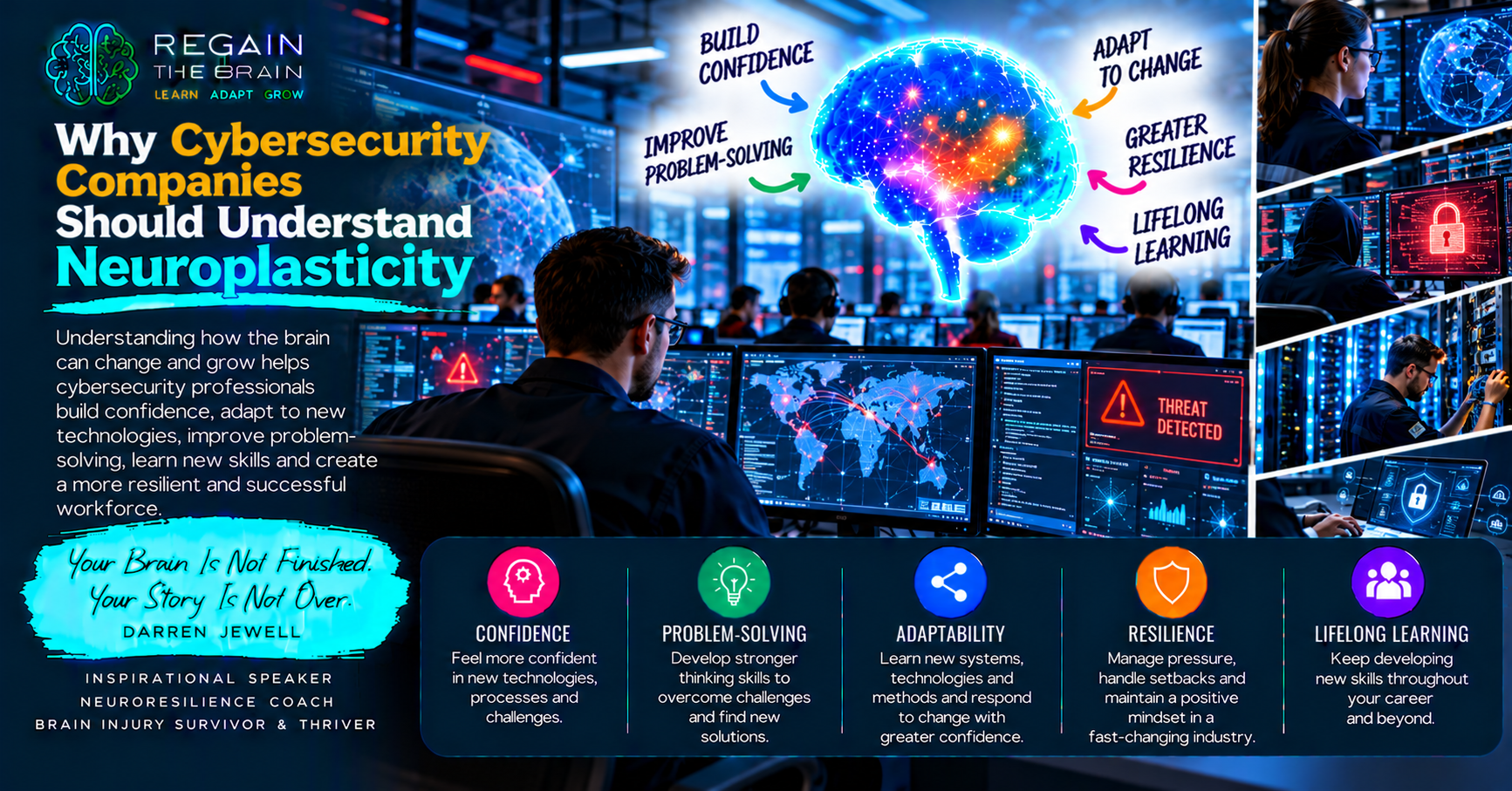
Cybersecurity companies spend their careers protecting networks, identifying vulnerabilities and responding to threats. But there is another extraordinary network that deserves our attention: the human brain. And understanding its ability to learn, adapt and change could offer cybersecurity professionals a valuable new perspective on confidence, resilience and lifelong learning.
Imagine working in an industry where yesterday’s knowledge may not be enough to address tomorrow’s challenges.
New technologies emerge.
Attack methods evolve.
Artificial intelligence introduces both opportunities and risks.
Security professionals must continually update their knowledge, investigate unfamiliar problems and make decisions in complex environments.
Behind every cybersecurity platform, monitoring system and digital defence strategy are people.
Security analysts.
Ethical hackers.
Incident responders.
Cybersecurity engineers.
Threat intelligence specialists.
Software developers.
Risk managers.
Chief Information Security Officers.
And the many other professionals responsible for protecting the digital systems on which businesses and communities depend.
These individuals work in an industry where learning is not simply something that happens at the beginning of a career.
It is an ongoing professional responsibility.
But there is an important question that I believe deserves greater attention.
If cybersecurity professionals understand how digital networks function, shouldn’t they also have opportunities to understand how the human brain learns and adapts?
My name is Darren Jewell. I am a London-based inspirational speaker, NeuroResilience Coach, brain injury survivor and passionate advocate for lifelong learning.
My mission is to make neuroplasticity an everyday word.
And I believe cybersecurity companies have an opportunity to introduce this fascinating subject into their leadership, employee development and workplace wellbeing programmes.
1. What Is Neuroplasticity?
Neuroplasticity describes the brain’s ability to change its connections and patterns of activity in response to learning, experience and other biological processes.
For much of our lives, we develop assumptions about what we can and cannot do.
We may believe that certain subjects are beyond us.
We may assume that learning becomes increasingly difficult as we grow older.
We may convince ourselves that we are simply not suited to particular challenges.
Yet the human brain retains a capacity to learn throughout adulthood.
When we practise unfamiliar skills, acquire knowledge or gain new experiences, learning involves changes in how the brain processes information.
That does not mean learning is always easy.
Nor does it mean that everyone learns at the same speed or can achieve identical outcomes.
But it does mean that our abilities are not necessarily fixed at the level we have reached today.
For cybersecurity professionals, this is an important message.
The industry requires continuous learning, and neuroplasticity provides a scientific foundation for understanding why lifelong development remains possible.
2. The Human Brain and Cybersecurity Networks
One of the things I find fascinating about cybersecurity is the relationship between networks and the human brain.
A computer network connects devices, systems and information.
The brain contains billions of neurons communicating through complex electrical and chemical processes.
Although these systems are fundamentally different, the comparison provides an interesting way to introduce neuroplasticity.
Digital networks are designed, configured, maintained and updated.
Neural connections can change as a result of learning and experience.
Consider a cybersecurity analyst learning to use an unfamiliar security platform.
Initially, the analyst may need to concentrate carefully on every process.
With effective instruction, practice and feedback, the system may become more familiar.
Knowledge develops.
Professional skills improve.
The analyst becomes better equipped to recognise relevant information and use the platform appropriately.
The brain participates in that learning process.
Cybersecurity professionals understand the importance of maintaining digital networks. Neuroplasticity reminds us that the networks involved in human learning also deserve our attention.
3. Why Cybersecurity Is an Industry of Lifelong Learning
Cybersecurity is not a profession in which someone can complete their training and assume they will never need to learn again.
Technologies evolve.
Security vulnerabilities are discovered.
Software changes.
Organisations introduce new digital systems.
Attackers develop unfamiliar techniques.
Professionals must continually update their knowledge.
A security analyst may need to learn a new monitoring platform.
A penetration tester may need to develop expertise in unfamiliar technologies.
A cybersecurity engineer may need additional training in cloud security.
A CISO may need to understand new regulatory requirements or emerging risks.
These developments make lifelong learning essential.
Understanding neuroplasticity can reinforce the message that learning does not have to stop at a particular age or career stage.
The threats may change. The technology may change. But our willingness to continue learning remains one of our most valuable professional qualities.
4. Why Confidence Matters in Cybersecurity
Cybersecurity can be an intimidating industry.
The technology is complex.
The terminology can be unfamiliar.
The consequences of mistakes can be significant.
And the volume of information professionals are expected to understand can sometimes feel overwhelming.
A junior analyst may question whether they belong in the industry.
An experienced IT professional moving into cybersecurity may feel like a beginner again.
A security engineer may hesitate to ask questions about unfamiliar technology.
A manager may worry about leading a team through a major security incident.
Confidence matters.
But confidence should not be confused with pretending to know everything.
In cybersecurity, recognising uncertainty and asking for assistance can be important professional behaviours.
For much of my life, I struggled with confidence.
For approximately half a century, I questioned my own abilities.
It was only later in life that I began seriously challenging some of those assumptions.
Learning the piano at 54 became an important part of that journey.
I discovered that confidence can develop gradually through experience, practice and progress.
Sometimes confidence is not what allows us to begin. Sometimes beginning is what allows confidence to develop.
5. My Personal Journey: From Brain Injury Survivor to Inspirational Speaker
At just 15 months old, I suffered a serious brain injury after falling from a balcony.
I spent three weeks in a coma.
The consequences of that injury affected my physical abilities, coordination, confidence and many aspects of my life.
Growing up, I experienced difficulties that other people did not always understand.
I also experienced bullying, which affected how I viewed myself.
For approximately half a century, confidence was something I struggled to develop.
I often questioned whether I was capable of achieving things that appeared to come naturally to other people.
There were opportunities I hesitated to pursue.
There were activities I assumed would be too difficult.
And there were times when I allowed my own doubts to influence the decisions I made.
But later in life, I began challenging those assumptions.
At 54, I decided to learn to play the piano.
I had no expectation of becoming a professional musician.
I simply wanted to learn.
I had to understand musical notation.
I had to practise unfamiliar movements.
I had to coordinate my hands.
I had to remember sequences.
And I had to accept that progress would take time.
There were moments when I became frustrated.
There were occasions when I wondered whether I would ever improve.
But I continued.
Gradually, I began noticing progress.
And that experience encouraged me to reconsider some of the beliefs I had held about my abilities.
It also encouraged me to explore neuroplasticity.
I became fascinated by the science of learning and the brain’s capacity to adapt.
My curiosity subsequently led me towards writing, music, language learning, technology and digital development.
I began creating projects that I would once have assumed were beyond me.
Today, I share my journey as an inspirational speaker and NeuroResilience Coach.
I do not claim that neuroplasticity has reversed my childhood brain injury.
Nor do I believe that determination alone can overcome every challenge.
But my experiences have taught me something important.
We should be careful about placing permanent limits on ourselves simply because something feels difficult today.
Your Brain Is Not Finished. Your Story Is Not Over.
6. Why Experienced Cybersecurity Professionals Can Continue Learning
Cybersecurity is an industry in which experience is enormously valuable.
An experienced security analyst may recognise patterns that a newer employee has not yet encountered.
A cybersecurity engineer may possess detailed knowledge of complex systems.
An incident response professional may have extensive experience managing difficult situations.
A CISO may have developed considerable expertise in organisational risk and leadership.
That experience deserves respect.
But professional experience should not be mistaken for the end of learning.
An experienced analyst may need to understand a new security platform.
A cybersecurity manager may develop unfamiliar leadership skills.
A security engineer may explore new areas of cloud infrastructure.
Understanding neuroplasticity helps challenge the misconception that learning becomes impossible later in life.
The adult brain retains the capacity to acquire new knowledge and skills, although the pace and nature of learning vary between individuals.
Experience gives us a foundation. Curiosity encourages us to build upon it.
7. Neuroplasticity and Cybersecurity Problem-Solving
Cybersecurity professionals regularly encounter unfamiliar problems.
An analyst may investigate unusual network activity.
An incident responder may need to determine the cause of a security event.
A security engineer may need to identify a weakness in an existing system.
A threat intelligence professional may need to interpret incomplete information.
These activities require technical knowledge, analytical thinking and professional judgement.
Problem-solving abilities can develop through appropriate training, experience and feedback.
Understanding neuroplasticity reinforces the importance of continued learning.
However, effective cybersecurity problem-solving also requires accurate information, established procedures, collaboration and suitable technical tools.
Neuroplasticity awareness can complement professional development, but it cannot replace technical expertise.
8. Why Cybersecurity Professionals Must Be Comfortable Being Beginners
One of the greatest challenges in professional development is accepting that we do not know everything.
This can become particularly difficult when we have spent years developing expertise.
We may feel uncomfortable asking basic questions.
We may worry that other people will judge us.
We may avoid unfamiliar subjects because we do not want to appear inexperienced.
Yet every expert was once a beginner.
And even experienced professionals become beginners again when technologies change.
When I started learning the piano at 54, I had to accept that I would make mistakes.
I had to practise simple exercises.
I had to work through frustration.
And I had to remind myself that learning something unfamiliar takes time.
For cybersecurity professionals, becoming comfortable with appropriate learning challenges can be valuable.
It encourages curiosity and the willingness to seek guidance.
Being a beginner is not evidence that you have failed. It is often evidence that you are learning something new.
9. Neuroplasticity and Cybersecurity Awareness Training
Cybersecurity is not solely the responsibility of technical specialists.
Employees throughout an organisation may need to recognise suspicious communications, protect sensitive information and follow security procedures.
Awareness training can help people understand relevant risks.
But effective training involves more than delivering information.
Employees need clear instructions, practical examples and opportunities to apply what they learn.
Understanding neuroplasticity can provide useful background knowledge about learning and the development of skills.
However, awareness programmes should be designed and evaluated using appropriate evidence about training effectiveness and human behaviour.
Neuroplasticity does not guarantee that employees will remember or correctly apply every security procedure.
For organisations, it can complement wider discussions about effective workplace learning.
10. Why Cybersecurity Teams Need Psychological Safety
Cybersecurity professionals sometimes work in environments where mistakes can have serious consequences.
That can create pressure.
Employees may worry about admitting uncertainty.
Junior professionals may hesitate to ask questions.
Team members may fear criticism when raising concerns.
Yet an organisational culture that discourages appropriate communication can create additional problems.
Psychological safety involves creating conditions in which people can raise concerns, ask questions and discuss mistakes without unnecessary humiliation or retaliation.
This does not remove accountability.
Nor does it mean ignoring professional standards.
It means recognising the value of honest communication and constructive learning.
Understanding neuroplasticity can contribute to conversations about professional development, but psychological safety also requires effective leadership, clear procedures and organisational commitment.
11. Neuroplasticity and Cybersecurity Incident Response
Cybersecurity incidents can place considerable demands on employees.
Teams may need to investigate unfamiliar activity, coordinate responses and make decisions under pressure.
Effective incident response requires technical competence, clear responsibilities and established procedures.
Training exercises and realistic simulations can help professionals develop relevant skills.
Understanding neuroplasticity offers a useful perspective on how learning and practice contribute to skill development.
However, incident response performance depends on far more than individual brain adaptability.
Staffing, communication, fatigue, technical tools and organisational preparation all matter.
For cybersecurity companies, neuroplasticity awareness can complement existing incident response training and professional development.
12. Why Workplace Resilience Matters in Cybersecurity
Cybersecurity can be a demanding profession.
Security incidents may require urgent attention.
Employees may face complex technical challenges.
Some roles involve shift work or on-call responsibilities.
Organisations may experience pressure to respond quickly to emerging threats.
These demands can affect employee wellbeing.
Resilience is therefore an important subject.
However, resilience should never mean expecting people to tolerate excessive workloads, chronic fatigue or inadequate support.
Genuine workplace resilience requires responsible leadership, appropriate staffing, realistic expectations and access to wellbeing resources.
Understanding neuroplasticity can contribute to conversations about learning and adaptation.
But it is not a substitute for effective workload management or mental health support.
13. Why Cybersecurity Leaders Should Understand Neuroplasticity
Cybersecurity leaders must make decisions in complex and changing environments.
They may need to communicate technical risks to non-technical executives.
They must support employees through unfamiliar challenges.
They may need to manage organisational change.
And they must remain informed about developing technologies and threats.
Effective leadership requires professional judgement, communication and a willingness to continue learning.
Understanding neuroplasticity can provide a useful perspective on lifelong professional development.
Leaders can develop unfamiliar skills through appropriate training, experience and feedback.
However, leadership development requires practical application and organisational support.
For CISOs, cybersecurity directors and security operations managers, an inspirational presentation about neuroplasticity can encourage reflection on the learning culture they create.
Great leaders do not need to know everything. They need to remain willing to learn.
14. Neuroplasticity and Artificial Intelligence in Cybersecurity
Artificial intelligence is influencing cybersecurity in several ways.
AI-based tools may assist with certain analytical, monitoring and security operations tasks.
At the same time, AI technologies can introduce new security risks and challenges.
Cybersecurity professionals may need to learn unfamiliar systems and evaluate new approaches to their work.
An analyst may be introduced to AI-assisted investigation tools.
A security engineer may need to understand new vulnerabilities.
A manager may need to evaluate how AI systems are governed and used.
Understanding neuroplasticity reinforces the importance of continued learning.
However, AI implementation requires appropriate validation, human oversight, privacy safeguards and cybersecurity controls.
Neuroplasticity awareness can complement digital skills development programmes.
15. Why Cybersecurity Companies Should Encourage a Growth Mindset
A growth mindset involves recognising that abilities can develop through effective learning strategies, practice, feedback and appropriate support.
This concept can be relevant to cybersecurity.
A junior analyst may initially struggle with unfamiliar tools.
An experienced engineer may need additional training in cloud security.
A manager may require support when developing leadership skills.
Constructive feedback and appropriate instruction can encourage progress.
However, a growth mindset must never become an excuse for inadequate training, unrealistic expectations or unsafe practices.
Employees need appropriate resources, supervision and professional development opportunities.
For cybersecurity companies, growth mindset education can complement existing workforce development programmes.
16. Neuroplasticity and Teamwork in Cybersecurity
Cybersecurity is rarely an entirely individual activity.
Security analysts, engineers, incident responders, developers, compliance professionals and organisational leaders often need to work together.
Effective teamwork requires communication, professional trust and clear responsibilities.
Employees can develop collaboration skills through training, mentoring and experience.
Understanding neuroplasticity reinforces the value of continued learning.
However, teamwork also depends on appropriate staffing, established procedures and supportive leadership.
For cybersecurity organisations, neuroplasticity awareness can complement wider discussions about professional development and collaboration.
17. Why Mentoring Matters in Cybersecurity
Cybersecurity is a field where experienced professionals can play an important role in developing newer employees.
A mentor may help a junior analyst understand unfamiliar systems.
An experienced engineer may explain how to approach technical problems.
A security manager may support an employee moving into a leadership role.
Mentoring can provide opportunities for learning, feedback and professional growth.
Understanding neuroplasticity reinforces the importance of continued skill development.
It can also challenge the assumption that early difficulties necessarily indicate a lack of ability.
However, mentoring should complement structured training and appropriate professional standards.
18. Why Cybersecurity Professionals Should Learn Skills Outside Technology
One of the things I have discovered through my own journey is that learning something completely different can be rewarding.
When I began learning the piano at 54, I was not doing it for professional advancement.
I wanted to experience something unfamiliar.
Learning music challenged me in ways I had not expected.
I had to develop patience.
I had to accept mistakes.
I had to practise consistently.
And I had to become comfortable with gradual progress.
That experience encouraged me to explore other interests, including languages, writing and technology.
I believe cybersecurity professionals can benefit personally from opportunities to learn outside their immediate specialism.
Music, languages, creative writing, photography or other interests can offer enjoyment, curiosity and a different kind of challenge.
These activities should not be presented as guaranteed ways to improve cybersecurity performance.
Their value can simply be the experience of learning something meaningful.
You do not have to turn every new skill into a career achievement. Sometimes the joy of learning is enough.
19. Brain Injury Awareness and Invisible Disabilities in Cybersecurity
One subject particularly close to my heart is brain injury awareness.
Brain injuries can affect memory, attention, movement, communication, emotional regulation and other aspects of daily life.
The consequences vary considerably between individuals.
Some difficulties may not be immediately visible.
As someone who has lived with the consequences of a serious childhood brain injury, I understand how easily assumptions can be made about another person’s abilities.
Cybersecurity organisations employ people with different backgrounds, experiences and needs.
Some employees may benefit from clear written instructions, accessible software, flexible arrangements or reasonable adjustments.
These decisions should be based on individual circumstances and the requirements of the role.
My personal experience should not be treated as representative of everyone living with a brain injury.
An inspirational presentation can complement specialist disability awareness and workplace inclusion training.
Sometimes the challenges people face are not the ones we can immediately see.
20. Why Cybersecurity Companies Should Promote Lifelong Learning
Cybersecurity organisations employ people with a wide range of skills.
Analysts, engineers, incident responders, threat intelligence professionals, developers, apprentices and senior leaders all contribute different expertise.
A workplace culture that values learning can help employees develop as technologies and responsibilities change.
Understanding neuroplasticity can encourage conversations about curiosity, confidence and professional development.
However, successful learning cultures require practical investment in training, mentoring, time and employee support.
For cybersecurity companies, neuroplasticity education can complement existing workforce development strategies.
My mission is to make neuroplasticity an everyday word.
And I believe cybersecurity organisations can play an important role in helping employees appreciate the value of continued development.
21. Why Book an Inspirational Speaker for a Cybersecurity Conference?
Cybersecurity companies, professional associations and technology organisations regularly organise conferences, leadership events, employee development days and workplace wellbeing programmes.
These events provide opportunities to introduce new perspectives.
Technical presentations are essential to the industry.
But there is also value in exploring the human experiences behind professional learning.
An inspirational speaker can provide a different perspective through authentic personal storytelling.
My presentations combine lived experience with accessible explanations of neuroplasticity, confidence, resilience and lifelong learning.
I aim to entertain, educate and inform.
Speaking topics can include:
- Neuroplasticity and the science of lifelong learning
- Building confidence in technically demanding careers
- Workplace resilience in cybersecurity
- The importance of curiosity and continuous development
- Developing a growth mindset
- Adapting to technological change
- Leadership and learning culture
- Brain injury awareness and invisible disabilities
- Challenging limiting beliefs
- Learning new skills later in life
My presentations are designed to complement, not replace, technical cybersecurity education or specialist employee wellbeing support.
22. What Could Cybersecurity Professionals Take Away?
When I deliver an inspirational presentation, I want people to leave with something worth thinking about.
Not simply a motivational phrase.
Not a promise that every challenge can be overcome.
But questions that encourage reflection.
For example:
What have I convinced myself I cannot learn?
When did I last attempt something completely unfamiliar?
Do I avoid asking questions because I worry about appearing inexperienced?
How do I respond when technology changes?
What could I learn from colleagues with different experiences?
What skill would I enjoy developing outside my professional life?
These questions can encourage conversations about confidence, learning and personal development.
23. Why Choose Darren Jewell as Your Cybersecurity Inspirational Speaker?
There are many technical speakers available for cybersecurity conferences.
My contribution is different.
I do not claim to be a cybersecurity specialist.
Instead, I offer a perspective shaped by my experiences of brain injury, low confidence, personal development and discovering new abilities later in life.
I understand what it feels like to doubt yourself.
I understand the frustration of struggling with unfamiliar tasks.
And I understand the satisfaction of discovering that you are capable of learning something you once considered beyond you.
My journey from childhood brain injury survivor to inspirational speaker and NeuroResilience Coach has strengthened my passion for helping people understand neuroplasticity.
I do not promise that a keynote will prevent cyber incidents, improve security performance or guarantee employee wellbeing.
Instead, I aim to introduce ideas that encourage curiosity, reflection and meaningful conversations about lifelong learning.
24. Book Darren Jewell for Your Next Cybersecurity Event
Are you a cybersecurity company director, Chief Information Security Officer, security operations leader, HR professional, Learning & Development manager or cybersecurity conference organiser looking for an inspirational speaker for cybersecurity companies?
I would welcome the opportunity to discuss how my presentations could complement your event or employee development programme.
Whether you are organising a cybersecurity conference, leadership meeting, technology event, employee wellbeing day or professional development programme, my aim is to deliver a presentation that encourages people to think differently about learning, confidence and resilience.
Cybersecurity professionals spend their careers protecting networks.
But there is another network worth understanding.
The extraordinary network inside every human brain.
And while technology continues to evolve, so can our knowledge, skills and understanding of ourselves.
Your Brain Is Not Finished. Your Story Is Not Over.
Darren Jewell
Inspirational Speaker | NeuroResilience Coach | Brain Injury Survivor & Thriver
Visit www.regainthebrain.com to enquire about booking an inspirational speaker for your cybersecurity company, technology organisation or industry event.
#NeuroplasticityAtWork #CybersecurityTraining #CybersecurityLeadership #WorkplaceResilience #CybersecurityWellbeing #LifelongLearning #GrowthMindset #CybersecurityConferenceSpeaker #InspirationalSpeaker #DarrenJewell #RegainTheBrain