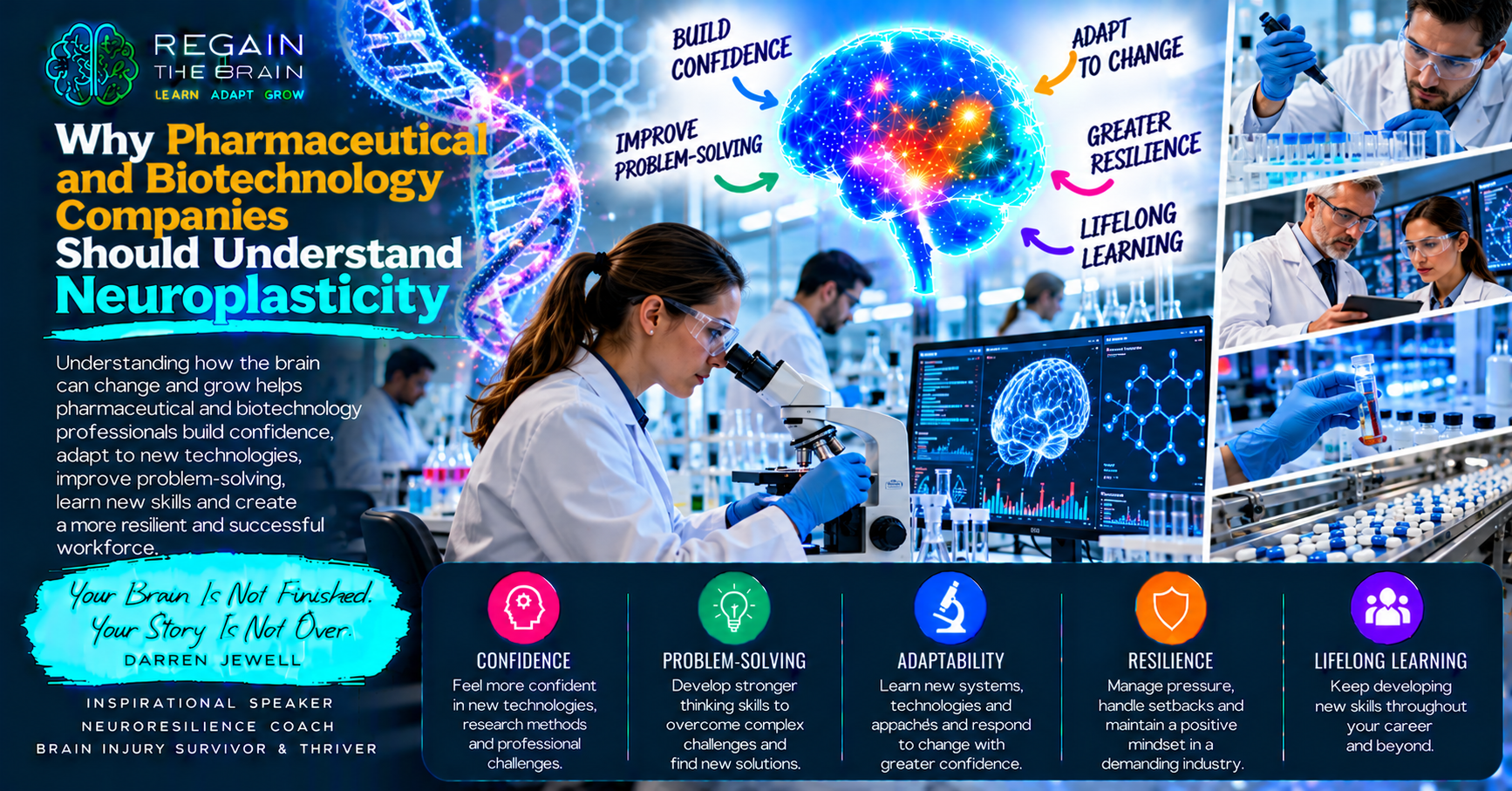
Pharmaceutical and biotechnology companies spend their careers exploring what is possible within the human body. They investigate disease, develop treatments, study biological processes and search for discoveries that may improve people’s lives. But while these industries continue pushing the boundaries of medical science, there is another remarkable area of human biology that deserves attention: the brain’s capacity to learn, adapt and change.
Every medical breakthrough begins with questions.
What if we could understand a disease differently?
What if a new technology could reveal something previously unknown?
What if a scientific assumption needs to be reconsidered?
What if an unfamiliar approach leads to a discovery?
These questions are part of the scientific process.
And behind every laboratory, clinical research programme, manufacturing facility and biotechnology innovation are people.
Scientists.
Researchers.
Laboratory technicians.
Clinical trial professionals.
Pharmacologists.
Biotechnologists.
Manufacturing specialists.
Regulatory affairs professionals.
Quality assurance teams.
And leaders responsible for guiding complex organisations.
These individuals work in industries where knowledge constantly develops.
New research findings emerge.
Technologies change.
Regulatory requirements evolve.
Scientific methods become increasingly sophisticated.
Employees must continue learning throughout their careers.
But learning is not simply about acquiring technical information.
It also involves confidence, curiosity, adaptability and the willingness to explore unfamiliar challenges.
This raises an interesting question.
Could understanding neuroplasticity help pharmaceutical and biotechnology professionals approach lifelong learning, technological change and professional development with greater confidence?
My name is Darren Jewell. I am a London-based inspirational speaker, NeuroResilience Coach, brain injury survivor and passionate advocate for lifelong learning.
My mission is to make neuroplasticity an everyday word.
And I believe pharmaceutical and biotechnology companies have an important opportunity to introduce this fascinating subject into their leadership, employee development and workplace wellbeing programmes.
1. What Is Neuroplasticity?
Neuroplasticity describes the brain’s ability to change its connections and patterns of activity in response to learning, experience and other biological processes.
Put simply, the brain is not completely fixed.
Throughout adulthood, people retain the capacity to acquire new knowledge, develop skills and adapt to unfamiliar experiences.
When someone learns a new skill, changes in brain activity and neural connections can contribute to that learning.
These processes vary depending on the individual, the activity and many other factors.
Neuroplasticity is not a guarantee that every difficulty can be overcome.
Nor does it mean that brain injuries or neurological conditions can always be reversed.
But it does provide an important scientific perspective on the continuing capacity for learning.
For pharmaceutical and biotechnology professionals, understanding neuroplasticity can reinforce the value of lifelong development.
2. Why Neuroplasticity Is Particularly Relevant to Life Sciences
Pharmaceutical and biotechnology companies already operate within the world of biological science.
Their employees understand that the human body is complex.
They recognise the importance of research, evidence and careful interpretation.
Neuroplasticity provides an interesting opportunity to explore how learning and experience relate to changes in the nervous system.
It is particularly relevant to fields such as neuroscience, neurology, rehabilitation research and the study of neurological conditions.
However, neuroplasticity also has broader relevance as a topic for workplace learning.
A laboratory scientist may need to master unfamiliar equipment.
A research manager may need to develop leadership skills.
A biotechnology employee may need to learn new manufacturing processes.
A regulatory professional may need to understand changing requirements.
These situations involve learning and adaptation.
Understanding neuroplasticity can encourage reflection on the importance of continued professional development.
3. Why Pharmaceutical Companies Need Lifelong Learners
The pharmaceutical industry depends on highly specialised knowledge.
Research scientists investigate biological mechanisms.
Clinical research professionals contribute to the evaluation of treatments.
Manufacturing employees work within controlled production environments.
Quality assurance professionals help maintain appropriate standards.
Regulatory specialists interpret complex requirements.
But the knowledge required in these roles continues to evolve.
New technologies are introduced.
Research methods develop.
Regulations change.
Digital tools become more sophisticated.
Employees must continue learning.
An experienced scientist may need to become familiar with a new analytical platform.
A manufacturing technician may require training in unfamiliar equipment.
A regulatory affairs professional may need to understand updated guidance.
Understanding neuroplasticity reinforces the importance of lifelong learning.
Scientific knowledge does not stand still, and neither should our opportunities to learn.
4. Why Confidence Matters in Scientific Careers
Scientific careers can be intellectually demanding.
Researchers may spend years developing expertise in specialised subjects.
Laboratory professionals may need to learn complex techniques.
Employees may encounter unfamiliar technologies.
Junior scientists may question whether they possess the ability to contribute meaningfully.
Experienced professionals may feel uncertain when moving into leadership positions.
Confidence can influence how people approach these challenges.
But confidence should not be confused with pretending to know something.
In science, recognising uncertainty and asking questions are essential professional behaviours.
For much of my life, confidence was something I struggled to develop.
Growing up with the consequences of a serious childhood brain injury affected how I viewed myself.
For approximately half a century, I questioned my own abilities.
But later in life, I began challenging those assumptions.
Learning the piano at 54 became an important part of that journey.
I discovered that confidence can develop through patience, practice and gradual progress.
Confidence does not always come before we attempt something unfamiliar. Sometimes it develops because we were willing to begin.
5. My Personal Journey: From Brain Injury Survivor to Inspirational Speaker
At just 15 months old, I suffered a serious brain injury after falling from a balcony.
I spent three weeks in a coma.
The consequences of that injury affected my physical abilities, coordination, confidence and many aspects of my life.
Growing up, I experienced challenges that other people did not always understand.
I also experienced bullying, which affected my self-belief.
For approximately half a century, confidence was something I struggled to develop.
There were many occasions when I questioned whether I was capable of achieving certain things.
I often assumed that some opportunities were beyond me.
But later in life, I began challenging those assumptions.
At 54, I decided to learn to play the piano.
It was something completely unfamiliar.
I had to learn to read music.
I had to coordinate my hands.
I had to remember sequences.
And I had to practise movements that initially felt difficult.
There were moments of frustration.
There were times when progress seemed painfully slow.
And there were occasions when I wondered whether I would ever improve.
But I continued learning.
Gradually, I began noticing progress.
And something important happened.
I started reconsidering some of the beliefs I had held about my own abilities.
That experience encouraged me to explore neuroplasticity and the science of lifelong learning.
It also inspired me to explore other unfamiliar subjects.
My curiosity has since encouraged me to explore writing, music, technology, language learning and the development of digital learning experiences.
Today, I share my journey as an inspirational speaker and NeuroResilience Coach.
I do not claim that neuroplasticity has reversed my childhood brain injury.
Nor do I believe that determination alone can overcome every challenge.
Instead, my experiences have strengthened my belief that people deserve opportunities to learn, develop and explore their abilities with appropriate support.
Your Brain Is Not Finished. Your Story Is Not Over.
6. Why Experienced Scientists Can Continue Learning
Experience is one of the pharmaceutical and biotechnology industries’ greatest assets.
An experienced research scientist may possess decades of specialist knowledge.
A laboratory manager may understand complex scientific procedures through years of practical experience.
A regulatory professional may have extensive knowledge of compliance requirements.
That expertise deserves respect.
But experience in one area does not prevent someone from learning something new.
An experienced scientist may develop skills in computational biology.
A laboratory professional may learn unfamiliar analytical techniques.
A biotechnology manager may explore new leadership approaches.
Understanding neuroplasticity can challenge the misconception that learning becomes impossible later in life.
The adult brain retains the capacity to acquire new knowledge and skills, although the pace and nature of learning vary between individuals.
Experience and curiosity are not opposites. They can be powerful partners.
7. Neuroplasticity and Scientific Discovery
Scientific discovery depends on curiosity, rigorous investigation and the willingness to evaluate evidence.
Researchers develop hypotheses.
They conduct experiments.
They analyse results.
They reconsider assumptions when evidence does not support their expectations.
Learning is central to this process.
Understanding neuroplasticity provides a useful perspective on the brain’s capacity to acquire knowledge and develop skills.
However, scientific discovery depends on much more than individual adaptability.
It requires appropriate methods, reliable data, collaboration, resources and critical evaluation.
Neuroplasticity awareness can complement conversations about professional learning, but it cannot replace the scientific method.
8. Why Biotechnology Professionals Need Adaptability
Biotechnology is a rapidly developing field.
Employees may work with sophisticated laboratory equipment, biological manufacturing systems, genetic technologies, analytical platforms and digital research tools.
As technologies evolve, professional responsibilities may change.
A laboratory scientist may need to learn a new technique.
A bioprocess engineer may require training in unfamiliar equipment.
A biotechnology project manager may need to coordinate new technical disciplines.
Understanding neuroplasticity can reinforce the importance of continued learning.
However, successful adaptation requires structured training, appropriate supervision and clearly defined competency standards.
For biotechnology companies, neuroplasticity awareness can complement existing workforce development programmes.
9. Neuroplasticity and Clinical Research
Clinical research involves complex scientific, ethical and regulatory responsibilities.
Professionals working in clinical trials must understand relevant procedures, documentation and participant protections.
As research methods and technologies evolve, employees may require additional training.
A clinical research associate may need to learn unfamiliar digital systems.
A trial manager may need to understand new operational processes.
A data specialist may need to develop knowledge of different analytical tools.
Understanding neuroplasticity can reinforce the value of professional development.
However, clinical research competence requires appropriate training and adherence to established ethical and regulatory standards.
Neuroplasticity awareness should complement, never replace, formal clinical research training.
10. Why Pharmaceutical Manufacturing Employees Should Understand Neuroplasticity
Pharmaceutical manufacturing requires precision, consistency and adherence to established procedures.
Employees may work with complex equipment, controlled processes and demanding quality requirements.
Technological developments may introduce unfamiliar machinery and digital systems.
An experienced manufacturing technician may need to learn a new production process.
A quality assurance employee may need to understand updated documentation systems.
A manufacturing manager may need to develop unfamiliar operational skills.
Understanding neuroplasticity can help challenge assumptions about employees’ ability to learn new technologies.
However, pharmaceutical manufacturing requires appropriate training, validated processes and compliance with applicable quality standards.
Neuroplasticity awareness can complement employee development programmes but cannot replace formal competency requirements.
11. Neuroplasticity and Problem-Solving in Biotechnology
Biotechnology professionals regularly encounter complex challenges.
A scientist may need to investigate unexpected experimental results.
A manufacturing engineer may need to identify the cause of a process deviation.
A research team may need to reconsider an experimental approach.
A project manager may need to coordinate unfamiliar technical requirements.
These situations require scientific knowledge, analytical thinking and professional judgement.
Problem-solving skills can develop through training, experience and constructive feedback.
Understanding neuroplasticity reinforces the importance of continued learning.
However, effective scientific problem-solving also requires reliable evidence, appropriate methods and rigorous evaluation.
For biotechnology companies, neuroplasticity awareness can complement professional development programmes.
12. Why Workplace Resilience Matters in Pharmaceutical Research
Scientific research can involve uncertainty.
Experiments may not produce the expected results.
Research projects may encounter setbacks.
Development programmes may take years.
Employees may face complex deadlines and demanding responsibilities.
These challenges can affect wellbeing.
Workplace resilience is therefore an important subject.
However, resilience should never mean expecting employees to tolerate excessive workloads, unsafe conditions or inadequate support.
Genuine workplace resilience requires responsible leadership, realistic expectations, appropriate resources and access to wellbeing support.
Understanding neuroplasticity can contribute to conversations about learning and adaptation.
But it is not a substitute for effective organisational support.
13. Why Pharmaceutical Leaders Should Understand Neuroplasticity
Pharmaceutical and biotechnology leaders face complex responsibilities.
They must coordinate scientific teams, manage projects, respond to technological change and maintain appropriate quality and regulatory standards.
Effective leadership requires communication, adaptability and professional judgement.
Understanding neuroplasticity can provide a useful perspective on continuing professional development.
Leaders can develop unfamiliar skills through training, experience and constructive feedback.
However, leadership development requires practical application and organisational support.
For pharmaceutical executives, biotechnology directors, research managers and laboratory leaders, an inspirational presentation about neuroplasticity can encourage reflection on the learning culture they create.
Great leaders do not need to know everything. They need to remain willing to learn.
14. Why Pharmaceutical Companies Should Encourage a Growth Mindset
A growth mindset involves recognising that abilities can develop through effective learning strategies, practice, feedback and appropriate support.
This concept can be relevant to pharmaceutical and biotechnology organisations.
A junior scientist may initially struggle with unfamiliar laboratory techniques.
A manufacturing employee may need additional training in new equipment.
A research manager may require support when developing leadership skills.
Constructive feedback and appropriate instruction can encourage progress.
However, a growth mindset must never become an excuse for inadequate training, unrealistic expectations or unsafe practices.
Employees need appropriate resources, supervision and professional development opportunities.
For life sciences organisations, growth mindset education can complement existing workforce development programmes.
15. Neuroplasticity and Artificial Intelligence in Life Sciences
Artificial intelligence is influencing pharmaceutical research and biotechnology.
AI-based tools may assist with certain analytical, modelling and research tasks.
These developments create opportunities for innovation.
But they also require employees to understand unfamiliar technologies.
A research scientist may need to learn new computational tools.
A biotechnology professional may be introduced to AI-assisted analytical platforms.
A pharmaceutical manager may need to understand new digital workflows.
Understanding neuroplasticity can reinforce the importance of continued learning.
However, AI implementation in life sciences requires appropriate validation, data protection, human oversight and regulatory compliance.
Neuroplasticity awareness can complement digital skills development programmes.
16. Why Collaboration Matters in Scientific Research
Pharmaceutical and biotechnology organisations depend on collaboration.
Researchers, clinicians, engineers, regulatory professionals, manufacturing employees and project managers often need to work together.
Effective teamwork requires communication, professional trust and clear responsibilities.
Employees can develop collaboration skills through training, mentoring and experience.
Understanding neuroplasticity can reinforce the value of continued learning.
However, teamwork also depends on appropriate staffing, established procedures and supportive leadership.
For life sciences organisations, neuroplasticity awareness can complement wider conversations about collaboration and professional development.
17. Why Mentoring Matters in Pharmaceutical and Biotechnology Careers
Mentoring can play an important role in scientific careers.
Experienced researchers may help junior scientists develop laboratory skills.
Senior professionals may support employees moving into unfamiliar responsibilities.
Managers may help colleagues develop leadership capabilities.
Mentoring provides opportunities for learning, feedback and professional growth.
Understanding neuroplasticity reinforces the importance of continued skill development.
It can also challenge the assumption that early difficulties necessarily indicate a lack of ability.
However, mentoring should complement structured training and appropriate professional standards.
18. Why Learning New Skills Outside Science Matters
One of the most important lessons I have learned is that personal development does not have to be limited to professional achievement.
When I began learning the piano at 54, I was not trying to become a professional musician.
I simply wanted to learn something new.
That experience became an important part of my personal development.
It reminded me that being a beginner can be challenging and rewarding.
My curiosity has since encouraged me to explore technology, music, writing and language learning.
I believe pharmaceutical and biotechnology professionals can find personal value in learning skills outside their specialist fields.
Music, languages, photography, creative writing or other interests can provide enjoyment, curiosity and opportunities for personal development.
These activities should not be presented as guaranteed ways to improve scientific performance.
Their value may simply be the experience of learning something meaningful.
You do not have to turn every new skill into a professional achievement. Sometimes the joy of learning is enough.
19. Brain Injury Awareness and the Life Sciences Industry
One subject particularly close to my heart is brain injury awareness.
Brain injuries can affect memory, attention, movement, communication, emotional regulation and other aspects of daily life.
The consequences vary considerably between individuals.
Some difficulties may not be immediately visible.
As someone who has lived with the consequences of a serious childhood brain injury, I understand how easily assumptions can be made about another person’s abilities.
Pharmaceutical and biotechnology organisations employ people with different backgrounds, experiences and needs.
Some employees may benefit from clear instructions, accessible technology, additional training time or reasonable adjustments.
These decisions should be based on individual circumstances and the requirements of the role.
My personal experience should not be treated as representative of everyone living with a brain injury.
An inspirational presentation can complement specialist disability awareness and workplace inclusion training.
Sometimes the challenges people face are not the ones we can immediately see.
20. Why Pharmaceutical and Biotechnology Companies Should Promote Lifelong Learning
Pharmaceutical and biotechnology organisations employ people with diverse backgrounds, experiences and abilities.
Scientists, researchers, technicians, clinical research professionals, manufacturing employees, apprentices and senior leaders all contribute different expertise.
A workplace culture that values learning can support employees as their responsibilities evolve.
Understanding neuroplasticity can encourage conversations about curiosity, confidence and professional development.
However, successful learning cultures require practical investment in training, mentoring and employee support.
For pharmaceutical and biotechnology companies, neuroplasticity education can complement existing workforce development strategies.
My mission is to make neuroplasticity an everyday word.
And I believe life sciences organisations can play an important role in helping employees appreciate the value of continued development.
21. Why Book an Inspirational Speaker for a Pharmaceutical or Biotechnology Event?
Pharmaceutical companies, biotechnology businesses, research organisations and professional associations regularly organise conferences, leadership meetings, employee development days and workplace wellbeing programmes.
These events provide opportunities to introduce fresh perspectives.
Scientific presentations are essential to the industry.
But there is also value in exploring the human experiences behind learning, confidence and personal development.
An inspirational speaker can offer a different perspective through authentic personal storytelling.
My presentations combine lived experience with accessible explanations of neuroplasticity, resilience, confidence and lifelong learning.
I aim to entertain, educate and inform.
Speaking topics can include:
- Neuroplasticity and the science of lifelong learning
- Building confidence in scientific careers
- Workplace resilience in pharmaceutical research
- Growth mindset in biotechnology
- Adapting to new technologies
- Leadership and continuous professional development
- Brain injury awareness and invisible disabilities
- Challenging limiting beliefs
- Learning new skills later in life
- Curiosity, confidence and personal development
Presentations can be adapted to the objectives of individual pharmaceutical and biotechnology organisations.
They are designed to complement, not replace, specialist scientific training or employee wellbeing support.
22. What Could Pharmaceutical and Biotechnology Employees Take Away?
My aim is not simply to deliver a motivational presentation that is forgotten when the event finishes.
I want audiences to leave with questions worth exploring.
For example:
What new skill have I avoided because I believe I am not naturally good at it?
How do I respond when scientific knowledge or technology changes?
What assumptions have I made about my own abilities?
Could I approach unfamiliar subjects with greater curiosity?
How could I better support colleagues who are learning new skills?
What would I enjoy learning simply for the experience?
These questions can encourage reflection on confidence, adaptability, learning and personal development.
23. Why Choose Darren Jewell as Your Inspirational Speaker?
There are many scientific and technical speakers available for pharmaceutical conferences and biotechnology events.
My contribution is different.
I do not claim to be a pharmaceutical researcher or biotechnology specialist.
Instead, I offer a perspective shaped by my experiences of brain injury, low confidence, personal development and discovering new abilities later in life.
I understand what it feels like to doubt yourself.
I understand the frustration of struggling with unfamiliar tasks.
And I understand the satisfaction of discovering that you are capable of learning something you once considered beyond you.
My journey from childhood brain injury survivor to inspirational speaker and NeuroResilience Coach has strengthened my passion for helping people understand neuroplasticity.
I do not promise that one presentation will transform a pharmaceutical organisation or guarantee improved scientific performance, employee wellbeing or commercial outcomes.
Instead, I aim to introduce ideas that encourage curiosity, reflection and meaningful conversations about lifelong learning.
24. Book Darren Jewell for Your Next Pharmaceutical or Biotechnology Event
Are you a pharmaceutical company executive, biotechnology director, research leader, HR professional, Learning & Development manager or life sciences conference organiser looking for an inspirational speaker for pharmaceutical and biotechnology companies?
I would welcome the opportunity to discuss how my presentations could complement your organisation’s professional development and employee wellbeing objectives.
Whether you are organising a pharmaceutical industry conference, biotechnology leadership event, research employee development day or corporate wellbeing programme, my aim is to deliver a presentation that encourages people to think differently about learning, resilience and personal growth.
Because the people who spend their careers exploring the possibilities of human biology deserve opportunities to recognise their own capacity to learn, adapt and develop.
Your Brain Is Not Finished. Your Story Is Not Over.
Darren Jewell
Inspirational Speaker | NeuroResilience Coach | Brain Injury Survivor & Thriver
Visit www.regainthebrain.com to enquire about booking an inspirational speaker for your pharmaceutical company, biotechnology organisation or life sciences event.
#NeuroplasticityAtWork #PharmaceuticalEmployeeTraining #BiotechnologyLeadership #LifeSciencesWellbeing #WorkplaceResilience #ScientificLearning #GrowthMindset #InspirationalSpeaker #BiotechnologyConferenceSpeaker #LifelongLearning #DarrenJewell #RegainTheBrain