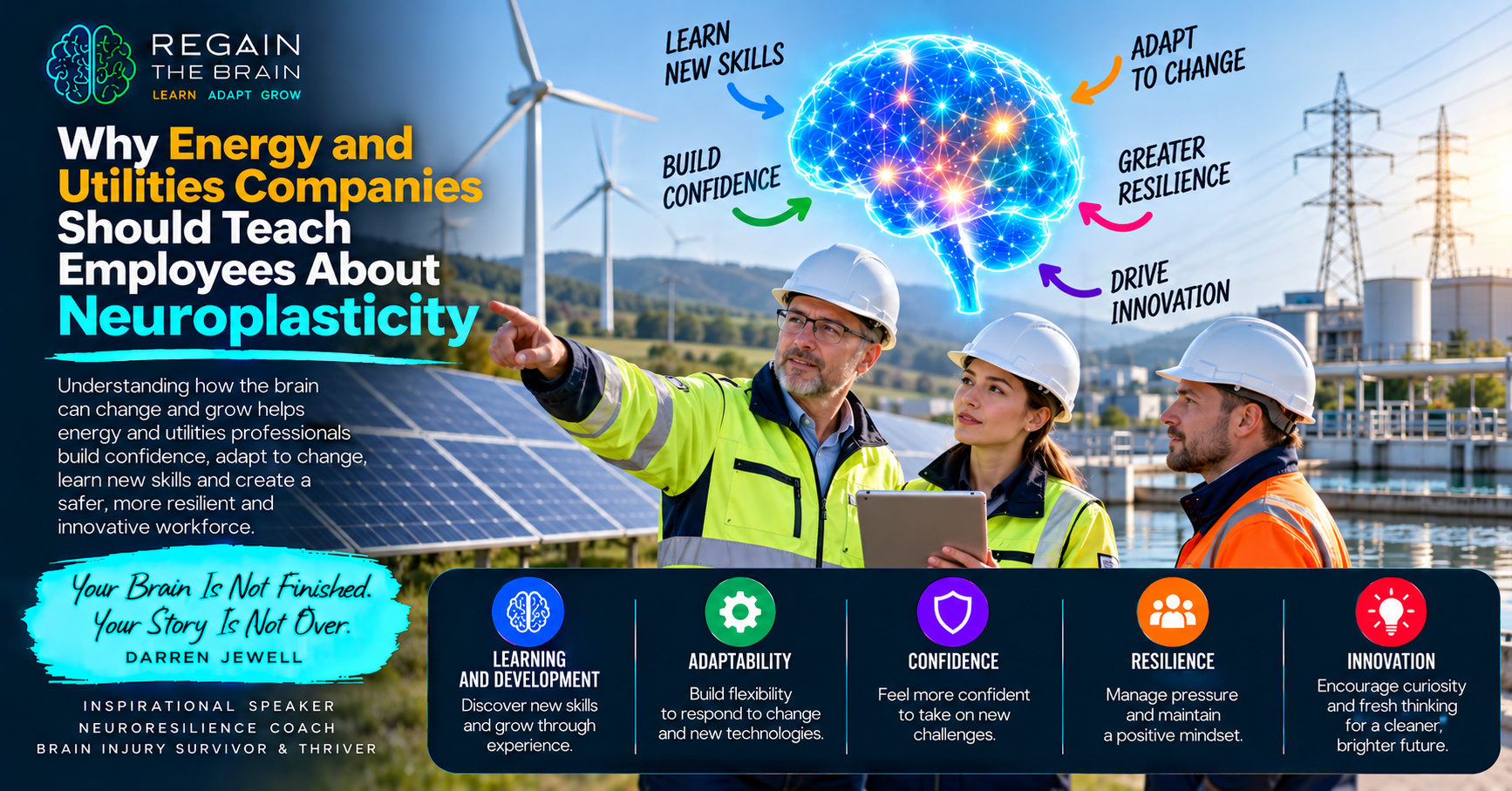
Energy and utilities companies keep our homes warm, our lights switched on, our water flowing and our businesses operating. But how often do these organisations encourage their employees to understand the remarkable ability of the human brain to learn, adapt and develop?
The energy and utilities sector is essential to modern society.
Every day, electrical engineers, gas technicians, water treatment specialists, renewable energy professionals, maintenance teams, customer service employees and operational managers work to deliver services that millions of people depend upon.
Their responsibilities require technical knowledge, concentration, problem-solving, communication and the ability to respond to changing circumstances.
But the energy industry is undergoing significant transformation.
Renewable energy technologies, smart electricity grids, automation, artificial intelligence, environmental regulations and changing consumer expectations are reshaping how energy and utilities organisations operate.
Employees must continually develop their skills, learn unfamiliar technologies and adapt to new working practices.
At the same time, many employees work in demanding environments where safety, concentration and sound professional judgement are essential.
This raises an important question.
Could understanding neuroplasticity help energy and utilities employees approach learning, technological change and professional development with greater confidence?
My name is Darren Jewell. I am a London-based inspirational speaker, NeuroResilience Coach, brain injury survivor and passionate advocate for lifelong learning.
I believe neuroplasticity deserves greater attention in energy industry employee training, utilities leadership development and workplace wellbeing programmes.
My mission is to make neuroplasticity an everyday word.
And I believe energy and utilities organisations have an important opportunity to introduce this subject to their employees.
1. What Is Neuroplasticity and Why Does It Matter in the Energy Industry?
Neuroplasticity describes the brain’s ability to change its connections and patterns of activity in response to learning, experience and other biological processes.
Scientific research has demonstrated that the adult brain retains the capacity for plasticity throughout life, although the nature and extent of that capacity vary between individuals.
This is relevant to energy and utilities professionals.
An electrical engineer learning new grid technologies, a gas technician developing unfamiliar technical skills or a water treatment employee mastering new monitoring equipment is engaging processes associated with learning and memory.
With appropriate instruction, practice and feedback, people can continue developing professional skills throughout their careers.
Understanding neuroplasticity can help challenge the assumption that someone’s current abilities represent the limits of what they can learn.
However, neuroplasticity does not mean that every skill can be mastered through determination alone.
Effective learning requires appropriate training, resources, supervision and supportive working conditions.
For energy and utilities companies, neuroplasticity awareness can complement existing technical training and professional development programmes.
2. Why Continuous Learning Is Essential in Energy and Utilities
The energy sector is changing rapidly.
Renewable energy systems are expanding.
Electricity networks are becoming increasingly sophisticated.
Smart meters and digital monitoring technologies are transforming energy management.
Water utilities are introducing new treatment and monitoring technologies.
Automation is influencing maintenance and operational processes.
These developments create an ongoing need for professional learning.
An engineer who has spent decades working with traditional electrical infrastructure may need to develop knowledge of renewable energy systems.
A gas industry professional may need to understand emerging low-carbon technologies.
A water utility employee may require training in new digital monitoring equipment.
Understanding neuroplasticity can encourage employees to recognise that learning remains possible throughout adulthood.
For HR directors and Learning & Development managers, introducing neuroplasticity awareness into energy sector employee development can reinforce the importance of continuous professional learning.
The technologies we use may change, but our opportunity to keep learning does not have to end.
3. Neuroplasticity and Workplace Safety Training
Safety is one of the most important responsibilities in the energy and utilities industry.
Employees may work with electricity, gas, pressurised systems, hazardous substances, heavy equipment or complex infrastructure.
These environments require appropriate qualifications, technical competence and strict adherence to safety procedures.
Learning and memory play important roles in developing professional competence.
Understanding neuroplasticity can provide background knowledge about how people acquire and practise skills.
For example, employees may develop familiarity with approved procedures through structured instruction, supervised practice and assessment.
However, neuroplasticity awareness must never be presented as a substitute for formal safety training.
Workplace safety depends on verified competence, appropriate supervision, reliable equipment, clear procedures and an effective organisational safety culture.
For energy companies, neuroplasticity education can complement existing training by encouraging employees to appreciate the value of continued learning.
4. Building Confidence in Energy and Utilities Employees
Confidence matters in technical professions.
Employees may need to learn unfamiliar equipment, communicate complex information, contribute to team discussions or take on new responsibilities.
A newly qualified engineer may feel uncertain when beginning their career.
An experienced technician may lack confidence when learning new digital systems.
A maintenance employee may feel nervous about moving into a supervisory role.
I understand what it feels like to question your own abilities.
For approximately half a century, confidence was something I struggled to develop.
Growing up with the consequences of a serious childhood brain injury affected how I viewed myself and what I believed I could achieve.
Later in life, I began challenging some of those assumptions.
Learning to play the piano in my fifties helped me appreciate that confidence can develop through patience, practice and gradual progress.
For energy and utilities professionals, this message can encourage a constructive approach to learning.
Confidence does not always come before we attempt something unfamiliar. Sometimes it develops because we were willing to begin.
Of course, confidence in safety-critical roles must always be supported by appropriate training and demonstrated competence.
5. My Personal Journey: From Brain Injury Survivor to Inspirational Speaker
At just 15 months old, I suffered a serious brain injury after falling from a balcony.
I spent three weeks in a coma.
The consequences of that injury affected my physical abilities, coordination, confidence and many aspects of my life.
Growing up, I experienced challenges that other people did not always understand.
I also experienced bullying, which affected my self-belief.
For approximately half a century, confidence was something I struggled to develop.
There were many occasions when I questioned whether I was capable of achieving certain things.
But later in life, I began challenging those assumptions.
At 54, I decided to learn to play the piano.
It was a completely unfamiliar experience.
I had to learn to read music, coordinate my hands, remember sequences and develop new movements.
Progress required concentration, patience and repeated practice.
There were moments of frustration.
There were times when I questioned whether I would ever improve.
But I continued learning.
That experience encouraged me to explore the science of neuroplasticity and helped me reconsider some of the beliefs I had held about my own abilities.
My curiosity has since encouraged me to explore writing, music, technology, language learning and the development of digital learning experiences.
Today, I share my journey as an inspirational speaker and NeuroResilience Coach.
My message is not that everyone can overcome every challenge through determination alone.
It is that people deserve opportunities to explore their abilities with appropriate support and realistic expectations.
I do not claim that neuroplasticity has reversed my childhood brain injury.
Instead, my experiences have strengthened my belief that learning and personal development can remain meaningful throughout life.
Your Brain Is Not Finished. Your Story Is Not Over.
6. Why Workplace Resilience Matters in Energy and Utilities
Energy and utilities employees often work in demanding environments.
Engineers may respond to unexpected equipment failures.
Maintenance teams may work under pressure to restore essential services.
Customer service employees may support people affected by power cuts or water supply problems.
Operational managers may need to coordinate teams during emergencies.
These responsibilities can create considerable professional and emotional pressure.
This makes energy sector workplace resilience and employee wellbeing important subjects.
However, resilience should never mean expecting employees to tolerate unsafe conditions, unreasonable workloads or excessive pressure.
Genuine workplace resilience requires supportive leadership, realistic expectations, adequate staffing, appropriate resources and access to professional support.
Neuroplasticity can contribute to educational conversations about learning and adaptation.
But it is not a substitute for effective safety management or workplace wellbeing policies.
For energy companies organising staff wellbeing events, an inspirational presentation can encourage reflection on confidence, learning and personal development.
7. Neuroplasticity and the Transition to Renewable Energy
The transition towards lower-carbon energy systems is creating new professional opportunities and training requirements.
Solar power, wind energy, battery storage, smart grids and other technologies require specialist knowledge.
Some employees may move from traditional energy roles into unfamiliar areas.
Others may need to develop additional technical qualifications.
For experienced professionals, this transition can feel challenging.
They may have spent decades developing expertise in established technologies.
Understanding neuroplasticity can help challenge the assumption that experienced employees are incapable of learning unfamiliar systems.
However, successful career transitions require accessible training, suitable qualifications, financial support where necessary and appropriate employment opportunities.
For renewable energy companies, neuroplasticity awareness can complement existing reskilling and workforce development programmes.
Experience and curiosity can work together. Learning something new does not erase the value of what we already know.
8. Neuroplasticity and Problem-Solving in Engineering
Engineering involves identifying problems, evaluating evidence and developing appropriate solutions.
Energy engineers may investigate equipment faults.
Water utility specialists may analyse treatment processes.
Maintenance professionals may troubleshoot complex systems.
These responsibilities require technical knowledge, attention and professional judgement.
Problem-solving skills can develop through training, experience and constructive feedback.
Understanding neuroplasticity provides a scientific perspective on learning and skill development.
However, neuroplasticity awareness alone does not improve engineering decisions.
Effective problem-solving depends on reliable information, appropriate qualifications, approved procedures and sound professional judgement.
For engineering teams, neuroplasticity education can complement existing technical development programmes.
9. Adapting to Artificial Intelligence and Automation
Artificial intelligence and automation are influencing the energy and utilities sector.
Digital technologies can assist with monitoring equipment, analysing operational information, forecasting demand and identifying potential maintenance requirements.
These developments create opportunities for efficiency and innovation.
But they also require employees to develop new skills.
An experienced technician may need to learn digital diagnostic systems.
An operations manager may need to understand AI-assisted monitoring.
A customer service employee may need to adapt to automated communication platforms.
Understanding neuroplasticity can encourage employees to approach unfamiliar technology with curiosity.
However, successful digital transformation requires appropriate training, cybersecurity safeguards, human oversight and clear operational procedures.
For energy companies, neuroplasticity awareness can complement wider technological change programmes.
10. Why Energy Industry Leaders Should Understand Neuroplasticity
Energy and utilities leaders face complex responsibilities.
They must manage employees, maintain safety standards, respond to technological change and support reliable service delivery.
Effective leadership requires communication, adaptability and professional judgement.
Understanding neuroplasticity can provide a useful perspective on continuing professional development.
Leaders can develop unfamiliar skills through training, experience and constructive feedback.
However, leadership development requires practical application and organisational support.
For energy company directors, operations managers and team leaders, an inspirational presentation about neuroplasticity can encourage reflection on the learning culture they create.
Great leaders do not need to know everything. They need to remain willing to learn.
11. Supporting Experienced Employees Through Technological Change
Many energy and utilities employees have spent decades developing valuable technical expertise.
Their experience can be an important organisational asset.
But technological developments may require them to learn unfamiliar systems and working practices.
Understanding neuroplasticity can help challenge assumptions about age and learning.
The adult brain retains the capacity to acquire new knowledge and skills, although the pace and nature of learning vary between individuals.
For energy companies, this creates an opportunity to support professional development across different career stages.
Experienced employees should receive appropriate training rather than being expected to adapt without support.
Being experienced does not mean your learning journey has finished.
12. Neuroplasticity and Teamwork in Energy Operations
Energy and utilities services depend on effective teamwork.
Engineers, technicians, maintenance teams, operational managers and customer service professionals often need to coordinate their activities.
Clear communication is especially important when working with complex infrastructure.
Employees may learn from colleagues through mentoring, supervised training and knowledge sharing.
These experiences can contribute to professional development.
However, effective teamwork also requires clear responsibilities, reliable procedures and supportive leadership.
For energy organisations, neuroplasticity awareness can complement wider conversations about collaboration and continuous improvement.
13. Why Employee Wellbeing Matters During Organisational Change
The energy transition and digital transformation may create uncertainty for employees.
Some may worry about unfamiliar technology.
Others may question whether their existing skills will remain relevant.
Organisational restructuring can also affect confidence and morale.
Understanding neuroplasticity can contribute to conversations about the continuing capacity to learn.
However, employee wellbeing requires more than motivational messages.
Organisations should provide transparent communication, accessible training, realistic expectations and appropriate support during change.
An inspirational presentation can complement these measures by encouraging reflection on confidence, adaptability and personal development.
14. Brain Injury Awareness and Invisible Disabilities in Energy Companies
One subject particularly close to my heart is brain injury awareness.
Brain injuries can affect memory, attention, movement, communication, emotional regulation and other aspects of daily life.
The consequences vary considerably between individuals.
Some difficulties may not be immediately visible.
As someone who has lived with the consequences of a serious childhood brain injury, I understand how easily assumptions can be made about another person’s abilities.
For energy and utilities companies, greater awareness of neurological differences can contribute to conversations about workplace inclusion, accessibility and reasonable adjustments.
Safety-critical roles must still be assessed against appropriate professional and legal requirements.
My personal experience should not be treated as representative of everyone living with a brain injury.
An inspirational presentation can complement specialist disability awareness and inclusive employment training.
Sometimes the challenges people face are not the ones we can immediately see.
15. Why Lifelong Learning Matters Beyond Energy Careers
Energy and utilities professionals spend their careers developing technical knowledge and professional skills.
But learning does not have to be limited to employment.
It can involve music, languages, cooking, technology, creative writing or completely unfamiliar interests.
When I began learning the piano at 54, I was not trying to become a professional musician.
I simply wanted to learn something new.
That decision became an important part of my personal development.
It reminded me that being a beginner can be both challenging and rewarding.
I believe this message is relevant to energy professionals.
You can spend decades developing expertise in one field while continuing to discover new interests and abilities elsewhere.
Your professional qualifications may be complete, but your learning journey does not have to be.
16. Why Energy Companies Should Promote a Culture of Lifelong Learning
Energy and utilities companies employ people with a wide range of professional backgrounds.
Engineers, technicians, customer service employees, project managers and senior executives all contribute different expertise.
A workplace culture that values learning can support employees as their responsibilities evolve.
Understanding neuroplasticity can encourage conversations about curiosity, adaptability and professional development.
However, successful learning cultures also require practical investment in training, mentoring and employee support.
For energy companies, neuroplasticity education can complement wider workforce development strategies.
My mission is to make neuroplasticity an everyday word.
And I believe energy and utilities organisations can help introduce this subject to a wider professional audience.
17. Why Book an Inspirational Speaker for an Energy or Utilities Industry Event?
Energy and utilities companies regularly organise staff conferences, leadership meetings, employee wellbeing days, technical development events and corporate training programmes.
These events provide opportunities to introduce fresh perspectives and encourage reflection.
An inspirational speaker can offer something different through authentic personal experience.
My presentations combine storytelling with accessible explanations of neuroplasticity, resilience, confidence and lifelong learning.
I aim to entertain, educate and inform while encouraging audiences to reflect on their own experiences.
Speaking topics can include:
- Neuroplasticity and the science of lifelong learning
- Energy industry workplace resilience and employee wellbeing
- Building confidence through learning and experience
- Growth mindset in engineering and technical teams
- Adapting to renewable energy technologies
- Artificial intelligence and continuous professional development
- Leadership development and workplace learning
- Brain injury awareness and invisible disabilities
- Supporting employees through technological change
- Learning new skills later in life
Presentations can be adapted to the objectives of individual energy and utilities organisations.
They are designed to complement existing technical training, professional development and employee wellbeing programmes.
18. What Could Energy and Utilities Employees Take Away?
My aim is not simply to deliver a motivational presentation that is forgotten when the event finishes.
I want audiences to leave with questions worth exploring.
For example:
What new professional skill have I avoided because I believe I am not naturally good at it?
How do I respond when technology or working practices change?
What assumptions have I made about my own abilities?
Could I approach unfamiliar systems with greater curiosity?
How could I better support colleagues who are learning new skills?
What would I enjoy learning outside my professional responsibilities?
These questions can encourage reflection on confidence, adaptability, learning and personal development.
19. Why Choose Darren Jewell as Your Inspirational Speaker?
There are many motivational speakers available for energy conferences and corporate events across the UK.
My approach is shaped by lived experience.
I understand what it means to face challenges that other people may not recognise.
I understand the impact that low confidence can have on someone’s life.
And I understand the satisfaction of discovering new abilities later in life.
My journey from childhood brain injury survivor to inspirational speaker and NeuroResilience Coach has strengthened my passion for helping people understand neuroplasticity.
I do not promise that one presentation will transform an energy company or guarantee improved safety, productivity or commercial performance.
Instead, I aim to introduce ideas that encourage curiosity, reflection and meaningful conversations about learning.
My mission is to make neuroplasticity an everyday word.
And I believe energy and utilities organisations can play an important role in helping employees appreciate the value of continued development.
20. Book Darren Jewell for Your Next Energy or Utilities Industry Event
Are you an energy company director, utilities manager, HR professional, Learning & Development specialist, renewable energy executive or industry conference organiser looking for an inspirational speaker for energy and utilities employees?
I would welcome the opportunity to discuss how my presentations could complement your organisation’s professional development and employee wellbeing objectives.
Whether you are organising an energy industry conference, utilities leadership event, employee development day or corporate wellbeing session, my aim is to deliver a presentation that encourages people to think differently about learning, resilience and personal growth.
Because the people who spend their careers powering our homes, supporting essential services and developing the technologies of tomorrow deserve opportunities to recognise their own capacity to learn and adapt.
Your Brain Is Not Finished. Your Story Is Not Over.
Darren Jewell
Inspirational Speaker | NeuroResilience Coach | Brain Injury Survivor & Thriver
Visit www.regainthebrain.com to enquire about booking an inspirational speaker for your energy company, utilities organisation or industry event.
#NeuroplasticityAtWork #EnergyIndustryTraining #UtilitiesEmployeeWellbeing #RenewableEnergySkills #WorkplaceResilience #EnergyLeadershipDevelopment #InspirationalSpeakerForEnergy #UtilitiesConferenceSpeaker #LifelongLearning #DarrenJewell #RegainTheBrain