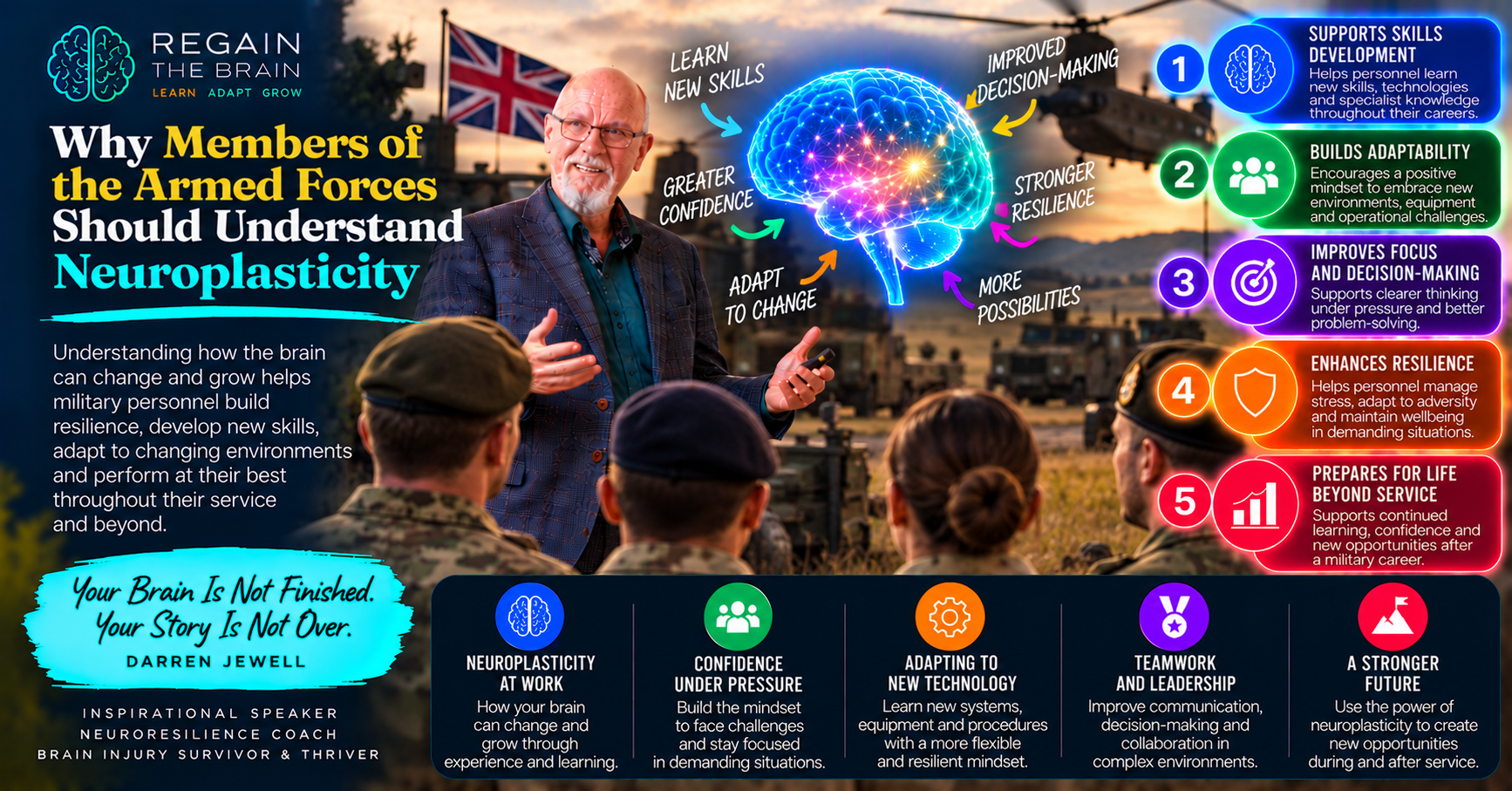
What if one of the most valuable tools available to members of the Armed Forces is something they already carry with them every day: their brain?
Whether serving in the British Army, Royal Navy or Royal Air Force, military personnel are expected to develop skills, adapt to unfamiliar environments, work under pressure and respond to changing circumstances.
Physical fitness, discipline, teamwork and specialist training are fundamental to military life.
But there is another subject that deserves greater attention.
Neuroplasticity: the brain’s ability to adapt and change through learning and experience.
Understanding this remarkable ability can provide a valuable perspective on military training, resilience, professional development and life beyond service.
1. Neuroplasticity and Military Training
Military training requires personnel to learn and practise a wide range of skills.
From navigation and communication to leadership, technical operations and emergency procedures, learning is central to military effectiveness.
Neuroplasticity describes changes in the brain’s connections and patterns of activity that occur in response to experience, learning and other biological processes.
When personnel practise unfamiliar skills, the brain engages networks involved in attention, memory, coordination and decision-making.
Over time, effective practice and feedback can contribute to improved performance.
Understanding the science behind learning can help military personnel appreciate why repetition, appropriate challenge, rest and constructive feedback matter.
2. Developing Adaptability in Unpredictable Environments
Military personnel regularly face situations where circumstances change quickly.
New technology, unfamiliar environments and changing operational requirements can demand considerable adaptability.
Understanding neuroplasticity can encourage a mindset that recognises the continuing capacity to develop new skills.
However, adaptability is not simply about individual determination.
It also depends on effective leadership, realistic training, preparation and appropriate organisational support.
Neuroplasticity provides one scientific perspective on how people learn to respond to unfamiliar challenges.
3. Resilience Is More Than Mental Toughness
Resilience is frequently associated with military service.
Yet resilience should not be confused with suppressing emotions or ignoring the effects of difficult experiences.
Genuine resilience can involve recognising when support is needed, developing constructive coping strategies and adapting to changing circumstances.
Military personnel may encounter experiences that affect their physical and psychological wellbeing.
Understanding how the brain responds to learning and experience can contribute to wider conversations about resilience, recovery and mental health.
It is important to recognise that neuroplasticity does not guarantee recovery from trauma or neurological injury.
Professional healthcare, appropriate rehabilitation and social support remain essential.
4. Neuroplasticity and Life After Military Service
For some service personnel, transitioning into civilian employment presents new challenges.
Skills developed during military service can be highly transferable, but moving into a different working environment may require additional learning and adaptation.
Some veterans may also be living with physical injuries, neurological conditions or psychological difficulties.
Understanding neuroplasticity can encourage continued learning and professional development without minimising these challenges.
The ability to learn does not disappear simply because someone changes careers or reaches a particular age.
5. Why My Brain Injury Story Matters
My name is Darren Jewell.
At just 15 months old, I suffered a serious brain injury after falling from a balcony.
I spent three weeks in a coma.
The consequences of that injury affected my physical abilities, confidence and many aspects of my life.
For approximately half a century, I struggled with self-belief.
But in my fifties, I began learning to play the piano.
That decision challenged my coordination, concentration, patience and long-held assumptions about what I could achieve.
It also strengthened my fascination with neuroplasticity and lifelong learning.
Today, as an inspirational speaker and NeuroResilience Coach, I share my experiences to encourage people to explore their own capacity for learning and personal development.
I do not claim to understand military service from personal experience.
Instead, I offer a different perspective on adversity, confidence, adaptation and the importance of continuing to learn.
6. Why Armed Forces Organisations Should Consider a Neuroplasticity Speaker
An inspirational presentation can complement military professional development, wellbeing initiatives, leadership events and veteran support programmes.
My presentations explore:
- Neuroplasticity and the science of learning
- Resilience and adapting to adversity
- Confidence and personal development
- Lifelong learning and developing new skills
- Brain injury awareness and invisible disabilities
- Growth mindset and embracing change
- Learning and identity beyond a previous career
The aim is to introduce accessible neuroscience through authentic personal storytelling.
Book Darren Jewell as an Inspirational Speaker
Are you organising an Armed Forces development event, military wellbeing day, leadership conference or veterans’ gathering?
I would welcome the opportunity to discuss how my personal experiences and understanding of neuroplasticity could contribute to your event.
Your Brain Is Not Finished. Your Story Is Not Over.
Darren Jewell
Inspirational Speaker | NeuroResilience Coach | Brain Injury Survivor & Thriver
#ArmedForcesWellbeing #MilitaryResilience #Neuroplasticity #VeteranSupport #MilitaryLeadership #ArmedForcesTraining #InspirationalSpeakerUK #BrainInjuryAwareness #DarrenJewell #RegainTheBrain