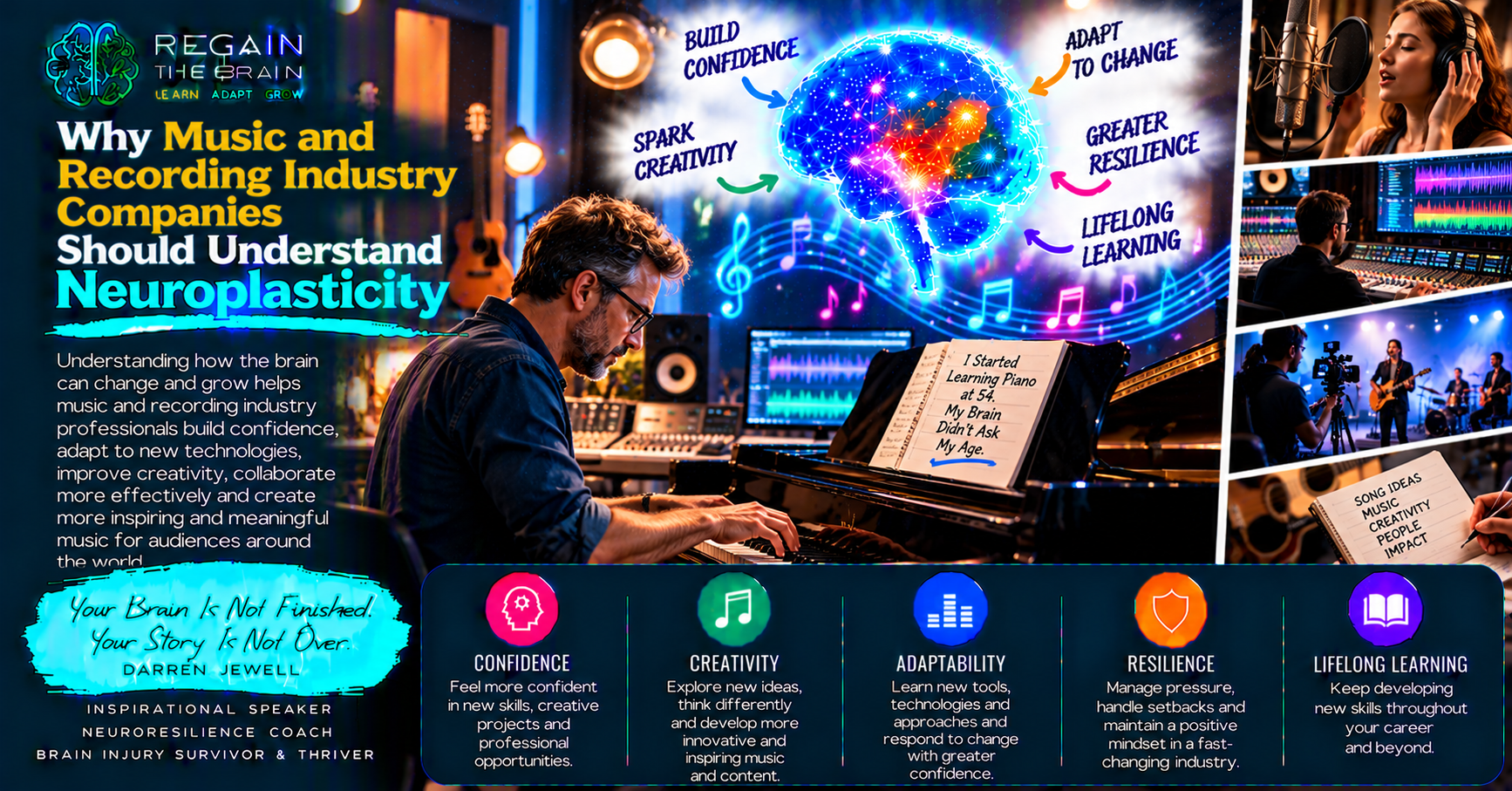
At 54 years old, I sat down at a piano and began learning something I had once assumed was beyond my abilities. I wasn’t trying to become a professional musician. I wasn’t preparing for a concert. I simply wanted to discover whether I could learn. What happened next changed the way I thought about my brain, my confidence and the possibilities that might still lie ahead.
Music has an extraordinary place in our lives.
A song can remind us of childhood.
A melody can bring back memories.
A piece of music can make us smile, reflect or feel emotional.
Music brings people together across cultures, generations and languages.
But behind every song, recording and performance are people who have spent time developing their abilities.
Musicians.
Songwriters.
Producers.
Sound engineers.
Recording artists.
Composers.
Music publishers.
Studio technicians.
Artist managers.
And record label executives.
These professionals work in an industry where creativity, technical expertise and adaptability matter.
New technologies emerge.
Recording methods evolve.
Distribution platforms change.
Audience expectations develop.
And musicians continue exploring unfamiliar sounds, instruments and creative possibilities.
But I believe there is another subject that deserves greater attention within the music and recording industries.
Neuroplasticity — the remarkable ability of the human brain to continue learning and adapting throughout life.
My name is Darren Jewell. I am a London-based inspirational speaker, NeuroResilience Coach, brain injury survivor and passionate advocate for lifelong learning.
My mission is to make neuroplasticity an everyday word.
And I believe music and recording industry companies have an opportunity to introduce this fascinating subject into their leadership, employee development and workplace wellbeing programmes.
1. What Is Neuroplasticity?
Neuroplasticity describes the brain’s ability to change its connections and patterns of activity in response to learning, experience and other biological processes.
Put simply, our brains are not completely fixed.
Throughout adulthood, we retain the capacity to acquire new knowledge, develop skills and adapt to unfamiliar experiences.
When someone learns a musical instrument, practises a rhythm or develops an unfamiliar professional skill, the brain participates in processes that support learning.
With appropriate instruction, practice and feedback, unfamiliar tasks may gradually become more familiar.
However, neuroplasticity does not mean learning is always easy.
It does not guarantee that everyone can achieve identical outcomes.
And it does not mean determination alone can overcome every challenge.
But it provides an important scientific perspective on our continuing capacity to learn.
For music and recording industry companies, understanding neuroplasticity can reinforce the importance of lifelong learning, creativity and professional development.
2. Why Music and the Human Brain Are Closely Connected
Music is a fascinating subject for neuroscience.
Listening to music involves several brain systems associated with hearing, perception, attention, memory and emotion.
Playing an instrument can involve additional processes associated with movement, coordination, timing and learning.
A pianist may need to read musical notation.
Coordinate both hands.
Listen carefully.
Remember sequences.
And adjust movements while playing.
A drummer may need to coordinate different rhythmic patterns.
A singer may need to control breathing, pitch and phrasing.
A guitarist may need to learn unfamiliar finger movements.
These activities can involve complex combinations of sensory, motor and cognitive processes.
Researchers have investigated how musical training relates to brain structure and function.
However, musical training does not guarantee broad improvements in intelligence, memory or unrelated abilities.
Understanding neuroplasticity provides a scientific perspective on musical learning without turning every musical activity into an unsupported brain-health claim.
Music is remarkable enough without needing exaggerated promises about what it can do.