What if one of the simplest ways to challenge your brain was already waiting in your kitchen?
When we think about keeping our brains active, we often imagine crossword puzzles, Sudoku, memory exercises or learning a new language.
But what about cooking?
Not simply preparing the same meals we have cooked hundreds of times before, but choosing a completely unfamiliar recipe, gathering the ingredients and attempting something new.
It might seem like an ordinary activity.
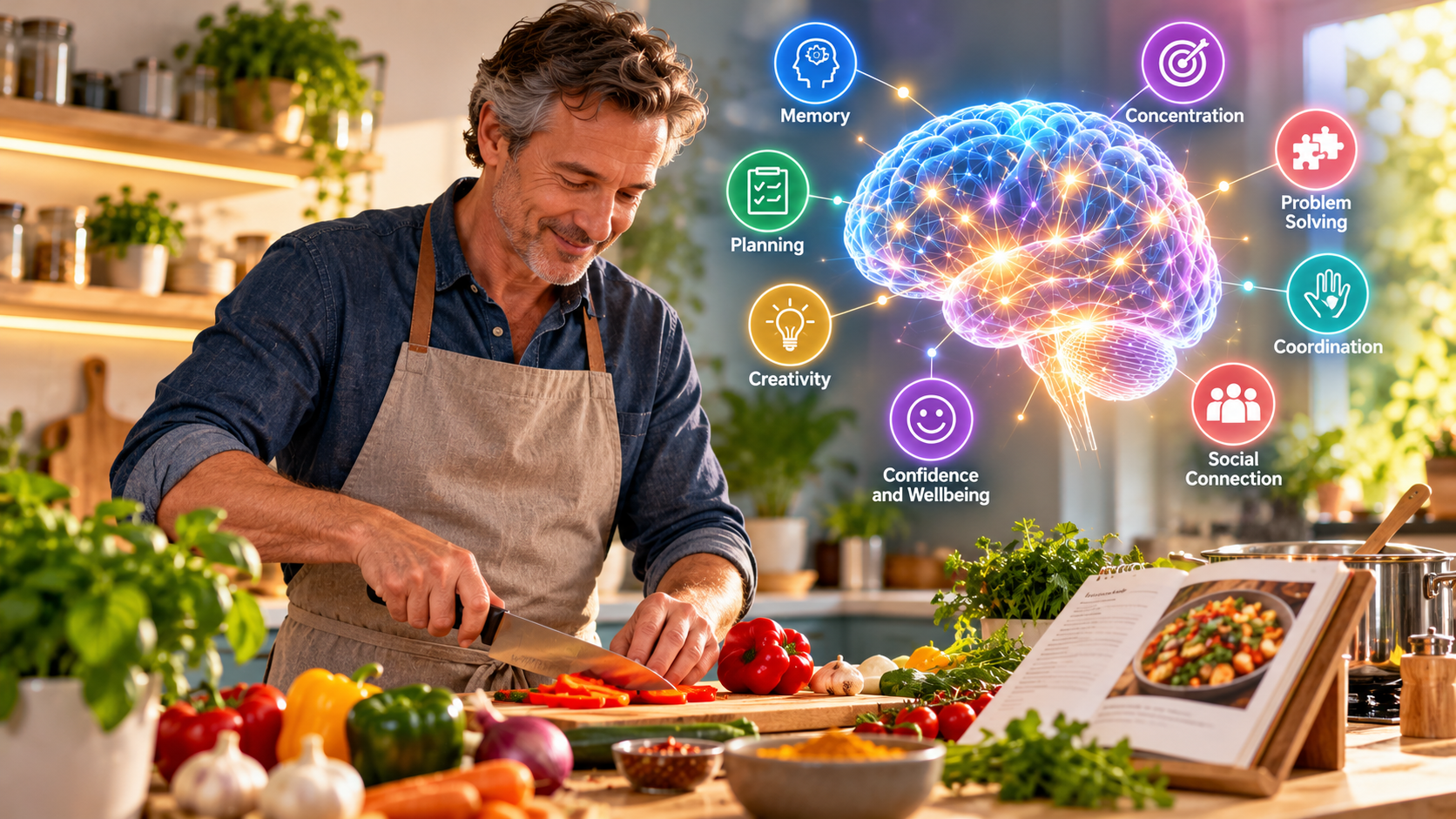
Yet cooking a new recipe can involve memory, concentration, planning, coordination, problem-solving and creativity.
It brings together several cognitive skills in one practical, enjoyable experience.
And perhaps most importantly, it reminds us that learning something new doesn’t have to be complicated to be worthwhile.
What Happens to Your Brain When You Learn Something New?
Our brains are constantly responding to the world around us.
Every experience, decision and action involves communication between networks of nerve cells known as neurons.
When we learn a new skill, the brain can adapt through a process called neuroplasticity.
Neuroplasticity is the brain’s ability to change its connections, structure and functions in response to learning, experience and other influences.
For example, when you practise an unfamiliar activity, the neural networks involved may become more efficient with repetition.
This is one reason why something that initially feels difficult can gradually become easier.
Think about the first time you learned to drive a car.
You probably had to concentrate on almost everything.
Steering, changing gears, checking mirrors, judging distances and watching other road users all required conscious attention.
Over time, many of those actions became more automatic.
Cooking can follow a similar pattern.
Preparing a familiar meal may require relatively little conscious thought.
But attempting a completely new recipe introduces unfamiliar instructions, ingredients, timings and techniques.
Suddenly, your brain has something different to work on.
That is where the opportunity for learning begins.
1. Cooking Challenges Your Memory
Imagine deciding to make homemade Thai green curry for the first time.
You have found a recipe, bought the ingredients and are ready to begin.
First, you need to remember which ingredients you have prepared.
Then you need to follow the instructions, keep track of cooking times and remember which steps come next.
This involves several aspects of memory.
Working memory allows us to hold and use information for short periods.
For example, you might read an instruction telling you to add garlic, ginger and spices before introducing the vegetables.
You then need to retain that information long enough to complete the step.
Long-term memory helps us draw upon previous experiences.
You may already know how to chop vegetables, boil rice or use a frying pan.
These existing skills provide a foundation for learning something new.
Prospective memory helps us remember to perform an intended action later.
Remembering to check the oven after 20 minutes is an everyday example.
Cooking brings these processes together in a meaningful activity.
Although cooking has not been proven to prevent dementia or reverse memory problems, learning recipes can provide useful opportunities to practise everyday cognitive skills.
And unlike a conventional memory exercise, the reward might be a delicious dinner.
2. Following a Recipe Develops Planning and Organisation
Cooking a new dish requires more than remembering ingredients.
It involves planning.
Before you begin, you may need to consider several questions.
Do I have everything I need?
Which ingredients should I prepare first?
How long will the meal take?
Can I cook different parts of the dish at the same time?
What should I do if something goes wrong?
These questions involve cognitive abilities known as executive functions.
Executive functions help us plan, organise, regulate behaviour, manage attention and work towards goals.
They are essential for everyday activities, from managing finances to organising appointments and completing projects.
When preparing a new recipe, you use these skills in a practical setting.
You might discover that the vegetables need chopping before the sauce can be prepared.
You may realise that the oven needs preheating.
Perhaps you need to adjust your original plan because one ingredient takes longer to cook than expected.
Each decision requires you to think about what needs to happen next.
This makes cooking a useful example of how ordinary activities can involve surprisingly complex thinking.
3. Cooking Encourages Concentration and Attention
We live in a world filled with distractions.
Mobile phones, notifications, television and constant streams of information compete for our attention.
Cooking something unfamiliar creates an opportunity to concentrate on a specific task.
You need to read instructions, measure ingredients, observe changes in texture and monitor cooking times.
If you lose concentration, you might forget an ingredient or overcook part of the meal.
This does not mean that cooking automatically improves everyone’s attention span.
However, it provides a practical opportunity to engage in focused activity.
You might find yourself concentrating on the sound of vegetables sizzling in a pan.
You notice the aroma of spices as they begin to release their flavour.
You watch a sauce gradually thicken.
These experiences can also encourage mindful attention.
Rather than worrying about yesterday or thinking about tomorrow, you become engaged in what is happening in front of you.
For some people, this can make cooking an enjoyable way to unwind.
4. Learning New Cooking Skills Involves Coordination
Cooking is not simply a mental activity.
It also requires physical movement.
Chopping vegetables, stirring ingredients, kneading dough and decorating a cake involve coordination between the brain, eyes and hands.
These activities use sensory and motor systems that help us control movement.
When learning a new cooking technique, we often need to practise unfamiliar sequences of actions.
Consider making fresh pasta for the first time.
You need to measure the ingredients, mix the dough, knead it to the correct consistency and eventually roll it into shape.
At first, your movements may feel awkward.
You might use too much pressure or struggle to achieve the right texture.
But with practice, your coordination can improve.
This is an example of motor learning.
The brain adapts as we develop and refine physical skills.
Cooking can therefore combine cognitive challenges with practical movement.
For anyone experiencing physical or cognitive difficulties, however, kitchen activities should be adapted to their abilities, with appropriate assistance and safety precautions where necessary.
5. Cooking Encourages Problem-Solving
Have you ever started preparing a meal only to discover that you are missing an important ingredient?
Perhaps the recipe requires fresh basil, but you only have dried herbs.
Maybe you need cream, but there is none in the fridge.
Or perhaps your sauce is much thinner than expected.
What do you do?
You have to think.
You consider alternatives, draw upon previous experience and decide how to respond.
This is problem-solving in action.
Not every substitution will work, of course, but experimenting with appropriate alternatives can encourage flexible thinking.
You might research another method or ask someone for advice.
You may even discover a variation that you prefer.
This is one of the reasons I believe trying unfamiliar activities is so valuable.
When everything is familiar, we can rely heavily on established routines. When something is new, we often have to think differently.
And learning to approach challenges from different perspectives is useful far beyond the kitchen.
6. Cooking Can Encourage Creativity
Recipes provide instructions, but they can also become starting points for creativity.
Once you understand the basics of a dish, you might begin experimenting.
Perhaps you change the seasoning.
You introduce a new vegetable.
You explore a different cooking method.
Or you combine ingredients from two culinary traditions.
Creativity involves generating ideas and exploring possibilities.
It is not limited to painting, writing or playing music.
Everyday activities can provide opportunities for creative thinking.
Cooking is particularly interesting because it engages multiple senses.
We respond to colours, aromas, flavours, textures and presentation.
A simple meal can become an opportunity to experiment and discover something unexpected.
And the more we explore unfamiliar ingredients and techniques, the more experiences we have to draw upon in the future.
7. The Emotional Benefits of Trying Something New
There is another important aspect of cooking that deserves attention.
Confidence.
When we attempt something unfamiliar, we expose ourselves to the possibility of making mistakes.
The first attempt may not go according to plan.
The bread might not rise.
The sauce might be too salty.
The cake might look nothing like the photograph in the recipe book.
But does that mean the experience was a failure?
Not necessarily.
Learning frequently involves trial and error.
When we practise, reflect and adjust our approach, we give ourselves opportunities to improve.
Completing a new recipe can also provide a sense of achievement.
You started with something you had never attempted before.
You followed a process, overcame challenges and produced a result.
That experience may encourage you to try another unfamiliar activity.
Small successes can contribute to our confidence in our ability to learn.
And confidence can influence whether we are willing to take on future challenges.
The important lesson is not that every meal must be perfect.
It is that being willing to try can be valuable in itself.
8. Cooking With Others Adds Another Dimension
Cooking doesn’t have to be a solitary activity.
Preparing a meal with a partner, friend, child or family member introduces opportunities for communication, cooperation and social connection.
You may need to divide responsibilities.
One person prepares the vegetables while another follows the recipe.
You discuss ingredients, solve problems together and coordinate the timing of different tasks.
These interactions involve social and cognitive skills.
They can also make learning more enjoyable.
Research consistently links supportive social relationships with better overall health and wellbeing, and social engagement is one factor associated with healthy cognitive ageing.
Cooking together can provide a natural opportunity to connect.
It may also allow people from different generations to share knowledge.
A grandparent might teach a traditional family recipe.
A younger family member might introduce an unfamiliar cuisine.
Both have something to contribute.
Both have something to learn.
9. Why Familiar Routines Are Useful, but New Experiences Matter
There is nothing wrong with preparing familiar meals.
Routines make everyday life more manageable.
They help us complete tasks efficiently without needing to consciously think through every detail.
But occasionally introducing something unfamiliar can provide a different kind of experience.
Imagine preparing the same five meals every week for several years.
You may become extremely efficient at making them.
Now imagine deciding to prepare a Japanese dish you have never attempted.
You encounter unfamiliar ingredients, new techniques and different cooking methods.
You need to read, plan, concentrate and practise.
This creates opportunities for learning that may not arise to the same extent when following a highly familiar routine.
Of course, novelty alone does not guarantee lasting improvements in memory or other cognitive abilities.
The brain benefits of an activity depend on factors such as the demands of the task, the individual and the amount and quality of practice.
Nevertheless, seeking new experiences is a practical way to remain curious and engaged with learning.
10. You Are Never Too Old to Learn Something New
One of the messages I share through Regain the Brain is that learning should not stop when we leave school or university.
It should continue throughout our lives.
I started learning to play the piano at 54.
I wasn’t concerned about becoming a concert pianist.
I wanted to challenge myself, learn something unfamiliar and discover what I could achieve.
The same philosophy can apply to cooking.
You don’t need to become a professional chef.
You don’t need an expensive kitchen or complicated equipment.
You simply need a willingness to try.
Perhaps you have always wanted to make homemade bread.
Maybe you would like to explore Indian cooking.
Perhaps you have never prepared fresh pasta or attempted a traditional dish from another country.
Whatever you choose, the important part is the experience of learning.
Age does not eliminate the brain’s capacity for neuroplasticity.
Although learning can change as we grow older, we retain the ability to develop new skills throughout life.
And that is something worth celebrating.
My Challenge to You: Cook Something You’ve Never Cooked Before
This week, I would like to encourage you to try a simple experiment.
Choose a recipe you have never prepared.
It doesn’t need to be difficult.
It might be a soup, a curry, a homemade pizza or a dessert.
Select something that interests you and is appropriate for your cooking abilities.
Then approach the experience with curiosity.
Read the instructions carefully.
Plan what you need.
Take your time.
Notice the decisions you make.
If something doesn’t work, consider what you might do differently next time.
And when you’ve finished, take a moment to appreciate what you’ve achieved.
You have explored something unfamiliar.
You have practised skills.
You may have solved unexpected problems.
And hopefully, you have something enjoyable to eat.
Final Thoughts: Brain Health Begins With Everyday Choices
When people hear the word neuroplasticity, they sometimes imagine complicated scientific experiments or advanced rehabilitation programmes.
But the brain’s capacity to learn and adapt is relevant to everyday life.
Learning to play an instrument, exploring a language, developing a new hobby or cooking an unfamiliar meal can all involve the processes that make learning possible.
No single activity can guarantee better brain health or protect us from neurological disease.
Healthy ageing and cognitive wellbeing are influenced by many factors, including physical health, sleep, exercise, social connection and lifelong experiences.
But we can choose to remain curious.
We can challenge established routines.
We can explore new experiences.
And we can remind ourselves that learning doesn’t have to stop at any particular age.
Sometimes, challenging your brain doesn’t require a classroom, a computer or a complicated exercise.
Sometimes, it simply requires a new recipe and the courage to give it a go.
So, what are you going to cook this week?
About Darren Jewell
Darren Jewell is a neuroresilience coach, inspirational speaker and founder of Regain the Brain.
Drawing on his lived experience of brain injury and his passion for neuroplasticity, Darren encourages people to embrace lifelong learning, develop resilience and discover new possibilities.
Through Regain the Brain, he shares practical insights into the importance of curiosity, personal development and challenging ourselves to try something new.
Because learning isn’t something we should leave behind as we grow older. It is something we can continue to enjoy throughout our lives.
Discover more at www.regainthebrain.com.