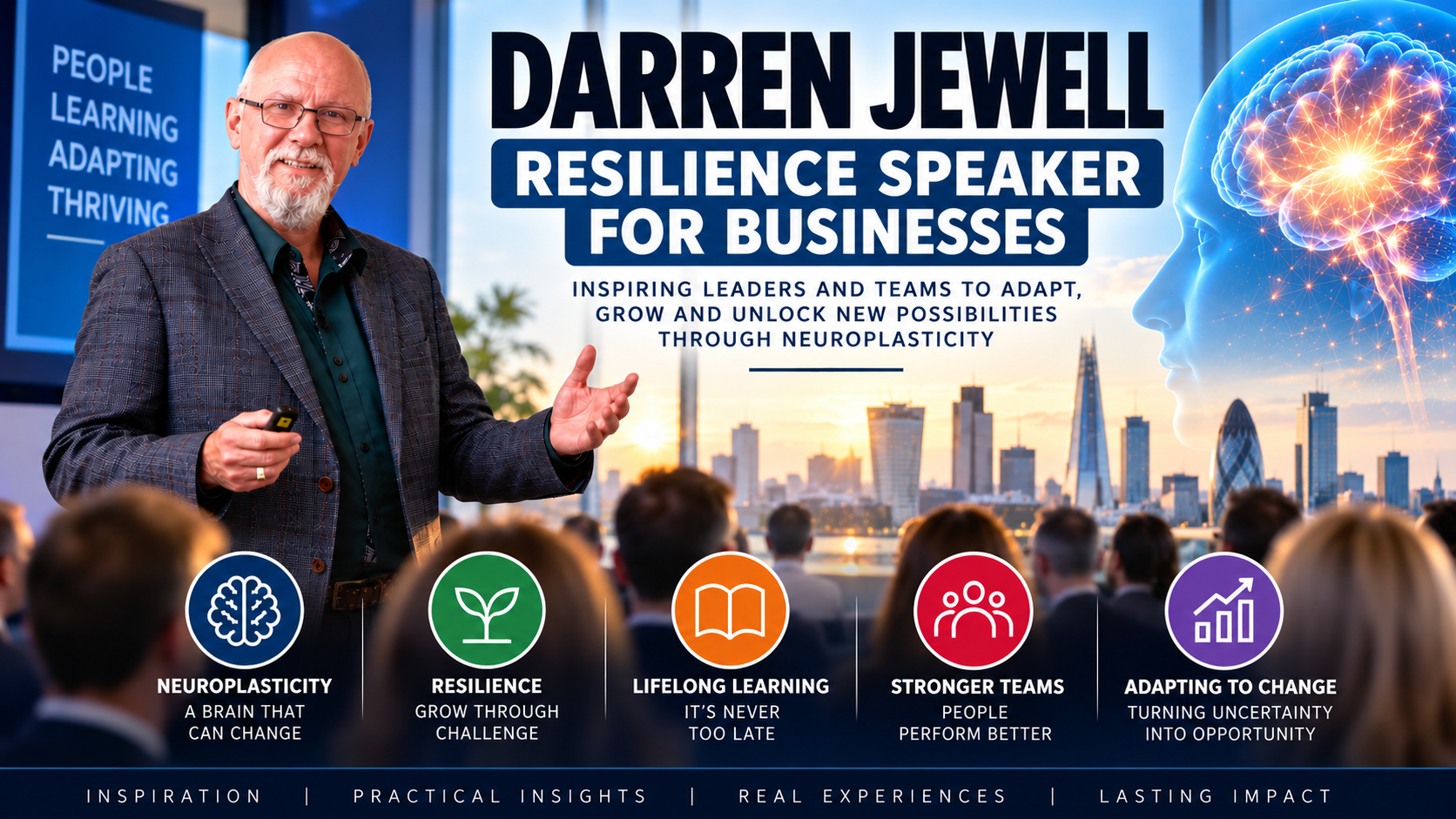
What separates organisations that struggle through change from those that learn, adapt and emerge stronger?
It is not always their technology, financial resources or market position.
Often, one of the most important differences is their people — how they respond to uncertainty, support one another, learn from setbacks and adapt to new challenges.
In today’s business environment, resilience has become an essential leadership and organisational capability.
Yet resilience is frequently misunderstood.
It is not about expecting employees to work harder, tolerate unlimited pressure or remain positive regardless of their circumstances.
Genuine resilience involves adaptability, psychological safety, supportive leadership and the ability to learn from experience.
For Darren Jewell, resilience speaker for businesses, neuroresilience coach and founder of Regain the Brain, these ideas are more than professional development concepts.
They are deeply connected to his personal experience of brain injury and his passion for understanding the remarkable adaptability of the human brain.
His message to businesses is clear:
The strongest organisations are not necessarily those that avoid challenges. They are those that create the conditions for people to learn, adapt and move forward together.
Why Resilience Matters More Than Ever in Business
The modern workplace is evolving at an extraordinary pace.
Artificial intelligence is transforming how organisations operate.
New technologies are changing established processes.
Economic uncertainty is influencing business decisions.
And employees are being asked to develop unfamiliar skills while maintaining performance.
For business leaders, this creates a significant challenge.
How do you encourage adaptability without overwhelming your workforce?
How do you support employees through change while maintaining productivity?
And how do you build confidence when the future feels uncertain?
These questions cannot be answered simply by telling people to become more resilient.
Organisations need to create environments where individuals feel supported, learning is encouraged and challenges can be approached constructively.
A resilience keynote speaker can help businesses begin these conversations by introducing new perspectives on change, confidence and personal development.
Darren Jewell: A Resilience Speaker with Lived Experience
There is a difference between understanding resilience as a theoretical concept and experiencing circumstances that demand significant adaptation.
Darren Jewell’s personal experience of brain injury has shaped his understanding of adversity, uncertainty and the importance of learning to approach life differently.
A brain injury can affect confidence, independence and familiar abilities.
Activities that once seemed straightforward may require additional concentration, patience or new strategies.
Progress may be unpredictable.
And the journey can involve challenges that are not always visible to others.
These experiences have influenced Darren’s interest in neuroplasticity, the brain’s ability to adapt and reorganise its connections through learning and experience.
They have also shaped his belief that resilience should not be confused with simply enduring hardship.
Sometimes resilience means asking for help.
Sometimes it means accepting that circumstances have changed.
And sometimes it means developing an entirely new approach to a familiar challenge.
These principles can provide valuable perspectives for business leaders navigating organisational change.
Resilience is not about pretending that difficulties do not exist. It is about developing constructive ways to respond to them.
What Is Neuroresilience, and Why Should Business Leaders Understand It?
Neuroresilience explores resilience through the lens of neuroscience, learning and the brain’s capacity for adaptation.
It draws on ideas associated with neuroplasticity, psychological flexibility, learning and behavioural development.
Neuroplasticity describes the brain’s ability to change its connections and functioning in response to experience.
This process contributes to how people develop new skills, form habits and adapt to unfamiliar situations.
For businesses, understanding these principles can encourage a more constructive approach to professional development.
Instead of assuming that employees possess fixed abilities, organisations can recognise that many skills improve through practice, feedback and appropriate support.
However, neuroplasticity is not a guarantee that every individual can master every skill or adapt at the same speed.
Learning depends on many factors, including previous experience, health, resources, motivation and the quality of training.
The practical message is that businesses should create opportunities for people to develop rather than making assumptions about their limitations.
Five Ways Resilient Organisations Approach Challenges Differently
1. They encourage learning rather than fearing mistakes
In workplaces where mistakes are automatically punished, employees may become reluctant to experiment or contribute unfamiliar ideas.
This can discourage innovation and prevent valuable lessons from emerging.
Resilient organisations recognise the difference between careless behaviour and reasonable mistakes made during learning.
They encourage reflection, constructive feedback and continuous improvement.
Employees are more likely to develop confidence when they know they can ask questions and learn without unnecessary embarrassment.
2. They support people through change
Organisational change can create uncertainty.
Employees may worry about their responsibilities, job security or ability to learn unfamiliar systems.
Effective leaders acknowledge these concerns rather than dismissing them.
They explain why changes are happening, provide appropriate training and allow time for adaptation.
Supportive communication can help reduce unnecessary uncertainty and encourage engagement.
3. They recognise the importance of psychological safety
Psychological safety refers to an environment where people feel able to speak up, ask questions and acknowledge mistakes without fear of humiliation or inappropriate punishment.
This is particularly important during periods of change.
Employees need to feel comfortable raising concerns and identifying problems.
A psychologically safe environment does not mean removing accountability.
It means creating conditions where honesty, learning and constructive discussion are encouraged.
4. They value different perspectives and experiences
Every employee brings a different combination of knowledge, skills and experiences.
These differences can contribute to creative thinking and better problem-solving.
Inclusive organisations recognise that people may approach challenges differently.
They also understand that some employees may require adjustments or additional support.
Darren’s experience of brain injury offers a personal perspective on the importance of looking beyond assumptions about someone’s abilities.
5. They understand that resilience requires recovery
A common misconception is that resilient employees should be able to withstand unlimited pressure.
In reality, chronic stress and insufficient recovery can affect concentration, decision-making and wellbeing.
Sustainable performance requires appropriate workloads, adequate rest and supportive management.
Resilience should never become an excuse for poor working conditions.
A resilient workplace is not one where people are expected to endure everything. It is one where people have the support and resources to respond effectively to challenges.
Neuroplasticity: The Science Behind Learning and Adaptability
One of the central themes of Darren’s speaking is neuroplasticity.
For much of the twentieth century, it was commonly assumed that the adult brain had relatively limited capacity for change.
Modern neuroscience has demonstrated that the brain remains capable of adaptation throughout adulthood.
When we learn new skills, practise unfamiliar tasks or acquire knowledge, activity within neural networks changes.
Repeated practice can contribute to changes in the strength and efficiency of certain connections.
These processes are involved in developing professional skills, learning new technologies and adapting to unfamiliar responsibilities.
For business leaders, the implications are significant.
Employees should not automatically be viewed as incapable of change because they have worked in a particular way for many years.
With suitable training, feedback and support, people can continue developing their capabilities.
This is especially relevant as artificial intelligence and digital transformation reshape workplaces.
Why Lifelong Learning Is a Competitive Advantage
Organisations often invest heavily in technology while overlooking the importance of helping employees develop the skills needed to use it effectively.
Yet technology alone does not create adaptability.
People need opportunities to understand unfamiliar tools, experiment with new approaches and build confidence through practice.
Lifelong learning supports this process.
Darren believes learning should continue throughout life, both professionally and personally.
He began learning the piano at 54, challenging the assumption that new skills must be developed during childhood.
Learning an instrument involves attention, memory, coordination and repeated practice.
It also requires a willingness to make mistakes.
For Darren, the experience represents a broader philosophy.
You are never too old to be curious, and you do not need to be an expert to begin learning something new.
In business, this mindset can encourage employees to approach professional development with greater openness.
Rather than seeing unfamiliar tasks as evidence of inadequacy, they can begin recognising them as opportunities to learn.
The Role of Resilience in Effective Leadership
Leadership is not simply about making decisions when everything is going well.
It is also about how leaders respond when circumstances become difficult.
During periods of uncertainty, employees often look to their leaders for direction, reassurance and clarity.
A leader who reacts to every setback with blame or frustration may unintentionally create an environment where people become afraid to speak openly.
By contrast, leaders who demonstrate curiosity, accountability and constructive problem-solving can encourage similar behaviours within their teams.
Resilient leadership involves several important capabilities.
Self-awareness: Recognising how personal reactions can influence decisions and relationships.
Adaptability: Remaining willing to reconsider established approaches when circumstances change.
Communication: Providing clear information and acknowledging uncertainty.
Empathy: Understanding that people respond differently to pressure and change.
Continuous learning: Seeking feedback and remaining open to developing new skills.
These capabilities are not necessarily fixed personality traits.
Many can be developed through experience, reflection, training and practice.
Building Confidence in Employees and Teams
Confidence plays an important role in workplace performance.
Employees who feel capable of learning and contributing may be more willing to participate in discussions, volunteer for responsibilities and explore unfamiliar approaches.
However, confidence can be affected by repeated setbacks, criticism or uncertainty.
Darren’s perspective on rebuilding confidence draws on his understanding of adversity and personal adaptation.
He encourages people to recognise the value of small achievements.
For example, an employee learning unfamiliar software may initially feel overwhelmed.
Rather than expecting immediate proficiency, a supportive manager can help them establish manageable learning goals.
Completing each stage provides evidence of progress.
Over time, this can contribute to greater familiarity and confidence.
The same principle can apply to public speaking, leadership development and professional transitions.
Confidence often develops through experience rather than appearing before we begin.
Why Businesses Need More Than Traditional Motivational Talks
Motivational speaking can create enthusiasm.
But enthusiasm alone does not necessarily produce lasting organisational change.
A meaningful keynote should encourage audiences to reflect on their behaviour, assumptions and opportunities for development.
Darren’s approach combines three important elements.
Personal experience
His lived experience of brain injury provides a perspective on adversity, adaptation and the importance of recognising individual challenges.
Accessible neuroscience
His interest in neuroplasticity helps audiences understand why learning and adaptation remain possible throughout adulthood.
Practical reflection
His message encourages people to consider how they approach unfamiliar challenges, develop confidence and remain curious.
The objective is not to promise that one presentation will transform an organisation.
It is to introduce ideas that can contribute to meaningful conversations and encourage constructive action.
Resilience in the Age of Artificial Intelligence
Artificial intelligence is creating both opportunities and uncertainty for businesses.
Some employees are excited about new technologies.
Others worry about how their roles may change.
Business leaders face the challenge of introducing innovation while supporting their workforce.
Resilience and adaptability are important during this transition.
However, successful adaptation requires more than encouraging employees to embrace change.
Organisations need to provide accessible training, clear communication and realistic opportunities to develop new skills.
Neuroplasticity reminds us that adults retain the capacity to learn.
This provides a useful perspective when considering how employees can develop the knowledge needed to work alongside emerging technologies.
Darren’s message encourages curiosity while recognising that meaningful learning takes time.
What Can Businesses Learn from the Experience of Brain Injury?
A brain injury and a workplace challenge are fundamentally different experiences.
They should never be treated as equivalent.
However, personal experiences of significant adversity can offer broader lessons about patience, adaptability and the importance of support.
Darren’s journey highlights several ideas that can resonate with business audiences.
Progress is not always predictable.
People may need different approaches to achieve similar objectives.
Confidence can be affected by unexpected circumstances.
Support can make a meaningful difference.
And personal capability should not be judged solely by previous performance.
These perspectives can encourage leaders to approach employees with greater understanding and flexibility.
What Can Audiences Take Away from a Darren Jewell Keynote?
A resilience keynote should leave audiences with ideas they can reflect on after the event.
Darren’s speaking themes encourage people to:
- Recognise that learning and adaptation remain possible throughout adulthood.
- Approach unfamiliar challenges with curiosity.
- Understand that resilience includes support, recovery and flexibility.
- Value small achievements as part of longer-term development.
- Challenge assumptions about age and personal capability.
- Consider how their behaviour influences the confidence of others.
- Explore opportunities for lifelong learning.
These themes can be relevant to senior leadership teams, managers, employees and professionals navigating career transitions.
Regain the Brain: Encouraging Resilience Through Lifelong Learning
Through Regain the Brain, Darren promotes the importance of curiosity, neuroplasticity and personal development.
His philosophy is that learning should not end when formal education finishes.
Whether someone is developing professional skills, learning a language, cooking a new recipe or exploring a creative hobby, unfamiliar experiences can provide opportunities for learning.
Darren wants people to recognise that growth does not always require dramatic achievements.
Sometimes it begins with one small decision.
One unfamiliar activity.
One new skill.
Or the willingness to become a beginner again.
For businesses, this philosophy can encourage a culture where learning is valued at every career stage.
Book Darren Jewell as a Resilience Speaker for Your Business
Are you organising a corporate conference, leadership event, employee wellbeing programme or professional development day?
Darren Jewell brings a distinctive personal perspective to conversations about resilience, neuroplasticity and lifelong learning.
As an inspirational speaker, neuroresilience coach and founder of Regain the Brain, he draws on his lived experience of brain injury to encourage audiences to think differently about adversity, confidence and adaptability.
His message is relevant to organisations navigating change, developing leaders or seeking to encourage a stronger culture of learning.
Whether your audience consists of CEOs, senior executives, managers or employees, Darren’s central message is one of curiosity, understanding and continued personal development.
The future belongs not simply to those who already know the answers, but to those who remain willing to learn, adapt and ask better questions.
To discover more about Darren Jewell and his inspirational speaking, visit www.regainthebrain.com.
Darren Jewell is an inspirational speaker, neuroresilience coach and founder of Regain the Brain. Drawing on his lived experience of brain injury, he advocates for resilience, neuroplasticity and lifelong learning as important elements of personal and professional development.