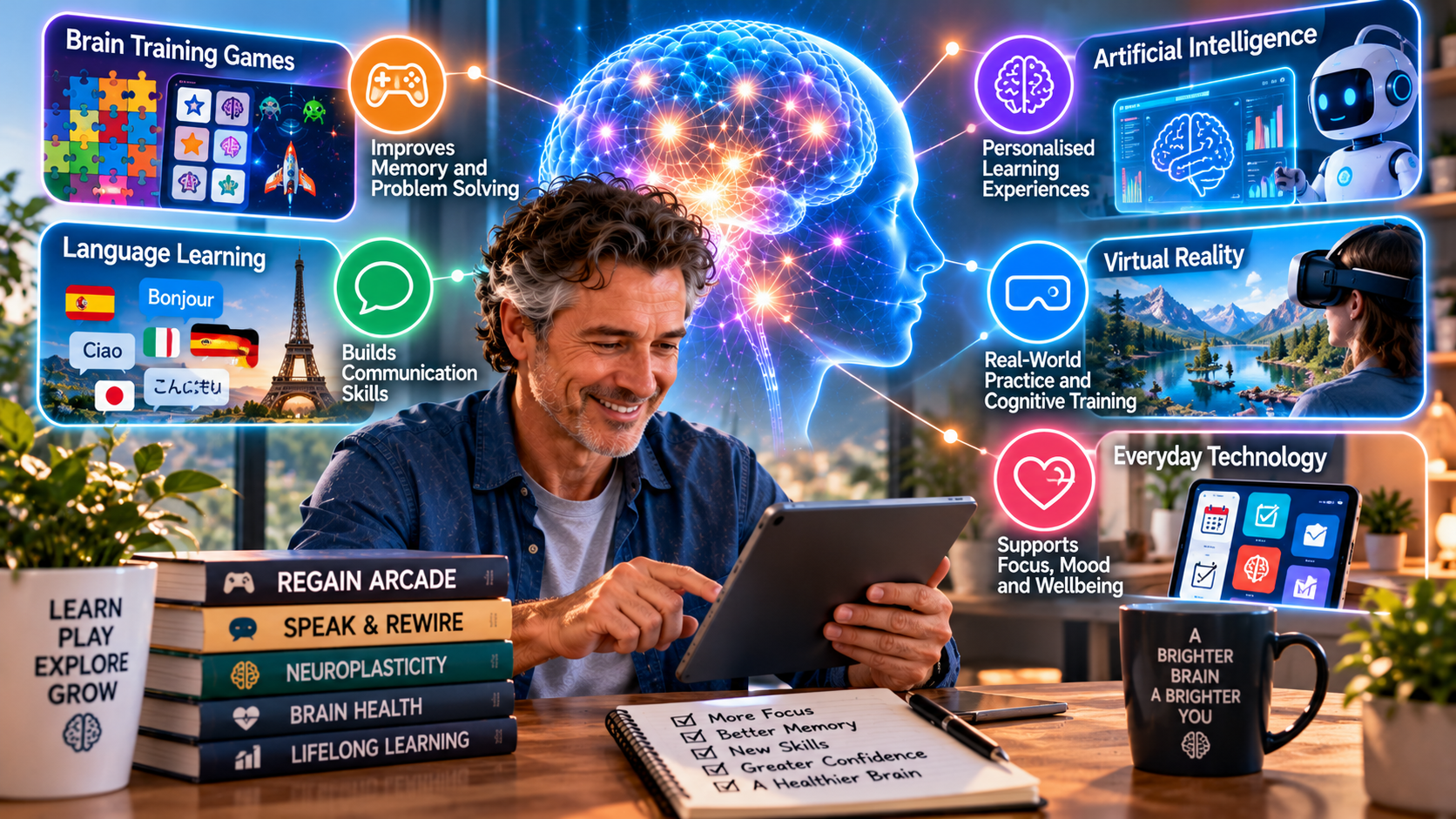
What if the technology we use every day could help us discover new ways to learn, challenge ourselves and understand how our brains work?
For many years, technology was often discussed as something that might make us mentally lazy.
We were warned that computers would stop us thinking for ourselves, smartphones would destroy our attention spans and video games would simply waste our time.
But the relationship between technology and the human brain is far more complicated.
Today, digital tools can help us learn foreign languages, practise musical instruments, explore virtual environments and develop unfamiliar skills.
Researchers are also investigating how technologies such as artificial intelligence, virtual reality and brain-computer interfaces might support neurological rehabilitation.
The possibilities are fascinating.
But there is an important distinction between technology that challenges us mentally and technology that has been scientifically demonstrated to improve overall brain health.
Not every brain-training game produces lasting cognitive benefits.
And not every digital activity that feels mentally demanding will improve memory, concentration or problem-solving in everyday life.
Nevertheless, technology is changing the way we learn, practise skills and engage with cognitive challenges.
And when combined with an understanding of neuroplasticity, it raises some interesting questions about the future of brain health.
1. What Is Brain Training?
Brain training generally refers to activities designed to challenge particular cognitive abilities.
These may include memory, attention, processing speed, reasoning, language or problem-solving.
Traditionally, people have engaged in mentally stimulating activities through reading, puzzles, board games, education and creative hobbies.
Digital technology has expanded the range of activities available.
Today, someone can practise a memory game on their phone, learn vocabulary through an app or complete interactive puzzles on a computer.
Some programmes are designed specifically as cognitive training tools.
Others are simply enjoyable activities that happen to involve cognitive skills.
This distinction matters.
A game that requires concentration is not automatically a clinically validated brain-training programme.
And improving your score in a game does not necessarily mean your memory or attention has improved in unrelated situations.
The scientific challenge is determining whether the benefits of practising one activity transfer to everyday life.
This is often called transfer of learning.
Researchers continue to investigate when, how and for whom this transfer occurs.
2. How Neuroplasticity Makes Learning Possible
Neuroplasticity is the brain’s ability to change its structure, connections and functions in response to experience, learning and other influences.
It is one of the biological foundations of learning.
When we practise an unfamiliar skill, networks of neurons become involved in processing information and coordinating our responses.
With repeated experience, these networks can adapt.
This may contribute to improvements in performance.
For example, someone learning to type may initially need to look at every key.
With practice, their movements can become more efficient.
Someone learning a language may initially struggle to remember unfamiliar words.
Over time, repeated exposure and retrieval practice can improve vocabulary knowledge.
Digital tools can provide opportunities for this kind of structured learning.
They can offer repetition, feedback and adjustable levels of difficulty.
However, neuroplasticity is not automatically beneficial in every circumstance.
And it does not mean that every digital activity creates meaningful improvements in overall cognitive health.
Technology can provide opportunities for learning-related neuroplasticity, but the value of those opportunities depends on what we practise and how we practise it.
3. How Brain-Training Games Challenge Cognitive Skills
Digital games can involve a wide range of mental activities.
A memory-matching game requires players to remember where particular objects appeared.
A puzzle game may involve planning and problem-solving.
A reaction-time game challenges the player to respond to changing information.
A strategy game may require decision-making and flexible thinking.
These activities can be engaging because they combine challenges with immediate feedback.
Players can often see their progress.
They may unlock new levels.
Or they may attempt to improve their previous performance.
This can encourage repeated practice.
Research suggests that people can improve at cognitive tasks they practise.
But broader benefits are less certain.
Some studies report improvements in specific cognitive abilities following particular training programmes, while others find limited evidence that these gains transfer widely.
For this reason, brain-training games should be approached with realistic expectations.
They can be enjoyable ways to challenge particular skills.
But they should not be promoted as guaranteed methods for preventing dementia, treating brain injury or improving general intelligence.
4. Why I Created Regain Arcade
My interest in brain health, neuroplasticity and technology has encouraged me to explore ways of making cognitive challenges more enjoyable.
One of those projects is Regain Arcade.
The idea is to create a collection of accessible digital games that involve different cognitive skills.
Some games focus on memory.
Others involve attention, sequencing, visual searching, coordination or problem-solving.
I wanted to explore how familiar arcade-style experiences could be adapted into activities that encourage people to participate, experiment and learn.
For example, a game involving a shopping list might challenge players to remember several items.
A hidden-object game could involve visual attention.
A sequencing game might require players to arrange steps in the correct order.
And a gentle reaction game could offer opportunities to practise responding to visual information.
These activities are intended to be engaging and accessible.
They are not clinically validated neurological rehabilitation treatments.
But they reflect my belief that learning and cognitive challenges do not always need to feel like formal exercises.
Sometimes, making an activity enjoyable is an important part of encouraging people to participate.
5. Can Video Games Be Good for Your Brain?
The idea that video games might have cognitive benefits has attracted considerable research interest.
Different types of games involve different mental demands.
Action games may require rapid visual attention and responses.
Strategy games can involve planning and decision-making.
Puzzle games often require pattern recognition and problem-solving.
Some research has identified improvements in particular cognitive tasks associated with certain gaming experiences.
However, the evidence is mixed.
The effects depend on the type of game, the skills being measured, the player’s previous experience and the quality of the research.
It would be misleading to claim that playing any video game will improve brain health.
But it would also be inaccurate to assume that all gaming is mentally passive.
Many games require active processing, learning and decision-making.
The key is to recognise what a game actually involves and avoid exaggerating its benefits.
For some people, gaming can also provide enjoyment, relaxation and social interaction.
Those experiences can have value in their own right.
6. How Artificial Intelligence Could Personalise Brain Training
Artificial intelligence is beginning to influence many areas of education and healthcare.
One interesting possibility is personalised digital learning.
Imagine a programme that monitors how someone performs during an activity.
If they consistently complete a task successfully, the programme might introduce additional challenges.
If they begin making frequent errors, it could reduce the difficulty or provide more guidance.
Some adaptive programmes already use predetermined rules to make these adjustments.
AI-based systems may use more complex approaches to identify patterns and personalise activities.
For example, an intelligent learning tool might analyse response times, accuracy and previous performance.
It could then suggest exercises appropriate to the person’s current level.
However, the ability to personalise a task does not automatically make the programme clinically effective.
Researchers still need to demonstrate whether these systems produce meaningful benefits.
AI also introduces concerns about privacy, accuracy, bias and transparency.
Particularly in healthcare, technology must be evaluated carefully.
The most promising future is one in which AI supports human learning and professional expertise rather than replacing them.
7. Virtual Reality and the Future of Cognitive Training
Virtual reality, commonly known as VR, allows people to interact with computer-generated environments.
Instead of completing an activity on a flat screen, users may feel as though they are inside a simulated setting.
This creates interesting possibilities for learning.
Imagine practising how to navigate a busy supermarket.
Or exploring a virtual city while following directions.
A person might complete tasks involving attention, memory, spatial awareness or decision-making.
Researchers are exploring how virtual reality could be used in education, training and neurological rehabilitation.
Some studies have reported promising findings for particular applications.
However, the evidence varies considerably.
Virtual reality can also create difficulties for some users.
These may include dizziness, nausea, visual discomfort, fatigue or sensory overload.
Accessibility and safety therefore need careful consideration.
For people living with neurological conditions, professional guidance may be necessary before using certain rehabilitation applications.
VR offers exciting possibilities, but it is not suitable for everyone.
8. How Language-Learning Apps Challenge the Brain
One of the most interesting uses of technology is language learning.
Modern apps can provide access to vocabulary, pronunciation exercises, listening activities and interactive lessons.
This allows people to practise unfamiliar languages without attending a traditional classroom.
Language learning involves several cognitive processes.
You need to remember vocabulary.
Recognise unfamiliar sounds.
Understand patterns.
Retrieve information.
And develop communication skills.
These activities engage networks involved in memory, attention and language processing.
Research suggests that learning a second language involves neuroplastic changes, although the broader cognitive benefits remain an area of investigation.
It has not been proven that learning a language prevents dementia.
Nevertheless, language learning can be an enjoyable and meaningful activity throughout adulthood.
And technology can make it easier to begin.
9. Speak & Rewire: Making Language Learning More Accessible
Another project I have been developing is Speak & Rewire.
The aim is to make language learning welcoming and enjoyable.
I wanted to create an experience where people could explore useful words and phrases without feeling overwhelmed.
Learning a language can be particularly rewarding because it has an immediate practical purpose.
You might learn a greeting before visiting another country.
Practise ordering food.
Or discover how to introduce yourself in a different language.
These small achievements can encourage further learning.
Speak & Rewire reflects my interest in lifelong learning and accessible technology.
It is an educational language-learning project rather than a clinically validated brain-health intervention.
But it demonstrates how digital tools can make unfamiliar learning experiences more approachable.
And that is something I believe technology can do particularly well.
10. Technology and Brain Injury Rehabilitation
Following a brain injury, people may experience difficulties with memory, attention, movement, communication or fatigue.
Rehabilitation often involves specialist assessment and individually tailored support.
Researchers are exploring whether digital technologies can complement established rehabilitation approaches.
For example, computer-based activities may provide opportunities to practise selected skills.
Virtual environments might allow someone to work through simulated everyday tasks.
Wearable devices may help monitor aspects of movement.
And AI-based tools could potentially support personalised programmes.
However, the effectiveness of these approaches varies.
A digital activity that improves performance on a computer screen may not necessarily improve everyday functioning.
Brain injury rehabilitation also requires consideration of emotional wellbeing, fatigue, accessibility and individual goals.
Technology should therefore be used appropriately and, where relevant, under professional guidance.
It should not replace qualified healthcare professionals.
11. Why Accessibility Is Essential in Brain-Training Technology
One of the challenges with digital learning tools is that people have different needs.
Some users may experience visual difficulties.
Others may struggle with fine motor control.
Some may have memory or attention difficulties.
And others may experience cognitive fatigue.
A programme that works well for one person may be frustrating or inaccessible to another.
This is why accessibility should be part of the design process.
Useful features may include adjustable difficulty, larger text, clear instructions and flexible timing.
Reduced animation can help people who experience visual sensitivity.
Alternative control methods may support users with physical limitations.
And opportunities to pause or repeat instructions can make activities more manageable.
Accessibility is not simply about making a product easier.
It is about allowing more people to participate.
The most advanced technology is not necessarily the most useful technology. Sometimes, the best innovation is making something simpler and more accessible.
12. Can Brain-Training Apps Prevent Dementia?
This is one of the most important questions to address.
Many commercial brain-training products suggest that regular use can protect the brain against ageing.
But the scientific evidence does not justify broad promises.
Although some cognitive training programmes have demonstrated benefits in particular cognitive tasks, it has not been established that commercial brain-training games generally prevent dementia.
Research into dementia risk reduction points towards a range of potentially modifiable factors.
These include cardiovascular health, physical activity, hearing health, social engagement and other aspects of lifestyle.
Cognitive engagement may be part of a broader approach to healthy ageing.
But no single app can guarantee protection against neurological disease.
People should therefore be cautious about products making dramatic claims.
A brain-training app may be enjoyable.
It may help you become better at particular tasks.
But those benefits should not be confused with proven prevention or treatment.
13. Why Technology Should Encourage Real-World Learning
One of the most useful ways to think about digital learning is as a starting point.
An app can help you learn vocabulary.
But using those words in conversation provides another learning experience.
A game can challenge planning.
But organising a real activity involves additional skills and demands.
A music-learning programme can introduce notes.
But practising an instrument develops physical and auditory abilities through direct experience.
Technology is most valuable when it supports meaningful goals.
Rather than asking whether an app makes someone generally smarter, we might ask:
Does it help them learn something they want to know?
Does it make an activity more accessible?
Does it encourage participation?
Does it support a useful real-world skill?
These questions help keep technology focused on human needs.
14. The Risks of Spending Too Much Time on Screens
Although technology offers opportunities for learning, balance matters.
Excessive screen use can interfere with sleep, physical activity and other important parts of daily life.
Some people may also experience eye strain, headaches or discomfort during prolonged sessions.
Highly engaging digital experiences can make it easy to lose track of time.
This is why healthy digital habits matter.
Taking breaks can help reduce prolonged sitting.
Limiting stimulating activities before bedtime may support sleep for some individuals.
And maintaining opportunities for physical movement, face-to-face interaction and offline hobbies contributes to a balanced lifestyle.
Technology should enrich our lives rather than displace everything else.
For brain health, a combination of activities is likely to be more sensible than relying exclusively on digital exercises.
15. Seven Ways to Use Technology to Challenge Your Brain
If you want to explore digital learning, here are seven practical ideas.
1. Learn a few words in another language
Use a language-learning app to practise useful vocabulary and pronunciation.
2. Try a puzzle or strategy game
Choose something that requires attention, planning or problem-solving.
3. Explore digital music lessons
Learn basic notes, rhythms or techniques for an instrument.
4. Use technology to develop a new skill
Try photography, coding, digital drawing or another unfamiliar activity.
5. Practise memory strategies
Use digital reminders, checklists or structured learning tools to support everyday organisation.
6. Explore accessible games
Choose activities with adjustable difficulty and controls appropriate for your abilities.
7. Connect digital learning with real life
Apply what you practise through conversations, hobbies and everyday experiences.
The aim is not to complete as many activities as possible.
It is to choose experiences that are enjoyable, appropriate and meaningful.
16. What Might Brain Training Look Like in the Future?
The next twenty years could bring significant developments in digital learning and rehabilitation technology.
Artificial intelligence may allow educational tools to become more personalised.
Virtual reality could provide increasingly realistic environments for practising skills.
Wearable devices may offer new ways to understand movement and activity.
Brain-computer interfaces may eventually support certain forms of communication and interaction for people with severe disabilities.
But these possibilities should be approached with both excitement and scientific caution.
Some technologies will prove valuable.
Others may not deliver the benefits initially promised.
And some may introduce new challenges involving privacy, affordability or accessibility.
The future of brain-training technology should not be judged simply by how sophisticated it becomes.
It should be judged by whether it genuinely helps people learn, participate and improve their quality of life.
17. My Vision for Technology and Lifelong Learning
My interest in neuroplasticity began with a fascination for the human brain and its capacity for adaptation.
My lived experience of brain injury has also influenced how I think about accessibility, resilience and the importance of recognising individual differences.
Through Regain the Brain, I want to encourage people to remain curious about learning.
I believe technology can play a valuable role in that process.
Not because every game or app will transform cognitive health.
But because well-designed tools can make learning more engaging and accessible.
Regain Arcade and Speak & Rewire are examples of how I am exploring those possibilities.
They reflect a simple idea.
Learning should not stop because we reach a certain age, experience a setback or feel uncertain about trying something unfamiliar.
Technology can help create opportunities to begin again.
Final Thoughts: The Future of Brain Training Is About People, Not Just Technology
We are living through a period of extraordinary technological development.
Artificial intelligence, virtual reality and digital learning platforms are changing how we access information and develop skills.
Some of these technologies may eventually make important contributions to neurological rehabilitation and cognitive health.
Others will remain primarily educational or recreational tools.
And that is perfectly acceptable.
Not every enjoyable activity needs to be presented as a medical treatment.
Sometimes, learning a language, solving a puzzle or playing a game is valuable because it encourages curiosity and provides enjoyment.
Neuroplasticity reminds us that the brain retains the capacity to adapt through experience.
Technology can provide new ways to engage in those experiences.
But the most important part of the process remains human.
Our curiosity.
Our willingness to practise.
Our ability to learn from mistakes.
And our desire to keep discovering what is possible.
The future of brain training isn’t simply about creating smarter technology.
It’s about using technology to create more opportunities for people to learn, adapt and enjoy life.
And that is a future I am excited to explore.
About Darren Jewell
Darren Jewell is a neuroresilience coach, inspirational speaker and founder of Regain the Brain.
Drawing on his lived experience of brain injury and his passion for neuroplasticity, Darren encourages individuals and organisations to embrace lifelong learning, develop resilience and explore new possibilities.
He is also developing digital educational projects including Regain Arcade, a collection of accessible games involving different cognitive challenges, and Speak & Rewire, a language-learning experience designed to encourage curiosity and practice.
Through inspirational speaking and coaching, Darren shares insights into learning, adaptability and the importance of continuing to challenge ourselves throughout life.
Technology may change how we learn. But curiosity will always be one of the reasons we begin.
Discover more at www.regainthebrain.com.
This article is intended for general educational purposes. Digital games and learning apps should not be considered substitutes for medical treatment, neurological rehabilitation or professional healthcare advice.