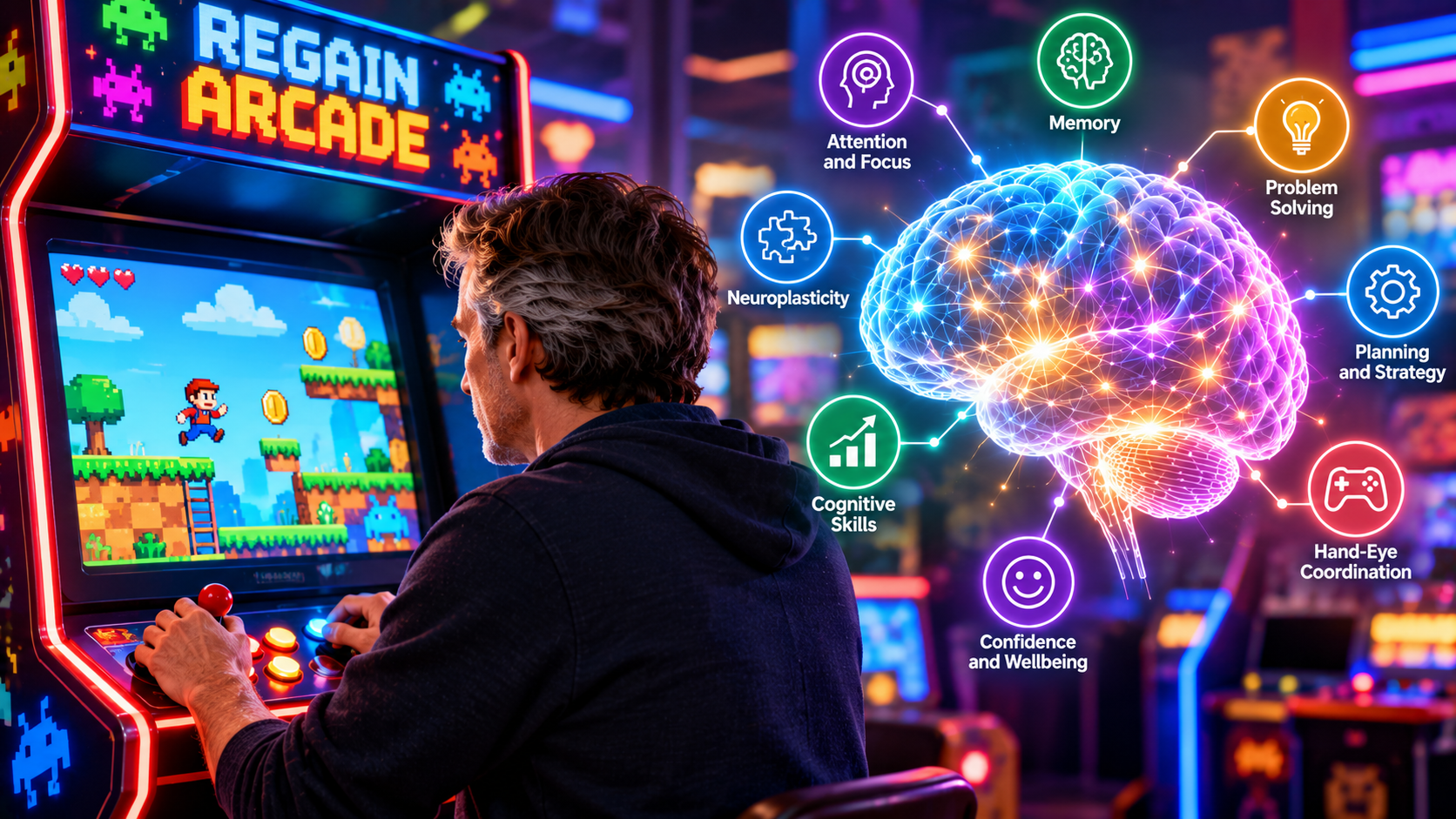
What if something millions of people enjoy for entertainment could also provide an opportunity to challenge their brains?
For decades, video games have attracted criticism.
We’ve heard concerns about excessive screen time, inactivity, addiction and the potential effects of gaming on children and adults.
Some of these concerns are justified, particularly when gaming begins to interfere with sleep, physical activity, relationships or everyday responsibilities.
But there is another side to the conversation.
What if certain video games could also provide opportunities to practise attention, memory, coordination, problem-solving and decision-making?
What if gaming could encourage people to learn unfamiliar skills, respond to changing situations and develop new strategies?
And what if the enjoyment of playing a game could make people more willing to engage in challenging activities?
These are questions that interest me enormously.
As someone passionate about neuroplasticity, lifelong learning and brain health, I believe we should look beyond the assumption that video games are simply a waste of time.
The science is more nuanced.
Not every video game is beneficial, and playing games does not automatically make your brain healthier. But certain games can provide meaningful cognitive challenges.
Let’s explore why.
What Happens in Your Brain When You Play a Video Game?
When you play a video game, your brain is not simply watching images on a screen.
Depending on the game, you may be processing visual information, making decisions, remembering instructions, coordinating movements and responding to unexpected events.
Imagine playing a game in which you must navigate a character through a maze.
You need to identify obstacles, remember possible routes and decide which direction to take.
Now imagine playing a fast-moving arcade game.
You may need to track moving objects, anticipate their movements and respond quickly.
Or consider a strategy game.
You might need to plan several moves ahead, manage resources and adapt when your original strategy fails.
These activities engage different cognitive processes.
The specific demands depend on the design of the game.
A puzzle game challenges the brain differently from a racing game, and a language-learning game involves different skills from a shooting game.
This is one reason researchers are interested in studying different types of games rather than treating all gaming as a single activity.
1. Video Games Can Challenge Attention and Concentration
Attention is essential for everyday life.
We rely on it when driving, reading, following conversations, working and learning new skills.
Certain video games require players to concentrate on relevant information while ignoring distractions.
For example, a game may involve tracking several moving objects while responding to changes in the environment.
Players must decide which information deserves attention and when to act.
Some studies of action video games have reported improvements in particular visual attention skills.
However, research findings vary, and improvements in game performance do not necessarily translate into better attention in everyday situations.
This distinction is important.
Becoming exceptionally good at a game does not automatically mean someone will become better at concentrating during meetings or remembering appointments.
Nevertheless, games that require focused attention can provide opportunities to practise attention-related tasks in an engaging environment.
And for many people, that engagement is part of the appeal.
2. Puzzle Games Encourage Problem-Solving
Think about classic puzzle games.
Tetris.
Sudoku.
Matching games.
Logic puzzles.
Maze challenges.
Each requires the player to identify patterns, consider possibilities and make decisions.
In Tetris, for example, players must mentally rotate shapes and decide where they should fit.
This involves visual-spatial processing.
In a logic puzzle, players may need to evaluate information, eliminate incorrect possibilities and test different approaches.
These activities involve problem-solving.
One particularly interesting aspect of puzzle games is the way they encourage repeated attempts.
A player may fail to complete a level several times.
They adjust their strategy.
They experiment with a different approach.
Eventually, they discover a solution.
This resembles an important part of learning.
We attempt something, evaluate the result and modify our approach.
The ability to adapt strategies is valuable in many areas of life.
Although puzzle games are not guaranteed to improve general intelligence, they can provide enjoyable opportunities to engage in structured problem-solving.
3. Gaming Can Involve Memory
Memory plays an important role in many video games.
Players may need to remember instructions, locations, sequences or patterns.
Consider a game such as Simon, where a sequence of colours or sounds must be remembered and repeated.
As the sequence becomes longer, the challenge increases.
Other games require players to remember where objects are hidden or which tasks need to be completed.
These activities place demands on working memory and other memory systems.
Working memory allows us to temporarily hold and manipulate information.
It is involved in everyday activities such as following directions, completing calculations and remembering what someone has just said.
Memory games can help players practise the particular tasks involved.
However, there is an important limitation.
Research on cognitive training suggests that improvements are often strongest in the tasks people practise, while broader improvements in unrelated everyday abilities are less certain.
This does not make memory games pointless.
It simply means we should be realistic about what they can achieve.
A game can be enjoyable, challenging and rewarding without needing to promise dramatic improvements in memory.
4. Video Games Can Challenge Hand-Eye Coordination
Many games require coordination between what we see and how we move.
When playing a racing game, we observe the road and adjust our controls.
In an arcade game, we track moving objects and respond using buttons or a joystick.
In a platform game, we judge distances and time our movements.
These activities involve communication between visual, sensory and motor systems.
With practice, players often become more accurate and efficient at the specific movements required.
This is an example of motor learning.
The brain can adapt as we practise coordinated movements.
For some individuals, games may also offer an accessible way to engage in movement-based activities.
However, the suitability of a game depends on a person’s abilities and circumstances.
Someone living with a neurological condition may experience fatigue, visual sensitivity, movement difficulties or other symptoms that make certain games unsuitable.
Accessibility settings, adjustable difficulty and opportunities to rest can therefore be particularly important.
5. Strategy Games Encourage Planning and Decision-Making
Some video games require much more than quick reactions.
Strategy games often involve planning, prioritising and evaluating different options.
Imagine managing a virtual city.
You need to decide where to build roads, how to allocate resources and how to respond to changing circumstances.
Every decision may influence what happens next.
Or consider a game of chess.
You need to anticipate your opponent’s moves, evaluate possible outcomes and adapt your strategy.
These activities involve executive functions.
Executive functions are cognitive processes that help us plan, organise, regulate behaviour and work towards goals.
Games that involve strategy can provide opportunities to engage these abilities.
They may also encourage players to recognise that there is often more than one way to solve a problem.
And that is an important lesson beyond gaming.
Sometimes, our first approach does not work.
The ability to reconsider and try something different can be valuable.
6. What Does Neuroplasticity Have to Do With Gaming?
Neuroplasticity is the brain’s ability to change its connections, structure and functions in response to learning, experience and other influences.
When we practise a skill repeatedly, the neural networks involved can adapt.
This applies to many activities.
Playing a musical instrument.
Learning a language.
Developing a sporting skill.
And learning to play a video game.
When someone begins an unfamiliar game, they may struggle with the controls, instructions or challenges.
Over time, they learn the rules.
They recognise patterns.
Their movements become more accurate.
They develop strategies.
These changes in performance reflect learning, which can involve neuroplasticity.
But there is an important distinction.
Neuroplasticity does not automatically mean that an activity produces a clinically meaningful improvement in brain health.
The brain adapts to many experiences, including some that are not beneficial.
The important questions are what someone is learning, whether the activity is appropriate and whether any improvements extend beyond the game itself.
Understanding this helps us appreciate the potential of gaming without exaggerating the science.
7. Could Video Games Support Brain Injury Rehabilitation?
This is a subject that particularly interests me because of my lived experience of brain injury.
Following a brain injury, people may experience difficulties involving memory, attention, coordination, processing speed or other abilities.
Rehabilitation often involves carefully selected activities designed to address individual needs and goals.
Researchers have explored whether digital games, virtual reality and game-based exercises can support certain aspects of neurological rehabilitation.
Some studies suggest that appropriately designed interventions may help with particular rehabilitation goals, especially when integrated into structured treatment programmes.
However, the evidence varies depending on the condition, type of intervention and outcome being measured.
A commercially available video game is not automatically a rehabilitation tool.
And a game that is enjoyable for one person may be unsuitable for another.
For example, fast-moving graphics, flashing lights or complicated controls may cause difficulties for people experiencing visual sensitivity, fatigue or cognitive overload.
This is why accessible design matters.
Games intended for people with neurological difficulties should consider adjustable difficulty, clear instructions, manageable sensory demands and opportunities to pause.
They should also avoid promising medical outcomes that have not been demonstrated.
Gaming may have a role as a supportive activity, but it should not be presented as a replacement for professional rehabilitation.
8. Why Enjoyment Matters When Learning
One of the greatest challenges in learning is maintaining motivation.
We may begin a new activity with enthusiasm but lose interest when it becomes difficult.
Video games often use features designed to encourage continued engagement.
Players receive feedback.
They complete challenges.
They unlock new levels.
They see their progress.
These features can make practice feel rewarding.
And repeated practice is often important when developing a new skill.
Imagine two activities requiring similar levels of concentration.
One feels repetitive and frustrating.
The other feels enjoyable and gives you a clear sense of progress.
You may be more willing to return to the second activity.
This is one reason game-based learning attracts interest in education and rehabilitation.
However, enjoyment and engagement should be balanced with wellbeing.
Games should encourage healthy participation rather than excessive or compulsive use.
The aim is to make learning accessible and enjoyable, not to keep someone playing indefinitely.
9. Why I Created Regain Arcade
My interest in gaming goes beyond simply playing video games.
It has also inspired me to explore creating games through my Regain the Brain project.
I wanted to bring together three things that matter to me:
Learning, enjoyment and accessibility.
The result is Regain Arcade, a collection of games designed to offer enjoyable challenges involving different cognitive and practical skills.
The idea is simple.
People should have opportunities to engage in activities that encourage them to think, concentrate, remember, plan and solve problems.
And those activities should be enjoyable.
Some games involve memory.
Others involve coordination, attention, sequencing or problem-solving.
For example, a memory game might challenge players to remember a sequence.
A hidden-object game might encourage visual searching.
A puzzle game might involve planning and recognising patterns.
A cooking-themed game might involve remembering instructions and completing tasks in the correct order.
The aim is not to claim that these games can cure neurological conditions or prevent cognitive decline.
They have not been established as clinical treatments.
Instead, Regain Arcade is intended to make cognitive challenges approachable and entertaining.
I also believe that accessibility should be an important part of game design.
Not everyone has the same abilities.
Some people need additional time.
Others may benefit from reduced visual stimulation, simpler controls or the ability to adjust difficulty.
Providing choices can help more people participate comfortably.
And that is something I want to continue developing.
10. Are All Video Games Good for the Brain?
No.
It would be misleading to suggest that every video game provides meaningful cognitive benefits.
Games differ enormously in their design and demands.
Some require complex decision-making.
Others involve relatively simple repeated actions.
And the amount of time spent gaming matters.
Excessive gaming can interfere with sleep, physical activity, work, relationships and other important aspects of life.
For a small proportion of people, gaming behaviour can become seriously problematic.
The World Health Organization recognises gaming disorder as a condition involving impaired control over gaming and continued gaming despite significant negative consequences.
That does not mean gaming is harmful for everyone.
It means balance matters.
A healthy approach might involve choosing games that are enjoyable and appropriately challenging, taking regular breaks and ensuring gaming remains one part of a varied lifestyle.
Physical exercise, social interaction, adequate sleep and other forms of learning remain important.
Video games should complement these activities rather than replace them.
11. Can Older Adults Benefit From Gaming?
Video games are often associated with younger generations.
But there is no reason that older adults cannot enjoy learning to play them.
In fact, learning an unfamiliar game may involve several challenges at once.
Understanding new rules.
Remembering controls.
Coordinating movements.
Solving problems.
Adapting to unfamiliar technology.
For someone who has never played video games, even a simple puzzle game can provide a new learning experience.
Some research has explored the potential of video-game-based training in older adults, with promising findings for certain cognitive outcomes.
However, results are mixed, and evidence that gaming prevents dementia or produces broad, lasting cognitive improvements remains insufficient.
The value of gaming may also extend beyond cognitive performance.
Games can provide entertainment, social interaction and a sense of achievement.
They may offer opportunities for grandparents to connect with grandchildren or for friends to enjoy a shared activity.
And they can challenge the assumption that learning new technology is only for younger people.
One of my strongest beliefs is that we should never allow age alone to stop us from exploring something unfamiliar.
12. Five Ways to Make Gaming a Positive Experience
If you are interested in exploring video games as an enjoyable cognitive activity, here are five suggestions.
1. Choose games that challenge you appropriately.
Look for activities involving memory, strategy, coordination or problem-solving that match your interests and abilities.
2. Start with manageable sessions.
There is no need to play for hours. Short sessions can provide an opportunity to learn without unnecessary fatigue.
3. Try different types of games.
Explore puzzles, strategy games, memory challenges and other genres to discover what you enjoy.
4. Pay attention to how you feel.
If a game causes headaches, dizziness, visual discomfort, fatigue or frustration, stop and consider whether it is appropriate for you.
5. Keep gaming balanced.
Continue making time for exercise, sleep, social relationships and activities away from screens.
For anyone living with brain injury or another neurological condition, it may be helpful to discuss suitable activities with a rehabilitation professional.
13. The Future of Gaming and Brain Health
Technology continues to create new possibilities.
Virtual reality can provide interactive environments.
Motion-controlled games can encourage physical movement.
Adaptive software can adjust difficulty based on performance.
Artificial intelligence may enable increasingly personalised learning experiences.
Researchers are exploring how these technologies might contribute to education, cognitive assessment and rehabilitation.
But innovation should be accompanied by careful scientific evaluation.
A technology can be exciting without being clinically effective.
The challenge is to identify which approaches genuinely help people, under what circumstances and for which outcomes.
I believe the future of game-based learning is particularly interesting.
Not because video games offer a magical solution to brain health, but because they can make challenging activities more accessible, engaging and enjoyable.
And when people enjoy learning, they may be more willing to continue.
Final Thoughts: Perhaps It’s Time to Think Differently About Gaming
Video games have often been portrayed as something we should avoid.
But perhaps the conversation needs greater balance.
Gaming is not automatically good or bad for the brain.
Its effects depend on the game, the person, the amount of time spent playing and the wider context.
Certain games can challenge memory, attention, coordination, planning and problem-solving.
They can introduce unfamiliar experiences and provide opportunities to practise new skills.
They can also bring enjoyment, achievement and social connection.
That doesn’t mean gaming should replace exercise, education, rehabilitation or other important activities.
It means we should recognise that learning can take many forms.
Sometimes it happens in a classroom.
Sometimes it happens while learning a musical instrument.
Sometimes it happens in the kitchen.
And sometimes it happens while playing a video game.
The important question isn’t simply whether you’re playing a game.
It’s what you’re learning, how you’re engaging and whether the experience is adding something positive to your life.
So perhaps the next time someone tells you that playing video games is a waste of time, you can explain that the answer is a little more interesting than that.
And who knows?
You might even encourage them to try a game themselves.
About Darren Jewell
Darren Jewell is a neuroresilience coach, inspirational speaker and founder of Regain the Brain.
Drawing on his lived experience of brain injury and his passion for neuroplasticity, Darren encourages people to embrace lifelong learning, develop resilience and explore new ways to challenge themselves.
Through projects such as Regain Arcade, he aims to make learning and cognitive challenges enjoyable and accessible.
Discover more at www.regainthebrain.com.
This article is for general educational purposes and does not constitute medical advice. Video games and Regain Arcade should not be considered substitutes for clinical assessment, treatment or rehabilitation.