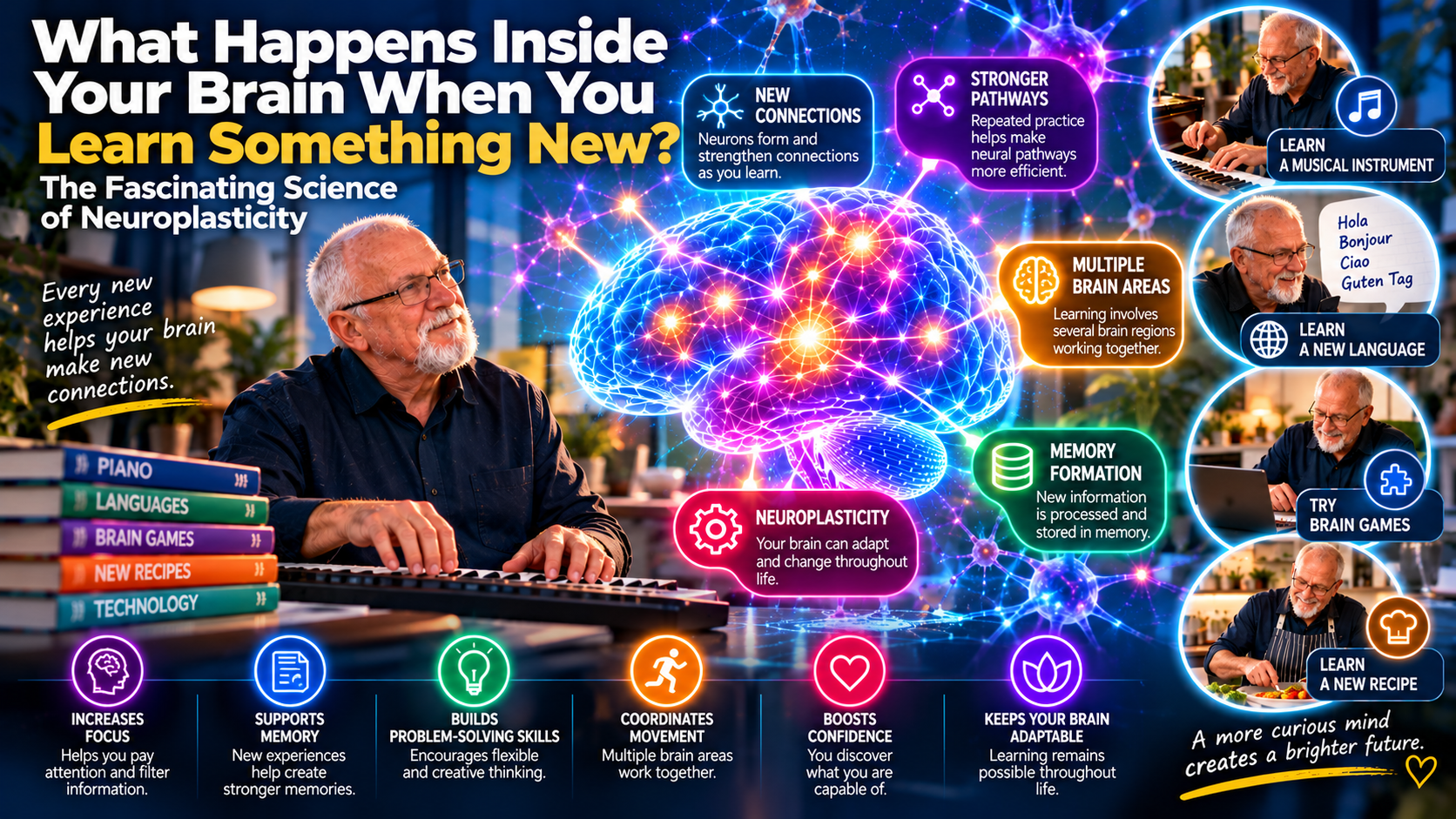
Have you ever wondered what is actually happening inside your brain when you learn something for the very first time?
Perhaps you are learning to play a musical instrument.
Trying to speak a foreign language.
Working out how to use unfamiliar technology.
Or attempting a new recipe.
At first, everything can feel difficult.
You need to concentrate.
You make mistakes.
You forget instructions.
And sometimes, you wonder whether you will ever get the hang of it.
But something remarkable is happening.
Your brain is processing unfamiliar information, drawing on previous experiences and beginning to develop the skills needed to perform the task.
With appropriate practice, activities that initially require considerable concentration may gradually become more familiar.
Movements can become smoother.
Information may become easier to recall.
And skills that once felt impossible may become part of your everyday abilities.
One of the scientific foundations of this process is neuroplasticity.
Neuroplasticity helps explain how our brains respond to learning and experience throughout life.
But what does that actually mean?
Do new connections form?
Do existing pathways become stronger?
Does learning change the physical structure of the brain?
And is it really possible to continue learning as we grow older?
Through my lived experience of brain injury and my interest in neuroscience, I have become fascinated by these questions.
When I started learning piano at 54, I was reminded of just how challenging and rewarding it can be to become a beginner again.
That experience reinforced my belief that learning should remain part of life, regardless of age.
Let’s explore what happens inside the brain when we learn something new.
1. Your Brain Is Constantly Processing Information
The human brain is an extraordinarily complex organ.
It contains billions of nerve cells called neurons.
These cells communicate through specialised connections known as synapses.
Neurons exchange information using electrical and chemical signals.
This communication allows the nervous system to coordinate movement, interpret sensory information, support memory and perform countless other functions.
Even when we are resting, the brain remains active.
It helps regulate essential bodily processes and supports the ongoing activity of different neural networks.
When we encounter something unfamiliar, multiple systems may become involved.
For example, learning a musical instrument can require coordination between areas associated with hearing, movement, attention and memory.
Learning a language may involve systems associated with speech perception, vocabulary, memory and language production.
The precise networks involved depend on the activity.
Learning is not something that happens in one isolated part of the brain. It involves interactions between multiple systems.
2. What Is Neuroplasticity?
Neuroplasticity refers to the nervous system’s ability to change its structure, connections and functioning in response to experience, learning, development and other influences.
It is one of the biological foundations of learning.
When we repeatedly practise a skill, changes can occur in how neural networks process information.
Some connections may become more effective.
Others may become less influential.
And patterns of activity may change as a skill becomes more familiar.
However, neuroplasticity is sometimes presented in misleading ways.
You may hear claims that every new thought creates a new neural pathway.
Or that anyone can completely rewire their brain simply by thinking positively.
The reality is more complex.
Neuroplasticity includes different biological processes operating across different timescales.
Not every learning experience produces a measurable structural change.
And not every neurological difficulty can be overcome through practice.
Nevertheless, the brain’s capacity to adapt is fundamental to our ability to learn.
3. What Happens When You Encounter Something Unfamiliar?
Imagine sitting at a piano for the first time.
You look at the keyboard.
You notice the arrangement of black and white keys.
You attempt to understand which notes correspond to particular sounds.
And you begin coordinating your fingers.
Initially, this requires conscious attention.
Your brain is processing unfamiliar sensory information and attempting to connect it with your movements.
You may need to think carefully before pressing each key.
You might make mistakes.
And the process can feel slow.
As you practise, you gain experience.
You begin recognising patterns.
Certain movements become more familiar.
And you may become better at anticipating what comes next.
These changes involve learning processes distributed across several neural systems.
The exact changes depend on the skill being acquired.
But the overall principle is straightforward.
Experience can influence how the brain processes information and supports behaviour.
4. How Neurons Communicate During Learning
Neurons communicate through specialised structures called synapses.
At many synapses, one neuron releases chemical messengers known as neurotransmitters.
These chemicals interact with receptors on another cell.
This contributes to the transmission and regulation of neural signals.
Learning can involve changes in the effectiveness of communication between neurons.
Some synaptic connections become more responsive under particular conditions.
Others may become less responsive.
These processes help neural networks adjust to experience.
However, learning cannot be reduced to a single chemical or connection.
Different neurotransmitters, cell types and brain regions contribute to different aspects of learning.
The brain operates as an interconnected system.
Understanding this complexity helps us avoid oversimplified claims about how learning works.
5. What Does It Mean to Strengthen a Neural Connection?
You may have heard the phrase:
Neurons that fire together wire together.
This is a popular way of describing an idea associated with Hebbian learning.
The general principle is that patterns of coordinated neural activity can influence connections between neurons.
One well-studied process is long-term potentiation, often abbreviated to LTP.
Under certain conditions, patterns of activity can produce a lasting increase in the effectiveness of synaptic communication.
Another process, long-term depression or LTD, can reduce synaptic effectiveness.
Both are relevant to how neural networks change.
But these processes do not explain every aspect of human learning.
And they should not be interpreted as proof that repeating any activity will automatically produce beneficial changes.
The brain needs to regulate and reorganise its activity in many different ways.
Learning is not simply about making every connection stronger.
Sometimes, more efficient processing involves changing which connections are used and how networks coordinate their activity.
6. Why Repetition Matters When Learning a New Skill
Think about learning to ride a bicycle.
The first attempts may involve uncertainty.
You need to coordinate balance, steering and movement.
You may find it difficult to perform all these actions together.
With practice, the task can become more familiar.
You begin making adjustments more efficiently.
And movements that initially required deliberate thought may become increasingly automatic.
Repeated experience provides opportunities for the nervous system to refine performance.
However, repetition is not the only requirement for learning.
The quality of practice matters.
Feedback matters.
And the level of challenge matters.
Repeating an incorrect technique without useful feedback may reinforce an ineffective approach.
This is why learning often benefits from instruction, reflection and gradual adjustment.
The aim is not simply to practise more.
It is to practise in ways that support useful learning.
7. Why Making Mistakes Can Help the Brain Learn
Mistakes are a normal part of learning.
When we attempt something unfamiliar, our expectations do not always match the outcome.
We press the wrong piano key.
Use an incorrect word.
Or misunderstand an instruction.
These differences between expected and actual outcomes can provide useful information.
The brain contains systems involved in detecting errors and updating predictions.
Learning from feedback can help us adjust future behaviour.
However, mistakes do not automatically produce improvement.
If we do not understand what went wrong, we may repeat the same error.
And if an activity is consistently overwhelming, frustration may interfere with learning.
Useful feedback can make a difference.
So can breaking a complicated activity into smaller parts.
A mistake is not proof that learning is impossible. It may be information that helps guide the next attempt.
8. What Happens to Your Memory When You Learn?
Memory is essential for many forms of learning.
When you encounter unfamiliar information, the brain needs to process it.
Some information may be retained briefly.
Other information may become part of longer-lasting memories.
Researchers distinguish between several memory systems.
Working memory helps us temporarily hold and manipulate information.
Episodic memory supports recollection of personal experiences.
Semantic memory involves knowledge and facts.
Procedural memory contributes to learned skills and habits.
Different brain systems are involved in these processes.
For example, the hippocampus plays an important role in forming many new declarative memories.
Other structures, including the basal ganglia and cerebellum, contribute to aspects of skill learning.
These systems interact.
When learning piano, you may need to remember instructions while also developing more familiar movement patterns.
Learning therefore involves more than one kind of memory.
9. Why the Hippocampus Is Important for Learning
The hippocampus is a structure located within the medial temporal lobe.
It plays a central role in forming and organising certain types of memory.
For example, when you learn the name of someone you have just met, processes involving the hippocampus may help support the formation of that memory.
The hippocampus is also important for aspects of spatial memory.
This helps us remember locations and relationships between places.
However, it is not accurate to describe the hippocampus as the brain’s only memory centre.
Memory depends on distributed networks.
And different kinds of learning rely on different systems.
The hippocampus is particularly important for forming many new memories of facts and experiences.
But learning a motor skill involves additional structures and processes.
10. Does Learning Create New Brain Cells?
This is one of the most common questions about neuroplasticity.
The creation of new neurons is called neurogenesis.
Neurogenesis is well established during brain development.
It also occurs in certain regions of the brains of some adult animals.
The extent and functional significance of new neuron production in the adult human brain remain subjects of scientific debate.
Therefore, it would be misleading to claim that learning a language or solving puzzles automatically creates new neurons.
Much of what we know about learning-related plasticity involves changes in existing neural connections and networks.
The brain can adapt in several ways without requiring the creation of entirely new neurons.
This distinction is important.
Neuroplasticity and neurogenesis are related concepts, but they are not interchangeable.
11. Can Learning Change the Physical Structure of the Brain?
Research suggests that learning and experience can sometimes be associated with measurable changes in brain structure.
Scientists have investigated these changes using brain imaging techniques.
For example, studies involving motor skill learning have reported changes in measures associated with particular brain regions.
Research involving musicians has also examined relationships between musical experience and brain structure.
However, interpreting these findings requires care.
Brain imaging does not allow researchers to observe every individual synaptic connection.
Changes in imaging measurements can reflect several biological processes.
And differences between experienced and inexperienced individuals do not always establish that training caused those differences.
Nevertheless, research supports the broader principle that experience and learning can influence brain organisation.
The nature and extent of these changes depend on the activity and individual circumstances.
12. Why Learning Becomes Easier With Practice
Have you ever noticed that a difficult activity gradually becomes more manageable?
At first, you need to concentrate on every step.
Later, you may perform some parts of the task with less conscious effort.
This can happen as knowledge and skills become more familiar.
For example, when learning to type, you may initially search for every letter.
With experience, you may become more fluent.
Similarly, when learning a language, familiar words may become easier to recognise and retrieve.
These improvements can involve changes in how neural systems coordinate activity.
But becoming more skilled does not mean the brain stops working.
It means the processes supporting the activity may become more efficient or better organised.
Practice can reduce the demands of some tasks, allowing attention to be directed towards more complex aspects of performance.
13. What Happens When You Learn a New Language?
Learning a language involves several cognitive processes.
You need to recognise unfamiliar sounds.
Associate words with meanings.
Understand grammatical patterns.
And develop the ability to produce speech or written language.
These activities involve networks associated with hearing, memory, language and executive functioning.
For example, learning a new word may involve connecting its sound or written form with a concept.
Repeated exposure and retrieval practice can help strengthen familiarity.
Using the word in different contexts may support understanding.
Research has investigated relationships between bilingualism, language learning and cognitive functioning.
Some studies report benefits in particular circumstances.
However, claims that learning another language automatically prevents dementia or produces broad improvements in intelligence are not established.
The strongest reason to learn a language may simply be that it allows you to communicate, explore another culture and develop a meaningful skill.
14. Why I Created Speak & Rewire
My interest in language learning eventually contributed to the development of Speak & Rewire.
I wanted to explore how technology could make learning unfamiliar words and phrases more approachable.
The idea was to create opportunities for people to engage with languages through manageable activities.
Learning a few words in another language may seem like a small achievement.
But it can be enjoyable.
It may help someone feel more confident when travelling.
And it can introduce them to unfamiliar sounds and expressions.
Speak & Rewire reflects my wider interest in neuroplasticity and lifelong learning.
It is an educational language-learning project rather than a clinically validated cognitive rehabilitation programme.
For me, its value lies in encouraging curiosity and participation.
15. What Happens in Your Brain When You Learn Music?
Learning a musical instrument is a particularly interesting example of complex skill development.
Playing piano can involve:
- Reading musical notation.
- Recognising patterns.
- Coordinating movements.
- Listening carefully.
- Remembering sequences.
- Adjusting timing.
- Responding to feedback.
These activities involve several interacting brain systems.
Auditory regions contribute to processing sound.
Motor networks support movement.
The cerebellum contributes to aspects of coordination and timing.
And memory systems support learning and recall.
Researchers have investigated how musical training relates to brain function and structure.
However, musical training should not be presented as a guaranteed way to prevent cognitive decline or repair brain injury.
It is a meaningful and enjoyable activity that can involve complex learning.
That is valuable in its own right.
16. What Learning Piano at 54 Taught Me About My Brain
When I started learning piano at 54, I was reminded of what it feels like to encounter something unfamiliar.
There were notes to recognise.
Movements to coordinate.
And patterns to practise.
I did not expect everything to become easy immediately.
I understood that learning would take time.
But the experience reinforced my curiosity about the brain.
It also reminded me that we do not need to be children to begin developing a new skill.
Sometimes, adults hesitate because they believe they have missed their opportunity.
They assume that learning belongs to younger people.
But that is not how lifelong learning works.
Adults can continue acquiring knowledge and developing abilities.
The pace and nature of learning may vary.
But the opportunity to explore does not simply disappear with age.
At 54, I wasn’t trying to turn back the clock. I was simply giving myself permission to learn something new.
17. Why Sleep Is Important After Learning
Sleep plays an important role in learning and memory.
Researchers have investigated how different stages of sleep contribute to memory consolidation.
Memory consolidation refers to processes through which newly acquired information becomes more stable or integrated with existing knowledge.
For example, after practising a skill, sleep may support aspects of retention and performance.
However, the relationship varies depending on the type of learning and the individual.
Sleep is not a guarantee that everything practised during the day will be remembered.
And different memory systems may be influenced in different ways.
Nevertheless, adequate sleep supports overall cognitive functioning.
Persistent sleep deprivation can interfere with attention, memory and emotional regulation.
For most adults, approximately seven to nine hours of sleep per night is a common recommendation, although individual needs vary.
18. Why Physical Activity May Support Learning
Physical activity has numerous benefits for physical and mental health.
It supports cardiovascular functioning.
Can contribute to better sleep.
And is associated with aspects of cognitive health.
Researchers have also investigated the relationship between exercise and biological processes involved in plasticity.
One area of interest is brain-derived neurotrophic factor, commonly called BDNF.
BDNF is a protein involved in neuronal survival and synaptic plasticity.
Some studies suggest that physical activity can influence BDNF-related processes.
However, the effects vary depending on factors such as exercise type, intensity and measurement methods.
It would be misleading to suggest that every walk directly creates new neural connections.
The practical message is that suitable physical activity can form part of a healthy lifestyle that supports brain and body wellbeing.
19. Why Stress Can Make Learning More Difficult
Stress influences several systems involved in attention, memory and decision-making.
A moderate level of challenge can sometimes increase alertness.
But excessive or prolonged stress may interfere with cognitive performance.
For example, someone attempting to learn a new skill while feeling overwhelmed may struggle to concentrate.
They may find it harder to remember instructions.
Or become frustrated more quickly.
The relationship between stress and learning is complex.
It depends on the nature, intensity and timing of the stressor.
But creating manageable learning conditions can be helpful.
This might involve reducing distractions.
Breaking tasks into smaller parts.
Taking appropriate breaks.
Or seeking guidance when needed.
Learning does not need to be uncomfortable to be meaningful.
20. Why Attention Matters When Learning Something New
Attention helps us select and process information.
When learning an unfamiliar activity, we often need to focus on details that experienced performers may no longer consciously notice.
For example, a beginner pianist may need to concentrate on individual finger movements.
A beginner language learner may focus carefully on pronunciation.
And someone using unfamiliar software may need to read each instruction.
Distractions can make this more difficult.
However, attention is not an unlimited resource.
Fatigue, stress and competing demands can influence concentration.
Shorter, focused practice sessions may be useful for some learners.
Others may prefer longer sessions.
The appropriate approach depends on the activity and the individual.
21. Why Spaced Practice Can Help You Remember
Imagine trying to learn twenty unfamiliar words in one evening.
You practise them repeatedly.
By the end of the session, they may seem familiar.
But a week later, you may struggle to remember them.
Now imagine practising those words across several days.
You review them.
Attempt to recall them.
And return to them after increasing intervals.
Research into learning has repeatedly demonstrated the value of spaced practice for many forms of memory.
Spaced practice involves distributing learning over time rather than concentrating everything into one session.
It can support longer-term retention.
However, the ideal spacing depends on what is being learned and when the information needs to be remembered.
The principle is simple.
Returning to information after a delay can be more useful for long-term retention than repeatedly reviewing it without a break.
22. Why Testing Yourself Can Improve Learning
One effective learning strategy is retrieval practice.
This involves attempting to recall information rather than simply reading it again.
For example, after learning several words in a foreign language, you might cover the translations and try to remember them.
Or after reading an article, you could explain the main ideas without looking at the text.
Retrieval practice can strengthen later recall.
It also helps identify what you have not yet learned.
However, feedback remains important.
If you repeatedly recall incorrect information without correction, mistakes may persist.
A useful approach is to attempt retrieval, check the answer and revisit anything that remains difficult.
This principle can be applied to many educational activities.
23. Can Learning New Things Help Keep Your Brain Healthy?
Researchers have investigated relationships between education, cognitive activity and healthy ageing.
Some observational studies suggest that people who remain cognitively engaged may experience more favourable cognitive outcomes.
Researchers have also explored the concept of cognitive reserve.
Cognitive reserve refers to the idea that differences in lifetime experiences and cognitive resources may influence how people cope with brain changes or pathology.
However, this does not mean that learning a particular skill prevents dementia.
Observational relationships can be influenced by many factors.
And the effectiveness of specific cognitive-training programmes varies.
The most responsible advice is to view learning as one part of a broader approach to wellbeing.
Physical activity, sleep, cardiovascular health, social connection and appropriate medical care also matter.
Learning can be enjoyable and meaningful without needing to be presented as a guaranteed medical intervention.
24. What Happens When You Stop Practising a Skill?
Learning does not always produce permanent performance improvements.
Skills and memories can change when they are no longer used.
For example, someone who studied a language many years ago may struggle to remember vocabulary.
A person who has not played a musical instrument for a long time may feel less fluent.
This does not necessarily mean that everything has been lost.
Previously learned information may sometimes be easier to relearn than completely unfamiliar material.
However, retention varies.
Some skills remain relatively stable.
Others require regular practice.
This is another reason why continued engagement can be useful.
If a skill matters to you, returning to it periodically may help maintain familiarity.
25. How Learning Changes Across the Lifespan
The brain undergoes significant development during childhood and adolescence.
But learning continues into adulthood.
Older adults can still acquire new knowledge and skills.
However, some aspects of cognitive performance may change with age.
Processing speed and certain forms of memory can be affected.
Health conditions, sensory changes and other factors may also influence learning.
At the same time, accumulated knowledge and experience can provide important advantages.
An older learner may bring patience, motivation and a broader understanding of how new information relates to existing knowledge.
There is no universal age at which meaningful learning becomes impossible.
The most effective approach is often to adapt learning methods to individual needs.
26. What About Learning After Brain Injury?
Brain injury can affect learning in different ways.
Some people experience difficulties with attention.
Others may have changes in memory, processing speed or executive functioning.
Fatigue can also influence the ability to participate in learning activities.
Neuroplasticity may contribute to aspects of neurological recovery.
But outcomes vary considerably.
Learning after brain injury may require adaptations.
For example, someone may benefit from shorter sessions.
Written instructions.
Repeated explanations.
Or reduced distractions.
Professional rehabilitation can help identify appropriate strategies.
It is important not to assume that someone who struggles to learn is simply failing to make enough effort.
Neurological conditions can create genuine barriers.
The goal should be meaningful participation supported by realistic expectations.
27. How Digital Games Can Engage Different Cognitive Skills
Digital games can involve a variety of cognitive activities.
A matching game may require remembering locations.
A puzzle may involve planning.
A target-selection game can require attention and coordination.
And a sequencing game may involve remembering patterns.
Through Regain Arcade, I have explored how digital games can provide accessible opportunities for engagement.
The aim is to make these activities enjoyable and approachable.
However, it is important to distinguish between practising a game and improving general cognitive functioning.
Becoming better at a puzzle does not automatically mean that someone’s memory or reasoning will improve in everyday life.
Regain Arcade is not a clinically validated rehabilitation treatment.
It is an educational and recreational project designed to encourage curiosity and participation.
28. Ten Practical Ways to Support Learning
If you want to develop a new skill, these strategies may help.
1. Choose something meaningful
Interest can support motivation.
2. Begin with manageable steps
Avoid making the activity unnecessarily overwhelming.
3. Practise regularly
Repeated experience can support skill development.
4. Spread practice over time
Spaced learning can help with long-term retention.
5. Test your recall
Attempt to remember information without always looking at the answer.
6. Seek useful feedback
Understanding mistakes can help you adjust your approach.
7. Protect your sleep
Adequate sleep supports cognitive functioning and memory.
8. Take appropriate breaks
Fatigue can interfere with concentration.
9. Vary your practice when appropriate
Applying skills in different contexts may help develop flexibility.
10. Be patient
Learning rates vary, and progress is not always consistent.
You do not need to use every strategy at once.
Choose approaches that suit the activity and your circumstances.
29. A Seven-Day Neuroplasticity and Learning Challenge
Would you like to experience what it feels like to begin learning something unfamiliar?
Try this gentle seven-day challenge.
It is an educational activity, not a medical treatment or a scientifically validated brain-training programme.
Day 1: Choose a skill
Select something you have never tried before.
Day 2: Learn the basics
Spend a short period exploring the activity.
Day 3: Practise and reflect
Notice what feels familiar and what remains difficult.
Day 4: Try retrieval
Attempt to remember something without referring to instructions.
Day 5: Use feedback
Identify one thing you could approach differently.
Day 6: Practise again
Return to the activity after a break.
Day 7: Reflect on the experience
Consider what you enjoyed, what you learned and whether you would like to continue.
The challenge does not require a particular level of achievement.
Its purpose is to encourage curiosity about learning.
30. Why I Believe Understanding Neuroplasticity Can Change How We Think About Ourselves
Through my lived experience of brain injury, I have become interested in the relationship between our experiences and our sense of what is possible.
When circumstances change unexpectedly, confidence can be affected.
We may begin questioning our abilities.
Or assume that certain opportunities are no longer available.
Understanding neuroplasticity does not remove every limitation.
But it provides a scientific basis for recognising that learning and adaptation can continue throughout life.
This has influenced the way I approach my own interests.
Learning piano.
Exploring languages.
Developing digital games.
And continuing to investigate neuroscience.
I do not see these activities as proof that every neurological challenge can be overcome.
I see them as opportunities to remain curious.
To develop new knowledge.
And to explore meaningful experiences.
For me, that is one of the most encouraging aspects of learning.
We do not need to know everything before we begin.
We simply need an opportunity to explore.
Final Thoughts: Every New Skill Begins With an Unfamiliar Experience
The next time you attempt something unfamiliar, remember that learning is a complex process.
Your brain is processing information.
Coordinating activity across neural networks.
Using feedback.
And drawing on previous experiences.
With appropriate practice, skills may become more familiar.
Memories may become easier to retrieve.
And activities that initially required considerable effort may gradually feel more manageable.
Neuroplasticity helps explain how the nervous system responds to learning.
But it is not magic.
It does not guarantee unlimited abilities.
And it does not mean that every challenge can be overcome simply through determination.
What it does remind us is that learning remains part of the human experience throughout life.
When I started learning piano at 54, I was not trying to prove that age was irrelevant.
I was simply exploring something I wanted to learn.
And that experience reinforced a message I now share through Regain the Brain.
You do not have to know how to do something before you begin.
You do not have to become an expert to enjoy learning.
And you do not have to be young to discover something new.
Sometimes, the most important part of learning is having the curiosity to start.
So, what would you like to learn next?
About Darren Jewell
Darren Jewell is a neuroresilience coach, inspirational speaker and founder of Regain the Brain.
Drawing on his lived experience of brain injury and his passion for neuroplasticity, Darren explores resilience, confidence, brain health and lifelong learning.
His projects include Regain Arcade, a collection of accessible digital games, and Speak & Rewire, a language-learning initiative designed to encourage curiosity and engagement.
Darren also began learning piano at 54, reflecting his belief that meaningful learning can remain part of life at any age.
Inspire Your Audience With the Science of Learning
Are you organising a corporate conference, leadership event, workplace wellbeing programme, educational gathering or community event?
Darren’s inspirational talks explore neuroplasticity, resilience, confidence and the importance of continuing to learn throughout life.
His message combines lived experience with accessible neuroscience and practical reflections on adaptability.
Discover Darren’s inspirational speaking and neuroresilience coaching services at www.regainthebrain.com.
This article provides general educational information and does not replace medical or neurological advice. People living with brain injury or other neurological conditions should seek appropriate professional guidance when considering rehabilitation or cognitive training activities.