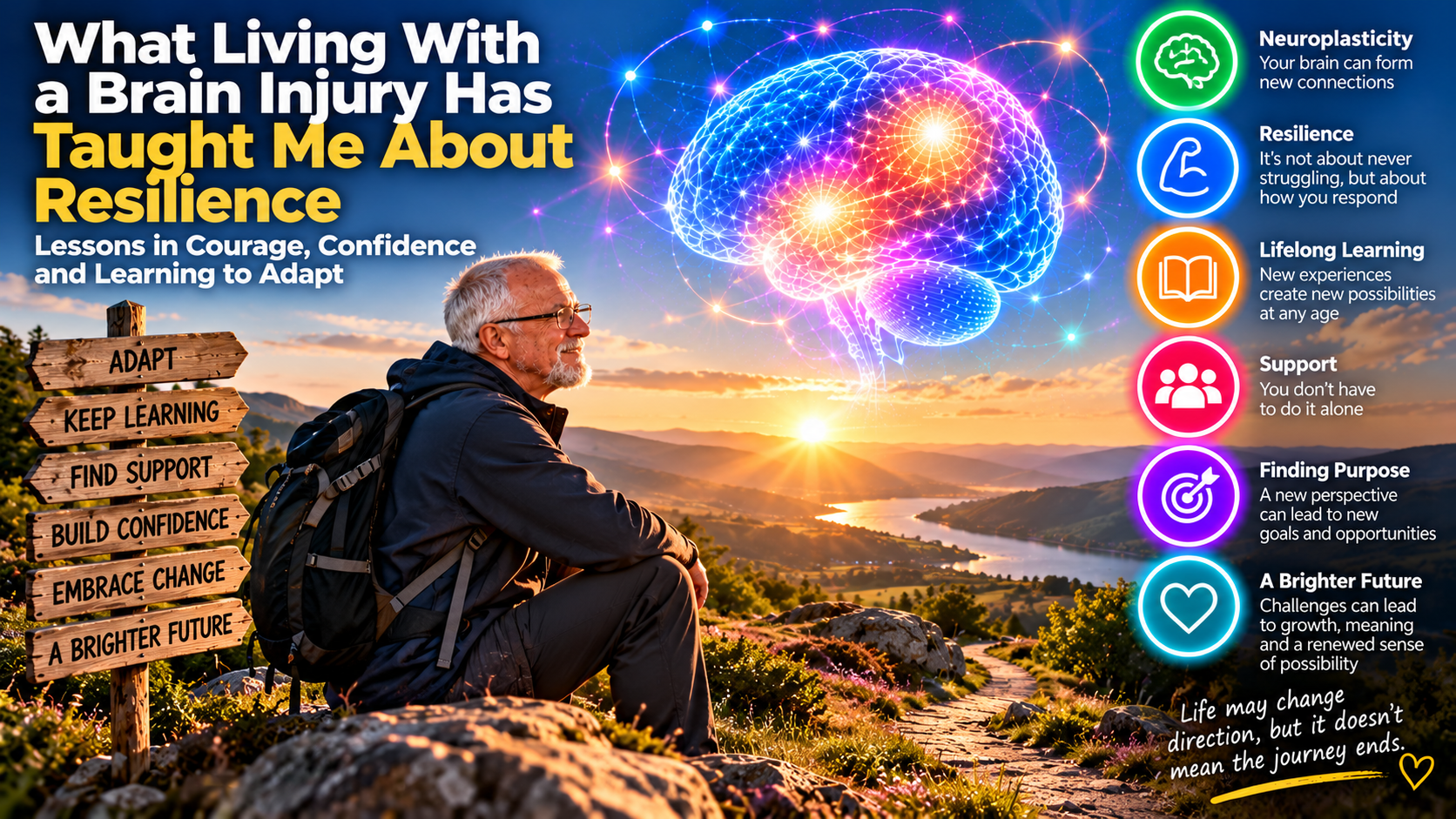
Sometimes, the greatest lessons in life are the ones we never expected to learn.
We make plans.
We imagine how our lives will unfold.
We develop ambitions, build relationships and work towards the future we hope to create.
And somewhere along the way, we begin to believe that tomorrow will look reasonably similar to today.
Until something happens that changes everything.
For me, living with the effects of a brain injury has profoundly influenced the way I understand resilience, confidence, identity and the remarkable complexity of the human brain.
It has also changed how I think about the word recovery.
Before experiencing a life-changing health challenge, it can be easy to assume that recovery is simply a matter of getting better.
You experience a problem.
You receive treatment.
You work hard.
And eventually, life returns to normal.
But the reality of living with a brain injury can be far more complicated.
Progress may be unpredictable.
Some difficulties may be invisible.
And the emotional challenges can sometimes be just as significant as the physical or cognitive ones.
Yet through these experiences, I have developed a deeper appreciation of something I now explore through my work at Regain the Brain.
Resilience is not about pretending life is easy. It is about discovering how to respond when life becomes difficult.
I want to share some of the lessons that living with brain injury has taught me, and why I believe they are relevant not only to people experiencing neurological conditions but also to anyone facing unexpected change.
1. Life Does Not Always Follow the Plan We Had in Mind
Most of us grow up believing that effort and determination will help us shape our future.
We work towards qualifications.
Develop careers.
Build relationships.
And pursue our ambitions.
There is comfort in believing that we have a reasonable amount of control over what happens next.
But life can challenge that assumption.
An accident.
An illness.
A bereavement.
Or another unexpected event can alter circumstances in ways we never anticipated.
Brain injury has taught me that there are things we cannot always control.
We cannot simply decide that a neurological difficulty will disappear.
We cannot guarantee that recovery will follow a particular timetable.
And we cannot always return to the life we imagined.
But this does not mean we have no choices.
Sometimes, we can influence how we approach the circumstances in front of us.
We can seek information.
Ask for support.
Adjust expectations.
And explore what remains possible.
I have come to believe that adaptability is an important part of resilience.
Not because adapting is always easy.
But because life sometimes asks us to find a different way forward.
2. Resilience Does Not Mean Being Strong Every Day
There is a popular image of resilience that I believe can be misleading.
The person who never gives up.
Never struggles.
Never feels overwhelmed.
And always manages to remain positive.
It sounds inspirational.
But it does not reflect the complexity of real life.
Living with a brain injury can involve difficult days.
There may be frustration.
Fatigue.
Uncertainty.
Or moments when something that once seemed straightforward becomes unexpectedly demanding.
Resilience does not require us to deny those experiences.
It does not mean smiling through every difficulty.
And it certainly does not mean refusing help.
Sometimes, resilience involves recognising that you need to rest.
Sometimes, it means asking someone to explain something again.
And sometimes, it means accepting that today is not the day to attempt a particular challenge.
Being resilient does not mean being unaffected by adversity.
It means finding ways to respond while recognising that our needs and circumstances are real.
3. The Invisible Challenges Can Be the Hardest to Explain
One of the difficulties associated with brain injury is that many symptoms are not immediately visible.
Someone may look physically well while experiencing challenges involving memory, concentration, fatigue or information processing.
Other people may assume that everything has returned to normal.
They may not understand why an activity is difficult.
Or why someone needs more time.
This can create a difficult situation.
You may find yourself having to explain experiences that other people cannot see.
And sometimes, even finding the words to describe those experiences can be challenging.
Living with brain injury has made me more aware of the importance of understanding invisible difficulties.
We cannot always know what another person is experiencing simply by looking at them.
This lesson extends far beyond neurological conditions.
People may be managing health problems, emotional challenges or personal circumstances that are not obvious.
A little patience can make a meaningful difference.
So can listening without immediately making assumptions.
4. Confidence Can Change When Life Changes
Confidence is often built through experience.
We become familiar with activities.
Develop skills.
And learn what we can reasonably expect from ourselves.
But what happens when those expectations are disrupted?
A task that once felt simple may become difficult.
A familiar environment may suddenly feel overwhelming.
Or an activity you previously enjoyed may require more effort.
These experiences can influence how you see yourself.
You may begin questioning your abilities.
Hesitating before attempting unfamiliar activities.
Or comparing your current circumstances with how things used to be.
I believe rebuilding confidence requires a different approach from simply telling yourself to be positive.
Confidence often grows through manageable experiences.
Through finding approaches that work.
And through recognising that your value as a person is not determined by how quickly or easily you complete a task.
Sometimes, confidence begins with giving yourself permission to learn again.
5. Small Achievements Deserve Recognition
We live in a society that often celebrates major achievements.
Promotions.
Qualifications.
Business success.
Sporting victories.
And dramatic personal transformations.
But when life changes unexpectedly, progress may look very different.
An achievement that appears small to someone else may represent considerable effort.
Completing an activity.
Learning a new approach.
Managing a difficult situation.
Or recognising when rest is needed.
These experiences deserve recognition.
Not because every small achievement represents a dramatic neurological breakthrough.
But because they can be personally meaningful.
They may help someone recognise progress that would otherwise go unnoticed.
I have come to appreciate that we should not measure every achievement against someone else’s expectations.
Sometimes, progress is not about how far you have travelled. It is about recognising what it took to move forward at all.
6. Recovery Is Not Always a Straight Line
One of the most important lessons I have learned is that progress does not always happen in a predictable way.
There may be periods when things seem to improve.
Other times, familiar difficulties may become more noticeable.
Fatigue, stress, sleep and changing circumstances can all influence how someone functions.
This can be frustrating.
Particularly when you expect improvement to happen consistently.
But neurological recovery is complex.
Different injuries produce different effects.
Some abilities may improve substantially.
Others may remain affected.
And some people develop strategies that help them manage difficulties rather than eliminating them.
This is why I believe we should be careful with the language we use around recovery.
Not everyone follows the same path.
And not every challenge can be overcome through determination alone.
A realistic understanding of recovery allows room for both hope and uncertainty.
7. Neuroplasticity Gave Me a New Appreciation of Learning
My interest in neuroplasticity has become an important part of my work.
Neuroplasticity refers to the brain’s ability to change its connections, structure and functions in response to experience, learning and other influences.
It helps explain how we acquire skills and adapt to unfamiliar demands.
Following some forms of neurological injury, plastic changes may contribute to aspects of recovery.
But neuroplasticity is not a miracle cure.
It does not guarantee that every damaged function can be restored.
And it should never be used to suggest that someone has failed because their recovery has been limited.
For me, the most meaningful lesson is that learning remains possible throughout life, although the extent and nature of change vary between individuals.
We can explore unfamiliar activities.
Develop strategies.
And sometimes discover new ways of doing things.
That possibility has encouraged my curiosity about the brain.
And it has become central to the message I share through Regain the Brain.
8. You Are More Than Your Brain Injury
A life-changing health condition can become a significant part of someone’s identity.
Medical appointments.
Symptoms.
Rehabilitation.
And everyday adaptations may occupy considerable time and attention.
It can sometimes feel as though everything revolves around the condition.
But a person is more than a diagnosis.
More than a medical history.
And more than the difficulties they experience.
We have interests.
Relationships.
Ideas.
Ambitions.
And experiences that cannot be reduced to a clinical description.
My brain injury has influenced my life.
It has shaped my understanding of resilience and contributed to the work I do today.
But it does not define everything about who I am.
I believe this is an important message for anyone living with a long-term condition.
Your circumstances may have changed.
But your identity is not limited to those circumstances.
9. Asking for Help Is Not a Sign of Weakness
Independence is something many people value.
We like being able to make our own decisions.
Complete tasks.
And manage everyday responsibilities.
When circumstances change, accepting assistance can feel uncomfortable.
You may worry about becoming a burden.
Or feel frustrated that something now requires support.
But I have come to believe that asking for help is not the opposite of resilience.
It can be part of resilience.
Recognising when support is needed requires awareness.
It may involve communicating honestly about difficulties.
And being willing to accept that we cannot always do everything alone.
This lesson is relevant in many areas of life.
Business leaders need advice.
Students need teachers.
Athletes need coaches.
And people experiencing health challenges may need professional and personal support.
There is no shame in recognising that other people can help us move forward.
10. Rest Is Not the Same as Giving Up
Our culture often celebrates constant activity.
We are encouraged to work harder.
Achieve more.
And remain productive.
But living with neurological difficulties can change the way we think about energy.
Cognitive fatigue is a significant challenge for some people with brain injury.
Activities that appear straightforward may require considerable mental effort.
Concentration.
Conversation.
Decision-making.
And processing information can all become demanding.
In these circumstances, rest is not necessarily a luxury.
It may be an important part of managing daily life.
This has reinforced a broader lesson for me.
We should not confuse exhaustion with achievement.
And we should not assume that the person who pushes hardest is always making the best decision.
Sometimes, recognising a limit is an act of good judgement.
11. Comparison Can Become an Unnecessary Burden
It is natural to compare ourselves with other people.
We notice what others achieve.
How quickly they progress.
And what appears to come easily to them.
But comparison can become particularly unhelpful when living with a neurological condition.
Two people with brain injuries may have very different experiences.
The cause, severity and location of injury may differ.
So may age, health, access to rehabilitation and personal circumstances.
Comparing recovery timelines can create unrealistic expectations.
The same is true when comparing ourselves with the person we were before an injury.
Remembering the past can be important.
But constantly measuring the present against it may become emotionally exhausting.
I believe a more constructive question is:
What would meaningful progress look like for me, given my circumstances today?
The answer may change over time.
And that is perfectly reasonable.
12. Learning to Adapt Is Different From Accepting Defeat
Sometimes, adapting to changed circumstances is misunderstood as giving up.
People may believe that accepting a limitation means abandoning hope.
But I see adaptation differently.
If one approach no longer works, exploring another approach can be a practical response.
For example, someone experiencing memory difficulties may use reminders or written instructions.
A person managing fatigue may organise activities around their available energy.
And someone with movement difficulties may benefit from adapted equipment.
These strategies do not necessarily remove the underlying condition.
But they may support independence and participation.
Adaptation is not about pretending nothing has changed.
It is about responding to what has changed.
And sometimes, that response can create opportunities that were not immediately obvious.
13. Why I Believe Curiosity Is So Important
One of the things that continues to motivate me is curiosity.
I want to understand how the brain works.
How people learn.
Why some activities become easier with practice.
And how technology might create new opportunities for engagement.
This curiosity has influenced several of my projects.
Through Regain the Brain, I explore neuroplasticity and resilience.
Through Regain Arcade, I have developed accessible digital games designed to encourage participation in different cognitive activities.
And through Speak & Rewire, I have explored how language-learning experiences can encourage people to try something unfamiliar.
These projects are not clinical treatments.
But they reflect my belief that curiosity can remain an important part of life.
We do not have to know everything before we begin exploring.
Sometimes, the first step is simply asking a question.
14. Starting to Learn Piano at 54 Reminded Me That Age Is Not the End of Learning
At 54, I started learning piano.
It was an opportunity to become a beginner again.
There were unfamiliar notes.
Movements to coordinate.
And musical patterns to understand.
I did not begin because I expected to become a professional musician.
I began because I wanted to learn.
The experience reinforced something I now share regularly.
Learning does not belong exclusively to the young.
Adults can continue developing skills and exploring interests throughout their lives.
Of course, learning may involve challenges.
Progress varies.
And some skills require considerable practice.
But the opportunity to begin does not disappear simply because we reach a particular birthday.
For me, learning piano became a reminder that curiosity can open doors at any age.
15. Resilience Is Not Always About Returning to Who You Were
When life changes unexpectedly, it is understandable to want everything to return to the way it was.
We may miss familiar abilities.
Established routines.
Or the confidence we previously experienced.
But sometimes, life does not return to exactly the same circumstances.
That can be difficult to acknowledge.
Resilience may involve grieving what has changed while gradually exploring what remains meaningful.
This does not mean that every loss must be transformed into a positive experience.
Some losses are genuinely painful.
And people deserve the space to recognise that.
But it may still be possible to develop new interests.
Find different approaches.
Or create a meaningful life that does not look identical to the one originally imagined.
For me, this is one of the most important distinctions between resilience and unrealistic positivity.
Resilience allows room for reality.
16. The Importance of People Who Understand
Human relationships can make an enormous difference during difficult times.
A person who listens.
Someone who offers practical support.
Or someone who understands that an invisible difficulty is still real.
These experiences can help reduce feelings of isolation.
Brain injury can sometimes affect social participation.
Fatigue may make gatherings difficult.
Communication challenges may create frustration.
And other people may not understand why circumstances have changed.
Supportive relationships do not eliminate every difficulty.
But they can make it easier to navigate them.
I believe understanding is one of the most valuable things we can offer another person.
We do not always need to provide an answer.
Sometimes, listening is enough.
17. Why Confidence Can Be Rebuilt Through Experience
Confidence is not something we can always create simply by repeating positive statements.
It often develops through experience.
When we attempt something manageable and recognise that we can participate, our expectations may begin to change.
For example, someone who feels uncertain about learning a new skill might begin with a small activity.
They may practise for a short period.
Become more familiar with the task.
And gradually decide whether they want to continue.
This does not guarantee that confidence will improve.
People may face significant psychological or neurological barriers that require professional support.
But manageable experiences can provide opportunities to develop self-belief.
The key is to avoid turning progress into pressure.
Confidence should not depend on achieving perfection.
18. What Brain Injury Has Taught Me About Patience
Patience sounds simple until circumstances require it.
We may want answers immediately.
Progress quickly.
And problems resolved.
But some challenges cannot be rushed.
Learning an unfamiliar skill takes time.
Adapting to changed circumstances can require experimentation.
And neurological recovery may follow a course that cannot be predicted.
Patience does not mean doing nothing.
It means recognising that meaningful change may take longer than we would prefer.
Sometimes, it also involves accepting that a particular outcome may not be possible.
This can be one of the most difficult lessons.
But realistic patience allows us to make decisions based on our circumstances rather than constantly fighting an imagined timetable.
19. Why I No Longer See Mistakes in Quite the Same Way
Mistakes can be uncomfortable.
They may affect confidence.
Especially when an activity used to feel easy.
But mistakes are also part of learning.
When we attempt something unfamiliar, we may misunderstand instructions.
Forget a step.
Or choose an approach that does not work.
Appropriate feedback can help us identify what needs changing.
However, not every mistake is a learning opportunity.
Some situations require additional support, adaptation or professional guidance.
And repeated difficulties should not automatically be interpreted as a lack of effort.
The lesson I take from mistakes is that they deserve curiosity rather than immediate self-criticism.
What happened?
Why might it have happened?
And what would make the next attempt more manageable?
20. Why Hope Must Be Grounded in Reality
Hope is important.
It can encourage us to explore possibilities.
Seek support.
And remain engaged with meaningful goals.
But hope should not depend on promises that cannot be supported.
Brain injury recovery is highly individual.
Some people experience substantial improvement.
Others live with persistent difficulties.
And no single activity or treatment can guarantee a particular outcome.
This is why I believe it is important to discuss neuroplasticity responsibly.
The brain has a remarkable capacity for learning and adaptation.
But that capacity has limits.
Hope becomes more meaningful when it is combined with accurate information and realistic expectations.
For me, hope is not about pretending that every difficulty will disappear.
It is about recognising that meaningful possibilities may still exist.
21. Why I Created Regain the Brain
My interest in resilience and neuroplasticity eventually became part of a wider purpose.
I wanted to explore the science of learning and adaptation.
Share ideas that might encourage others.
And contribute to conversations about brain health, confidence and neurological challenges.
That motivation led to Regain the Brain.
Through the project, I explore subjects such as:
- Neuroplasticity and lifelong learning.
- Brain injury and resilience.
- Confidence after life-changing experiences.
- Leadership and adaptability.
- Accessible digital activities.
- The relationship between neuroscience and emerging technology.
I believe these subjects are connected.
They all raise questions about how people respond to change.
How they develop skills.
And how they find meaningful ways forward when circumstances become unfamiliar.
Regain the Brain reflects both my personal experience and my continuing curiosity.
22. Why My Experience Has Influenced My Approach to Inspirational Speaking
When I speak about resilience, I do not want to present it as an abstract concept.
I want people to understand that resilience is relevant to real experiences.
Unexpected setbacks.
Changes in confidence.
Difficult decisions.
And circumstances that challenge our assumptions about the future.
My lived experience of brain injury has influenced the way I think about these subjects.
It has encouraged me to consider the importance of adaptability, patience and realistic expectations.
I believe these lessons are relevant in many settings.
For business leaders navigating organisational change.
For employees facing uncertainty.
For individuals experiencing health challenges.
And for anyone trying to rebuild confidence after an unexpected event.
The circumstances may be different.
But the importance of responding thoughtfully to change is widely relevant.
23. Seven Lessons I Would Share With Anyone Facing a Life-Changing Challenge
If I could offer seven lessons from my reflections on brain injury and resilience, they would be these.
1. You do not have to be strong every day
Difficult emotions are part of being human.
2. Your progress does not need to match anyone else’s
Circumstances and recovery experiences vary.
3. Asking for help is not failure
Support can be an important part of adapting.
4. Rest can be necessary
Exhaustion should not be confused with achievement.
5. Your identity is bigger than your difficulties
A health condition does not define everything about you.
6. Learning can continue throughout life
New interests and skills may still be possible, although abilities and circumstances vary.
7. Resilience does not require pretending everything is fine
It involves responding realistically and constructively to difficult circumstances.
These lessons are not a formula for recovery.
They are reflections that I hope may encourage people to approach themselves and others with greater understanding.
24. What I Would Say to Someone Who Has Recently Experienced a Brain Injury
If you are reading this after experiencing a brain injury, I want to acknowledge something important.
Your experience is your own.
You may be facing difficulties that other people do not understand.
You may feel uncertain about what comes next.
Or frustrated that life has changed in ways you never expected.
There is no requirement to turn your experience into an inspirational story.
You do not have to feel grateful for what has happened.
And you do not need to prove your resilience to anyone.
Appropriate medical care, rehabilitation and support are important.
So is having the opportunity to express how you feel.
If you are able to explore meaningful activities, do so at a pace that suits your circumstances.
If you need help, ask for it.
And if progress is slower or different from what you hoped, that does not mean you have failed.
Your experience deserves understanding.
25. What Living With Brain Injury Has Taught Me About the Future
I cannot predict every challenge that lies ahead.
None of us can.
Life continues to change.
Technology develops.
Circumstances evolve.
And we encounter experiences we could never have anticipated.
But I have come to value curiosity.
Learning.
And the willingness to reconsider familiar assumptions.
My interest in neuroscience has opened up subjects I continue to explore.
My work through Regain the Brain has given me opportunities to share those interests.
And developing projects such as Regain Arcade and Speak & Rewire has allowed me to combine learning with creativity and technology.
I do not see these activities as proof that brain injury can always be overcome.
I see them as part of my own continuing journey.
A journey that has been influenced by challenges but is not limited to them.
Final Thoughts: Resilience Is About Finding Your Own Way Forward
If there is one thing living with brain injury has taught me, it is that resilience is far more complex than simply refusing to give up.
It is not about being positive every day.
It is not about pretending that difficulties do not exist.
And it is not about measuring ourselves against someone else’s expectations.
Sometimes, resilience means taking action.
Sometimes, it means changing direction.
Sometimes, it means asking for support.
And sometimes, it means accepting that rest is what you need most.
Through my experience, I have developed a deeper appreciation of neuroplasticity, learning and the importance of adapting to unfamiliar circumstances.
But I have also learned that we must be realistic about the challenges people face.
Not every problem has a simple solution.
Not every difficulty disappears.
And not every experience needs to be transformed into a success story.
Yet I believe there can still be room for curiosity.
For meaningful relationships.
For discovering unfamiliar interests.
And for creating a future that reflects who we are today.
When I started learning piano at 54, I wasn’t trying to prove anything to the world.
I was simply allowing myself to become a beginner again.
That experience reflects something I now believe strongly.
Our lives may change in ways we never expected.
But change does not always mean the end of possibility.
Sometimes, it asks us to explore a different path.
And sometimes, the courage lies not in knowing exactly where that path will lead, but in being willing to discover what comes next.
About Darren Jewell
Darren Jewell is a neuroresilience coach, inspirational speaker and founder of Regain the Brain.
Drawing on his lived experience of brain injury, Darren explores resilience, confidence, neuroplasticity and the importance of lifelong learning.
His work combines personal experience with accessible neuroscience and a passion for encouraging people to remain curious about their abilities and possibilities.
Darren is also developing Regain Arcade, a collection of accessible digital games, and Speak & Rewire, a language-learning initiative.
He began learning piano at 54, reflecting his belief that age does not have to mark the end of meaningful learning.
Invite Darren to Share His Story
Are you organising a corporate conference, leadership event, healthcare gathering, workplace wellbeing programme or community event?
Darren’s inspirational talks explore the realities of living with brain injury, rebuilding confidence, developing resilience and responding to unexpected change.
His message combines lived experience with accessible neuroscience and practical reflections on adaptability and lifelong learning.
Discover Darren’s inspirational speaking and neuroresilience coaching services at www.regainthebrain.com.
This article reflects personal experiences and general educational information. Brain injury affects individuals differently, and the reflections shared here should not be interpreted as medical advice or a universal model of recovery. People experiencing neurological symptoms or emotional difficulties should seek appropriate professional support.