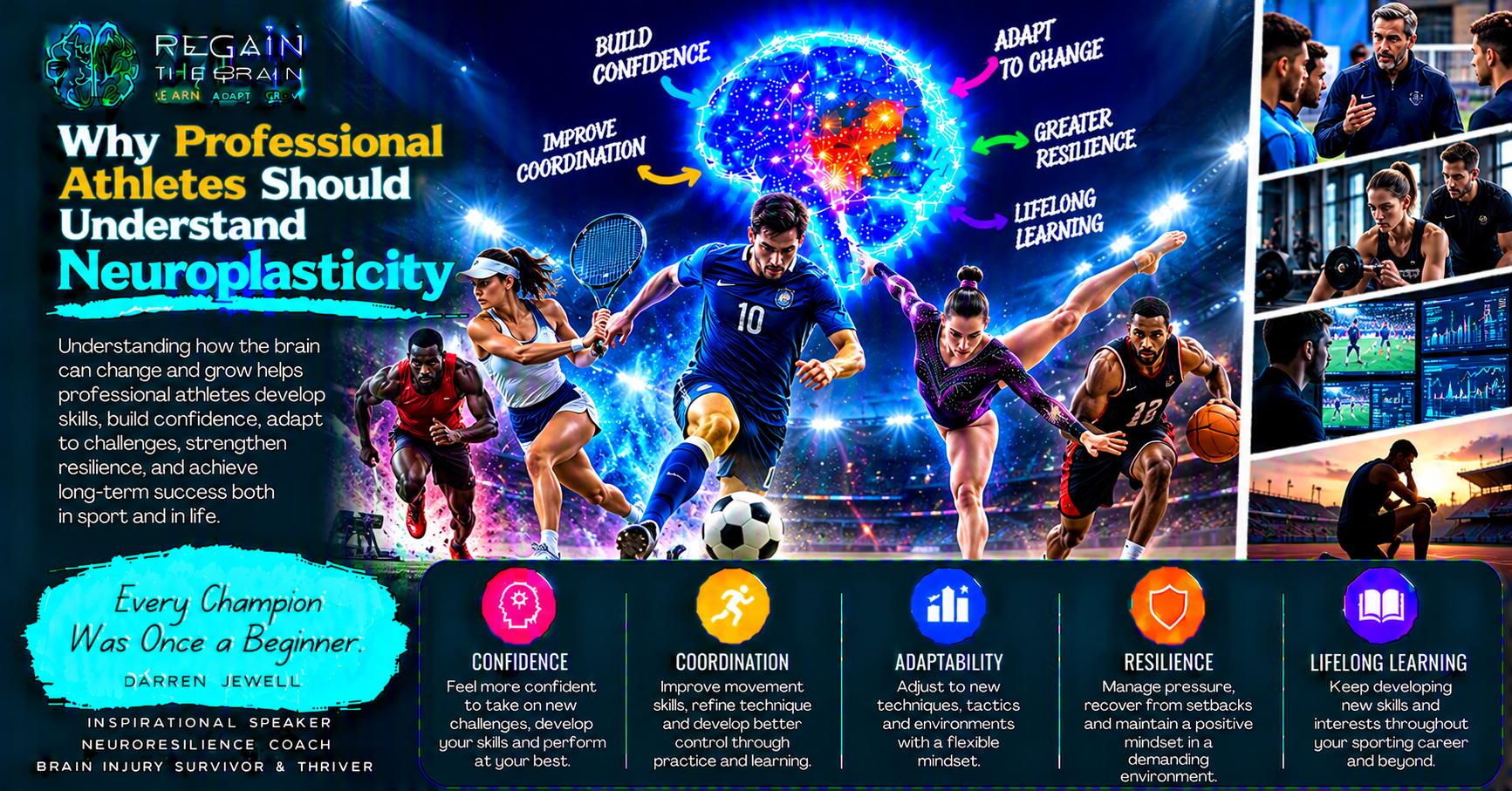
What separates a professional athlete from someone who has never played their sport before?
Natural ability?
Physical strength?
Speed?
Coordination?
Determination?
All these factors may contribute to sporting performance.
But there is another element that deserves attention.
The extraordinary ability of the human brain to learn and refine skills through experience and practice.
Think about a professional footballer controlling a ball while moving at speed.
A tennis player responding to a powerful serve.
A gymnast performing a carefully rehearsed sequence.
Or a golfer coordinating a complex swing.
These activities require more than physical strength.
They involve perception, timing, attention, coordination, decision-making and movement.
And behind these abilities is the human nervous system.
One of the fascinating subjects connected to learning and movement is neuroplasticity.
Neuroplasticity describes the brain’s ability to change its connections and patterns of activity in response to learning, experience and other biological processes.
For professional athletes, understanding neuroplasticity can offer a useful perspective on skill development, confidence, adaptability and lifelong learning.
My name is Darren Jewell.
I am a London-based inspirational speaker, NeuroResilience Coach, brain injury survivor and passionate advocate for lifelong learning.
My mission is to make neuroplasticity an everyday word.
And I believe professional sport offers a powerful opportunity to explore the relationship between learning, confidence, resilience and human potential.
Because even the most experienced athlete was once a beginner.
1. What Is Neuroplasticity?
Neuroplasticity describes the brain’s capacity to change its connections and patterns of activity in response to experience, learning and other biological processes.
Throughout life, the brain remains capable of adaptation.
When someone learns a new skill, practises an unfamiliar movement or develops knowledge through experience, processes involving the brain help support that learning.
For example, learning to play a musical instrument requires coordination between perception, movement, attention and memory.
Learning a sporting technique may involve some of these same broad functions, although the specific skills and demands differ.
With appropriate coaching, practice and feedback, people can improve particular abilities.
However, neuroplasticity does not mean that everyone can achieve the same sporting performance.
Genetics, physical characteristics, health, training opportunities, motivation and many other factors influence athletic development.
Neuroplasticity is one part of a much more complex picture.
But it is an important subject for understanding how people continue learning.
2. Why Sporting Excellence Is Built Through Learning
Watch an elite athlete perform and the movements may appear effortless.
A footballer controls a difficult pass.
A basketball player makes a precise shot.
A swimmer coordinates breathing and movement.
A gymnast completes a complex routine.
Yet these abilities usually represent years of training.
Athletes learn techniques.
Practise movements.
Receive coaching.
Review performances.
And make adjustments.
What appears effortless to a spectator may be the result of considerable preparation.
Understanding neuroplasticity provides one perspective on the brain’s involvement in developing these skills.
However, effective training also depends on physical conditioning, appropriate coaching, recovery and sport-specific expertise.
Sporting excellence is rarely the result of one remarkable moment. It is often built through countless hours of purposeful learning.
3. Why the Brain Matters in Physical Coordination
Physical coordination is something many people take for granted.
We walk.
Reach for objects.
Climb stairs.
Catch a ball.
And perform countless movements throughout the day.
But movement depends on complex interactions between the brain, spinal cord, nerves, muscles and sensory systems.
Professional athletes rely on these systems when performing demanding physical tasks.
A tennis player must coordinate visual information with rapid movement.
A goalkeeper must respond to a changing situation.
A dancer must remember sequences and control body position.
And a golfer must coordinate timing and movement.
Relevant skills can improve through appropriate training.
But physical performance is influenced by many factors, including injury, fatigue and individual differences.
Understanding neuroplasticity can complement education about motor learning.
It should not replace specialist coaching or medical advice.
4. Why Confidence Matters in Professional Sport
Confidence can influence how athletes approach challenges.
A young footballer may feel nervous before making a first-team appearance.
A tennis player may struggle with self-doubt after a series of defeats.
A gymnast may feel uncertain when learning a difficult routine.
And an experienced athlete may question their abilities after a disappointing performance.
These experiences are understandable.
Confidence does not mean never feeling nervous.
It can develop through preparation, experience, constructive feedback and appropriate support.
I understand the importance of confidence because it was something I struggled with for much of my life.
Following a serious childhood brain injury, I experienced difficulties with coordination and physical abilities.
Those challenges affected how I viewed myself.
For approximately half a century, I often assumed certain achievements were beyond me.
Later in life, I began questioning those assumptions.
And that journey changed my relationship with learning.
5. My Personal Journey: From Brain Injury Survivor to Learning the Piano at 54
At just 15 months old, I suffered a serious brain injury after falling from a balcony.
I spent three weeks in a coma.
The consequences of that injury affected my physical abilities, coordination, confidence and many aspects of my life.
Growing up, I experienced challenges that other people did not always understand.
I also experienced bullying.
Those experiences influenced how I viewed myself.
I questioned my abilities.
I worried about making mistakes.
And I sometimes avoided unfamiliar opportunities because I feared failure.
For approximately half a century, confidence was something I struggled to develop.
I had gradually formed beliefs about what I could and could not do.
And some of those beliefs became so familiar that I rarely questioned them.
But at 54, I made a decision that began to change my perspective.
I decided to learn to play the piano.
For someone who had lived with coordination difficulties following a childhood brain injury, this was a meaningful challenge.
I needed to learn to read music.
Understand where the notes were.
Coordinate my hands.
Remember sequences.
And practise movements that initially felt unfamiliar.
There were frustrating moments.
Sometimes progress seemed painfully slow.
Sometimes I wondered whether I would ever improve.
But I continued practising.
Gradually, I began noticing progress in the skills I was learning.
And something important happened.
I began questioning some of the assumptions I had held about myself.
If I could begin learning the piano at 54, what else might I enjoy exploring?
That question led me towards new interests.
Writing.
Technology.
Language learning.
Website development.
Creating digital experiences.
And eventually sharing my story through inspirational speaking.
I did not suddenly become good at everything.
I still encountered difficulties.
I still needed help.
And I still had moments of uncertainty.
But my attitude towards unfamiliar challenges began to change.
Rather than automatically assuming I could not do something, I became more willing to explore whether I could learn.
That shift in perspective was enormously important to me.
It also encouraged me to investigate neuroplasticity and the science of lifelong learning.
Today, I am passionate about sharing that message.
I do not claim that learning the piano reversed my childhood brain injury.
Nor do I believe neuroplasticity guarantees recovery or removes every limitation.
But my experience reminded me that the assumptions we hold about ourselves are not always reliable predictions of what we might learn.
There is something about professional sport that makes this especially meaningful.
Athletes understand the frustration of unfamiliar movements.
They know what it feels like to practise something repeatedly.
They understand that progress is not always immediate.
And they know that developing a skill can involve setbacks.
Of course, learning the piano is not the same as competing in professional sport.
But both can involve coordination, attention, practice and feedback.
When I began learning the piano at 54, I was not trying to become a professional musician.
I simply wanted to learn.
And that decision encouraged me to explore possibilities I had previously overlooked.
I started learning the piano at 54. My brain didn’t ask my age.
That experience encouraged me to challenge limiting beliefs I had held for decades.
And today, I want to encourage others to consider what they may still be capable of learning.
Your Brain Is Not Finished. Your Story Is Not Over.
6. Why Repetition Matters in Sporting Skills
Athletes often repeat particular movements during training.
A basketball player practises shooting.
A footballer works on passing.
A golfer rehearses aspects of a swing.
A swimmer refines technique.
And a tennis player develops different strokes.
Purposeful repetition can contribute to skill development.
But repeating a movement incorrectly does not necessarily lead to improvement.
Athletes need appropriate coaching, feedback and opportunities to adjust their technique.
Training should also account for fatigue, injury risk and recovery.
Understanding neuroplasticity reinforces the importance of learning through experience.
However, effective practice is about more than simply performing the same movement thousands of times.
Quality, feedback and appropriate progression matter as much as repetition.
7. Why Learning a New Technique Can Feel Difficult
Imagine a professional athlete who has performed a particular movement for years.
It feels familiar.
They understand its timing.
And they have developed routines through extensive practice.
Then a coach suggests changing part of the technique.
Suddenly, the movement may feel awkward.
The athlete may need to concentrate on details that previously required little conscious attention.
Performance may temporarily feel less consistent while the new approach is being learned.
This can be frustrating.
Understanding neuroplasticity provides a perspective on the brain’s capacity to adapt through learning.
But changes to sporting technique should be guided by qualified coaches and appropriate evidence.
Not every proposed adjustment will improve performance.
And changing a familiar technique is not automatically beneficial.
8. Why Attention and Decision-Making Matter in Sport
Professional sport often requires rapid decisions.
A footballer must recognise space.
A tennis player must anticipate an opponent’s shot.
A rugby player must evaluate passing options.
And a goalkeeper must respond to changing information.
These decisions depend on perception, knowledge, experience and sport-specific skills.
Athletes may develop relevant abilities through training and competitive experience.
Understanding neuroplasticity can complement conversations about learning and decision-making.
However, it does not mean that general brain exercises automatically improve performance in a particular sport.
Skills are often specific to the tasks being practised.
For athletes, effective development should focus on relevant sporting demands and evidence-based coaching.
9. Why Athletes Need to Adapt to Change
Professional athletes regularly encounter change.
A new coach may introduce a different playing system.
An athlete may move to another team.
Competition rules may change.
New technology may influence training.
And physical capabilities may evolve over the course of a career.
These situations can require new learning.
Understanding neuroplasticity reinforces the importance of adaptability.
However, successful adaptation also depends on appropriate coaching, communication and support.
Adaptability is not about expecting athletes to manage every challenge alone. It is about helping them develop the skills and resources needed to respond effectively.
10. Why Feedback Is Essential for Athletic Development
Feedback plays an important role in sport.
A coach may identify a technical problem.
A video analysis session may reveal an aspect of movement that needs attention.
A training exercise may show where an athlete is improving.
And competition experience may highlight areas for further development.
Constructive feedback can help athletes understand their performance.
But feedback must be accurate, relevant and communicated appropriately.
Constant criticism is not the same as effective coaching.
Understanding neuroplasticity reinforces the importance of learning through experience.
For sporting organisations, the practical lesson is to create training environments where feedback supports development rather than undermining confidence.
11. Why Mistakes Are Part of Learning
Every athlete makes mistakes.
A footballer misses a pass.
A tennis player makes an unforced error.
A basketball player misses a shot.
A gymnast struggles with a sequence.
And a golfer misjudges a putt.
Mistakes can provide useful information when they are reviewed constructively.
But learning from mistakes requires more than simply accepting them.
Athletes need to understand what happened.
Consider relevant factors.
Receive appropriate feedback.
And adjust their training where necessary.
Understanding neuroplasticity reinforces the importance of learning.
However, mistakes involving safety or injury risks require immediate attention and appropriate professional guidance.
A mistake does not have to define an athlete, but understanding it can contribute to future development.
12. Why Mental Resilience Matters in Professional Sport
Professional sport can involve considerable psychological demands.
Athletes may experience public criticism.
Selection uncertainty.
Competition pressure.
Injuries.
Changes in performance.
And the challenge of balancing sporting commitments with personal life.
Resilience is therefore an important subject.
But resilience should never mean expecting athletes to ignore pain, conceal mental health difficulties or tolerate harmful environments.
Genuine support requires responsible coaching, appropriate medical care, psychological support where needed and a culture that takes athlete wellbeing seriously.
Understanding neuroplasticity can contribute to conversations about learning and adaptation.
But it is not a substitute for professional mental health care.
A strong sporting organisation should care about the person behind the performance.
13. Why Confidence Can Change Throughout an Athletic Career
Confidence is not necessarily constant.
An athlete may feel confident during a successful season.
Then experience uncertainty following an injury or disappointing performance.
A young player may feel nervous when joining a senior team.
An established athlete may question their future as their career progresses.
These experiences are part of the human side of sport.
Confidence can be supported through appropriate preparation, coaching, experience and constructive feedback.
But it is important not to confuse confidence with guaranteed success.
An athlete can feel confident and still lose.
They can feel nervous and still perform well.
Understanding neuroplasticity reinforces the importance of continued learning.
However, confidence is shaped by many psychological, social and environmental factors.
14. Why Injury Rehabilitation Requires Specialist Support
Injuries can interrupt athletic careers.
Some athletes experience muscle or joint injuries.
Others may experience concussion or more serious neurological conditions.
Rehabilitation depends on the nature and severity of the injury.
It may involve medical assessment, physiotherapy, supervised exercise and other specialist interventions.
Neuroplasticity can be relevant to some forms of neurological rehabilitation.
However, it does not guarantee recovery.
And it should never be used to encourage athletes to return to training or competition before they are medically ready.
This subject is particularly meaningful to me because I have lived with the consequences of a serious childhood brain injury.
My experience has taught me the importance of recognising individual circumstances.
Recovery and adaptation are not identical for everyone.
An athlete’s long-term health must always matter more than the pressure to return quickly.
15. Why Brain Injury Awareness Matters in Sport
Brain injury awareness is a subject particularly close to my heart.
Brain injuries can affect memory, attention, movement, communication, emotional regulation and other aspects of everyday life.
The consequences vary considerably between individuals.
Some difficulties may not be immediately visible.
In sport, concussion and other head injuries require particular attention.
Athletes, coaches and sporting organisations should follow appropriate medical guidance and established concussion protocols.
Symptoms must never be dismissed simply because an athlete wants to continue competing.
Neuroplasticity does not remove the need for medical assessment.
Nor does it guarantee recovery from a brain injury.
My personal experience should not be treated as representative of everyone living with a neurological condition.
But I believe sharing my story can contribute to important conversations about brain injury awareness, accessibility and respect for individual circumstances.
16. Why Coaches Should Understand Lifelong Learning
Coaches play an important role in athletic development.
They teach techniques.
Provide feedback.
Support preparation.
And help athletes respond to challenges.
But coaches also need to continue learning.
Sporting knowledge evolves.
Training methods develop.
Technology changes.
And different athletes may require different approaches.
Understanding neuroplasticity reinforces the importance of continued professional development.
However, coaching should be informed by sport-specific evidence, safeguarding responsibilities and appropriate professional standards.
A coach who values learning can help create an environment where athletes feel supported in developing their skills.
17. Why Team Sports Depend on Communication
Team sports require coordination between people.
Footballers communicate about positioning.
Rugby players coordinate attacking and defensive movements.
Basketball players respond to teammates.
And team captains help organise players during competition.
Communication skills can develop through training, experience and constructive feedback.
Understanding neuroplasticity reinforces the importance of learning.
However, successful teamwork also depends on trust, clear roles and responsible leadership.
A successful team is not simply a collection of talented individuals. It is a group of people learning how to work together.
18. Why Athletes Should Continue Learning Beyond Sport
Professional sporting careers do not last forever.
Some athletes retire earlier than expected.
Others move into coaching, broadcasting, business or completely different occupations.
These transitions can create uncertainty.
An athlete who has spent years developing a sporting identity may wonder what comes next.
That is one reason I believe lifelong learning matters beyond performance.
Learning a new skill can offer opportunities for personal development and enjoyment.
It may also support preparation for a future career.
Understanding neuroplasticity reinforces the idea that adults can continue developing unfamiliar abilities.
However, successful career transitions require practical education, planning, resources and support.
An athlete’s sporting career may end, but their opportunities to learn do not have to end with it.
19. Why Age Should Not End Personal Development
I began learning the piano at 54.
That decision remains one of the most meaningful turning points in my life.
I was not trying to become a professional musician.
I simply wanted to explore something new.
That experience encouraged me to develop other interests.
Writing.
Technology.
Languages.
And digital development.
I sometimes wonder how many people avoid unfamiliar activities because they believe they are too old.
Perhaps a retired footballer wants to learn an instrument.
Perhaps a former athlete wants to study a new subject.
Or perhaps someone who has never played sport wants to begin a suitable recreational activity later in life.
Adulthood does not eliminate our capacity to learn.
Of course, physical abilities and health circumstances vary.
Activities should be appropriate to individual needs and capabilities.
But age alone should not be treated as proof that learning is impossible.
You do not have to be an elite athlete to discover the satisfaction of developing a new skill.
20. Why Sporting Organisations Should Promote a Learning Culture
Professional sporting organisations bring together people with different roles.
Athletes.
Coaches.
Medical professionals.
Performance analysts.
Strength and conditioning specialists.
Administrators.
And senior leaders.
Each group requires specialist knowledge.
A culture that values learning can support people as their responsibilities evolve.
Understanding neuroplasticity can encourage conversations about curiosity, confidence and professional development.
However, effective learning cultures require practical investment in training, feedback, safeguarding and appropriate support.
My mission is to make neuroplasticity an everyday word.
And I believe sport provides an excellent opportunity to encourage conversations about the brain’s continuing capacity to learn.
21. Why Book an Inspirational Speaker for a Sporting Organisation?
Professional sports clubs, governing bodies, athlete development programmes and sporting associations regularly hold conferences, leadership meetings, team events and wellbeing programmes.
These events may focus on performance, coaching, leadership and professional development.
All are important subjects.
But there can also be value in exploring the human experiences behind confidence, resilience and lifelong learning.
An inspirational speaker can offer a different perspective through authentic personal storytelling.
My presentations combine lived experience with accessible explanations of neuroplasticity, confidence, resilience and lifelong learning.
I aim to entertain, educate and inform.
Speaking topics can include:
- Neuroplasticity and the science of lifelong learning
- Building confidence through new experiences
- My experience of learning the piano at 54
- Coordination challenges and personal development
- Challenging limiting beliefs
- Adapting to unfamiliar situations
- Workplace and sporting resilience
- Brain injury awareness
- Lifelong learning beyond athletic careers
- Discovering new abilities later in life
Presentations can be adapted to the objectives of individual sporting organisations.
They are designed to complement, not replace, specialist coaching, medical care or professional psychological support.
22. What Could Professional Athletes Take Away From My Story?
When I speak to an audience, I want people to leave with more than a temporary feeling of motivation.
I want them to reflect on their own assumptions.
Perhaps an athlete is struggling to develop a particular skill.
Perhaps someone is questioning their confidence after a disappointing performance.
Perhaps an experienced professional is considering life after sport.
Or perhaps someone has spent years believing they are incapable of learning an unfamiliar activity.
I would encourage them to consider a few questions.
What have I stopped myself from trying because I fear I will struggle?
Am I confusing unfamiliarity with inability?
How could I approach learning with greater curiosity?
What assumptions have I made about my own abilities?
How can I support others who are developing new skills?
What would I enjoy learning outside my professional responsibilities?
These questions do not promise instant transformation.
But they can encourage reflection, curiosity and a different approach to lifelong learning.
23. Why Choose Darren Jewell as Your Inspirational Speaker?
There are many professional athletes, sports psychologists, coaches and performance specialists available to speak at sporting events.
My contribution is different.
I do not claim to be a professional athlete, sports scientist or neuroscientist.
Instead, I offer a personal perspective shaped by my experiences of brain injury, coordination difficulties, low confidence and discovering new abilities later in life.
I understand what it feels like to doubt yourself.
To struggle with physical coordination.
To question your abilities.
And to assume that certain achievements belong to other people.
For approximately half a century, those experiences influenced my life.
Then, at 54, I decided to learn the piano.
That decision encouraged me to question assumptions I had held about myself.
It opened the door to further learning.
Writing.
Technology.
Languages.
Digital development.
And eventually sharing my story through inspirational speaking.
My journey has strengthened my passion for helping people understand neuroplasticity and the value of lifelong learning.
I do not promise that one presentation will improve sporting performance, accelerate injury recovery or guarantee psychological resilience.
Instead, I aim to offer a meaningful human perspective that encourages curiosity, reflection and conversations about what people may still be capable of learning.
24. Book Darren Jewell for Your Next Sporting Event
Are you a professional athlete, sports coach, club executive, athlete development manager, sporting association representative or conference organiser looking for an inspirational speaker for professional athletes and sporting organisations?
I would welcome the opportunity to discuss how my presentations could complement your organisation’s leadership, personal development and wellbeing objectives.
Whether you are organising a sports conference, athlete development event, club leadership meeting or team wellbeing programme, my aim is to deliver a presentation that encourages people to think differently about confidence, adaptability and lifelong learning.
Professional sport reminds us that progress often requires patience.
A skill is introduced.
A movement is practised.
Feedback is received.
And gradual improvements may begin to appear.
My own journey has involved many similar experiences.
For much of my life, I questioned what I was capable of achieving.
Later in life, I began discovering that some of those assumptions were not the final word.
I started learning new skills.
Exploring unfamiliar interests.
And finding the confidence to share my story.
That journey is still continuing.
And perhaps that is the most important message I can offer.
You do not have to become the best in the world at something to discover the extraordinary satisfaction of learning it.
Your Brain Is Not Finished. Your Story Is Not Over.
Darren Jewell
Inspirational Speaker | NeuroResilience Coach | Brain Injury Survivor & Thriver
Visit www.regainthebrain.com to enquire about booking an inspirational speaker for your professional sports club, sporting organisation, athlete development programme or industry conference.
#NeuroplasticityAtWork #ProfessionalAthletes #SportsPerformance #MotorLearning #SportsCoaching #AthleteWellbeing #WorkplaceResilience #LifelongLearning #GrowthMindset #InspirationalSpeaker #BrainInjuryAwareness #DarrenJewell #RegainTheBrain