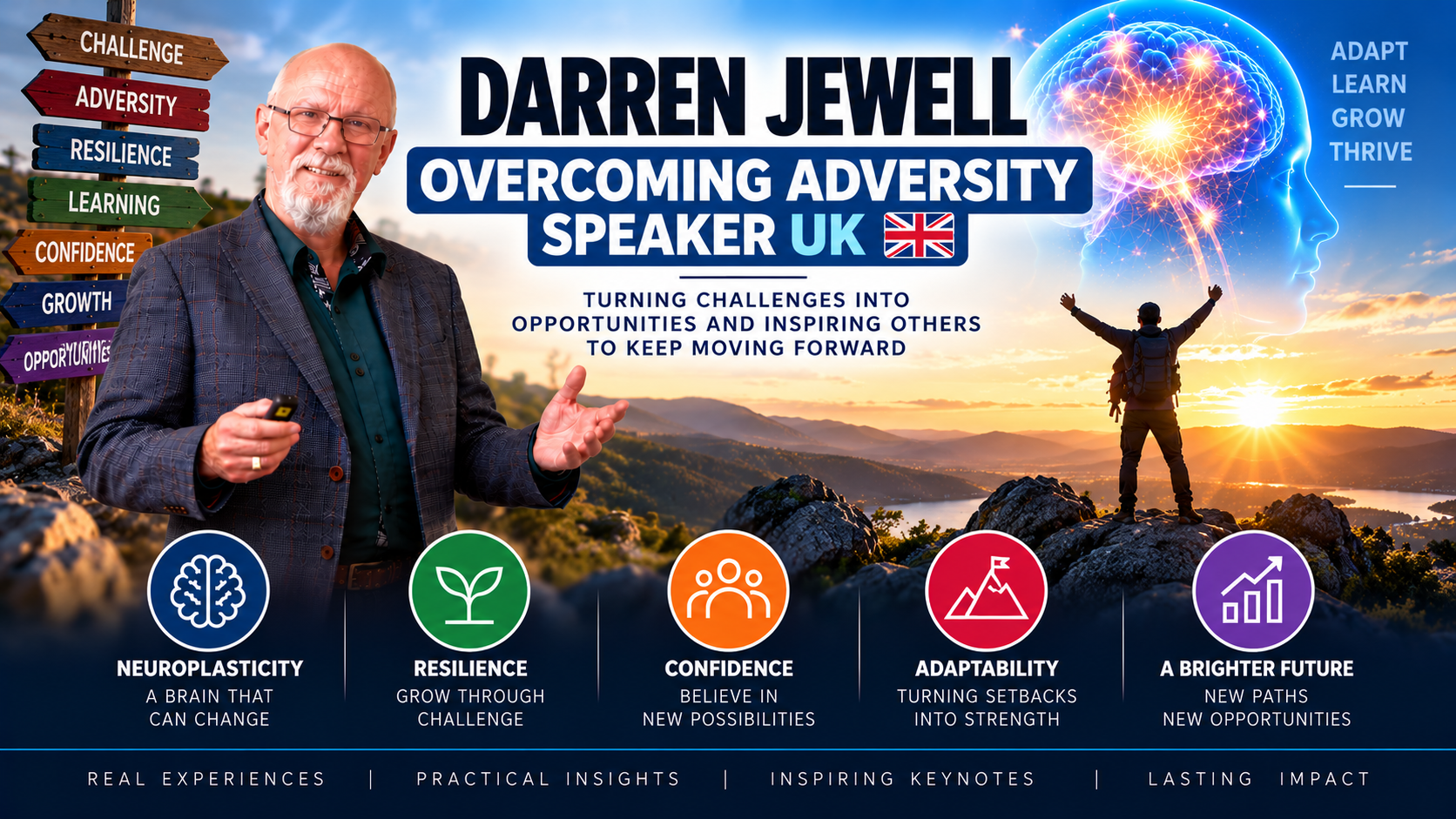
Overcoming Adversity Speaker UK: Darren Jewell on Turning Challenges into Opportunities
Life doesn’t always go according to plan. Sometimes the greatest challenges we face become the experiences that change how we see ourselves, our abilities and our future.
What happens when everything you thought you knew about your life suddenly changes?
What happens when familiar routines become difficult, confidence begins to disappear and the future you imagined no longer seems certain?
And perhaps most importantly, how do you begin moving forward when the path ahead looks completely different?
For Darren Jewell, overcoming adversity speaker, neuroresilience coach and founder of Regain the Brain, these questions are deeply personal.
Having experienced a brain injury, Darren understands that adversity is not simply an inconvenience or an obstacle to overcome. Sometimes it fundamentally changes how we experience the world.
But through his journey, he has developed a powerful belief:
We cannot always control what happens to us, but we can explore new ways to respond, adapt and discover what may still be possible.
Today, Darren shares his passion for resilience, neuroplasticity and lifelong learning, encouraging individuals, businesses and organisations to reconsider what it means to face challenges and move forward.
What Does It Really Mean to Overcome Adversity?
When people hear the phrase “overcoming adversity”, they often imagine extraordinary achievements.
An athlete recovering from a serious injury.
An entrepreneur rebuilding a business after failure.
Someone overcoming seemingly impossible circumstances.
These stories can be inspiring, but they sometimes create an unrealistic impression of resilience.
Not every challenge ends with a dramatic victory.
Not every difficulty can be resolved through determination alone.
And not every person returns to the life they knew before.
Sometimes overcoming adversity means learning to live with changed circumstances.
Sometimes it means asking for help.
Sometimes it means accepting that progress will take longer than expected.
And sometimes it means discovering a different way to achieve something meaningful.
Darren believes resilience should not be measured by how quickly someone recovers or how successfully they hide their struggles.
True resilience can involve recognising our limitations, accepting support and finding constructive ways to move forward.
This perspective is particularly important in a world where people are frequently encouraged to remain positive regardless of their circumstances.
Darren Jewell: An Overcoming Adversity Speaker with Lived Experience
There is a difference between reading about adversity and experiencing circumstances that change your life.
Darren’s experience of brain injury has shaped his understanding of confidence, identity, resilience and the importance of adaptation.
A brain injury can affect many aspects of everyday life.
Memory may become more challenging.
Concentration may require greater effort.
Familiar activities may take longer.
And some difficulties may remain invisible to the people around us.
These experiences can affect far more than physical or cognitive abilities.
They can influence relationships, independence, confidence and a person’s sense of identity.
For Darren, his experiences have encouraged him to explore how the brain works and how people can continue learning and adapting throughout life.
His message is not that every neurological challenge can be overcome.
Instead, it is that personal growth, meaningful experiences and opportunities for learning may remain possible even when life changes unexpectedly.
This understanding forms an important part of his work as an inspirational speaker and neuroresilience coach.
The Hidden Challenges of Adversity
One of the most difficult aspects of adversity is that other people cannot always see what someone is experiencing.
A person may appear confident while privately questioning their abilities.
An employee may seem capable while managing significant stress.
Someone living with a brain injury may look physically well while experiencing cognitive fatigue or difficulty processing information.
These invisible challenges can lead to misunderstanding.
People may assume that someone is coping because they are not openly struggling.
They may expect progress to happen more quickly.
Or they may underestimate the effort required to complete everyday activities.
Darren believes that understanding these experiences can encourage greater empathy.
For business leaders, this means recognising that employees may face challenges that are not immediately apparent.
For families and communities, it means appreciating that everyone responds differently to difficult circumstances.
And for individuals facing adversity, it means recognising that their progress does not need to look identical to someone else’s.
Neuroplasticity: Understanding the Brain’s Ability to Adapt
One of the most fascinating areas of neuroscience is neuroplasticity.
Neuroplasticity describes the brain’s ability to change and reorganise its connections in response to learning, experience and certain forms of injury.
For many years, it was commonly believed that the adult brain had relatively limited capacity for change.
Modern neuroscience has demonstrated that the brain continues adapting throughout adulthood.
When we practise unfamiliar skills, learn new information or develop different approaches to tasks, activity within neural networks can change.
With repetition and appropriate feedback, these changes can contribute to learning and improved performance.
Following certain types of brain injury, neuroplasticity can also play a role in rehabilitation and adaptation.
However, it is important to recognise that neuroplasticity does not guarantee complete recovery.
Outcomes vary according to the nature of the injury, individual circumstances and access to appropriate support.
For Darren, understanding neuroplasticity has encouraged a lifelong interest in learning.
He wants people to appreciate that the brain is not simply a fixed collection of abilities.
It is a complex organ that continues responding to experience.
Our brains may change throughout life, and that gives us an important reason to remain curious about what we can still learn.
Five Lessons About Overcoming Adversity
1. Resilience does not mean never struggling
One of the greatest misconceptions about resilience is that resilient people never experience doubt, fear or uncertainty.
In reality, these feelings are natural responses to difficult circumstances.
Being resilient does not require us to suppress our emotions or pretend that everything is fine.
It may involve acknowledging difficulties and finding appropriate ways to respond.
For Darren, resilience is not about becoming invulnerable.
It is about recognising that support, patience and adaptation can all contribute to moving forward.
2. Progress is not always a straight line
We often imagine progress as a series of continuous improvements.
But real life rarely works that way.
There may be good days and difficult days.
Periods of development and unexpected setbacks.
Moments of confidence followed by uncertainty.
This is particularly relevant to people navigating life-changing experiences.
Darren encourages audiences to recognise that setbacks do not automatically erase previous progress.
Sometimes development requires adjusting expectations and trying a different approach.
3. Small achievements can make a meaningful difference
When facing a significant challenge, it can be easy to focus exclusively on the final destination.
But small achievements deserve recognition.
Completing an unfamiliar task.
Learning a new skill.
Rebuilding a routine.
Or attempting something that previously felt intimidating.
These experiences can provide a sense of progress and accomplishment.
Sometimes the smallest step forward represents an enormous personal achievement.
4. Asking for help is not a weakness
Many people associate resilience with independence.
They believe that being strong means handling every difficulty alone.
But support can be an essential part of responding to adversity.
Family members, friends, colleagues, healthcare professionals and wider communities may all play important roles.
Seeking appropriate support does not diminish someone’s achievements.
It can provide the resources, understanding and encouragement needed to navigate difficult circumstances.
5. Adversity can change our direction without ending our journey
Some life experiences permanently change what is possible.
This can involve loss, disappointment and significant adjustment.
It is important not to romanticise these experiences or suggest that adversity is always beneficial.
However, people may still discover meaningful opportunities within changed circumstances.
They may develop new interests.
Build different relationships.
Explore unfamiliar skills.
Or reconsider what matters most to them.
Darren’s message encourages audiences to recognise that a different future can still contain purpose and possibility.
The Connection Between Adversity and Confidence
Confidence is something many people take for granted until it begins to disappear.
An unexpected setback can make us question abilities that previously felt familiar.
A business leader may lose confidence following a difficult decision.
An employee may become uncertain after redundancy.
Someone experiencing a serious health challenge may question whether they can continue participating in activities they once enjoyed.
Rebuilding confidence can take time.
It may involve setting manageable goals, recognising strengths and developing new experiences of achievement.
Darren’s interest in neuroresilience includes understanding how learning and adaptation can contribute to personal confidence.
He encourages people to recognise that confidence does not always appear before we attempt something.
Sometimes it develops through experience.
You do not always need to feel confident before taking the first step. Sometimes confidence grows because you were willing to begin.
Why Lifelong Learning Is an Important Part of Darren’s Message
One of Darren’s strongest beliefs is that learning should never stop.
He encourages people to remain curious, explore unfamiliar activities and challenge assumptions about age.
This philosophy is closely connected to his interest in neuroplasticity.
Learning new skills involves the brain processing information, coordinating actions and developing familiarity through practice.
Whether someone is studying a language, learning an instrument or exploring unfamiliar technology, the experience can provide opportunities for personal development.
Darren began learning the piano at 54.
He did not begin because he expected to become a professional musician.
He began because he wanted to challenge himself and discover something new.
For Darren, the experience represents an important principle.
You are never too old to become a beginner, and you do not have to master everything you attempt.
Learning can be valuable simply because it introduces curiosity, enjoyment and a sense of discovery.
Why Businesses Need to Understand Adversity and Resilience
Adversity is not limited to personal life.
Businesses regularly experience uncertainty, disruption and unexpected challenges.
Economic pressures.
Technological change.
Leadership transitions.
Organisational restructuring.
And the increasing demands placed on employees.
These circumstances can affect confidence, motivation and performance.
However, organisations should not assume that resilience means expecting people to tolerate unlimited pressure.
Sustainable resilience requires supportive leadership, realistic workloads, effective communication and opportunities for development.
Darren’s speaking encourages business audiences to reconsider how they approach change.
His personal experiences provide a perspective on the importance of adaptability, patience and understanding.
Although workplace challenges are not equivalent to living with a neurological injury, some broader lessons about support and learning can be relevant.
Overcoming Adversity in Leadership
Leaders are often expected to demonstrate confidence, make difficult decisions and provide direction during uncertain times.
But leaders are human.
They experience setbacks.
They make mistakes.
And they sometimes encounter situations for which their previous experience has not prepared them.
Effective leadership does not require pretending that uncertainty does not exist.
It can involve acknowledging challenges, seeking information and remaining open to different approaches.
Darren believes leaders can benefit from understanding the importance of adaptability.
A leader who recognises when a strategy is no longer working may be better positioned to respond constructively than someone who continues simply because changing direction feels uncomfortable.
Resilience is not always about persistence.
Sometimes it is about having the courage to reconsider.
Why Personal Stories Can Inspire Lasting Reflection
Facts and statistics can help audiences understand a subject.
But personal stories can create a different kind of connection.
When someone shares an experience of adversity, audiences may recognise elements of their own lives.
A leader may remember a professional setback.
An employee may reflect on a difficult period.
Someone living with a disability may appreciate hearing a perspective shaped by lived experience.
Darren’s approach combines personal experience with accessible discussions about neuroscience and lifelong learning.
His objective is not simply to make audiences feel motivated for a few hours.
It is to encourage them to consider how they approach challenges and what they might do differently.
Meaningful inspiration can begin with a change in perspective.
What Can Audiences Learn from an Overcoming Adversity Keynote?
Darren’s keynote themes encourage audiences to reflect on several important ideas.
- Resilience is about adaptation, not pretending difficulties do not exist.
- Progress can take many forms and does not always follow a predictable path.
- Neuroplasticity helps explain the brain’s ability to learn and change.
- Confidence may develop through manageable achievements.
- Asking for support can be an important part of resilience.
- Lifelong learning can remain meaningful at every age.
- Different people experience adversity in different ways.
- A changed path can still offer opportunities for connection, purpose and discovery.
These themes can resonate with corporate audiences, healthcare professionals, charities, educators and community organisations.
From Adversity to Advocacy: The Regain the Brain Philosophy
Through Regain the Brain, Darren promotes greater awareness of neuroplasticity, resilience and lifelong learning.
His mission is to encourage people to remain curious about their abilities and continue exploring opportunities for personal development.
Learning does not always require a formal qualification.
Sometimes it begins with something simple.
Cooking a meal you have never prepared.
Learning five words in another language.
Trying a musical instrument.
Exploring unfamiliar technology.
Or developing a new creative interest.
These activities can challenge familiar routines and provide opportunities to practise different skills.
They can also introduce enjoyment and a sense of achievement.
Darren believes lifelong learning is not simply about improving performance.
It is about remaining engaged with life and recognising that curiosity can continue enriching our experiences.
Why Book Darren Jewell as an Overcoming Adversity Speaker in the UK?
Organisations often seek inspirational speakers who can connect with audiences through authentic experiences.
Darren brings a personal perspective shaped by his lived experience of brain injury and his passion for understanding the human brain.
His speaking themes are relevant to:
- Corporate conferences and leadership events.
- Employee wellbeing and professional development programmes.
- Brain injury charities and awareness events.
- Healthcare and rehabilitation conferences.
- Educational institutions and lifelong learning initiatives.
- Community organisations and inspirational gatherings.
His message encourages audiences to think differently about adversity, resilience and personal capability.
Rather than promising that every challenge can be overcome, he encourages people to recognise the importance of adaptation, support and meaningful progress.
Book Darren Jewell — Overcoming Adversity Speaker UK
Are you looking for an overcoming adversity speaker who can inspire your audience through lived experience, resilience and the science of neuroplasticity?
Darren Jewell is an inspirational speaker, neuroresilience coach and founder of Regain the Brain.
Drawing on his personal experience of brain injury, he shares a message about confidence, adaptability and the importance of lifelong learning.
His presentations are relevant to organisations seeking meaningful conversations about overcoming challenges, rebuilding confidence and exploring new possibilities.
Whether your event takes place in London or elsewhere in the United Kingdom, Darren’s message encourages audiences to recognise that personal development does not necessarily end when circumstances change.
We may not always be able to choose the challenges life places before us. But with understanding, support and a willingness to adapt, we can continue exploring what comes next.
Discover more about Darren Jewell and his inspirational speaking at www.regainthebrain.com.
Darren Jewell is an inspirational speaker, neuroresilience coach and founder of Regain the Brain. Drawing on his lived experience of brain injury, he promotes resilience, neuroplasticity, confidence and lifelong learning.
This article is intended for educational and inspirational purposes and does not replace professional medical, psychological or rehabilitation advice.