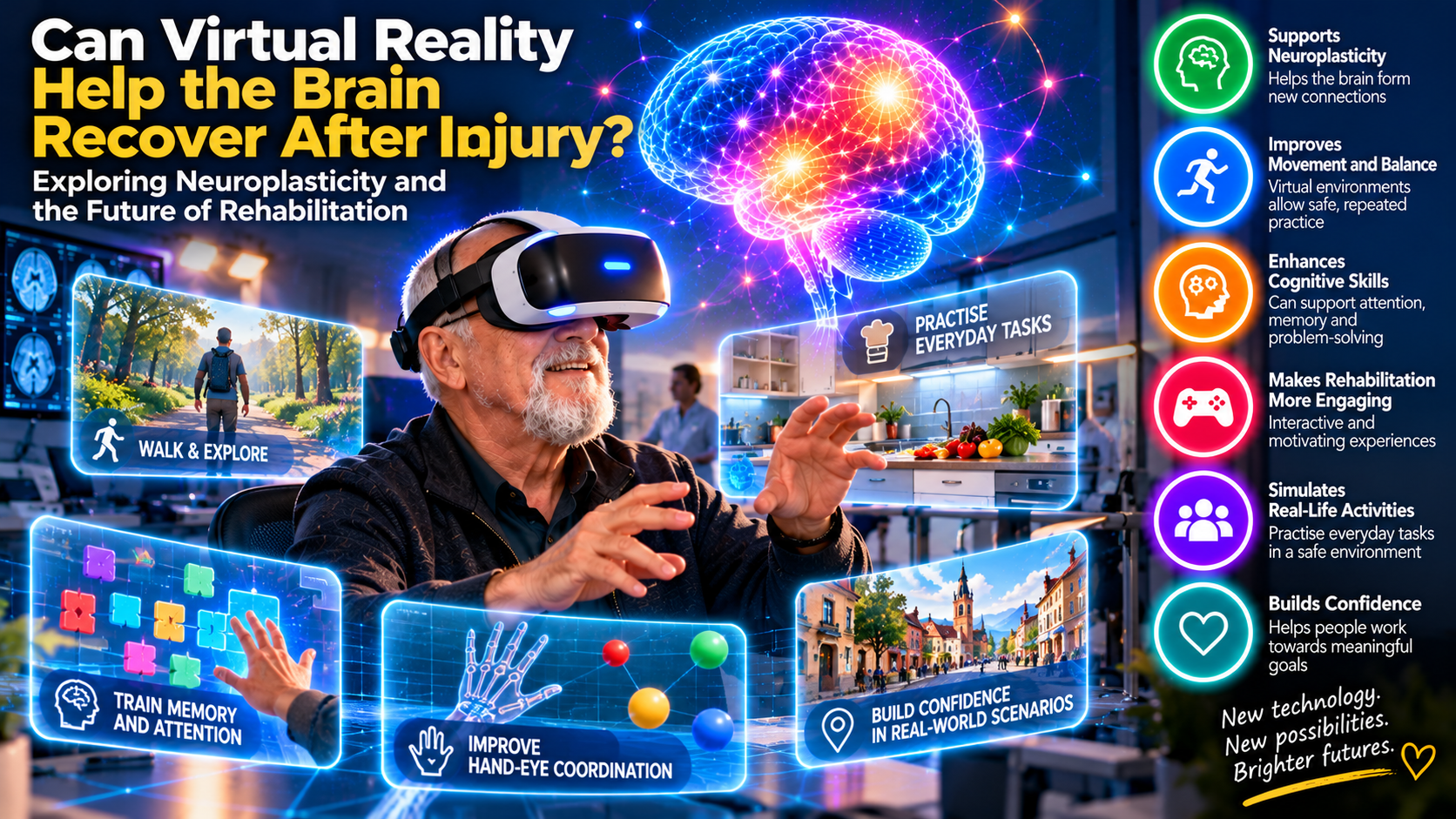
Imagine being able to practise walking through a busy shopping centre without leaving a rehabilitation clinic.
Or reaching for objects in a virtual kitchen while recovering from a stroke.
Perhaps even practising everyday activities in a simulated environment where mistakes can be made without the same consequences they might have in the real world.
What once sounded like science fiction is now an area of serious scientific investigation.
Virtual reality, commonly known as VR, is being explored as a tool in neurological rehabilitation.
Researchers and healthcare professionals are investigating whether immersive digital environments can support movement, balance, attention and other aspects of recovery.
But how effective is virtual reality?
Can it actually help the brain recover after injury?
And could this technology become an important part of rehabilitation in the future?
Through my lived experience of brain injury and my interest in neuroplasticity, I find these developments fascinating.
I have also become interested in the potential of technology through projects such as Regain Arcade, where I explore how accessible digital games can encourage people to engage with different cognitive challenges.
However, it is important to distinguish between promising technology and proven treatment.
Virtual reality cannot guarantee recovery from brain injury.
And not every VR game or application has been clinically validated.
Nevertheless, research suggests that certain virtual reality interventions may provide useful opportunities for rehabilitation.
Let’s explore what the science tells us.
1. What Is Virtual Reality?
Virtual reality is a technology that allows people to experience and interact with computer-generated environments.
In many cases, users wear a headset that displays a simulated three-dimensional world.
As they move their head, the view changes to reflect their movements.
Some systems also use handheld controllers, cameras or sensors to track physical actions.
For example, a person might enter a virtual room where they can reach towards objects.
Another application might simulate walking through a park.
Or a rehabilitation programme might present interactive exercises designed to practise particular movements.
Virtual reality systems vary considerably.
Some provide fully immersive experiences through headsets.
Others use large screens, motion-tracking technology or less immersive computer-based environments.
This distinction matters because different systems place different demands on users.
A highly immersive headset may be appropriate for one person but uncomfortable or unsuitable for another.
The most important question is not how impressive the technology looks.
It is whether the experience is appropriate for the individual and the rehabilitation goal.
2. What Happens to the Brain After an Injury?
An acquired brain injury can affect the brain in many different ways.
The consequences depend on factors such as the cause, location and severity of the injury.
Some people experience difficulties with movement.
Others may have changes involving memory, attention, communication or emotional regulation.
Fatigue is also a common challenge.
Recovery varies considerably between individuals.
Some people experience substantial improvement.
Others continue living with long-term difficulties.
And progress may not follow a predictable path.
Rehabilitation aims to support functioning, independence and participation in meaningful activities.
It may involve physiotherapy, occupational therapy, speech and language therapy, psychological support or other specialist approaches.
The goal is not always to restore every ability to its previous level.
Sometimes, rehabilitation involves learning compensatory strategies or adapting the environment.
Virtual reality is being investigated as one possible tool within this wider process.
3. What Is Neuroplasticity, and Why Does It Matter?
Neuroplasticity refers to the brain’s ability to change its connections, structure and functions in response to experience, learning and other influences.
It plays an important role in learning and adaptation.
Following neurological injury, plastic changes may contribute to some aspects of recovery.
For example, repeated practice of particular movements may help support motor learning.
Rehabilitation programmes often involve practising meaningful activities, receiving feedback and gradually adjusting the level of challenge.
Virtual reality can potentially provide an environment in which these activities are repeated.
However, neuroplasticity should not be misunderstood.
It does not mean the brain can always repair itself completely.
And it does not mean every digital experience produces beneficial neurological changes.
The effects of rehabilitation depend on the individual, the injury and the intervention.
Neuroplasticity provides a scientific foundation for understanding learning and adaptation, but it is not a guarantee of recovery.
4. Why Researchers Are Interested in Virtual Reality Rehabilitation
Virtual reality has several characteristics that make it interesting for rehabilitation.
It can provide interactive tasks.
Allow repeated practice.
Offer immediate feedback.
And sometimes adjust difficulty to suit the user.
Imagine someone practising reaching movements.
A virtual environment might present objects at different positions.
The person attempts to reach towards them.
The system responds to their movements.
And the activity can be repeated.
This may create opportunities for structured practice.
Researchers have also investigated whether virtual environments can make certain rehabilitation activities more engaging.
However, engagement alone does not establish clinical effectiveness.
A person may enjoy a virtual activity without experiencing measurable improvement in everyday functioning.
The value of VR must therefore be assessed through appropriate research and meaningful outcomes.
5. Can Virtual Reality Help People Recovering From Stroke?
Stroke rehabilitation is one of the areas in which virtual reality has received considerable research attention.
Some VR interventions focus on upper-limb movement.
For example, a person may practise reaching, grasping or moving their arm in response to virtual objects.
Other systems focus on balance, walking or functional activities.
Systematic reviews have reported that certain VR-based interventions can improve selected motor outcomes after stroke, particularly when used alongside conventional rehabilitation.
However, the findings vary between studies.
Different systems use different technologies, exercises and treatment schedules.
The quality of evidence also differs.
Virtual reality is therefore not a universal solution.
It may be useful for selected patients and goals when integrated into an appropriate rehabilitation programme.
Treatment decisions should be guided by qualified professionals.
6. Can Virtual Reality Improve Balance and Walking?
Balance and mobility can be affected by neurological injury.
Some people experience weakness.
Others may have difficulties with coordination, sensory processing or maintaining stability.
Virtual reality systems have been investigated as ways to practise balance and movement.
For example, a person might respond to visual targets while standing with appropriate support.
Another programme might involve stepping exercises or simulated navigation.
These activities may encourage repeated movement and provide feedback.
However, immersive environments can also create risks.
Some people experience dizziness, nausea or disorientation.
Others may have a greater risk of falling.
This is why rehabilitation activities involving balance or walking should be selected and supervised appropriately.
Virtual reality should never be assumed to be safe simply because the environment is digital.
The person is still moving in the physical world.
7. Can VR Support Memory and Attention Rehabilitation?
Brain injury can affect cognitive functions such as attention, memory and planning.
Researchers have investigated whether virtual environments can provide opportunities to practise tasks involving these abilities.
For example, a simulated shopping activity might require someone to remember a list of items.
A virtual kitchen could involve following a sequence of instructions.
And a simulated street crossing might involve paying attention to changing information.
These environments can resemble everyday situations.
That makes them interesting from a rehabilitation perspective.
However, evidence for cognitive benefits remains variable.
Improving performance within a virtual task does not necessarily mean that the person will perform better in everyday life.
Researchers must investigate whether improvements transfer to meaningful activities outside the simulation.
This is one of the most important questions in digital cognitive rehabilitation.
8. The Difference Between Practising in VR and Improving in Real Life
Imagine someone becomes very good at completing a virtual shopping task.
They remember the items.
Navigate the environment.
And complete the activity successfully.
That may demonstrate learning within the virtual programme.
But can they manage a real shopping trip more independently?
Not necessarily.
The real world contains additional demands.
Noise.
Unexpected distractions.
Physical movement.
Social interactions.
And changing circumstances.
A virtual environment may reproduce some of these challenges, but not all of them.
Rehabilitation research therefore needs to measure real-world outcomes.
For example, does the intervention help someone complete a meaningful daily activity?
Does it improve independence?
Or reduce the level of assistance required?
The success of rehabilitation should not be judged solely by performance inside a headset.
It should be considered in relation to the person’s everyday life and goals.
9. Could Virtual Reality Make Rehabilitation More Engaging?
Rehabilitation can involve repeated exercises.
Some activities may feel monotonous.
Others may be physically or mentally demanding.
Virtual reality can introduce interactive elements that some people find enjoyable.
A reaching exercise might become a game involving collecting virtual objects.
A balance activity might involve responding to targets within a simulated environment.
This may help some individuals remain engaged.
However, enjoyment is personal.
Not everyone likes wearing a headset.
Some people find virtual environments uncomfortable or overwhelming.
Others may prefer conventional exercises.
The goal should not be to replace every traditional rehabilitation activity with technology.
It should be to identify which approaches are appropriate and effective for the individual.
10. Why Repetition Is Important in Rehabilitation
Learning often requires repeated practice.
When developing a new skill, we usually need opportunities to perform an activity, receive feedback and make adjustments.
This applies to many forms of motor learning.
For example, learning to coordinate a movement may involve practising it repeatedly under appropriate conditions.
Virtual reality systems can potentially support structured repetition.
Some programmes can also record aspects of performance.
This may help clinicians monitor progress.
However, repetition alone is not enough.
The activity needs to be appropriate.
The level of difficulty matters.
And excessive practice may lead to fatigue or discomfort.
For people living with neurological conditions, carefully managed rehabilitation is often more useful than simply increasing the number of repetitions.
11. What Is the Role of Feedback in Virtual Reality?
One interesting feature of virtual reality is the ability to provide immediate feedback.
For example, a person attempting to reach a virtual object may see whether their movement was successful.
A system might indicate that a target has been reached.
Or display information about the movement.
Feedback can be an important part of learning.
It helps people recognise the relationship between their actions and outcomes.
However, feedback needs to be designed carefully.
Too much information can become distracting.
And feedback that is confusing or discouraging may reduce engagement.
The most appropriate approach depends on the task and the person.
In clinical rehabilitation, feedback should support meaningful goals rather than simply encourage higher game scores.
12. Could Virtual Reality Help People Living With Traumatic Brain Injury?
Traumatic brain injury, or TBI, can affect physical, cognitive and emotional functioning.
Researchers have investigated virtual reality in relation to different rehabilitation goals following TBI.
These include balance, attention, executive functioning and practising everyday tasks.
Some small studies have reported promising results.
However, the evidence remains limited in several areas.
Study designs, sample sizes and interventions vary.
This makes it difficult to draw broad conclusions.
VR may offer useful opportunities in selected rehabilitation settings.
But it should not be presented as an established treatment for every difficulty associated with traumatic brain injury.
Individual assessment and appropriate professional guidance remain essential.
13. What About Functional Neurological Disorder?
Functional neurological disorder, often called FND, involves neurological symptoms associated with altered nervous system functioning.
Symptoms can include movement difficulties, sensory changes, functional seizures and other experiences.
Treatment is individualised and may involve specialist physiotherapy, psychological approaches and other forms of support.
Virtual reality has attracted some exploratory research interest in relation to functional symptoms and rehabilitation.
However, evidence is currently insufficient to establish general-purpose VR as a proven treatment for FND.
Some people may also experience symptoms that make immersive technology difficult to tolerate.
Visual sensitivity, dizziness, fatigue or sensory overload may be relevant.
Anyone living with FND should discuss rehabilitation options with appropriately qualified healthcare professionals.
Technology should complement evidence-informed care, not replace it.
14. Can Virtual Reality Help Rebuild Confidence?
Following neurological injury, people may feel uncertain about attempting familiar activities.
They may worry about making mistakes.
Experiencing symptoms.
Or struggling in unfamiliar environments.
Some virtual reality programmes are designed to provide opportunities to practise activities within controlled settings.
For example, a simulated environment might allow someone to explore aspects of a task before attempting it in everyday life.
Successful experiences may contribute to confidence for some individuals.
However, this should not be assumed.
A virtual experience may also create anxiety or frustration.
And confidence gained in a simulation may not automatically transfer to real-world situations.
Appropriate assessment, gradual progression and professional support are important.
15. Why Virtual Reality Could Be Useful for Practising Everyday Activities
Occupational therapy often focuses on helping people participate in meaningful daily activities.
These might include preparing meals.
Shopping.
Managing routines.
Or navigating environments.
Virtual reality can potentially simulate some of these activities.
For example, a virtual kitchen might allow someone to practise following a sequence.
A simulated supermarket could involve identifying products and managing distractions.
And a virtual home might be used to explore planning tasks.
However, a simulated activity cannot reproduce every physical and social demand of the real world.
It may be most useful when combined with other forms of practice.
The important consideration is whether it helps someone achieve a meaningful rehabilitation goal.
16. What Are the Risks and Limitations of Virtual Reality?
Virtual reality is not suitable for everyone.
Potential difficulties include:
- Dizziness or nausea.
- Visual discomfort.
- Headaches.
- Sensory overload.
- Cognitive fatigue.
- Balance difficulties.
- Disorientation.
- Physical safety risks.
Some people may also find headsets uncomfortable or difficult to use.
Others may have difficulties with the controls.
Certain visual effects may be unsuitable for people with particular sensitivities or seizure risks.
These issues need to be considered before using immersive technology.
A healthcare professional can help determine whether a particular system is appropriate.
VR sessions may also need to be short, supervised or modified.
More immersive does not always mean more effective.
17. Why Accessibility Must Be Central to VR Rehabilitation
People living with neurological conditions have different abilities and needs.
A rehabilitation technology should not assume that everyone can stand, walk, use handheld controllers or tolerate complex visual environments.
Accessible design may include adjustable controls.
Seated activities.
Simplified instructions.
Reduced visual movement.
Comfortable audio settings.
And flexible session lengths.
Some users may require assistance to put on or remove equipment.
Others may benefit from less immersive screen-based alternatives.
Accessibility is not simply a matter of convenience.
It can determine whether someone can participate safely and meaningfully.
This is one of the lessons I have also considered while developing accessible digital activities through Regain Arcade.
Technology should adapt to the needs of people wherever practical.
People should not be expected to adapt themselves to inaccessible technology.
18. Could Virtual Reality Be Used at Home?
Home-based rehabilitation technologies are attracting increasing interest.
For some people, travelling to rehabilitation appointments can be difficult.
Distance, mobility and fatigue may create barriers.
In theory, suitable home-based VR systems could provide additional opportunities for practice.
However, home use introduces important challenges.
A person may require supervision.
Equipment may need setting up.
Physical space must be safe.
And exercises need to be appropriate for the individual’s condition.
There are also questions about data privacy, technical support and cost.
A commercially available VR headset should not automatically be treated as a medical rehabilitation device.
Home-based VR rehabilitation should follow appropriate professional guidance.
19. How Artificial Intelligence Could Improve Virtual Reality Rehabilitation
Artificial intelligence may eventually help make virtual rehabilitation systems more responsive.
For example, a system could analyse aspects of a user’s performance.
It might adjust the difficulty of a task.
Or suggest when an activity should be modified.
AI could also help generate more varied virtual environments.
However, these possibilities introduce important responsibilities.
An AI system should not make unsupported claims about someone’s neurological recovery.
Nor should it independently replace clinical judgement without appropriate validation.
Privacy, transparency and safety are essential.
The use of AI in rehabilitation must be supported by reliable evidence and appropriate oversight.
The combination of AI and VR is promising, but it remains an area requiring careful development and evaluation.
20. Could Virtual Reality and Brain-Computer Interfaces Work Together?
Brain-computer interfaces, sometimes called BCIs, are technologies designed to interpret certain signals associated with brain activity.
Researchers have investigated whether BCIs can be combined with feedback systems and rehabilitation technologies.
For example, some experimental approaches involve detecting patterns of brain activity and using them to control or influence a digital system.
Virtual reality could potentially provide an interactive environment for certain BCI applications.
However, these technologies remain specialised.
Their clinical effectiveness depends on the condition, system and intended outcome.
It would be misleading to suggest that combining a headset with brain monitoring automatically accelerates neurological recovery.
The field is developing, and further research is needed.
21. How VR Differs From Traditional Brain-Training Games
Virtual reality and conventional digital games share some features.
Both can present interactive challenges.
Both can provide feedback.
And both can be designed with adjustable difficulty.
But VR may create a greater sense of being present within a simulated environment.
It can also incorporate body movement and spatial interaction.
For example, a conventional computer game might ask a player to click on objects.
A VR system could allow someone to reach towards objects in a three-dimensional environment.
Neither approach is automatically superior.
A simple computer game may be more accessible and comfortable for some people.
An immersive system may be useful for particular tasks.
The best choice depends on the purpose, the person and the available evidence.
22. What Developing Regain Arcade Has Taught Me About Digital Experiences
Through Regain Arcade, I have explored the idea that digital games can provide enjoyable opportunities to engage with different cognitive activities.
Memory.
Attention.
Planning.
Coordination.
And problem-solving.
My aim has been to make these activities accessible and enjoyable.
But I also believe it is essential to communicate clearly about their limitations.
Regain Arcade is not a clinically validated rehabilitation treatment.
It is a collection of digital games designed to encourage participation and engagement.
Virtual reality rehabilitation operates within a different context when it is developed, tested and used as a clinical intervention.
Nevertheless, both areas raise similar design questions.
How can technology be made more accessible?
How can difficulty be adjusted?
How can we reduce unnecessary frustration?
And how can we create experiences that respect the individual?
These are questions I believe will become increasingly important as digital technology develops.
23. Why Research Matters More Than Impressive Technology
Virtual reality can look extraordinary.
A headset may transport someone into a realistic environment.
A digital system may respond instantly to their movements.
And sophisticated graphics can make an experience feel remarkably immersive.
But impressive technology is not the same as effective healthcare.
A rehabilitation intervention needs to be evaluated.
Researchers must examine whether it produces meaningful benefits.
Whether those benefits last.
And whether the intervention is safe and appropriate.
They must also compare it with existing approaches.
If a VR system produces similar outcomes to a simpler, less expensive intervention, that matters when considering its practical value.
Technology should be judged by what it helps people achieve.
Not simply by how futuristic it appears.
24. What Might VR Rehabilitation Look Like in Ten Years?
The future of virtual reality rehabilitation is difficult to predict.
But several possibilities are worth exploring.
Systems may become lighter and more comfortable.
Motion tracking could become more accurate.
Accessibility settings may improve.
And virtual environments might become easier to personalise.
Clinicians may eventually have more tools for monitoring particular rehabilitation activities.
There could also be greater integration between home-based technology and professional services.
However, technological progress does not guarantee better clinical outcomes.
New systems will still need appropriate research.
Healthcare organisations will also need to consider cost, training, safety and accessibility.
The most valuable future developments will be those that produce meaningful improvements for patients.
25. Why Human Rehabilitation Professionals Will Still Matter
Technology can provide tools.
But rehabilitation is fundamentally about people.
A physiotherapist may recognise when a movement needs adjusting.
An occupational therapist may help someone identify meaningful daily goals.
A speech and language therapist may address communication difficulties.
And psychological support may help people manage emotional challenges.
These professionals consider the individual as a whole.
Their work involves clinical judgement, communication and an understanding of personal circumstances.
Virtual reality may support aspects of rehabilitation.
But it should not be assumed that technology can replace the relationships and expertise involved in personalised care.
The future may involve more collaboration between professionals and digital tools.
Rather than replacing one with the other.
26. What My Experience of Brain Injury Has Taught Me About Hope and Technology
Living with the effects of brain injury has influenced my interest in rehabilitation and the human brain.
It has also shaped the way I think about hope.
I believe people deserve encouragement.
They deserve access to useful information.
And they deserve opportunities to explore approaches that may support their wellbeing.
But hope should not depend on exaggerated promises.
Not every neurological difficulty can be reversed.
Not every rehabilitation intervention works for everyone.
And progress can be unpredictable.
This is why I find research into virtual reality so interesting.
It represents an effort to explore new possibilities.
But those possibilities need to be tested carefully.
For me, the most important question is not whether virtual reality looks like the future.
It is whether it can make a meaningful difference to someone’s life.
27. Seven Questions to Ask About Virtual Reality Rehabilitation
If you or someone you know is considering VR as part of rehabilitation, these questions may be useful.
1. What is the rehabilitation goal?
Is the intervention intended to support movement, balance, attention or another function?
2. What evidence supports this particular system?
Research into one VR programme does not establish the effectiveness of every other programme.
3. Is it appropriate for the person’s condition?
Individual symptoms and medical circumstances matter.
4. Will professional supervision be provided?
Some activities require direct guidance.
5. What are the potential risks?
Consider dizziness, fatigue, sensory sensitivity and physical safety.
6. How will progress be measured?
Look for meaningful outcomes beyond game scores.
7. How does it fit into the wider rehabilitation plan?
VR should complement appropriate care rather than replace it without evidence.
These questions can help people evaluate the technology more realistically.
Final Thoughts: Could Virtual Reality Become Part of the Future of Brain Injury Rehabilitation?
Virtual reality is one of the most interesting technologies being explored in neurological rehabilitation.
It can create interactive environments.
Provide opportunities for repeated practice.
And allow certain activities to be simulated in controlled settings.
Research suggests that some VR-based interventions may support particular rehabilitation outcomes, especially in selected areas of stroke rehabilitation.
But important questions remain.
Which patients benefit most?
Which activities are effective?
How well do improvements transfer into everyday life?
And how can the technology be made safe, affordable and accessible?
These questions will shape the future of VR rehabilitation.
Through my lived experience of brain injury, I have come to appreciate that recovery is rarely simple.
People face different challenges.
Progress varies.
And there are no universal solutions.
But I also believe that carefully researched technology may provide useful new opportunities.
The aim should never be to replace realistic expectations with dramatic promises.
It should be to develop tools that support meaningful rehabilitation goals.
Virtual reality may not be able to turn back time or erase a brain injury.
But for some people, appropriately designed rehabilitation technology may offer another way to practise, learn and work towards meaningful goals.
And that is a possibility worth investigating.
About Darren Jewell
Darren Jewell is a neuroresilience coach, inspirational speaker and founder of Regain the Brain.
Drawing on his lived experience of brain injury and his passion for neuroplasticity, Darren explores the relationship between neuroscience, resilience, learning and emerging technology.
His projects include Regain Arcade, a collection of accessible digital games designed to encourage cognitive engagement through enjoyable activities, and Speak & Rewire, a language-learning initiative.
Through inspirational speaking, coaching and educational projects, Darren encourages individuals, leaders and organisations to remain curious about the brain and the possibilities created by lifelong learning.
Explore the Future of Neuroplasticity and Resilience
Are you organising a healthcare conference, leadership event, technology exhibition, workplace wellbeing programme or community gathering?
Darren’s inspirational talks explore neuroplasticity, brain injury, resilience, confidence and the opportunities and limitations of emerging technologies.
His message combines lived experience with accessible neuroscience and a realistic, encouraging perspective on adaptation.
Discover Darren’s inspirational speaking and neuroresilience coaching services at www.regainthebrain.com.
This article is intended for general educational purposes and does not replace medical advice, neurological assessment or professional rehabilitation. Virtual reality interventions should be selected with appropriate clinical guidance, particularly for people with neurological symptoms, balance difficulties or sensory sensitivities.