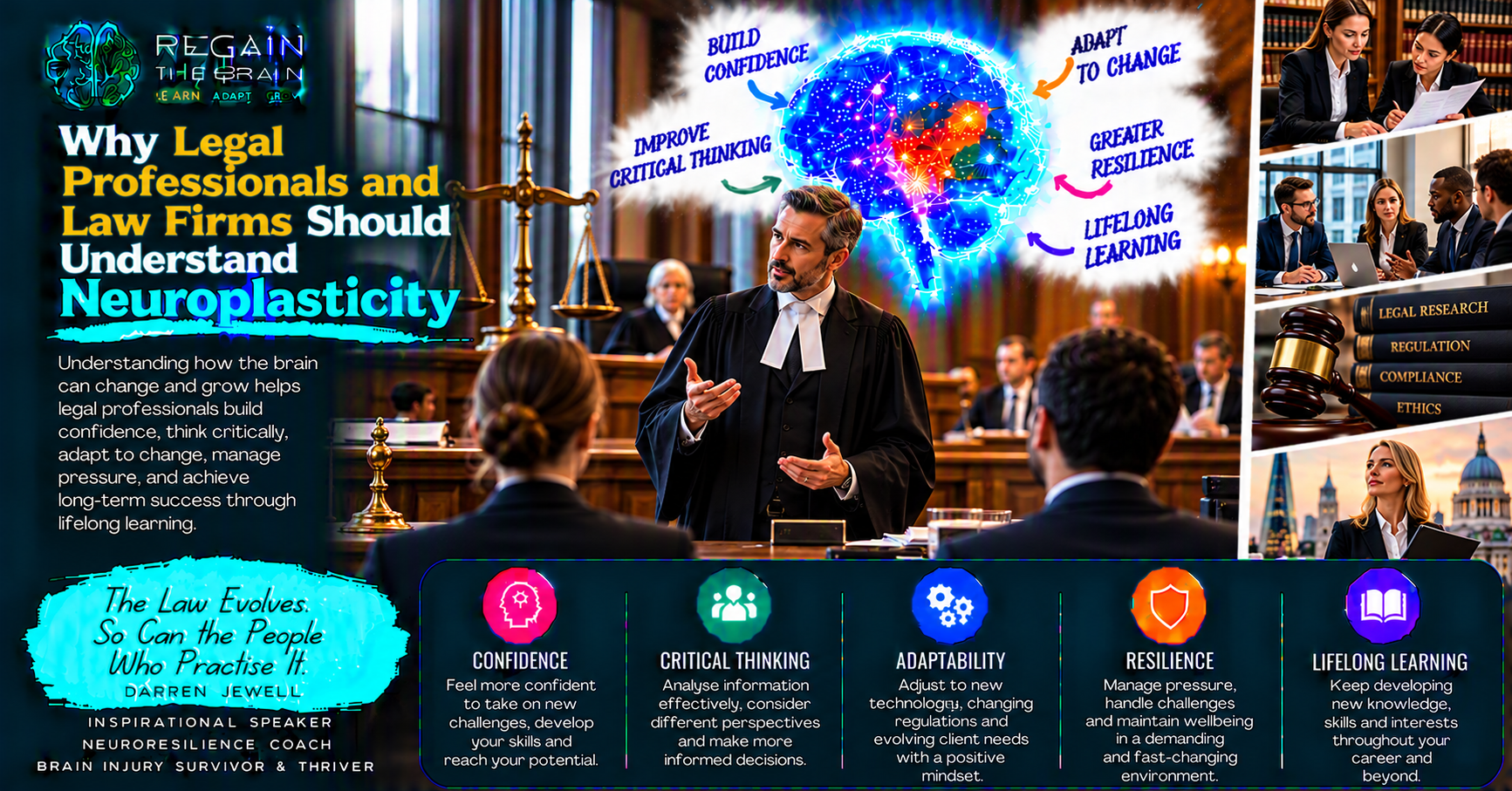
Imagine spending years studying the law, developing your professional expertise and building a successful legal career, only to discover that the way you work is changing faster than ever before.
New technologies are emerging.
Artificial intelligence is influencing legal research and document review.
Clients expect efficient, accessible services.
Regulations and legal interpretations continue to evolve.
And legal professionals must constantly develop their knowledge to remain effective.
But there is something fascinating about the human brain that I believe deserves greater attention within the legal profession.
Our brains retain the capacity to learn and adapt throughout our lives.
This ability is known as neuroplasticity.
For solicitors, barristers, legal executives, law firm partners and other legal professionals, understanding neuroplasticity can offer a valuable perspective on professional development, confidence, adaptability and lifelong learning.
My name is Darren Jewell.
I am a London-based inspirational speaker, NeuroResilience Coach, brain injury survivor and passionate advocate for lifelong learning.
My mission is to make neuroplasticity an everyday word.
And I believe the legal profession is an excellent place to encourage conversations about how people learn, develop their abilities and respond to change.
Because the law may be built on precedent, but the people practising it must continue learning.
1. What Is Neuroplasticity?
Neuroplasticity describes the brain’s ability to change its connections and patterns of activity in response to learning, experience and other biological processes.
It is one of the reasons human beings can continue acquiring knowledge and developing skills throughout adulthood.
Think about the first time you learned something complicated.
Perhaps you learned to drive.
Studied a foreign language.
Used unfamiliar technology.
Or attempted to play a musical instrument.
At first, the task may have demanded considerable concentration.
With appropriate instruction, practice and feedback, aspects of the task may gradually have become more familiar.
Learning involves changes in the brain, although those changes are complex and depend on many factors.
Neuroplasticity does not mean that everyone learns at the same speed.
It does not guarantee that every difficulty can be overcome.
And it does not mean that simply thinking positively will produce new abilities.
But it reminds us that our capacity to learn does not disappear when we reach adulthood.
For legal professionals, that is an important message.
2. Why the Legal Profession Depends on Lifelong Learning
Becoming a legal professional requires years of education and training.
But qualification is not the end of learning.
It is the beginning of a career in which knowledge must continue developing.
Legislation changes.
Court decisions influence legal interpretation.
Professional obligations evolve.
New technologies enter the workplace.
And clients present unfamiliar challenges.
A solicitor who qualified twenty years ago may now work with systems that barely existed at the beginning of their career.
A newly qualified lawyer may have to develop expertise in emerging areas of law.
And an experienced partner may need to learn new leadership or technological skills.
Understanding neuroplasticity reinforces the importance of continued professional development.
However, professional competence also depends on rigorous education, supervision, ethical standards and practical experience.
The legal profession does not stand still, and neither should professional learning.
3. Why Legal Knowledge Requires More Than Memorisation
When people think about studying law, they often imagine memorising legislation and legal principles.
But effective legal practice requires much more.
Professionals must interpret information.
Evaluate evidence.
Recognise relevant distinctions.
Construct arguments.
Communicate clearly.
And exercise sound professional judgement.
These are complex skills.
They develop through education, practice, experience and feedback.
Understanding neuroplasticity provides a perspective on the brain’s continuing involvement in learning.
However, knowing about neuroplasticity does not automatically improve legal reasoning.
Developing expertise requires appropriate instruction, critical thinking and professional experience.
The lesson is not that learning is effortless.
It is that professional development remains an ongoing process.
4. Why Confidence Matters in Legal Careers
Confidence can influence how legal professionals approach their responsibilities.
A trainee solicitor may feel intimidated during an important meeting.
A junior barrister may experience anxiety before appearing in court.
An experienced lawyer may hesitate before speaking at a conference.
And someone promoted to partner may question their leadership abilities.
These experiences can occur even among highly capable professionals.
Confidence does not necessarily mean the absence of nerves.
It can develop through preparation, experience, feedback and appropriate support.
This subject is particularly meaningful to me.
For approximately half a century, confidence was something I struggled to develop.
My experiences following a serious childhood brain injury influenced how I viewed myself and what I believed I could achieve.
Later in life, I began questioning some of those assumptions.
And that journey changed my relationship with learning.
5. My Personal Journey: From Brain Injury Survivor to Discovering New Possibilities
At just 15 months old, I suffered a serious brain injury after falling from a balcony.
I spent three weeks in a coma.
The consequences of that injury affected my coordination, physical abilities, confidence and many aspects of my life.
Growing up, I experienced challenges that other people did not always understand.
I also experienced bullying.
Those experiences influenced how I viewed myself.
I questioned my abilities.
I worried about making mistakes.
And I sometimes avoided unfamiliar opportunities because I feared failure.
For approximately half a century, confidence was something I struggled to develop.
I had gradually formed beliefs about what I could and could not do.
And some of those beliefs became so familiar that I rarely questioned them.
But at 54, I made a decision that began to change my perspective.
I decided to learn to play the piano.
For someone who had lived with coordination difficulties following a childhood brain injury, this was a meaningful challenge.
I needed to learn to read music.
Understand where the notes were.
Coordinate my hands.
Remember sequences.
And practise movements that initially felt unfamiliar.
There were frustrating moments.
Sometimes progress seemed painfully slow.
Sometimes I wondered whether I would ever improve.
But I continued practising.
Gradually, I began noticing progress in the skills I was learning.
And something important happened.
I began questioning some of the assumptions I had held about myself.
If I could begin learning the piano at 54, what else might I enjoy exploring?
That question led me towards new interests.
Writing.
Technology.
Language learning.
Website development.
Creating digital experiences.
And eventually sharing my story through inspirational speaking.
I did not suddenly become good at everything.
I still encountered difficulties.
I still needed help.
And I still had moments of uncertainty.
But my attitude towards unfamiliar challenges began to change.
Rather than automatically assuming I could not do something, I became more willing to explore whether I could learn.
That shift in perspective was enormously important to me.
It also encouraged me to investigate neuroplasticity and the science of lifelong learning.
Today, I am passionate about sharing that message.
I do not claim that learning the piano reversed my childhood brain injury.
Nor do I believe neuroplasticity guarantees recovery or removes every limitation.
But my experience reminded me that the assumptions we hold about ourselves are not always reliable predictions of what we might learn.
There is a connection here with the legal profession.
Imagine someone who has spent years developing expertise in one area of law.
They understand their responsibilities.
They have established routines.
They know how to approach familiar problems.
Then a new opportunity appears.
Perhaps they are offered a leadership role.
Perhaps they need to learn unfamiliar technology.
Perhaps they are considering moving into a different legal specialism.
Or perhaps they have an opportunity to speak publicly but lack confidence.
Suddenly, they are faced with a question.
Am I capable of doing this?
For many years, my instinctive answer would have been no.
Learning the piano encouraged me to approach that question differently.
Not with certainty.
Not with unrealistic expectations.
But with curiosity.
I started learning the piano at 54. My brain didn’t ask my age.
And that experience helped me discover something I now share through my speaking work:
Your Brain Is Not Finished. Your Story Is Not Over.
6. Why Learning New Legal Skills Can Feel Uncomfortable
Legal professionals are often expected to demonstrate competence and authority.
Clients rely on their expertise.
Colleagues seek their advice.
And important decisions may depend on their judgement.
But even experienced professionals can feel uncomfortable when learning something unfamiliar.
An established solicitor may find new technology frustrating.
A newly appointed partner may need to develop management skills.
A specialist lawyer may be required to understand an unfamiliar area of practice.
At first, learning can make capable people feel like beginners again.
That experience is not necessarily evidence of inability.
It may simply reflect the demands of acquiring unfamiliar knowledge.
Understanding neuroplasticity can help reinforce the importance of continued learning.
However, organisations must provide suitable training, supervision and time for professional development.
7. Why Artificial Intelligence Is Changing Legal Work
Artificial intelligence is influencing parts of the legal profession.
AI-assisted tools may support legal research, document analysis, drafting workflows and administrative tasks.
These developments create opportunities.
But they also introduce important risks.
AI-generated information may be inaccurate.
Legal authorities may be misrepresented or invented.
Confidential information may require special protection.
And automated outputs may contain errors that are not immediately obvious.
Legal professionals must understand the limitations of these tools.
Human verification, professional judgement, confidentiality safeguards and compliance with applicable duties remain essential.
Understanding neuroplasticity can encourage openness to learning unfamiliar technology.
But it cannot replace technical training, professional regulation or responsible AI governance.
The future of legal technology requires more than powerful software. It requires people who know how to use it responsibly.
8. Why Critical Thinking Remains Essential
Legal work involves evaluating information.
An argument may sound persuasive but lack sufficient evidence.
A document may contain important inconsistencies.
A legal interpretation may require careful examination.
And a client’s account may raise questions that need further investigation.
Critical thinking is therefore fundamental.
Legal professionals must distinguish assumptions from evidence.
They must recognise uncertainty.
And they must be willing to reconsider conclusions when new information becomes available.
These skills can develop through education, supervised practice and professional experience.
Understanding neuroplasticity reinforces the broader value of continued learning.
But it should never be presented as a substitute for rigorous legal analysis.
9. Why Communication Skills Matter in the Legal Profession
Legal professionals regularly communicate complicated information.
They explain legal options.
Discuss risks.
Present arguments.
Negotiate agreements.
And help clients understand unfamiliar processes.
But technical knowledge alone does not guarantee effective communication.
A client may feel anxious.
They may be unfamiliar with legal terminology.
They may have difficulty processing large amounts of information.
Or they may need additional time to consider their options.
Communication skills can develop through training, experience and constructive feedback.
Understanding neuroplasticity can complement conversations about professional development.
However, accessible communication also requires empathy, appropriate adjustments and a genuine commitment to understanding individual needs.
10. Why Public Speaking Confidence Matters for Lawyers
Public speaking is an important part of many legal careers.
Barristers may present arguments in court.
Solicitors may speak at professional events.
Partners may address employees or clients.
And legal specialists may deliver training.
Yet public speaking can feel intimidating.
Even experienced professionals may experience nerves before addressing an audience.
I understand that feeling.
For many years, confidence was a major challenge in my own life.
The idea of standing in front of people and sharing my story would once have seemed far beyond my abilities.
But my experiences with learning and personal development encouraged me to explore new possibilities.
Today, public speaking is an important part of my work.
I do not suggest that everyone will become comfortable with public speaking simply through determination.
But preparation, suitable training, gradual experience and support can help people develop relevant skills.
11. Why Legal Professionals Need Adaptability
Legal professionals work in an environment where circumstances can change.
A new judgement may influence how a legal issue is approached.
Legislation may be amended.
A client’s circumstances may evolve.
Technology may alter established workflows.
And organisations may restructure their services.
These changes can require professionals to develop new knowledge.
Understanding neuroplasticity reinforces the importance of lifelong learning.
However, adaptability must be supported by accurate information, appropriate resources and professional judgement.
Adaptability is not about abandoning established standards. It is about developing the knowledge needed to respond responsibly to new circumstances.
12. Why Workplace Resilience Matters in Law Firms
Legal work can involve demanding deadlines, emotionally difficult cases and significant professional responsibility.
Some lawyers also experience long working hours and pressure associated with client expectations.
These demands can affect wellbeing.
Resilience is therefore an important subject for legal organisations.
But resilience should never mean expecting employees to tolerate excessive workloads, harassment, unsafe conditions or inadequate support.
A healthy workplace requires responsible leadership.
Realistic expectations.
Appropriate supervision.
Clear communication.
And access to suitable wellbeing resources.
Understanding neuroplasticity can contribute to conversations about learning and adaptation.
But it is not a substitute for organisational responsibility or professional mental health support.
A successful law firm should value the wellbeing of the people who make its work possible.
13. Why Law Firm Leaders Should Understand Neuroplasticity
Becoming a successful lawyer does not automatically make someone an effective manager.
Legal expertise and leadership require overlapping but different skills.
Partners and senior managers may need to develop abilities in communication, delegation, mentoring, conflict resolution and organisational decision-making.
These skills can improve through training, experience and constructive feedback.
Understanding neuroplasticity provides a useful perspective on continued professional development.
However, effective leadership also requires accountability, appropriate resources and a supportive organisational culture.
For law firm partners and senior legal executives, an inspirational presentation about neuroplasticity can encourage reflection on how they support learning within their teams.
14. Why Mentoring Matters in Legal Careers
Imagine a trainee solicitor beginning their first placement.
They may have strong academic knowledge.
But the practical realities of legal work can feel unfamiliar.
They need to understand professional expectations.
Learn workplace procedures.
Develop communication skills.
And recognise when to seek advice.
An experienced mentor can help make that transition more manageable.
Mentoring provides opportunities for guidance, feedback and professional reflection.
Understanding neuroplasticity reinforces the importance of learning through experience.
But effective mentoring requires time, clear expectations and appropriate supervision.
A good mentor does more than share knowledge. They help create an environment in which another person can develop confidence and competence.
15. Why Law Firms Should Encourage a Growth Mindset
A growth mindset involves recognising that abilities can develop through effective learning strategies, practice, feedback and appropriate support.
This idea can be relevant to the legal profession.
A trainee may initially struggle with drafting.
A junior lawyer may need time to develop confidence in client meetings.
An experienced solicitor may be learning new technology.
And a partner may need to develop unfamiliar management skills.
These are opportunities for professional development.
However, a growth mindset should never become an excuse for unrealistic expectations or inadequate supervision.
Professional competence must remain the priority.
The message is not that everyone can achieve anything through positive thinking.
It is that people should have meaningful opportunities to learn and improve.
16. Why Learning From Mistakes Requires Professional Responsibility
Learning often involves recognising errors and improving our understanding.
But legal practice is a profession in which mistakes can have serious consequences.
An incorrect deadline.
An inaccurate document.
A confidentiality breach.
Or an unsupported legal argument can affect clients and organisations.
That is why professional learning must operate within appropriate systems of supervision, quality control and accountability.
Constructive feedback can help legal professionals develop their skills.
But serious errors must be addressed through established procedures and professional obligations.
Understanding neuroplasticity reinforces the value of continued learning.
It does not justify avoidable mistakes or reduce professional responsibility.
17. Why Client Empathy Matters
Legal professionals frequently work with people experiencing difficult circumstances.
A client may be dealing with divorce.
Employment problems.
Financial uncertainty.
A business dispute.
Or the loss of a loved one.
For the legal professional, the matter may involve familiar procedures.
For the client, it may be one of the most stressful experiences of their life.
This difference matters.
Effective client communication requires listening, clarity and respect.
Empathy does not mean abandoning professional objectivity.
It means recognising the human circumstances surrounding legal problems.
Understanding neuroplasticity can complement broader conversations about learning and interpersonal development.
But compassionate client service ultimately depends on professional conduct and organisational values.
18. Why Age Should Not Define a Legal Professional’s Potential
One of the most important lessons I have learned is that personal development does not have to stop at a particular age.
I began learning the piano at 54.
I was not trying to become a professional musician.
I simply wanted to learn something new.
That experience encouraged me to explore other interests.
Writing became one of them.
Technology became another.
And sharing my story through public speaking became an important part of my life.
I sometimes wonder how many people avoid unfamiliar opportunities because they believe they have missed their chance.
Perhaps an experienced solicitor wants to explore a new area of law.
Perhaps someone is considering entering the legal profession later in life.
Or perhaps a senior lawyer wants to develop new technological skills.
Adulthood does not eliminate our capacity to learn.
Progress may vary between individuals, and circumstances can affect opportunities.
But age alone should not be treated as proof that someone cannot develop unfamiliar abilities.
Experience and curiosity can belong together at every stage of a professional career.
19. Why Brain Injury Awareness Matters in Legal Services
Brain injury awareness is particularly close to my heart.
Brain injuries can affect memory, attention, movement, communication, emotional regulation and other aspects of daily life.
The consequences vary considerably between individuals.
Some difficulties may not be immediately visible.
Because I have lived with the consequences of a serious childhood brain injury, I understand how easily assumptions can be made about another person’s abilities.
Law firms and legal organisations have opportunities to make their workplaces and services more accessible.
Some employees may benefit from clear written instructions, accessible technology, structured training or reasonable adjustments based on their individual circumstances.
Clients may require accessible communication, additional time to process information or other appropriate support.
These considerations can be especially important when someone is navigating an unfamiliar legal process.
Neuroplasticity does not remove the need for accessibility.
Nor does my personal experience represent everyone living with a brain injury.
An inspirational presentation can complement specialist disability awareness and accessibility training.
Access to justice should include recognising that people do not all communicate, process information or experience the world in the same way.
20. Why Legal Organisations Should Promote Lifelong Learning
The legal profession brings together people with different experiences, responsibilities and areas of expertise.
Trainee solicitors.
Barristers.
Legal executives.
Paralegals.
Partners.
Compliance specialists.
And business support professionals all contribute to the work of legal organisations.
Their learning needs will differ.
But a shared commitment to professional development can support employees as their roles evolve.
Understanding neuroplasticity offers an accessible way to introduce conversations about learning throughout adulthood.
However, successful learning cultures require practical investment in training, mentoring, supervision and employee support.
My mission is to make neuroplasticity an everyday word.
And I believe the legal profession can play an important role in encouraging conversations about confidence, curiosity and lifelong learning.
21. Why Book an Inspirational Speaker for a Legal Conference?
Law firms, legal associations and professional organisations regularly hold conferences, leadership meetings, employee development days and workplace wellbeing programmes.
These events often focus on legal developments, regulation, technology and professional practice.
All are essential subjects.
But there can also be value in exploring the human experiences behind confidence, resilience and personal development.
An inspirational speaker can offer a different perspective through authentic personal storytelling.
My presentations combine lived experience with accessible explanations of neuroplasticity, confidence, resilience and lifelong learning.
I aim to entertain, educate and inform.
Speaking topics can include:
- Neuroplasticity and the science of lifelong learning
- Building confidence in demanding professions
- Challenging limiting beliefs
- My experience of learning the piano at 54
- Adaptability during technological change
- Workplace resilience and employee wellbeing
- Leadership and professional development
- Brain injury awareness and accessible workplaces
- Rediscovering curiosity in adulthood
- Recognising that personal development does not have an expiry date
Presentations can be adapted to the objectives of individual legal organisations.
They are designed to complement, not replace, specialist legal education, professional training or employee wellbeing support.
22. What Could Legal Professionals Take Away From My Story?
When I speak to an audience, I want people to leave with more than a temporary feeling of motivation.
I want them to reflect on their own assumptions.
Perhaps a junior solicitor has avoided an opportunity because they lack confidence.
Perhaps an experienced lawyer feels intimidated by unfamiliar technology.
Perhaps a partner has forgotten what it feels like to be a beginner.
Or perhaps someone has spent years believing they are not capable of learning a particular skill.
I would encourage them to consider a few questions.
What have I stopped myself from trying because I fear I will struggle?
Am I confusing unfamiliarity with inability?
How could I approach professional development with greater curiosity?
What assumptions have I made about my own abilities?
How can I help colleagues feel more comfortable asking questions?
What would I enjoy learning outside my professional responsibilities?
These questions do not promise instant transformation.
But they can encourage reflection, curiosity and a different approach to lifelong learning.
23. Why Choose Darren Jewell as Your Inspirational Speaker?
There are many experienced lawyers, judges, legal academics and technology specialists available to speak at legal conferences.
My contribution is different.
I do not claim to be a legal expert, practising solicitor or neuroscientist.
Instead, I offer a personal perspective shaped by my experiences of brain injury, low confidence, personal development and discovering new abilities later in life.
I understand what it feels like to doubt yourself.
To question your abilities.
To avoid unfamiliar opportunities.
And to assume that certain achievements belong to other people.
For approximately half a century, those experiences influenced my life.
Then, at 54, I decided to learn the piano.
That decision encouraged me to question assumptions I had held about myself.
It opened the door to further learning.
Writing.
Technology.
Languages.
Digital development.
And eventually sharing my story through inspirational speaking.
My journey has strengthened my passion for helping people understand neuroplasticity and the value of lifelong learning.
I do not promise that one presentation will transform a law firm or guarantee improved employee wellbeing, professional performance or commercial results.
Instead, I aim to offer a meaningful human perspective that encourages curiosity, reflection and conversations about what people may still be capable of learning.
24. Book Darren Jewell for Your Next Legal Conference or Law Firm Event
Are you a law firm partner, solicitor, barrister, legal executive, HR professional, Learning & Development specialist or conference organiser looking for an inspirational speaker for legal professionals and law firms?
I would welcome the opportunity to discuss how my presentations could complement your organisation’s leadership, professional development and employee wellbeing objectives.
Whether you are organising a legal industry conference, law firm leadership event, corporate learning day or employee wellbeing programme, my aim is to deliver a presentation that encourages people to think differently about confidence, adaptability and lifelong learning.
The legal profession is built on examining evidence, questioning assumptions and understanding different perspectives.
And perhaps those principles offer something valuable beyond the courtroom.
What if we examined some of the assumptions we hold about ourselves?
What if we questioned the belief that we are too old to learn?
What if we recognised that struggling with an unfamiliar skill does not automatically mean we are incapable of developing it?
For much of my life, I accepted limitations that I rarely questioned.
Later in life, I began discovering that some of those assumptions were not the final word.
I started learning new skills.
Exploring unfamiliar interests.
And finding the confidence to share my story.
That journey is still continuing.
And perhaps that is the most important message I can offer.
Sometimes the most important assumption we can challenge is the one we have made about ourselves.
Your Brain Is Not Finished. Your Story Is Not Over.
Darren Jewell
Inspirational Speaker | NeuroResilience Coach | Brain Injury Survivor & Thriver
Visit www.regainthebrain.com to enquire about booking an inspirational speaker for your law firm, legal association, professional development event or legal industry conference.
#NeuroplasticityAtWork #LegalProfession #LawFirms #LegalLeadership #Solicitors #Barristers #WorkplaceResilience #LifelongLearning #GrowthMindset #InspirationalSpeaker #BrainInjuryAwareness #DarrenJewell #RegainTheBrain