What happens when the people responsible for leading an organisation through change begin to question their own ability to adapt?
Businesses are facing an extraordinary period of transformation.
Artificial intelligence is reshaping industries. Economic uncertainty is influencing decisions. Employees are adapting to new technologies, changing expectations and unfamiliar ways of working.
Yet behind every business strategy, technological advancement and organisational transformation are human beings.
People who experience uncertainty.
People who sometimes lose confidence.
People who make mistakes, encounter setbacks and need time to learn.
And people whose ability to adapt can be strengthened when they receive the right support and opportunities.
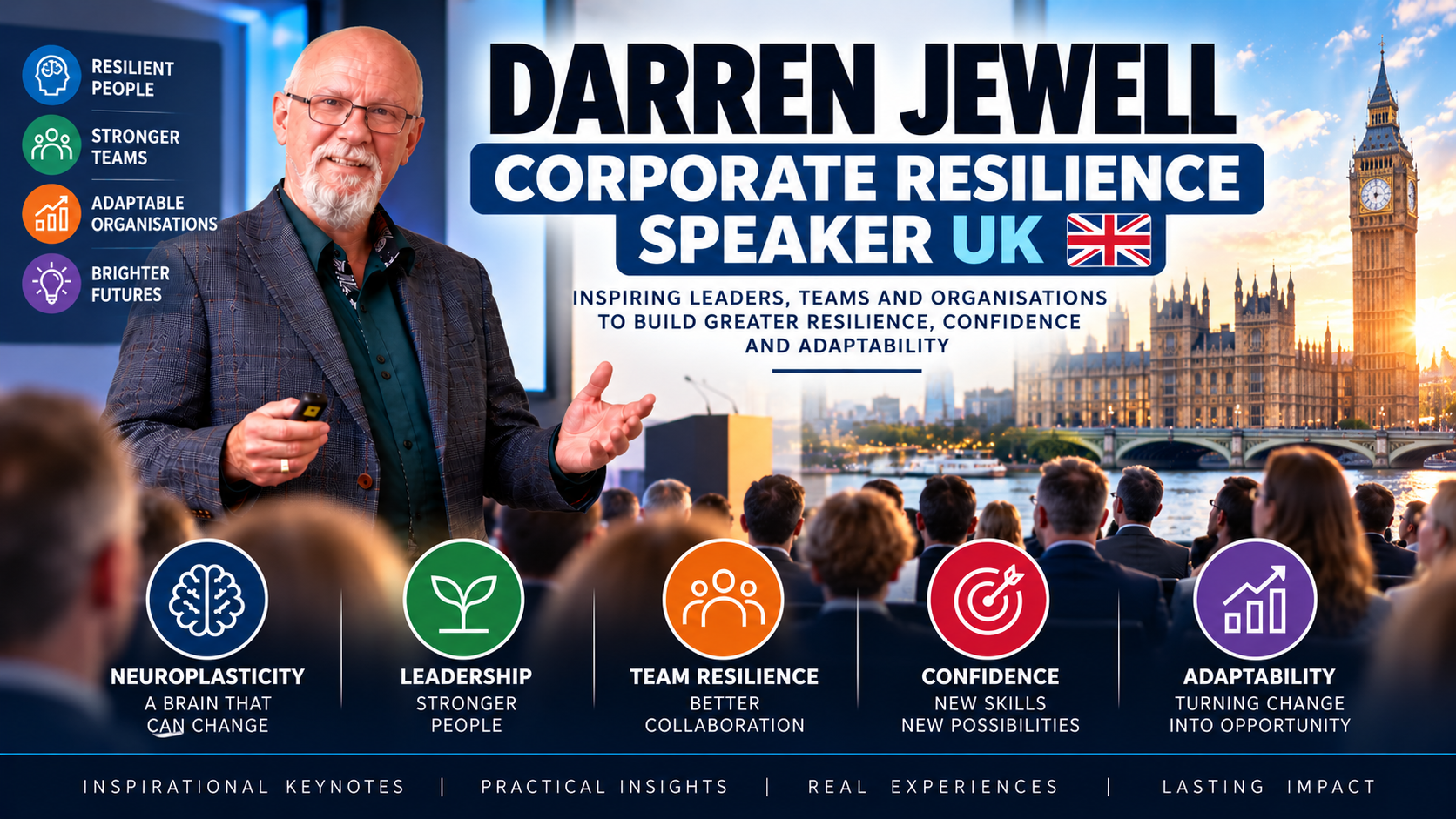
For Darren Jewell, corporate resilience speaker in the UK, neuroresilience coach and founder of Regain the Brain, understanding the human side of change is essential.
Drawing on his lived experience of brain injury and his interest in neuroplasticity, Darren encourages leaders and organisations to think differently about resilience.
His message is simple:
Resilience is not about expecting people to withstand unlimited pressure. It is about creating the conditions in which people can learn, adapt and move forward.
Why Corporate Resilience Matters More Than Ever
Resilience has become one of the most frequently discussed qualities in modern business.
Organisations want resilient employees.
Leaders want adaptable teams.
And executives want businesses capable of responding to unexpected challenges.
But what does resilience actually mean in a corporate environment?
It is not simply the ability to keep working when circumstances become difficult.
Nor is it about ignoring stress, suppressing emotions or pretending that every challenge can be overcome through determination.
Corporate resilience involves the ability of individuals, teams and organisations to prepare for disruption, respond constructively and adapt when circumstances change.
It includes effective leadership, communication, psychological safety, learning opportunities and appropriate support.
For businesses operating in uncertain environments, these capabilities can make a meaningful difference.
However, resilience must be developed through organisational practices as well as individual attitudes.
A motivational presentation may encourage reflection, but sustainable resilience also requires action from leadership.
Darren Jewell: A Corporate Resilience Speaker with a Different Perspective
Many corporate speakers discuss resilience through the lens of business success.
Darren approaches the subject from another perspective.
His understanding of adversity has been shaped by his personal experience of brain injury.
A brain injury can change familiar routines, affect confidence and require someone to approach everyday activities differently.
Challenges may not always be visible to others.
Progress can be unpredictable.
And the process of adaptation may involve considerable patience and support.
These experiences have influenced Darren’s interest in the human brain and its ability to respond to learning and experience.
They have also encouraged him to question some of the traditional assumptions surrounding resilience.
Sometimes moving forward requires determination.
Sometimes it requires a new strategy.
Sometimes it requires support from others.
And sometimes it requires accepting that the original plan is no longer the most appropriate one.
For business leaders, these ideas provide an opportunity to reconsider how they approach change.
The strongest leader is not necessarily the person who never struggles. It may be the person who recognises when something needs to change and has the courage to respond.
What Can Business Leaders Learn from Neuroplasticity?
Neuroplasticity describes the brain’s ability to modify and reorganise its connections in response to learning, experience and certain forms of injury.
For many years, people believed that the adult brain had relatively limited capacity for change.
Modern neuroscience has demonstrated that learning and experience continue to influence the brain throughout adulthood.
When we practise unfamiliar skills, neural networks involved in those activities can change.
With repetition and appropriate feedback, performance may improve.
This is relevant to professional development.
Employees learning unfamiliar software, managers developing communication skills and executives adapting to new responsibilities all engage in processes involving learning.
However, neuroplasticity is not a guarantee that everyone can develop every ability to the same level.
Individual circumstances, health, experience, training quality and available support all influence learning.
The important lesson for organisations is that people should not automatically be considered incapable of development because of their age or previous experience.
Five Foundations of a Resilient Corporate Culture
1. Leadership that encourages learning
Leaders influence how employees approach challenges.
When managers demonstrate curiosity, acknowledge uncertainty and seek feedback, they can encourage similar behaviours within their teams.
A learning-oriented leader does not need to possess every answer.
Instead, they recognise the importance of asking questions and remaining open to new information.
This becomes particularly valuable during periods of technological or organisational change.
2. Psychological safety
Employees need to feel comfortable raising concerns, asking questions and acknowledging mistakes.
Psychological safety helps create an environment where people can speak openly without unnecessary fear of humiliation.
It does not mean removing accountability or accepting poor performance.
It means encouraging constructive conversations that support learning and improvement.
3. Adaptability and continuous development
Businesses that invest in employee learning can help their workforce respond to changing requirements.
Training should not be limited to new recruits or younger employees.
People at every career stage may benefit from opportunities to develop unfamiliar skills.
4. Supportive communication
Uncertainty can create anxiety and confusion.
During periods of change, leaders should communicate clearly about what is happening, why decisions are being made and what support is available.
Honest communication is particularly important when not every answer is known.
5. Sustainable performance and wellbeing
Resilience should never become an excuse for excessive workloads or inadequate support.
People need appropriate rest, realistic expectations and working environments that recognise their wellbeing.
Sustainable resilience is not achieved by demanding more from exhausted employees.
It requires organisations to consider how work is structured and managed.
The Hidden Cost of Poor Workplace Resilience
When organisations struggle to manage change effectively, the consequences can extend beyond immediate performance.
Employees may become reluctant to contribute ideas.
Communication may deteriorate.
Confidence in leadership can decline.
And uncertainty may influence engagement and wellbeing.
These problems are not always caused by individuals lacking resilience.
They may reflect organisational systems, unrealistic expectations or inadequate communication.
Businesses should therefore avoid treating resilience as a purely personal responsibility.
A more effective approach considers both individual development and the environment in which people work.
Darren’s speaking encourages audiences to recognise this distinction.
The objective is not to encourage employees to tolerate every challenge.
It is to promote thoughtful approaches to adaptation, support and learning.
Why Confidence Matters During Organisational Change
Confidence can influence how people respond to unfamiliar responsibilities.
An experienced employee who has spent years using one system may feel uncertain when a new technology is introduced.
A manager promoted into a leadership role may question their ability to manage a larger team.
A senior executive navigating a difficult business decision may experience doubts about their judgement.
These experiences are understandable.
Confidence is not always constant, even among highly successful professionals.
Darren’s perspective on rebuilding confidence is informed by his understanding of adversity.
He believes recognising manageable progress can be valuable.
Rather than expecting immediate mastery, individuals can focus on developing familiarity through practice.
For example, an employee learning a new digital platform may benefit from structured training and opportunities to practise without unnecessary pressure.
Each achievement can contribute to greater confidence.
Confidence does not always come before action. Sometimes it grows because we have taken the first step.
Corporate Resilience in the Age of Artificial Intelligence
Artificial intelligence is transforming how businesses operate.
From administrative processes to data analysis and customer service, new technologies are changing established working practices.
For some employees, these developments create excitement.
For others, they create uncertainty about the future.
Leaders must therefore consider both technological implementation and the human experience of change.
Introducing a new system is not the same as ensuring employees feel confident using it.
Organisations need to provide appropriate training, communicate expectations and allow people time to develop unfamiliar skills.
Neuroplasticity offers an encouraging perspective.
Adults retain the capacity to learn throughout life.
However, successful learning requires more than motivation.
It also depends on resources, practice, feedback and support.
Darren encourages leaders to approach technological change with curiosity while recognising the importance of helping employees adapt.
Why Lifelong Learning Should Be Part of Every Business Strategy
Many organisations invest heavily in recruitment while overlooking the potential of developing their existing workforce.
Yet employees often possess valuable knowledge and experience that can provide a foundation for learning new skills.
Encouraging lifelong learning can help businesses respond to changing demands.
It can also contribute to employee engagement and personal development.
Darren’s own decision to begin learning the piano at 54 illustrates his commitment to remaining curious.
Learning a musical instrument involves attention, memory, coordination and repeated practice.
It also requires a willingness to make mistakes.
For Darren, the experience represents an important lesson.
You do not have to be young to learn something new. You have to be willing to become a beginner.
In business, this philosophy can help challenge assumptions about age, experience and adaptability.
A senior executive learning unfamiliar technology and a graduate developing leadership skills are both engaged in learning.
Neither should be embarrassed about not knowing something yet.
Resilience and the Importance of Inclusive Leadership
Every employee brings different abilities, experiences and perspectives to the workplace.
Some may be living with disabilities or long-term health conditions.
Others may experience difficulties that are not immediately visible.
Darren’s experience of brain injury has given him an appreciation of why organisations should avoid making assumptions based on appearance.
Someone may seem physically well while experiencing challenges involving concentration, fatigue or information processing.
Inclusive leadership involves recognising that employees may need different approaches or adjustments.
This can include flexible working arrangements, accessible communication or changes to the working environment.
A resilient organisation should not expect everyone to respond identically to challenges.
Instead, it should recognise individual circumstances and provide appropriate support.
The Difference Between Motivation and Lasting Organisational Change
An inspirational keynote can encourage audiences to think differently.
It can introduce new perspectives and create opportunities for discussion.
However, one presentation cannot transform an organisation’s culture on its own.
Meaningful change requires leadership commitment and continued action.
For example, a company inspired to encourage lifelong learning may need to invest in employee development programmes.
An organisation seeking greater psychological safety may need to review management practices.
A business interested in employee wellbeing may need to examine workloads and support systems.
Darren’s message is intended to contribute to these conversations.
He encourages audiences to reflect on what resilience means and how learning, adaptability and support can influence their approach to challenges.
What Makes Darren Jewell Different as a Corporate Resilience Speaker?
Darren’s approach brings together three important perspectives.
Lived experience of adversity
His experience of brain injury provides a personal foundation for discussing uncertainty, confidence and adaptation.
An interest in neuroscience
His focus on neuroplasticity encourages audiences to appreciate the brain’s capacity for learning and change.
A passion for lifelong learning
His commitment to trying unfamiliar activities demonstrates the value of curiosity and continued development.
Together, these themes offer a perspective that connects personal experience with challenges faced by modern organisations.
His message is not about promising instant transformation.
It is about encouraging people to recognise opportunities for learning and meaningful progress.
What Can Audiences Take Away from a Corporate Resilience Keynote?
Darren’s speaking themes encourage business audiences to consider how they respond to challenges and support the people around them.
Key messages include:
- Resilience involves adaptability, support and realistic expectations.
- Learning remains possible throughout adulthood.
- Confidence can develop through manageable achievements.
- Effective leaders remain willing to learn and seek feedback.
- Psychological safety can support communication and improvement.
- Organisational change requires attention to human needs.
- Lifelong learning can benefit individuals and businesses.
- Different people may need different forms of support.
These ideas can provide useful starting points for leadership discussions, employee development initiatives and organisational change programmes.
Regain the Brain: Inspiring People to Learn, Adapt and Grow
Through Regain the Brain, Darren promotes greater awareness of neuroplasticity, resilience and lifelong learning.
His philosophy is that learning should not end when formal education finishes.
Whether someone is developing professional skills, exploring unfamiliar technology, learning a language or trying a creative activity, new experiences can provide opportunities for personal development.
For Darren, curiosity is not simply a professional advantage.
It is a way of remaining engaged with life.
Learning something new can introduce enjoyment, challenge assumptions and create a sense of achievement.
This philosophy also has relevance to organisations.
Businesses that value learning can encourage employees to remain open to new ideas and approaches.
Why Book a Corporate Resilience Speaker in the UK?
Corporate conferences, leadership retreats, employee development days and wellbeing events provide opportunities to bring people together around important ideas.
A corporate resilience speaker can help introduce conversations about how organisations respond to change.
For businesses navigating uncertainty, these conversations can be particularly valuable.
Darren’s combination of lived experience and an interest in neuroscience provides a foundation for presentations about resilience, confidence and adaptability.
His themes are relevant to CEOs, senior executives, managers, HR professionals and employees.
Whether an organisation is introducing new technology, developing its leadership team or encouraging continuous learning, his message can help audiences reconsider what it means to adapt.
Book Darren Jewell as Your Corporate Resilience Speaker in the UK
Are you organising a corporate conference, leadership event, employee wellbeing programme or professional development day?
Darren Jewell is an inspirational speaker, neuroresilience coach and founder of Regain the Brain.
Drawing on his personal experience of brain injury, he encourages audiences to explore resilience, neuroplasticity and the importance of lifelong learning.
His message is designed for organisations that want to encourage curiosity, support adaptability and develop a greater understanding of the human side of change.
Whether your event is in London or elsewhere in the United Kingdom, Darren’s themes offer an opportunity to inspire reflection and meaningful conversations.
The future of business will not be shaped solely by the technology organisations adopt, but also by the willingness of their people to learn, adapt and grow.
To learn more about Darren Jewell and his inspirational speaking, visit www.regainthebrain.com.
Darren Jewell is an inspirational speaker, neuroresilience coach and founder of Regain the Brain. Drawing on his lived experience of brain injury, he promotes resilience, neuroplasticity, lifelong learning and greater awareness of the importance of adaptability.
This article is intended for educational and professional development purposes. It does not replace individual medical or psychological advice.