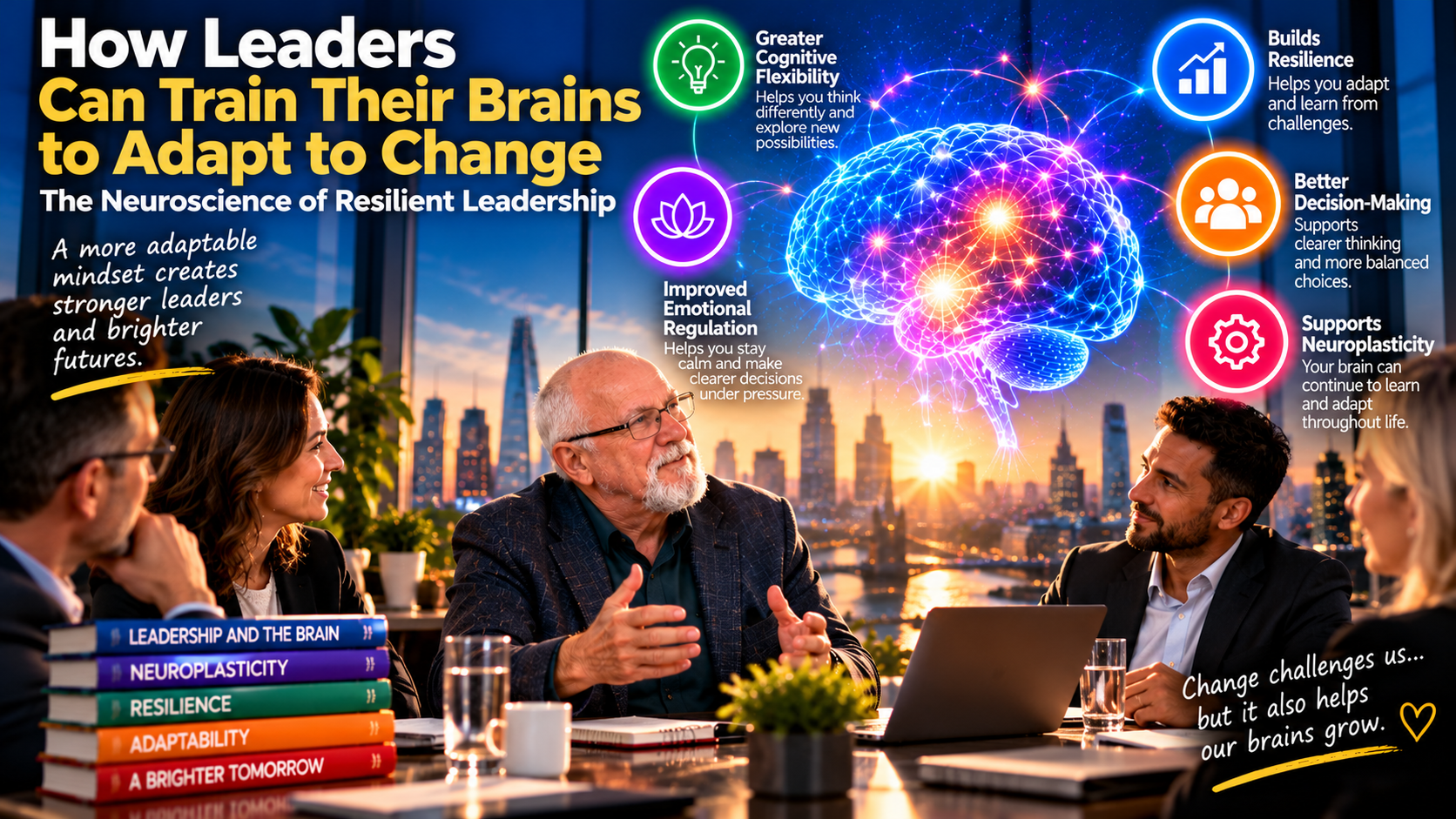
What separates a leader who struggles when everything changes from one who can adapt, learn and move forward?
Is it intelligence?
Experience?
Confidence?
Or something happening inside the brain?
The business world is changing at an extraordinary pace.
Artificial intelligence is transforming industries.
Technology is changing how organisations operate.
Customer expectations continue to evolve.
And leaders are being asked to make important decisions in situations where the answers are not always clear.
The leadership strategies that worked ten years ago may not be appropriate for tomorrow.
Yet many leaders continue to rely on familiar ways of thinking, even when circumstances suggest that a different approach is needed.
Why?
Because change can be uncomfortable.
Our brains develop expectations based on previous experiences. Familiar routines often require less conscious effort than unfamiliar situations.
When those expectations are challenged, we may experience uncertainty, frustration or stress.
But neuroscience also offers an encouraging insight.
The human brain retains a capacity to learn and adapt throughout life.
This capacity, known as neuroplasticity, provides one of the foundations for developing new skills and changing established behaviours.
It does not mean leaders can simply think themselves into becoming more resilient.
But it does suggest that adaptability can be supported through learning, practice, reflection and experience.
Through my lived experience of brain injury and my work exploring neuroresilience, I have become fascinated by the relationship between the brain, confidence and our responses to unexpected change.
I believe these lessons have enormous relevance for business leaders.
So, how can leaders develop the habits and skills that help them adapt?
And what does neuroscience actually tell us about resilient leadership?
Let’s explore.
1. Why Adaptability Has Become an Essential Leadership Skill
Leadership has always involved change.
Businesses grow.
Markets fluctuate.
Competitors introduce new ideas.
And organisations need to respond to unfamiliar circumstances.
But the pace and complexity of modern business can make adaptation particularly demanding.
Consider the introduction of artificial intelligence.
Some leaders immediately explore how AI might improve productivity.
Others hesitate because they are unfamiliar with the technology.
Some organisations experiment carefully.
Others attempt to resist change altogether.
The most effective response is not necessarily to embrace every new development.
Good leadership involves evaluating opportunities and risks before making decisions.
But refusing to reconsider established practices can create problems.
Adaptable leaders are willing to ask whether their current approach remains appropriate.
They recognise that experience is valuable without assuming that past success guarantees future success.
Leadership adaptability is not about constantly changing direction. It is about recognising when change is necessary and responding thoughtfully.
2. Why Our Brains Often Prefer Familiar Routines
Think about how many activities you complete automatically.
Driving a familiar route.
Preparing your morning coffee.
Using a computer programme you know well.
Or following an established work routine.
With experience, many activities become easier and require less deliberate attention.
This is useful because it allows us to manage everyday demands efficiently.
However, familiar patterns can also influence how we respond to new information.
We may favour approaches that previously worked.
Interpret unfamiliar ideas through existing assumptions.
Or hesitate before adopting a different strategy.
Psychologists describe several forms of cognitive bias that can influence decision-making.
For example, confirmation bias involves giving greater weight to information that supports existing beliefs.
This can become a problem in leadership.
A manager may continue supporting a strategy because it succeeded in the past, even when new evidence suggests that circumstances have changed.
Developing adaptability involves learning to recognise when familiar thinking is no longer serving us.
3. What Is Neuroplasticity, and Why Should Leaders Understand It?
Neuroplasticity refers to the brain’s ability to change its connections, structure and functions in response to experience, learning and other influences.
It is involved in developing skills, acquiring knowledge and adapting to new demands.
When someone learns to use unfamiliar software, they engage processes associated with learning.
When a manager develops better communication skills through practice and feedback, learning-related changes may occur.
And when someone becomes more comfortable with a new responsibility, experience contributes to their developing competence.
However, neuroplasticity is often exaggerated in popular discussions.
It does not mean every thought rewires the brain in a dramatic or measurable way.
It does not guarantee that anyone can master any skill.
And it does not mean that neurological injury can always be overcome through determination.
For leaders, the most useful message is more practical.
Our previous experiences influence our abilities and expectations, but learning can continue throughout life.
This makes continued development an important part of leadership.
4. Why Change Can Trigger Stress
Uncertainty can be stressful.
When familiar circumstances change, people may worry about what happens next.
Will the business remain profitable?
Will employees accept a new strategy?
Will a technology investment succeed?
Could a decision damage the organisation?
These concerns can create pressure.
The brain’s stress-response systems involve interactions between neural networks, hormones and the autonomic nervous system.
When a situation is perceived as threatening, the body may prepare to respond.
Heart rate can increase.
Attention may become focused on immediate concerns.
And stress-related hormones such as cortisol may be released.
Short-term stress is not necessarily harmful.
It can sometimes support alertness and performance.
However, persistent or excessive stress can interfere with sleep, concentration, emotional regulation and decision-making.
Leaders who experience sustained pressure may therefore benefit from developing effective ways to manage stress.
The aim is not to eliminate every stressful situation.
It is to respond in ways that protect wellbeing and support thoughtful decisions.
5. The Role of the Prefrontal Cortex in Leadership
The prefrontal cortex is involved in several functions relevant to leadership.
These include planning, decision-making, working memory and aspects of behavioural regulation.
When leaders evaluate competing priorities, consider consequences or manage impulses, they draw on networks involving the prefrontal cortex and other brain regions.
But leadership cannot be reduced to one part of the brain.
Decision-making also involves emotion, memory, motivation and social understanding.
These processes interact.
For example, a leader responding to a difficult employee situation may need to consider company policy, emotional reactions, legal obligations and the wider consequences of their decision.
This requires more than analytical reasoning alone.
Effective leadership involves integrating information from several sources while remaining aware of personal biases and emotional responses.
6. Why Emotional Regulation Matters During Change
Imagine a company experiencing an unexpected setback.
A major client leaves.
Revenue falls.
And employees become concerned about their future.
The leader’s response can influence the atmosphere throughout the organisation.
If the leader reacts with anger, blame or panic, employees may become reluctant to communicate openly.
If the leader remains composed and explains what is known, what remains uncertain and what will happen next, the organisation may be better positioned to respond.
Emotional regulation does not mean suppressing every feeling.
Nor does it mean pretending that difficult circumstances are unimportant.
It involves recognising emotions and responding appropriately.
Useful approaches may include pausing before reacting, seeking additional information and considering alternative interpretations.
For leaders experiencing persistent stress, professional support may also be appropriate.
Resilient leadership is not about never feeling pressure. It is about developing constructive ways to respond when pressure arises.
7. Cognitive Flexibility: The Ability to Think Differently
Cognitive flexibility refers to the ability to adjust thinking or behaviour when circumstances, rules or demands change.
It is an important aspect of executive functioning.
Imagine a company that has always relied on face-to-face sales.
Customer behaviour changes, and online purchasing becomes increasingly important.
A cognitively flexible leader may consider whether existing sales methods need adapting.
They might investigate digital platforms, consult employees and experiment with different approaches.
A less flexible response might involve insisting that the previous strategy must continue because it has always worked.
Cognitive flexibility does not mean abandoning established principles.
It means being willing to reconsider assumptions when evidence suggests that another approach may be more effective.
Leaders can practise this through perspective-taking, scenario planning and reviewing decisions.
8. Why Leaders Need to Become Comfortable With Not Knowing
Senior leaders often feel pressure to provide answers.
Employees look to them for direction.
Investors expect confidence.
And customers want reassurance.
But no leader can know everything.
New technologies, markets and regulations create unfamiliar questions.
Pretending to understand something can be more dangerous than acknowledging uncertainty.
For example, a CEO considering an AI implementation may not understand every technical detail.
A constructive response would be to seek reliable expertise, ask questions and evaluate the evidence.
This demonstrates responsible leadership.
It also encourages a learning culture.
When leaders admit that they need more information, employees may feel more comfortable asking questions themselves.
Being willing to learn is not a weakness.
It is a practical requirement in a changing world.
9. Why Psychological Safety Supports Adaptability
Psychological safety refers to a shared belief that people can take interpersonal risks within a team without unnecessary fear of humiliation or punishment.
It can influence whether employees feel comfortable speaking up.
Imagine an organisation introducing a new system.
An employee notices a problem.
But they fear their manager will react negatively.
They remain silent.
The problem continues.
Now imagine a workplace where employees can raise concerns constructively.
The issue may be identified earlier.
This can provide an opportunity to adjust the implementation.
Psychological safety does not remove accountability.
Employees still have responsibilities.
But it can encourage the communication necessary for organisations to learn.
Leaders who want adaptable teams should consider how their behaviour affects whether people feel able to share information.
10. Why Learning From Mistakes Is Essential
Every leader makes mistakes.
Some decisions produce unexpected outcomes.
Strategies fail.
And assumptions turn out to be incorrect.
The important question is what happens afterwards.
Does the organisation investigate the reasons?
Does it identify useful lessons?
Or does it focus exclusively on assigning blame?
Learning involves using feedback to adjust expectations and behaviour.
Neural systems associated with reinforcement learning contribute to how people respond when outcomes differ from predictions.
However, mistakes do not automatically lead to improvement.
Useful learning requires appropriate feedback, reflection and opportunities to apply what has been learned.
Leaders can encourage this by reviewing important decisions and asking what should be repeated or changed.
The goal is not to celebrate failure for its own sake.
It is to extract useful information when things do not go as planned.
11. How Curiosity Can Make Leaders More Adaptable
Curiosity encourages us to explore unfamiliar information.
It motivates questions.
Challenges assumptions.
And creates opportunities for learning.
A curious leader may ask:
Why do our customers behave this way?
What are our competitors doing differently?
Could this process be improved?
What might we be overlooking?
These questions can help organisations identify possibilities that established routines conceal.
Curiosity also encourages leaders to recognise the limits of their knowledge.
Rather than assuming they already understand every issue, they remain open to different perspectives.
This does not mean pursuing every new idea.
Effective curiosity is combined with critical thinking.
Leaders need to distinguish between interesting possibilities and approaches supported by sufficient evidence.
12. What My Experience of Brain Injury Has Taught Me About Adaptability
My lived experience of brain injury has influenced the way I understand change.
When life changes unexpectedly, familiar assumptions may no longer apply.
Activities that once seemed straightforward can become more challenging.
Expectations may need adjusting.
And confidence can be affected.
These experiences have encouraged me to think about adaptability differently.
I do not believe resilience means pretending difficulties do not exist.
Nor do I believe neuroplasticity guarantees that every limitation can be overcome.
Sometimes, adaptation involves developing an unfamiliar skill.
Sometimes, it means finding a different way to complete a familiar activity.
And sometimes, it involves recognising when support or rest is needed.
I believe these lessons have relevance for leadership.
Organisations cannot always control the changes they face.
But leaders can influence how they evaluate circumstances, seek support and respond.
13. Why Learning Something New Can Challenge Established Thinking
One way to experience the challenges of learning is to become a beginner again.
When I started learning piano at 54, I entered a subject where I had much to discover.
I needed to become familiar with notes, movements and musical patterns.
Some things required repeated practice.
Others took longer than I expected.
But the experience reminded me that being a beginner is not something to be embarrassed about.
For leaders, this is an important lesson.
Someone may be highly experienced in business while knowing very little about a new technology or industry.
Being successful in one area does not eliminate the need to learn in another.
Trying an unfamiliar activity can also remind us what employees experience when they are asked to develop new skills.
It can encourage patience and empathy.
14. Why Age Is Not a Barrier to Leadership Development
Some people assume that learning becomes impossible or unimportant later in life.
But adults can continue developing skills throughout their lives.
Learning may become different with age.
Processing speed, prior experience, motivation and health can influence performance.
However, there is no universal age at which leadership development must stop.
An experienced executive can learn new technology.
A manager can improve communication skills.
And a business owner can develop unfamiliar approaches to problem-solving.
The important consideration is whether learning opportunities are appropriate and meaningful.
Leadership development should not be reserved exclusively for younger employees.
Experience and continued learning can complement one another.
15. Why Sleep Matters for Decision-Making
Leaders sometimes treat sleep as an inconvenience.
Long working hours may be celebrated.
And exhaustion can become associated with commitment.
But sleep plays an important role in cognitive functioning.
Insufficient sleep can affect attention, working memory, emotional regulation and decision-making.
It may also influence how people respond to stressful situations.
For leaders making important decisions, these effects deserve attention.
Protecting adequate sleep is not a sign of lacking ambition.
It is part of maintaining the capacity to perform effectively.
Individual sleep needs vary, but most adults generally require around seven to nine hours per night.
Persistent sleep difficulties should be discussed with an appropriate healthcare professional.
16. Why Physical Activity Can Support Leadership Wellbeing
Physical activity is associated with numerous health benefits.
Regular movement can support cardiovascular health, mood and sleep.
Research has also investigated its relationship with cognitive functioning.
For leaders who spend much of their day sitting in meetings or working at computers, opportunities for movement may be limited.
Simple changes can help.
Taking a walk during a break.
Using stairs when appropriate.
Or scheduling time for suitable exercise.
Physical activity does not guarantee better leadership decisions.
But supporting physical and mental wellbeing can contribute to the conditions needed for effective work.
People with disabilities or health conditions may require adapted activities and professional guidance.
17. Why Leaders Should Challenge Their Own Assumptions
Experience can be valuable.
It provides knowledge about what has worked in the past.
But experience can also create strong expectations.
A leader may assume customers will continue behaving in familiar ways.
Or believe a particular management style is always effective.
These assumptions can become problematic when circumstances change.
One practical approach is to deliberately seek alternative explanations.
For example:
What evidence would suggest our strategy is wrong?
What might someone outside our industry notice?
What are we assuming without checking?
Could our competitors be responding to a change we have overlooked?
These questions encourage critical thinking.
They do not guarantee better decisions.
But they can reduce the risk of relying exclusively on familiar interpretations.
18. How Leaders Can Practise Adaptability Through Small Changes
Adaptability does not always require a major transformation.
Sometimes, leaders can practise responding to unfamiliar situations through manageable activities.
For example, they might experiment with a different meeting format.
Learn to use a new digital tool.
Invite feedback from employees outside their usual team.
Or explore a different approach to solving a recurring problem.
The purpose is not to introduce change simply for the sake of change.
It is to become more comfortable evaluating unfamiliar possibilities.
Leaders should consider the potential consequences of any experiment.
Low-risk situations are often appropriate starting points.
And changes should be assessed rather than automatically adopted.
19. The Importance of Reflection in Leadership Development
Busy leaders often move from one decision to the next without taking time to reflect.
But reflection can support learning.
It provides an opportunity to examine what happened.
Why a decision was made.
And whether the outcome matched expectations.
For example, after completing a major project, a leader might ask:
What worked well?
What difficulties emerged?
What information did we overlook?
How did we respond to unexpected challenges?
What would we do differently next time?
These questions can help identify patterns.
Reflection is particularly valuable when it leads to practical adjustments.
Simply thinking about an experience is not always enough.
Learning becomes more useful when insights influence future behaviour.
20. Ten Practical Ways Leaders Can Develop Greater Adaptability
Here are ten approaches that can support learning and adaptability.
1. Remain curious
Ask questions and explore unfamiliar perspectives.
2. Continue learning
Develop skills relevant to changing professional demands.
3. Challenge assumptions
Consider whether established beliefs remain supported by evidence.
4. Practise emotional regulation
Recognise stress and respond thoughtfully.
5. Encourage psychological safety
Make it easier for employees to raise concerns and share ideas.
6. Learn from mistakes
Use feedback to improve decisions and processes.
7. Seek different perspectives
Consult people with varied experiences and expertise.
8. Protect your wellbeing
Recognise the importance of sleep, movement and manageable workloads.
9. Experiment responsibly
Explore new approaches while evaluating potential risks.
10. Reflect regularly
Review decisions and identify opportunities for improvement.
These habits do not guarantee success.
But they can contribute to a leadership approach that values learning and thoughtful adaptation.
21. A Seven-Day Adaptable Leadership Challenge
If you are a manager, business owner or CEO, consider trying this seven-day challenge.
It is designed to encourage reflection rather than promise dramatic neurological change.
Day 1: Identify an assumption
Choose one belief about your organisation that may need reviewing.
Day 2: Ask a new question
Invite someone to share a perspective you haven’t considered.
Day 3: Learn something unfamiliar
Spend time exploring a relevant new skill or technology.
Day 4: Review a recent mistake
Consider what useful information emerged from the experience.
Day 5: Listen to your team
Ask employees what might help them work more effectively.
Day 6: Explore an alternative
Consider another way of approaching a familiar challenge.
Day 7: Reflect
Identify one lesson you would like to apply in future.
The aim is not to become a completely different leader in a week.
It is to begin developing habits that support ongoing learning.
22. Why Adaptable Leaders Need Resilient Organisations
A leader cannot create an adaptable organisation alone.
Employees need appropriate training.
Teams require clear communication.
Systems must support changing demands.
And organisations need resources to implement new approaches.
For example, a company may encourage employees to adopt unfamiliar technology.
But if training is inadequate, frustration may increase.
Similarly, a leader may promote innovation while punishing every unsuccessful experiment.
Employees will quickly recognise the contradiction.
Adaptability needs to be supported by organisational practices.
This includes realistic expectations, psychological safety, effective feedback and appropriate resources.
The responsibility for adaptation should not rest entirely on individuals.
23. The Difference Between Resilience and Simply Pushing Harder
Resilience is sometimes misunderstood as the ability to continue regardless of circumstances.
Leaders may feel pressure to work longer hours.
Ignore exhaustion.
Or persist with strategies that are no longer effective.
But resilience does not always mean pushing harder.
Sometimes, it involves changing direction.
Seeking support.
Reducing unnecessary demands.
Or recognising that a particular goal is no longer appropriate.
This is particularly important when discussing health and wellbeing.
Persistent overwork can have significant consequences.
A resilient leader should not be expected to ignore their physical or psychological needs.
Instead, resilience can involve responding flexibly while recognising personal and organisational limits.
24. What Artificial Intelligence Teaches Us About Adaptability
Artificial intelligence provides a useful example of the challenges facing modern leaders.
Some AI tools can automate tasks.
Support information processing.
And create new opportunities for businesses.
But AI also introduces concerns involving accuracy, privacy, security, bias and accountability.
Leaders need to understand both the possibilities and the limitations.
They may need to develop unfamiliar knowledge.
Consult technical experts.
And reconsider existing processes.
This requires adaptability.
But it also requires judgement.
The goal should not be to adopt AI simply because it is fashionable.
It should be to determine whether particular technologies can provide meaningful benefits while managing risks appropriately.
Leaders who remain curious and willing to learn may be better positioned to evaluate these developments.
25. Why Neuroresilience Matters for the Future of Leadership
Through Regain the Brain, I explore how neuroscience, learning and resilience relate to the challenges people experience.
My interest in neuroresilience comes partly from recognising that life does not always follow a predictable path.
Unexpected events can challenge our confidence.
Change our circumstances.
And require us to reconsider familiar ways of thinking.
I believe leaders face similar challenges in organisational life.
They cannot predict every market development.
Prevent every setback.
Or guarantee that every strategy will succeed.
But they can develop habits that support thoughtful responses.
They can encourage learning.
Create environments where people feel able to communicate.
And recognise when a different approach may be needed.
Neuroplasticity provides a scientific foundation for understanding learning and adaptation.
Resilience provides a broader framework for considering how people respond to adversity.
Together, these ideas offer useful lessons for leadership.
Final Thoughts: The Future Belongs to Leaders Who Keep Learning
Leadership is not simply about having experience.
It is about knowing how to use experience while remaining open to change.
The world will continue to evolve.
Technology will develop.
Markets will shift.
And organisations will encounter challenges that cannot always be predicted.
Leaders who insist that yesterday’s answers must always work tomorrow may struggle to respond.
But leaders who remain curious, reflective and willing to learn can develop more flexible approaches.
Neuroscience reminds us that learning remains possible throughout life.
Psychology helps explain how stress, emotion and cognitive biases influence our decisions.
And lived experience teaches us that adaptation is not always easy.
Through my own experience of brain injury, I have come to appreciate that resilience does not mean controlling everything that happens.
Sometimes, it means recognising what has changed and exploring what can be done next.
For business leaders, this is a message worth remembering.
You do not need to know everything.
You do not need to get every decision right.
And you do not need to pretend that uncertainty has disappeared.
But you do need to remain willing to learn.
Because the greatest leadership skill may not be knowing exactly what to do when everything is familiar.
It may be knowing how to respond when everything changes.
And that begins with a willingness to think differently.
About Darren Jewell
Darren Jewell is a neuroresilience coach, inspirational speaker and founder of Regain the Brain.
Drawing on his lived experience of brain injury and his passion for neuroplasticity, Darren encourages business leaders, organisations and individuals to explore resilience, confidence, adaptability and lifelong learning.
Through inspirational speaking, coaching and educational projects, he shares accessible insights into neuroscience and the importance of responding constructively to change.
Help Your Leaders Become More Adaptable and Resilient
Is your organisation navigating change, introducing new technology or looking to develop greater resilience within its leadership teams?
Darren’s inspirational talks explore neuroplasticity, adaptability, confidence and the neuroscience of responding to unfamiliar challenges.
His message combines lived experience with accessible science and practical lessons for leaders and teams.
Discover Darren’s inspirational speaking and neuroresilience coaching services at www.regainthebrain.com.
This article provides general educational information and does not replace medical, psychological or professional organisational advice.