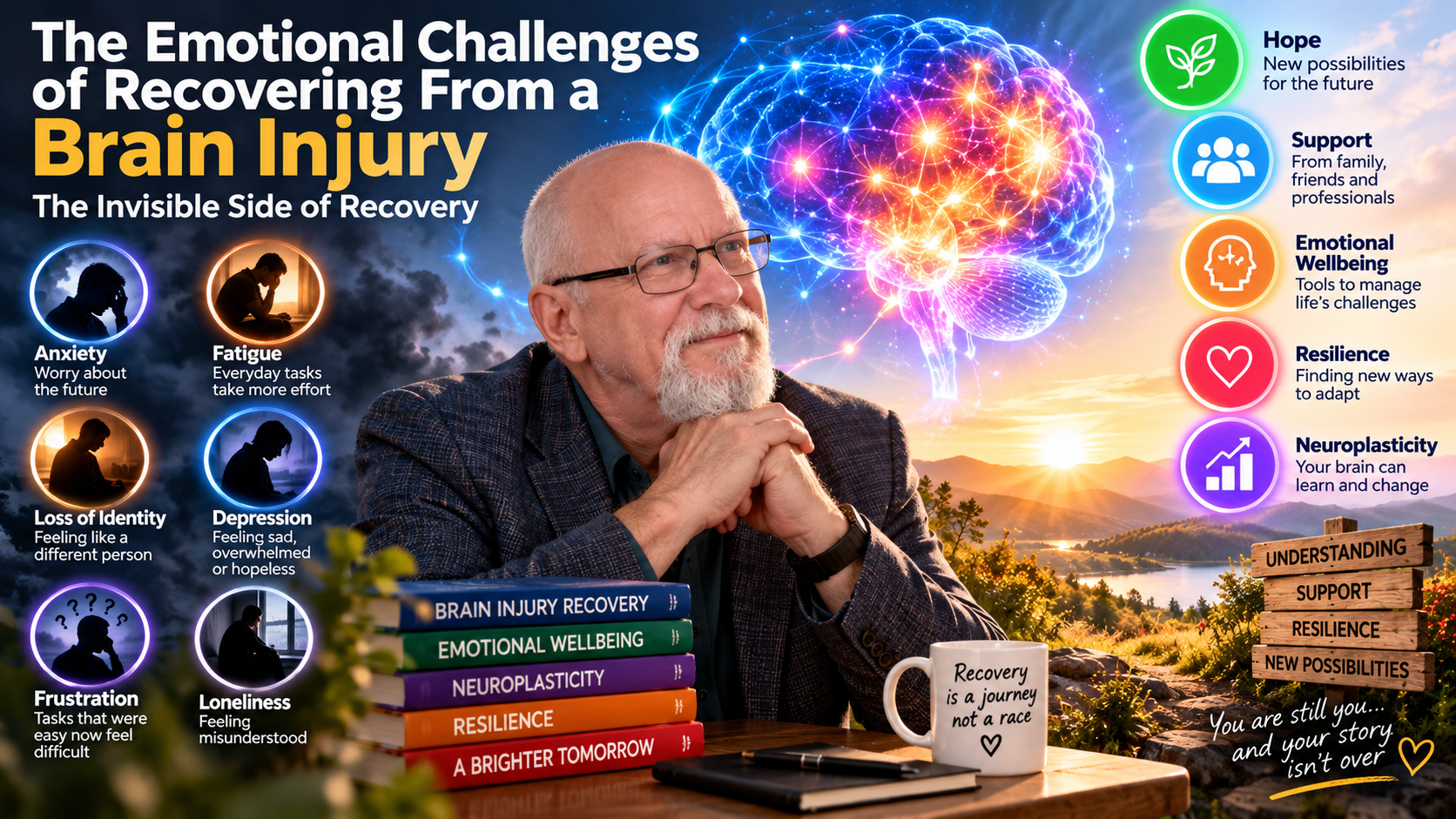
What happens when the greatest challenges following a brain injury are the ones nobody else can see?
When someone experiences a brain injury, people often focus on the physical consequences.
Can they walk?
Can they speak?
Can they return to work?
Can they perform the everyday activities they managed before?
These are important questions.
But there is another side of brain injury recovery that deserves just as much attention.
The emotional side.
The frustration of struggling with something that once felt effortless.
The uncertainty of not knowing what tomorrow will bring.
The loss of confidence.
The fear of being misunderstood.
And sometimes, the overwhelming feeling that the person you once were has changed.
Through my own lived experience of brain injury, I have come to appreciate how deeply these challenges can affect someone’s sense of identity, independence and self-belief.
Recovery is not simply about what the brain can physically or cognitively do.
It can also involve learning how to live with change.
For some people, the emotional consequences of a brain injury can be as challenging as the physical or cognitive effects.
And because these difficulties are not always visible, they can be overlooked.
So, what are the emotional challenges of recovering from a brain injury, and how can people find meaningful ways to navigate them?
Let’s explore this important subject.
1. Why Brain Injury Recovery Is About More Than Physical Healing
A brain injury can affect many different aspects of a person’s life.
Depending on the nature and severity of the injury, someone may experience changes involving:
- Memory and concentration.
- Movement and coordination.
- Communication and language.
- Fatigue and sleep.
- Emotional regulation.
- Behaviour and social interaction.
- Confidence and independence.
Not everyone experiences all these difficulties.
And the effects can vary considerably between individuals.
Some people recover relatively quickly.
Others experience long-term challenges.
But even when physical recovery is progressing, emotional adjustment may continue.
Someone might regain the ability to walk independently but still feel anxious about going outside.
Another person may return to work while privately struggling with fatigue, uncertainty or reduced confidence.
These experiences remind us that recovery cannot always be measured through physical milestones alone.
A person may appear to be recovering well while still facing significant emotional challenges.
2. The Shock of Life Changing Unexpectedly
Many people develop expectations about how their lives will unfold.
We make plans.
Build careers.
Develop relationships.
And establish routines that provide familiarity and stability.
A brain injury can disrupt those expectations.
Sometimes, the change happens suddenly.
An accident.
A fall.
A stroke or another acquired neurological event.
In other circumstances, the effects of an injury may become more apparent over time.
The experience can leave someone feeling uncertain about their future.
Activities that previously felt predictable may become difficult.
Responsibilities may need to change.
And plans that once seemed straightforward may no longer feel realistic.
This disruption can produce powerful emotional reactions.
Fear.
Sadness.
Anger.
Confusion.
Or a sense of disbelief.
These responses are not necessarily signs that someone is coping badly.
They may reflect the enormous adjustment involved in experiencing a life-changing event.
3. Why Loss of Identity Can Be One of the Hardest Challenges
Before a brain injury, someone may have defined themselves through particular roles.
A parent.
A professional.
A business owner.
An athlete.
A partner.
Or someone who has always been independent.
These roles can become important parts of our identity.
But what happens when an injury changes our ability to fulfil them?
Someone who previously worked in a demanding profession may struggle to return to the same responsibilities.
A person who enjoyed physical activities may find that fatigue or movement difficulties affect their participation.
Another individual may need assistance with tasks they once completed independently.
These changes can create a sense of loss.
People may begin questioning who they are.
They may feel disconnected from their previous identity.
Or they may struggle to recognise the person they have become.
This is one reason emotional adjustment can take time.
Recovering from a brain injury may involve not only adapting to changed abilities but also reconsidering how you understand yourself.
4. The Frustration of Everyday Tasks Becoming Difficult
Imagine being able to complete a task effortlessly for years.
Then, following a brain injury, you discover that the same activity now requires considerable concentration.
Perhaps you struggle to remember information.
You lose your place during a conversation.
You become overwhelmed by a busy environment.
Or you need additional time to complete something familiar.
These experiences can be frustrating.
The difficulty is not always the task itself.
It can also be the comparison with how easily you managed it before.
You remember what you used to be capable of doing.
And that memory can make the present feel particularly difficult.
Frustration may also increase when other people underestimate the effort involved.
Someone might say:
“But you used to be able to do that.”
Or:
“Surely it can’t be that difficult.”
Comments like these may be intended as encouragement.
But they can make someone feel misunderstood.
A more helpful response is often to recognise the difficulty and ask what support would be useful.
5. Why Brain Injury Can Affect Emotional Regulation
The brain plays a central role in emotional processing and regulation.
Networks involving areas such as the prefrontal cortex, amygdala and other interconnected regions contribute to how we respond to emotional experiences.
Brain injury can sometimes affect these systems.
As a result, some people experience changes in emotional regulation.
They may become more irritable.
Feel overwhelmed more easily.
Experience sudden emotional reactions.
Or find it harder to manage frustration.
Other factors can contribute too.
Pain, poor sleep, fatigue, medication effects and stressful circumstances may influence emotional wellbeing.
It is important not to assume that every emotional difficulty is caused directly by damage to a particular brain region.
Emotional changes after brain injury can arise through several interacting biological, psychological and social processes.
If emotional or behavioural changes are significant, assessment by an appropriate healthcare professional can help identify potential causes and support needs.
6. The Invisible Burden of Cognitive Fatigue
One of the most misunderstood difficulties following brain injury is cognitive fatigue.
This is not necessarily the same as ordinary tiredness.
Some people find that activities requiring concentration become exhausting.
Reading.
Following conversations.
Making decisions.
Processing information.
Or spending time in noisy environments.
Tasks that appear simple to others may require substantial mental effort.
And the effects can sometimes continue after the activity has finished.
Cognitive fatigue can also influence emotional wellbeing.
When someone is exhausted, frustration may increase.
Concentration may become more difficult.
And managing everyday demands can feel overwhelming.
This is why appropriate pacing and rest can be important.
For some people, learning to recognise early signs of fatigue becomes part of managing daily life.
Rest should not automatically be interpreted as laziness or a lack of motivation.
Sometimes, managing fatigue is one of the most important parts of adapting to life after brain injury.
7. Anxiety and Fear During Brain Injury Recovery
Anxiety can be a significant challenge following brain injury.
Someone may worry about whether they will recover.
Whether they will be able to work.
Whether they will regain independence.
Or whether another health problem might occur.
Everyday situations may also become intimidating.
Busy shopping centres.
Social gatherings.
Travelling independently.
Or returning to unfamiliar responsibilities.
Some people become concerned about making mistakes in public.
Others worry that their difficulties will be misunderstood.
These fears can influence behaviour.
A person may begin avoiding activities they previously enjoyed.
But avoidance can sometimes reduce opportunities for social participation and confidence-building.
Support should be tailored to the individual.
Depending on the circumstances, this may include rehabilitation, psychological therapy or other professional assistance.
It is important to recognise that anxiety after brain injury is not simply a matter of lacking courage.
It can be a complex response to neurological changes and difficult life circumstances.
8. Depression and Emotional Wellbeing After Brain Injury
Depression is another important consideration in brain injury recovery.
Some people experience persistent sadness, reduced enjoyment, hopelessness or changes in motivation.
These symptoms may be influenced by the injury itself, associated neurological changes, pain, fatigue, loss of independence and other circumstances.
Depression should not be dismissed as an inevitable part of recovery.
Nor should it be treated as something someone can overcome simply by thinking positively.
Effective support is available.
Assessment by a GP or appropriate healthcare professional can help determine whether treatment or psychological support may be beneficial.
For people living with brain injury, services may need to consider communication, memory and cognitive difficulties when providing care.
Family members and carers can also play an important role in recognising changes.
If someone expresses thoughts of self-harm or suicide, it is important to take those concerns seriously and seek urgent support.
Emotional wellbeing deserves the same attention as physical and cognitive rehabilitation.
9. Why Relationships Can Change After a Brain Injury
Brain injury can affect relationships in unexpected ways.
A person may experience changes in communication.
Fatigue may limit social activities.
Emotional regulation difficulties may create misunderstandings.
And family responsibilities may need to be reorganised.
Partners can find themselves taking on unfamiliar roles.
Parents may worry about how changes affect their children.
Friends may not understand why someone no longer participates in the same activities.
These changes can create strain.
But they can also provide opportunities for greater understanding when people receive appropriate support.
Clear communication is important.
So is recognising that family members and carers may have emotional needs of their own.
Support groups, counselling and specialist brain injury services can sometimes help families navigate these adjustments.
The goal should not be to expect everyone to return immediately to previous relationship patterns.
It is to find ways of maintaining meaningful connections while recognising changed circumstances.
10. The Loneliness of Living With an Invisible Injury
One of the most difficult aspects of some brain injuries is that the effects are not always obvious.
A person may look physically well.
They may speak clearly.
And they may appear comfortable during a short conversation.
But this does not reveal what they experience throughout the day.
They might struggle with memory.
Become exhausted after social interaction.
Find busy environments overwhelming.
Or experience difficulties that become more noticeable under pressure.
Because these challenges are invisible, other people may make assumptions.
They may believe the person has fully recovered.
Or wonder why they cannot manage particular responsibilities.
This misunderstanding can create isolation.
Someone may stop explaining their difficulties because they feel nobody understands.
They may withdraw from social situations.
Or feel uncomfortable asking for help.
This is why awareness matters.
Not every disability is visible, and not every recovery can be judged by outward appearance.
11. Grieving the Life You Expected to Have
Grief is not limited to bereavement.
People can grieve the loss of abilities, opportunities, independence and familiar ways of living.
Following a brain injury, someone may grieve the life they expected to have.
They may miss their previous career.
Their independence.
Their energy.
Or their ability to participate in particular activities.
These feelings can coexist with gratitude and hope.
A person can appreciate the support they have received while still feeling sadness about what has changed.
They can recognise progress while wishing the injury had never happened.
There is no requirement to view brain injury as a positive experience.
And people should not feel pressured to describe their recovery as inspirational.
Acknowledging loss can be an important part of emotional adjustment.
For some people, professional psychological support may help them process these experiences.
12. Why Comparing Yourself With Your Previous Life Can Be Painful
After a brain injury, people may repeatedly compare their present abilities with how they functioned before.
“I used to be able to do this.”
“I never needed help with that.”
“Why can’t I manage what I once found easy?”
These thoughts are understandable.
They reflect awareness of change.
But constant comparison can sometimes make it difficult to recognise current achievements.
For example, a task that now takes longer may still represent meaningful progress.
Learning a compensatory strategy may be an important accomplishment.
And recognising when to rest may help someone manage their day more effectively.
This does not mean people should stop hoping for improvement.
It means recognising that progress may need to be evaluated in relation to present circumstances.
Sometimes, the most useful question is not:
Why am I not who I was before?
But:
What might help me live as well as possible now?
13. What My Own Experience Has Taught Me About Emotional Recovery
Living with a brain injury has influenced how I understand resilience, confidence and personal adaptation.
It has encouraged me to look beyond the visible aspects of recovery.
One of the lessons I believe is particularly important is that people cannot always be judged by what others see.
A person may be working incredibly hard to manage difficulties that remain invisible.
Another may be adjusting to changes in confidence or identity.
And someone who appears to be progressing well may still have challenging days.
My experience has also shaped my interest in neuroplasticity.
I find the brain’s capacity to learn and adapt fascinating.
But I do not believe neuroscience should be used to suggest that people can overcome every difficulty through determination.
Recovery is influenced by many factors.
Some limitations may remain.
And emotional adjustment deserves patience and understanding.
For me, neuroresilience is not about pretending that brain injury has no lasting consequences.
It is about exploring meaningful ways to adapt while recognising the realities of the experience.
14. Can Neuroplasticity Help With Emotional Recovery?
Neuroplasticity refers to the brain’s ability to change its connections, structure and functions in response to experience, learning and other influences.
It contributes to learning and certain aspects of neurological recovery.
Researchers have also investigated how psychological therapies, rehabilitation and behavioural interventions influence brain functioning.
However, emotional recovery after brain injury cannot be reduced to neuroplasticity alone.
It is influenced by relationships, mental health, practical support, personal circumstances and the neurological effects of the injury.
For example, learning strategies to manage frustration may be helpful for some people.
Others may benefit from psychological therapy adapted to their cognitive needs.
And some may require medical treatment or specialist rehabilitation.
Neuroplasticity provides a useful scientific framework for understanding adaptation.
But it is not a guarantee that emotional difficulties will disappear.
The most helpful approach is often one that recognises the interaction between brain health, emotional wellbeing and everyday life.
15. Why Small Victories Matter During Recovery
When someone is recovering from a brain injury, large goals can feel overwhelming.
Returning to work.
Regaining independence.
Managing complex responsibilities.
Or rebuilding confidence.
These may be meaningful long-term aims.
But progress often involves smaller steps.
Completing a manageable activity.
Using a new strategy.
Participating in a conversation.
Or recognising when rest is needed.
Small achievements can provide useful feedback.
They may help someone recognise progress that would otherwise be overlooked.
However, recovery is not always linear.
Some days may be more difficult than others.
And progress can vary depending on fatigue, health and other circumstances.
Small victories should therefore be recognised without creating pressure to achieve something new every day.
Sometimes, maintaining a manageable routine is itself an important accomplishment.
16. Why Rest Is Part of Recovery
People recovering from brain injury may feel pressure to do more.
They want to regain abilities.
Return to familiar activities.
And demonstrate progress.
But excessive activity can sometimes worsen fatigue or other symptoms.
Appropriate rest and pacing may be important parts of rehabilitation and everyday management.
The right balance varies between individuals and conditions.
For some people, gradual increases in activity may be recommended.
Others may require carefully structured fatigue-management strategies.
Healthcare professionals can provide guidance based on the person’s circumstances.
Rest should not be viewed as failure.
It is not necessarily a sign that someone lacks motivation.
And it should not be something people feel guilty about needing.
Recovery is not a competition to see who can push themselves the hardest.
17. How Families and Friends Can Provide Emotional Support
Supporting someone after a brain injury can be challenging, especially when their difficulties are unfamiliar.
But understanding and patience can make a meaningful difference.
Here are several ways families and friends may be able to help.
Listen without immediately trying to fix everything
Sometimes, someone needs to explain how they feel without being offered an instant solution.
Avoid making assumptions based on appearance
A person who looks well may still be experiencing significant difficulties.
Respect fatigue and individual limits
Understand that social activities or conversations may require considerable effort.
Recognise meaningful progress
Small achievements may represent substantial effort.
Encourage appropriate professional support
Emotional difficulties deserve proper attention.
Maintain the person’s autonomy
Where possible, involve them in decisions affecting their life.
Look after your own wellbeing
Carers and family members may also need practical and emotional support.
Supporting recovery is not about expecting constant positivity.
It is about creating an environment where people feel understood and respected.
18. Why Returning to Work Can Be Emotionally Difficult
Returning to employment after a brain injury can be an important goal.
Work may provide income, routine, social connection and a sense of identity.
But returning can also create anxiety.
Someone may worry about whether they can manage their previous responsibilities.
They may be concerned about memory difficulties.
Fatigue.
Concentration.
Or how colleagues will respond.
Employers can play an important role by considering reasonable adjustments and appropriate occupational health guidance.
Depending on individual needs, adjustments might include modified hours, additional breaks, written instructions or changes to particular tasks.
A successful return to work should not be measured solely by how quickly someone resumes full responsibilities.
It should also consider whether the arrangement is sustainable and appropriate.
In the UK, employees with qualifying disabilities may be entitled to reasonable adjustments under the Equality Act 2010.
Understanding these responsibilities can help organisations create more inclusive workplaces.
19. The Importance of Professional Emotional Support
Not everyone needs the same type of support following a brain injury.
Some people benefit from informal support through family, friends and community groups.
Others may require specialist psychological or psychiatric care.
A GP can often provide an initial point of contact.
Depending on individual circumstances, support may involve clinical psychology, neuropsychology, counselling, psychiatry or specialist rehabilitation services.
Treatment may need to be adapted when someone experiences memory, communication or concentration difficulties.
It is also important to consider whether emotional symptoms may be influenced by sleep problems, medication, pain or other medical factors.
Seeking help should not be treated as evidence that someone is failing to cope.
It is a practical way of addressing difficulties that can affect quality of life.
UK support organisations
People living with acquired brain injury and their families may find information and support through organisations such as:
- Headway — The Brain Injury Association: www.headway.org.uk
- NHS: www.nhs.uk
- The Brain & Spine Foundation: information and resources relating to neurological conditions.
Availability of services varies by location.
If someone is in immediate danger or experiencing a mental health emergency, urgent medical assistance should be sought.
20. Seven Practical Ways to Support Emotional Wellbeing After Brain Injury
Although every person’s circumstances are different, the following approaches may provide useful starting points.
1. Recognise your emotions
Allow yourself to acknowledge frustration, sadness or uncertainty without judging those feelings.
2. Set realistic expectations
Work with appropriate professionals to identify manageable goals.
3. Learn to recognise fatigue
Notice situations that increase exhaustion and explore suitable pacing strategies.
4. Maintain meaningful connections
Stay in touch with supportive people in ways that suit your energy and abilities.
5. Celebrate individual progress
Recognise achievements without comparing your recovery with someone else’s.
6. Seek appropriate support
Talk to healthcare professionals when emotional difficulties become persistent or interfere with daily life.
7. Be open to adapting your future
Your life may not return to exactly what it was before, but meaningful experiences and relationships may still be possible.
These approaches are not a substitute for personalised rehabilitation or mental healthcare.
They are reminders that emotional wellbeing deserves attention throughout recovery.
21. Why Hope and Realism Must Work Together
Hope can be important during brain injury recovery.
It may encourage someone to engage with rehabilitation.
Explore unfamiliar strategies.
Or remain connected to meaningful goals.
But hope should not depend on unrealistic promises.
Neuroplasticity does not guarantee complete recovery.
Determination cannot remove every neurological limitation.
And progress may be affected by factors beyond a person’s control.
Realistic hope recognises these uncertainties.
It allows people to pursue meaningful possibilities while acknowledging the realities of their circumstances.
Sometimes, hope involves working towards improvement.
At other times, it involves discovering ways to live well with lasting changes.
Both can be valuable.
Hope does not require certainty about the future. It can begin with recognising that meaningful possibilities may still exist.
22. What Society Needs to Understand About Brain Injury
Greater awareness of brain injury could make a meaningful difference to people living with its effects.
We need to understand that recovery is individual.
That emotional difficulties are real.
And that invisible symptoms can significantly affect everyday life.
We also need to recognise that people should not be defined entirely by their injuries.
Someone living with a brain injury remains a person with interests, relationships, opinions and aspirations.
They deserve opportunities to participate in society.
To learn.
To contribute.
And to make choices about their lives.
Employers, educators, healthcare providers and communities all have a role to play.
Sometimes, support involves specialist services.
At other times, it begins with something simpler.
Listening.
Showing patience.
And resisting the temptation to judge what we cannot see.
Final Thoughts: Recovery Is About More Than Getting Back to Who You Were
Brain injury recovery can involve extraordinary challenges.
Some are physical.
Some are cognitive.
And others are deeply emotional.
The frustration of changed abilities.
The fear of an uncertain future.
The loss of confidence.
The strain on relationships.
And the difficulty of adjusting to a life that may look different from the one you expected.
These experiences deserve recognition.
Through my lived experience of brain injury, I have come to appreciate that resilience is not always about overcoming every obstacle.
Sometimes, it is about learning to adapt.
Recognising when support is needed.
And finding meaning in achievements that may appear small to others.
Neuroplasticity offers important insights into how the brain can learn and change.
But emotional recovery is also shaped by understanding, relationships, practical support and individual circumstances.
We should never assume that someone has fully recovered simply because they look well.
Nor should we expect people to remain positive every day.
Sometimes, the most helpful thing we can offer is understanding.
Because behind every brain injury is a person.
A person with a history.
A person with feelings.
A person with hopes.
And a person whose experiences deserve to be heard.
Recovery is not always about returning to the person you were before.
Sometimes, it is about discovering how to live meaningfully as the person you are today.
And that journey deserves compassion, patience and respect.
About Darren Jewell
Darren Jewell is a neuroresilience coach, inspirational speaker and founder of Regain the Brain.
Drawing on his lived experience of brain injury and his passion for neuroplasticity, Darren raises awareness of the physical, cognitive and emotional challenges people may experience following neurological injury.
Through inspirational speaking, coaching and educational projects, he encourages greater understanding of resilience, adaptability, confidence and the importance of recognising invisible challenges.
Bring Greater Understanding of Brain Injury to Your Organisation
Are you organising a healthcare conference, corporate wellbeing event, leadership programme or community awareness event?
Darren’s inspirational talks explore the lived experience of brain injury, the importance of neuroplasticity and the emotional challenges involved in adapting to life-changing circumstances.
His message encourages audiences to look beyond visible appearances, recognise individual progress and develop greater understanding of neurological differences.
Discover Darren’s inspirational speaking and neuroresilience coaching services at www.regainthebrain.com.
This article provides general educational information and does not replace medical, psychological or rehabilitation advice. If you or someone you know is experiencing persistent emotional difficulties following brain injury, seek guidance from an appropriate healthcare professional.