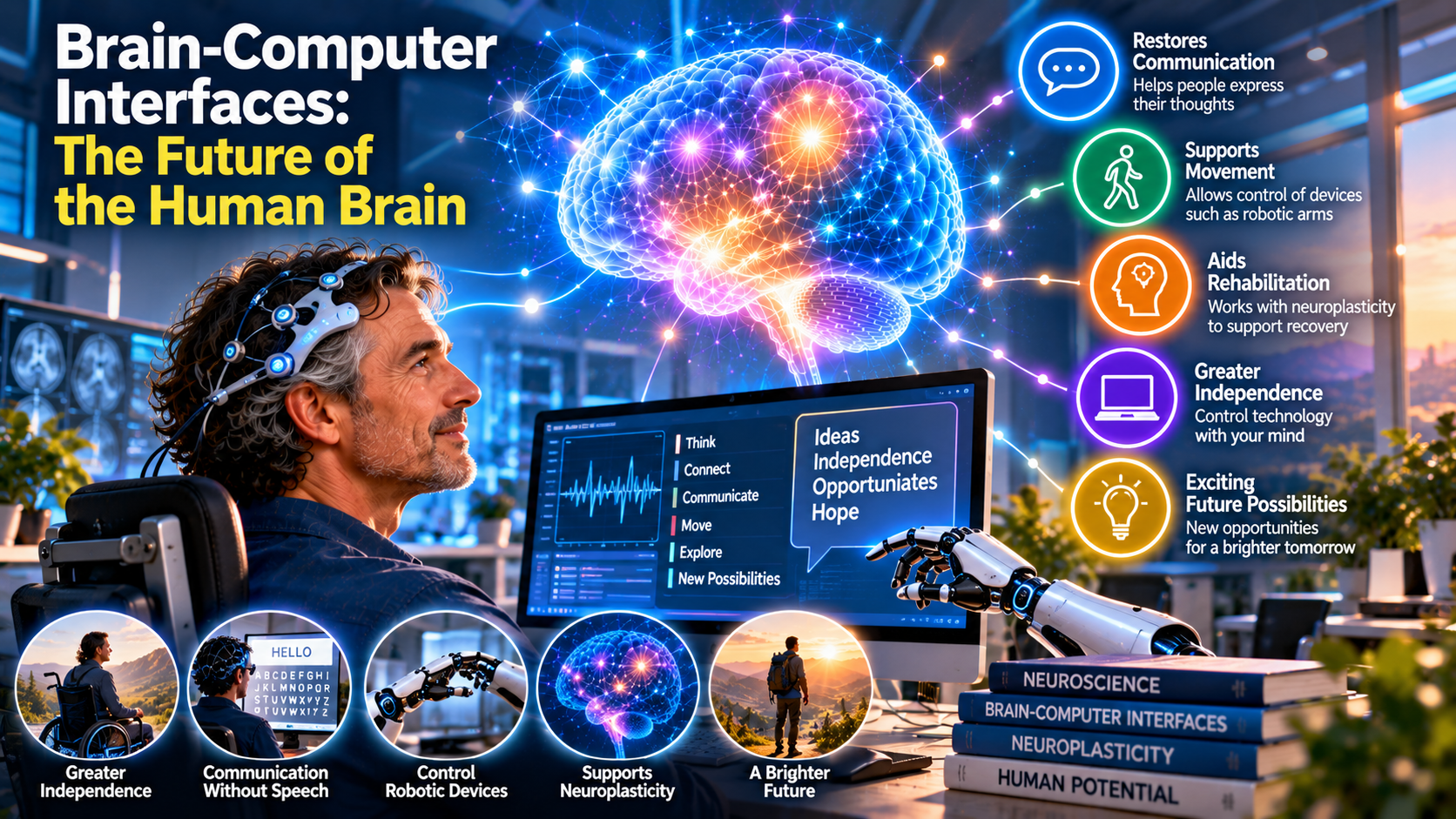
Imagine being able to control a computer without moving your hands.
Imagine someone who has lost the ability to speak being able to communicate again through technology.
Or a person living with paralysis using signals from their brain to operate a robotic arm.
These ideas might sound like science fiction.
But they are becoming part of real scientific research.
Around the world, neuroscientists, engineers and medical researchers are developing technologies known as brain-computer interfaces, or BCIs.
These systems create a connection between brain activity and external devices.
Some are designed to help people communicate.
Others aim to restore a degree of independence following severe neurological injury or disease.
And researchers are investigating whether brain-computer interfaces could eventually support new approaches to rehabilitation.
For someone like me, who has a personal interest in brain injury, neuroplasticity and the extraordinary complexity of the human brain, this field raises some fascinating questions.
Could technology help people regain abilities they have lost?
Could it create new opportunities for people living with neurological conditions?
And how might the relationship between the human brain and artificial intelligence develop in the future?
The possibilities are remarkable.
But the science also requires careful understanding.
Brain-computer interfaces are not magical devices that can read every thought or instantly repair a damaged brain.
They are complex technologies with important limitations.
Let’s explore what they can do today, what researchers hope to achieve and what the future might hold.
1. What Is a Brain-Computer Interface?
A brain-computer interface is a system that uses information from brain activity to control or communicate with an external device.
Normally, when we want to perform an action, our brain sends signals through the nervous system to our muscles.
For example, when you decide to move your hand, networks within the brain help plan and initiate that movement.
Signals travel through pathways in the nervous system.
Muscles respond.
And your hand moves.
But what happens when those pathways are damaged?
A person may still be able to think about moving their hand while being unable to produce the movement.
Brain-computer interfaces attempt to use measurable brain activity to create an alternative communication pathway.
A system may record signals associated with intended movement or another mental task.
Computer software then processes those signals.
The system attempts to identify patterns that correspond to particular commands.
Those commands can be used to control a device.
For example, a person might learn to move a cursor across a computer screen using a BCI.
Other systems have been used experimentally to control robotic devices or support communication.
The central idea is to translate selected patterns of brain activity into useful actions.
2. How Do Brain-Computer Interfaces Work?
Although brain-computer interfaces vary considerably, many follow a similar process.
First, the system records brain activity.
Second, software processes the recorded signals.
Third, an algorithm attempts to identify patterns associated with particular intentions or tasks.
Finally, the system translates those patterns into commands.
For example, imagine someone using a BCI to select letters on a computer screen.
The system might analyse patterns of brain activity associated with a particular selection task.
It then interprets those patterns and identifies the intended letter.
Over time, some systems can be calibrated to the individual user.
This is important because brain signals vary between people.
They can also change over time.
Researchers therefore need to consider signal quality, accuracy, reliability and the effort required to operate the system.
A brain-computer interface is not simply a device that understands everything happening inside someone’s mind.
It is a specialised system trained to interpret particular signals under defined conditions.
3. The Difference Between Invasive and Non-Invasive Brain-Computer Interfaces
There are several ways to measure brain activity.
Two broad categories are invasive and non-invasive brain-computer interfaces.
Non-invasive brain-computer interfaces
Non-invasive systems measure brain activity without surgically placing electrodes inside the skull.
One common method is electroencephalography, known as EEG.
EEG uses electrodes placed on the scalp to detect electrical activity generated by populations of neurons.
These systems have the advantage of avoiding brain surgery.
However, signals recorded through the scalp can be affected by noise and have limitations in spatial precision.
This can make it difficult to identify some types of brain activity.
Invasive brain-computer interfaces
Invasive systems involve surgically implanted electrodes.
These may be placed on the brain’s surface or within brain tissue, depending on the technology.
Implanted electrodes can record certain neural signals with greater precision.
However, surgery introduces risks.
These may include infection, bleeding, tissue responses and complications involving implanted hardware.
Long-term reliability is another important consideration.
The choice between different approaches depends on the intended application, potential benefits and medical risks.
Neither approach is universally superior.
4. Can Brain-Computer Interfaces Help People With Paralysis?
One of the most promising applications of BCI technology involves people living with severe paralysis.
Some individuals retain the ability to plan or imagine movements even when they cannot physically carry them out.
Researchers have investigated whether these movement-related signals can be used to control external devices.
Experimental systems have enabled some participants to operate computer cursors, select commands and control robotic arms.
These demonstrations are scientifically significant.
They show that certain intentions can be translated into actions without relying on the usual muscular pathways.
However, most advanced implanted BCI systems remain experimental.
They are not yet widely available as routine medical treatments.
Performance also varies between users and devices.
A successful research demonstration does not mean the technology is ready for everyday use by everyone with paralysis.
Nevertheless, the possibility of restoring some degree of independent control is one of the reasons this field has attracted so much attention.
5. Could Brain-Computer Interfaces Help People Communicate Again?
Imagine understanding everything happening around you but being unable to express your thoughts through speech.
For some people with severe paralysis or neurological conditions, communication can be extremely difficult.
This is an area where brain-computer interfaces may offer important possibilities.
Researchers have developed experimental systems that attempt to decode signals associated with intended speech.
Some studies have demonstrated ways to translate neural activity into text or synthesised speech.
Other systems allow users to select letters or words through brain-controlled interfaces.
The goal is not necessarily to restore natural speech directly.
Instead, technology may provide alternative ways for a person to communicate.
This distinction matters.
A system that generates words from selected neural signals is not the same as a device that reads someone’s private thoughts without their participation.
Current communication BCIs generally require substantial training, calibration and carefully designed tasks.
But the progress in this field has been remarkable.
For someone who has lost the ability to communicate easily, even an imperfect new method of expression could make a meaningful difference.
6. Brain-Computer Interfaces and Brain Injury Rehabilitation
Brain injury can affect movement, communication, attention, memory and many other functions.
The effects depend on the nature and location of the injury.
Rehabilitation is therefore highly individual.
Researchers are investigating whether brain-computer interfaces could support particular aspects of neurological rehabilitation.
For example, some experimental systems attempt to detect a person’s intention to move.
That signal may then trigger feedback or an external device.
In certain research settings, this approach has been combined with rehabilitation exercises.
The idea is that pairing attempted movement with appropriate feedback might support learning-related processes.
However, this is an area of ongoing investigation.
Evidence varies depending on the neurological condition, type of BCI and rehabilitation programme.
It would be misleading to suggest that brain-computer interfaces can currently reverse brain injury or restore lost abilities reliably.
They should be understood as potential tools that may complement established rehabilitation approaches.
Professional assessment and evidence-based treatment remain essential.
7. What Does Neuroplasticity Have to Do With Brain-Computer Interfaces?
Neuroplasticity is the brain’s ability to change its connections, structure and functions in response to experience, learning and other influences.
It plays an important role in learning and certain aspects of rehabilitation.
Some brain-computer interfaces rely on users learning how to produce or regulate particular patterns of brain activity.
The system may also adapt to the user through changes in its decoding algorithms.
This creates an interesting relationship between biological learning and technological adaptation.
The person learns to operate the interface.
The software may learn to interpret the person’s signals more effectively.
Researchers are also investigating whether certain BCI-based rehabilitation approaches can influence neural activity and functional recovery.
But this does not mean a BCI automatically rewires the brain in a beneficial way.
The effects depend on the system, the task, the user and the wider rehabilitation programme.
Neuroplasticity and brain-computer interfaces are connected through learning and adaptation, but the clinical benefits must be demonstrated rather than assumed.
8. How Artificial Intelligence Is Helping BCI Research
Artificial intelligence has become an important part of modern brain-computer interface research.
Brain signals are complex.
They can contain large amounts of information.
And identifying useful patterns can be difficult.
Machine-learning algorithms can be trained to recognise relationships between recorded activity and intended actions.
For example, an algorithm might learn which neural patterns are associated with attempting particular hand movements.
It can then use those patterns to predict commands.
More advanced approaches may help decode speech-related activity or improve the accuracy of device control.
However, AI systems are not infallible.
They can make errors.
They may require substantial training data.
And their performance can decline when conditions change.
Researchers also need to consider how well algorithms work across different individuals.
The goal is to develop systems that are reliable, safe and useful outside carefully controlled laboratory environments.
9. What Is Neuralink?
One of the companies that has brought widespread public attention to brain-computer interfaces is Neuralink.
Neuralink is developing an implantable brain-computer interface intended to allow people with severe neurological disabilities to interact with digital devices.
Its work has attracted considerable media coverage because of its technological ambitions and the involvement of Elon Musk.
However, Neuralink is only one organisation working in this field.
Academic laboratories, hospitals and other companies have been developing BCI technologies for many years.
It is also important to distinguish between demonstrations, clinical trials and approved medical treatments.
An experimental device may produce promising results while still requiring extensive research into safety, effectiveness and long-term reliability.
Claims about future capabilities should therefore be treated as possibilities rather than established outcomes.
The most important question is not which company attracts the most attention.
It is whether the technology can safely and meaningfully improve people’s lives.
10. Other Organisations Exploring Brain-Computer Interfaces
The field extends far beyond any single company.
Researchers and organisations have developed different approaches to recording and interpreting brain activity.
Some focus on implanted electrodes.
Others investigate less invasive methods.
And some specialise in communication or movement-related applications.
For example, academic research groups associated with BrainGate have contributed to important developments in implanted BCI systems.
Other organisations, including Synchron, have explored alternative implantation approaches.
Research teams have also developed experimental speech-decoding systems for people with severe communication difficulties.
These projects vary in design, maturity and intended application.
Their progress should be evaluated through peer-reviewed evidence and appropriate clinical oversight.
The wider field is advancing through collaboration between neuroscience, engineering, medicine and computer science.
11. Could Brain-Computer Interfaces Eventually Restore Movement?
One particularly exciting area of research involves connecting brain activity with technologies that support movement.
Some experimental systems have linked brain signals to external stimulators or other devices.
Researchers have explored whether these approaches can help bypass damaged pathways in the nervous system.
For example, experimental brain-spine interface research has demonstrated ways to use recorded brain activity to help control stimulation associated with walking in selected participants.
These studies represent important scientific advances.
But they involve highly specialised systems and small numbers of participants.
They do not establish that paralysis can now be routinely reversed.
There are also major challenges involving surgery, individual suitability, long-term performance and accessibility.
Still, the research illustrates how brain-computer interfaces might eventually become part of more sophisticated assistive and rehabilitation technologies.
12. Could We Control Everyday Technology With Our Minds?
Imagine being able to operate a computer without using a keyboard or mouse.
Or control certain smart-home functions through a brain-computer interface.
For people with severe physical disabilities, these applications could have practical value.
Some BCI systems already allow selected users to control computer interfaces experimentally.
Future developments may make these systems more reliable and easier to use.
However, the phrase controlling technology with your mind can create unrealistic expectations.
Current systems generally interpret particular measurable brain signals.
They do not provide unrestricted control over every device simply by thinking about it.
Many also require specialised equipment, training and ongoing support.
For people without disabilities, conventional interfaces may remain faster, simpler and more practical for many tasks.
The most important applications may therefore be those where alternative forms of control are genuinely needed.
13. What Are the Risks of Brain-Computer Interfaces?
Although brain-computer interfaces offer exciting possibilities, they also introduce important risks.
Implanted devices involve surgical considerations.
Hardware can fail.
Signals may become less reliable over time.
And users may experience frustration if systems do not perform consistently.
There are also psychological and practical concerns.
Someone who becomes dependent on an assistive device may be significantly affected if it stops working or support becomes unavailable.
Long-term maintenance and access to specialist care are therefore important.
For non-invasive systems, risks may be lower, but usability and reliability remain challenges.
These technologies need careful evaluation.
The aim should not simply be to demonstrate what is technically possible.
It should be to develop systems that are safe, dependable and appropriate for the people who use them.
14. Brain Data, Privacy and Ethical Questions
Brain-computer interfaces raise ethical questions that deserve serious attention.
Neural recordings can contain sensitive information.
Even when a device is designed to decode only particular signals, the data may still require strong protections.
Who owns the information recorded by a brain-computer interface?
How should it be stored?
Who should be allowed to access it?
Could it be used for purposes beyond those originally agreed?
And what happens if a company stops supporting an implanted device?
These questions become increasingly important as technology develops.
Privacy, informed consent and meaningful user control should be central considerations.
It is also important to avoid exaggerating what current systems can decode.
Today’s BCIs are not capable of universally reading a person’s complete thoughts.
But technological limitations today do not eliminate the need to establish responsible safeguards for tomorrow.
15. Will Brain-Computer Interfaces Be Available to Everyone?
One of the biggest challenges facing advanced medical technology is accessibility.
Developing sophisticated devices can be expensive.
Implanted systems may require surgery, specialist monitoring and long-term technical support.
This can limit who is able to benefit.
There are also questions about healthcare funding and clinical eligibility.
If a technology demonstrates meaningful benefits, how should access be determined?
How can researchers ensure that people with different disabilities and backgrounds are represented in studies?
And how can products be designed around real user needs rather than technological novelty?
For me, accessibility is particularly important.
Technology should not be judged only by how impressive it looks in a demonstration.
It should also be judged by whether people can realistically use it.
The future of brain-computer interfaces should be about improving independence and quality of life, not simply creating increasingly advanced machines.
16. What Could Brain-Computer Interfaces Look Like in 20 Years?
Predicting the future of neuroscience is difficult.
Technologies that appear promising today may encounter unexpected obstacles.
Others may advance more quickly than researchers anticipate.
Over the next twenty years, we might see improvements in signal processing, device design and long-term reliability.
Communication systems could become faster and easier to operate.
Assistive technologies may offer more natural control.
And rehabilitation research may identify specific circumstances in which BCI-based interventions provide meaningful benefits.
However, these are possibilities rather than guarantees.
Progress will depend on clinical evidence, engineering advances, regulation, affordability and public trust.
The future may also involve combinations of technologies.
Artificial intelligence could help interpret neural signals.
Robotics may translate commands into movement.
And personalised rehabilitation programmes could potentially incorporate feedback from several sources.
But the value of these systems will depend on what they actually achieve for users.
17. Why the Human Experience Must Remain at the Centre
When we discuss advanced neuroscience, it is easy to become fascinated by the technology itself.
The electrodes.
The algorithms.
The robotic arms.
The computer screens responding to brain activity.
But behind every research project involving a person with a disability is an individual with their own experiences, preferences and goals.
For one person, the most meaningful achievement might be sending a message independently.
For another, it could be operating a computer.
Someone else might want greater control over an assistive device.
These goals may appear modest compared with dramatic science-fiction predictions.
But they can have enormous personal significance.
Technology should therefore be developed with meaningful involvement from the people it is intended to support.
Their priorities should help shape research questions, design decisions and definitions of success.
18. What Living With a Brain Injury Has Taught Me About Technology
My lived experience of brain injury has influenced my interest in neuroscience, rehabilitation and the possibilities created by technology.
I understand that neurological challenges can affect far more than a person’s physical abilities.
They can influence confidence, independence, communication and everyday participation.
This is one reason I find brain-computer interfaces so interesting.
They represent an attempt to use scientific knowledge to address difficulties that can have a profound impact on people’s lives.
But I also believe we need to be realistic.
People living with neurological conditions deserve accurate information.
They deserve meaningful support.
And they deserve technology that has been properly evaluated.
Hope is important.
But hope should not depend on exaggerated promises.
For me, the most encouraging developments are those that focus on practical improvements in independence, accessibility and quality of life.
19. How Brain-Computer Interfaces Connect With My Work at Regain the Brain
Through Regain the Brain, I explore neuroplasticity, resilience, lifelong learning and the relationship between the brain and human experience.
My projects also include accessible digital learning activities through Regain Arcade and language learning through Speak & Rewire.
These projects are very different from clinical brain-computer interface research.
They are educational and recreational tools, not medical devices.
But they share a broader interest in how technology can create opportunities for participation and learning.
I believe the most valuable innovations begin with understanding people’s needs.
Sometimes, that means developing highly sophisticated medical technology.
At other times, it means making everyday activities easier to access.
Both approaches can matter.
And both remind us that technology is most useful when it serves a meaningful human purpose.
20. Five Questions We Should Ask About the Future of Brain-Computer Interfaces
As this field develops, I believe there are five important questions worth considering.
1. Does the technology genuinely improve people’s lives?
Scientific demonstrations are exciting, but practical benefits matter most.
2. Is it safe and reliable?
Devices must be evaluated for both immediate risks and long-term use.
3. Is the evidence strong enough?
Promising early findings need to be tested through rigorous research.
4. Will people be able to access it?
Affordability, healthcare provision and accessibility should be part of the conversation.
5. Are users being given meaningful choices?
People should understand the potential benefits, limitations and risks before deciding whether a technology is appropriate for them.
These questions can help us evaluate innovation without losing sight of the people it is intended to support.
Final Thoughts: The Future of Brain-Computer Interfaces Is About Human Possibility
The idea of connecting the human brain directly with technology once belonged largely to science fiction.
Today, it is an active area of neuroscience and engineering research.
Brain-computer interfaces have already demonstrated the ability to translate selected neural signals into useful commands.
Experimental systems have helped some people communicate, control computer interfaces and interact with assistive devices.
Researchers are also exploring potential applications in neurological rehabilitation.
But major challenges remain.
Safety.
Reliability.
Accessibility.
Long-term effectiveness.
And the ethical responsibilities associated with neural data.
We should be excited by genuine scientific progress without assuming that every ambitious prediction will become reality.
For me, the most inspiring aspect of this technology is not the possibility of creating a futuristic connection between humans and machines.
It is the possibility of helping people participate more fully in everyday life.
To communicate.
To make choices.
To interact with the world.
And perhaps to regain a degree of independence that once seemed beyond reach.
The greatest achievement of brain-computer interface technology may not be teaching machines to understand the brain.
It may be giving more people the opportunity to make themselves understood.
And that is a future worth exploring.
About Darren Jewell
Darren Jewell is a neuroresilience coach, inspirational speaker and founder of Regain the Brain.
Drawing on his lived experience of brain injury and his passion for neuroplasticity, Darren encourages individuals, leaders and organisations to explore resilience, adaptability, lifelong learning and the extraordinary complexity of the human brain.
Through inspirational speaking, coaching and educational projects, he shares accessible insights into neuroscience, personal development and the opportunities created by emerging technology.
Explore the Future of the Human Brain
Are you organising a corporate conference, technology event, leadership programme or wellbeing event?
Darren’s inspirational talks explore neuroplasticity, resilience, human adaptability and the relationship between neuroscience and personal development.
His approach combines lived experience with accessible insights into the science of learning and adaptation.
Discover Darren’s inspirational speaking and neuroresilience coaching services at www.regainthebrain.com.
This article provides general educational information. Brain-computer interfaces and experimental neurological technologies should not be considered established treatments unless supported by appropriate clinical evidence and regulatory approval. People considering medical devices or rehabilitation interventions should seek advice from qualified healthcare professionals.