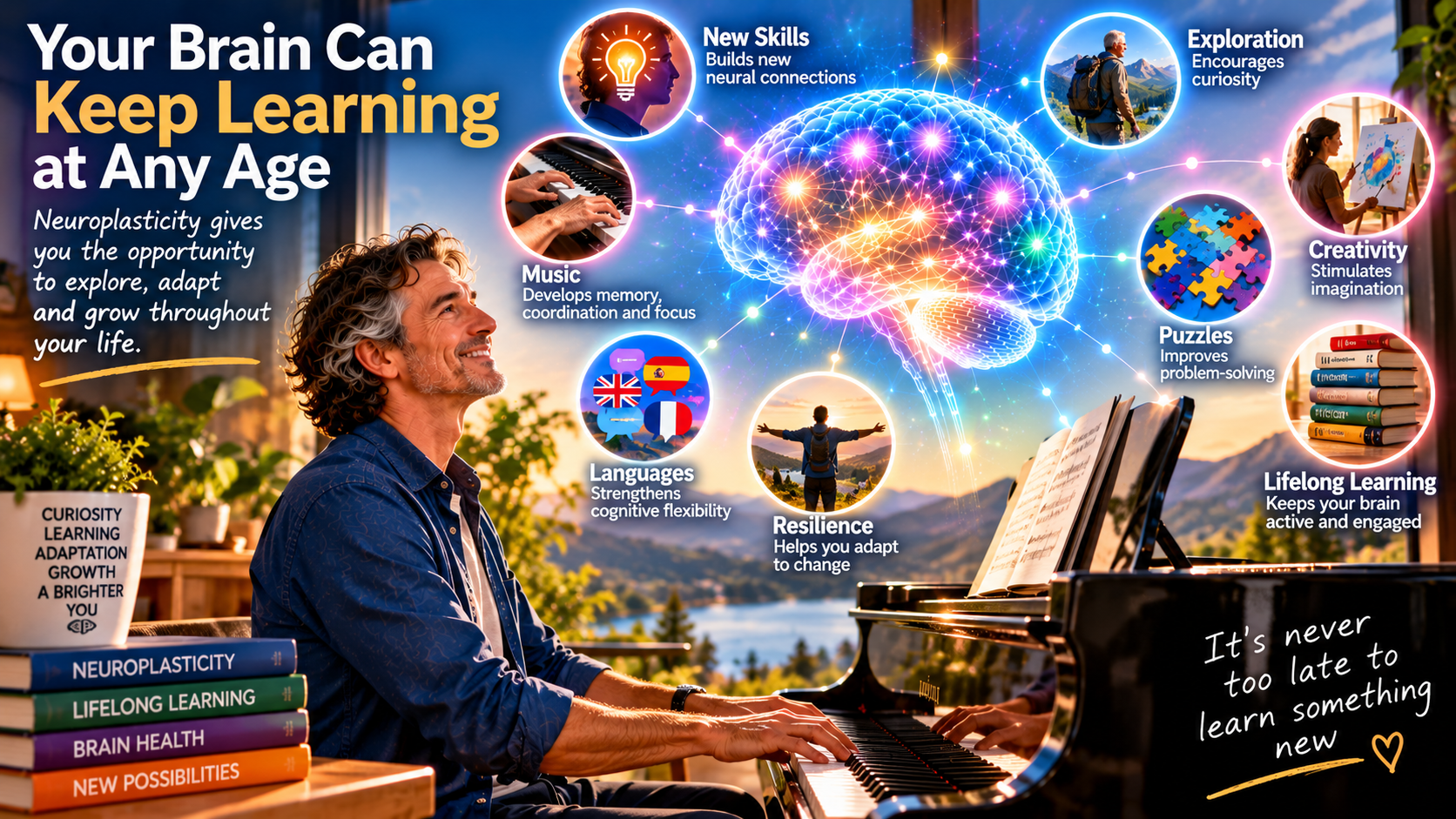
What if one of the most limiting beliefs we carry through life is the idea that our brains eventually stop changing?
Perhaps you’ve heard someone say:
“I’m too old to learn that.”
“My brain doesn’t work the way it used to.”
“You can’t teach an old dog new tricks.”
Or perhaps you’ve said something similar yourself.
For generations, many people believed that the adult brain was largely fixed.
Once childhood and adolescence were over, it was assumed that our brain’s structure and abilities were relatively permanent.
If we struggled with a particular skill, we might conclude that we simply weren’t capable of learning it.
If life changed unexpectedly, we might believe our ability to adapt was limited.
But modern neuroscience has transformed our understanding of the human brain.
We now know that the brain retains an extraordinary capacity to change throughout life.
This ability is known as neuroplasticity.
And while neuroplasticity does not mean that anything is possible or that every neurological condition can be reversed, it challenges the belief that learning and adaptation belong exclusively to the young.
So, can you really rewire your brain at any age?
The answer is yes, but understanding what that means is just as important as understanding what it doesn’t mean.
Let’s explore the science.
1. What Is Neuroplasticity?
Neuroplasticity refers to the brain’s ability to change its structure, connections and functions in response to experience, learning, development and other influences.
Your brain contains billions of neurons.
These specialised cells communicate through complex networks.
Connections between neurons, known as synapses, play an important role in how information is processed and transmitted.
When we learn or practise a skill, activity within these networks can change.
Some connections may become stronger.
Others may become weaker.
And patterns of activity can become more efficient with experience.
Neuroplasticity also includes changes beyond individual synapses, such as alterations in how brain networks are organised.
These processes help explain how we acquire knowledge, develop skills and adapt to changing circumstances.
However, neuroplasticity is not a magical switch that can be turned on whenever we want.
It is a collection of biological processes influenced by many factors, including age, experience, health and the type of learning involved.
Neuroplasticity means the brain can change. It does not mean every change is easy, beneficial or unlimited.
2. Does Your Brain Stop Developing After Childhood?
One of the most persistent myths about the brain is that development ends when we reach adulthood.
Childhood is certainly an important period of brain development.
During early life, the brain undergoes substantial changes as children acquire language, movement, social abilities and other skills.
Some forms of plasticity are particularly pronounced during developmental periods.
But brain change does not suddenly stop at a particular birthday.
Adults continue to learn new information and develop unfamiliar abilities.
We can acquire professional skills.
Learn languages.
Practise musical instruments.
Adapt to new technologies.
And change established habits.
The biological mechanisms involved may differ from those seen during childhood.
And some kinds of learning can become more difficult with age.
But the adult brain remains capable of experience-dependent change.
This is one of the most encouraging findings of modern neuroscience.
Age can influence how we learn, but it does not remove our capacity to learn.
3. How Does the Brain Rewire Itself?
The phrase rewiring your brain is often used to describe neuroplasticity.
It is a useful metaphor, although it can oversimplify what actually happens.
Your brain does not contain electrical wires that can simply be disconnected and rearranged.
Instead, learning involves changes in biological networks.
One important process is synaptic plasticity.
Synapses are the points where neurons communicate with one another.
Their effectiveness can change through experience and activity.
Researchers have studied processes such as long-term potentiation and long-term depression, which involve lasting increases or decreases in synaptic strength.
These mechanisms contribute to our understanding of learning and memory.
Other forms of plasticity can involve changes in brain network activity, myelination and structural organisation.
The exact changes depend on the experience and the systems involved.
For example, learning a musical instrument involves networks associated with movement, hearing, attention and memory.
Learning a language involves partly different networks.
There is no single brain-rewiring process that works identically for every activity.
4. Why Repetition Matters for Neuroplasticity
Think about the first time you attempted an unfamiliar skill.
Perhaps you learned to drive.
Tried using a computer.
Or attempted to play a musical instrument.
Initially, the experience may have required considerable concentration.
You had to think carefully about each movement or decision.
You probably made mistakes.
And progress may have felt slow.
But with repeated practice, some aspects of the activity became easier.
You began recognising patterns.
Your responses became more familiar.
And you needed less conscious effort for certain parts of the task.
Practice supports learning through repeated engagement with relevant neural systems.
However, repetition alone is not always enough.
The quality of practice matters.
Feedback can help identify errors.
Appropriate challenges can encourage improvement.
And rest can support learning and recovery.
Repeating an ineffective technique without correction may simply reinforce the wrong approach.
Meaningful progress often comes from combining repetition with attention, feedback and patience.
5. What Learning Piano at 54 Taught Me About the Brain
I started learning to play the piano at 54.
It was an experience that reinforced my interest in neuroplasticity and lifelong learning.
I could have decided that learning a musical instrument was something people needed to begin as children.
I could have convinced myself that I was too old.
Or that developing an unfamiliar skill would be too difficult.
But I wanted to explore what was possible.
Learning piano involves several different abilities.
You need to recognise notes.
Listen carefully.
Coordinate your hands.
Remember sequences.
And gradually connect what you see, hear and do.
At the beginning, these demands can feel overwhelming.
But learning is not about being immediately good at something.
It is about developing skills through experience.
My decision to begin at 54 was not about proving that age has no effect on learning.
Age can influence how quickly we acquire certain abilities.
Instead, it was about refusing to assume that an unfamiliar challenge was automatically beyond me.
I didn’t need to become a concert pianist.
I simply wanted to learn.
And that decision opened the door to an experience I continue to value.
6. Can You Learn New Skills in Your 50s, 60s and 70s?
Absolutely.
People can learn new skills throughout adulthood, including later life.
The process may differ from learning during childhood.
Some aspects of processing speed, memory and sensory functioning can change with age.
Older adults may also bring valuable advantages to learning.
These can include accumulated knowledge, experience, motivation and established problem-solving strategies.
The important question is not whether everyone learns at the same speed.
They don’t.
The more useful question is whether meaningful learning remains possible.
And for many skills, it does.
Someone in their fifties might learn photography.
A person in their sixties may begin studying another language.
Someone in their seventies might explore digital technology.
And another person may decide to take up painting or music.
The value of these experiences extends beyond cognitive performance.
Learning can provide enjoyment, purpose, social connection and a sense of achievement.
You do not need to become an expert for the experience to be worthwhile.
7. Neuroplasticity and Brain Injury Recovery
Neuroplasticity is particularly important in discussions about neurological rehabilitation.
Following a brain injury, some people experience changes in movement, memory, attention, communication or other abilities.
The effects vary considerably depending on the nature and severity of the injury.
Rehabilitation may involve helping people practise skills, develop compensatory strategies and adapt to changes in functioning.
Neuroplastic processes can contribute to recovery and adaptation.
For example, structured rehabilitation may encourage repeated practice of movements or cognitive tasks.
But brain injury recovery is complex.
Not all neurological damage can be reversed.
And improvements are influenced by factors such as injury characteristics, rehabilitation, overall health and individual circumstances.
Some people experience substantial recovery.
Others continue living with significant long-term difficulties.
It would be misleading to suggest that positive thinking or repeated practice can guarantee recovery.
Neuroplasticity provides a scientific explanation for certain forms of adaptation.
It is not a promise that every lost ability will return.
Why individual progress matters
Through my lived experience of brain injury, I have come to appreciate how important it is to recognise individual circumstances.
A small achievement for one person may require enormous effort.
And progress does not always follow a predictable path.
For some people, learning a new strategy may be more realistic than restoring a previous ability.
That does not make the achievement less meaningful.
Neuroplasticity gives us reasons to explore possibilities, while respecting the realities and limitations of neurological injury.
8. Can You Rewire Your Brain to Change Habits?
Habits are patterns of behaviour that can become increasingly automatic through repetition and experience.
They often involve associations between situations, actions and outcomes.
Brain networks involving the basal ganglia and other regions contribute to habit learning.
This helps explain why familiar routines can become easier to perform without extensive conscious thought.
But it also helps explain why established habits can be difficult to change.
If you have repeated a behaviour for years, simply deciding to stop may not be enough.
Changing habits often requires identifying triggers, developing alternative responses and practising new routines.
For example, someone who automatically checks their phone whenever they feel bored might begin replacing that behaviour with a different activity.
Over time, a new routine may become more familiar.
However, habit change is not always straightforward.
Stress, environment, motivation and other factors can influence behaviour.
Some behaviours are also associated with medical or psychological conditions that require professional support.
Neuroplasticity contributes to our understanding of habit learning, but it does not mean every habit can be changed quickly or through willpower alone.
9. How Sleep Supports Learning and Brain Plasticity
Sleep is essential for many aspects of brain functioning.
It plays an important role in memory consolidation, emotional regulation and overall health.
When we learn something new, the brain continues processing information beyond the period of active practice.
Sleep is involved in processes that help stabilise and reorganise certain memories.
This is one reason rest can be important when developing unfamiliar skills.
Imagine practising a difficult piece of music.
You spend time learning the notes.
You make mistakes.
You gradually improve.
Then you return to the instrument the following day.
Sometimes, aspects of the activity may feel more familiar.
That does not mean sleep has magically completed the learning process.
But it illustrates why practice and recovery should be considered together.
For adults, getting sufficient good-quality sleep is an important part of maintaining overall health.
Most adults generally need around seven to nine hours per night, although individual requirements vary.
10. Can Exercise Help Support Neuroplasticity?
Physical activity has attracted considerable interest in neuroscience.
Researchers have investigated how exercise influences brain health, cognition and processes associated with plasticity.
One area of research involves brain-derived neurotrophic factor, commonly known as BDNF.
BDNF is a protein involved in neuronal functioning and synaptic plasticity.
Some studies suggest that exercise can influence BDNF levels, although findings depend on the type of activity, individual characteristics and measurement methods.
Regular physical activity also supports cardiovascular health, which is important for the brain.
Some research has reported cognitive benefits associated with aerobic exercise programmes.
However, these findings do not mean that every walk creates new neurons or that exercise can reverse neurological damage.
Walking, swimming, cycling and other suitable forms of activity can contribute to a healthy lifestyle.
The most appropriate activity depends on individual health and abilities.
For people with neurological conditions or mobility difficulties, professional guidance may be important.
11. Why Learning a Language Can Challenge Your Brain
Learning another language involves several cognitive processes.
You need to recognise unfamiliar sounds.
Remember vocabulary.
Understand grammatical patterns.
Retrieve information.
And practise communication.
These activities involve networks associated with language, attention and memory.
Research has identified brain changes associated with language learning and bilingual experience.
However, claims that learning a language automatically prevents dementia or makes people generally more intelligent are not supported by consistent evidence.
The broader cognitive benefits remain an area of scientific investigation.
Nevertheless, language learning can provide meaningful opportunities for lifelong learning.
You can begin with simple words and phrases.
Practise regularly.
And gradually develop your knowledge.
This interest is one of the reasons I have been developing Speak & Rewire, a language-learning project designed to make exploring unfamiliar languages enjoyable and accessible.
The project is educational rather than a clinically validated brain-health intervention.
But it reflects my belief that learning should remain available to people throughout life.
12. Can Brain-Training Games Rewire Your Brain?
Brain-training games often involve memory, attention, problem-solving or reaction-time challenges.
When people practise these activities, they can become better at the specific tasks involved.
But an important scientific question is whether these improvements transfer to everyday cognitive functioning.
Research findings are mixed.
Some structured cognitive training programmes have demonstrated benefits in particular areas.
However, there is limited evidence that commercial brain-training games consistently produce broad improvements in general intelligence or prevent dementia.
This distinction matters.
A game may challenge your memory without being a proven treatment for memory problems.
And improving your reaction time in a game does not necessarily mean your reaction time will improve in every real-world situation.
Why I created Regain Arcade
My interest in accessible learning encouraged me to develop Regain Arcade.
The project explores digital games involving different cognitive challenges.
Some activities focus on memory.
Others involve attention, sequencing, coordination or problem-solving.
The aim is to create enjoyable opportunities for participation and learning.
These games are not clinically validated neurological rehabilitation treatments.
But they demonstrate how technology can make unfamiliar challenges more approachable.
And enjoyment can be an important reason people choose to keep practising.
13. Does Neuroplasticity Have an Age Limit?
There is no single birthday when neuroplasticity stops.
However, it is important to distinguish between different forms of plasticity.
Some developmental processes are particularly active during childhood.
Certain learning abilities are influenced by sensitive periods.
And ageing can affect the efficiency of particular cognitive and biological processes.
For example, acquiring native-like pronunciation in a second language is generally easier when exposure begins early in life.
But adults can still learn new languages.
Likewise, developing complex motor skills may involve different challenges at different ages.
Yet adults can continue improving with suitable practice.
The important point is that neuroplasticity changes across the lifespan.
It does not simply disappear.
The brain you have today is not identical to the brain you had twenty years ago. And it will continue responding to experience in the years ahead.
14. What Neuroplasticity Cannot Do
Because neuroplasticity is such an encouraging subject, it is sometimes exaggerated.
You may encounter claims that you can completely rewire your brain in a few weeks.
Or that thinking positively can reverse neurological conditions.
Some products suggest that their exercises can dramatically increase intelligence or prevent cognitive decline.
These claims deserve scrutiny.
Neuroplasticity is a real and well-established feature of the nervous system.
But its effects depend on biological conditions and the experiences involved.
Not all changes are beneficial.
Not every skill transfers to unrelated abilities.
And neurological recovery has important limitations.
The brain cannot always compensate fully for injury or disease.
Scientific research continues to investigate how plasticity can be supported through rehabilitation and other interventions.
But it is important to separate established evidence from speculation.
Hope is valuable.
So is accuracy.
And people deserve both.
15. Seven Everyday Activities That Encourage Learning and Adaptation
If you want to explore lifelong learning, you don’t need expensive equipment or complicated programmes.
Here are seven accessible ideas.
1. Learn a musical instrument
Practising music involves listening, coordination, attention and memory.
2. Explore another language
Start with useful vocabulary and gradually develop your knowledge.
3. Try a new recipe
Cooking can involve planning, sequencing, attention and practical problem-solving.
4. Develop a creative hobby
Painting, photography, writing and other creative activities provide opportunities to practise unfamiliar skills.
5. Learn to use new technology
Explore a digital tool or application that interests you.
6. Challenge yourself with puzzles
Choose puzzles that require reasoning, attention or problem-solving.
7. Take up a suitable physical activity
Walking, dancing or another appropriate activity can support physical wellbeing while providing opportunities to develop skills.
These activities are not guaranteed to improve every aspect of cognition.
But they can encourage meaningful engagement, enjoyment and learning.
And that makes them valuable.
16. Why Small Steps Matter When Learning Something New
One of the biggest mistakes people make when beginning a new activity is expecting immediate results.
They imagine how well they would like to perform.
Then they compare that image with their first attempt.
The difference can feel discouraging.
But learning is usually gradual.
A beginner learning piano may initially struggle to recognise notes.
Someone studying a language may forget unfamiliar vocabulary.
A person learning to use technology may need to repeat instructions several times.
These experiences are normal parts of learning.
Breaking a challenge into smaller tasks can make the process more manageable.
Instead of trying to master an entire piece of music, practise a short section.
Instead of memorising fifty unfamiliar words, begin with a few.
Instead of expecting immediate confidence, focus on becoming familiar with the activity.
Small achievements provide feedback that progress is possible.
And repeated practice creates further opportunities to learn.