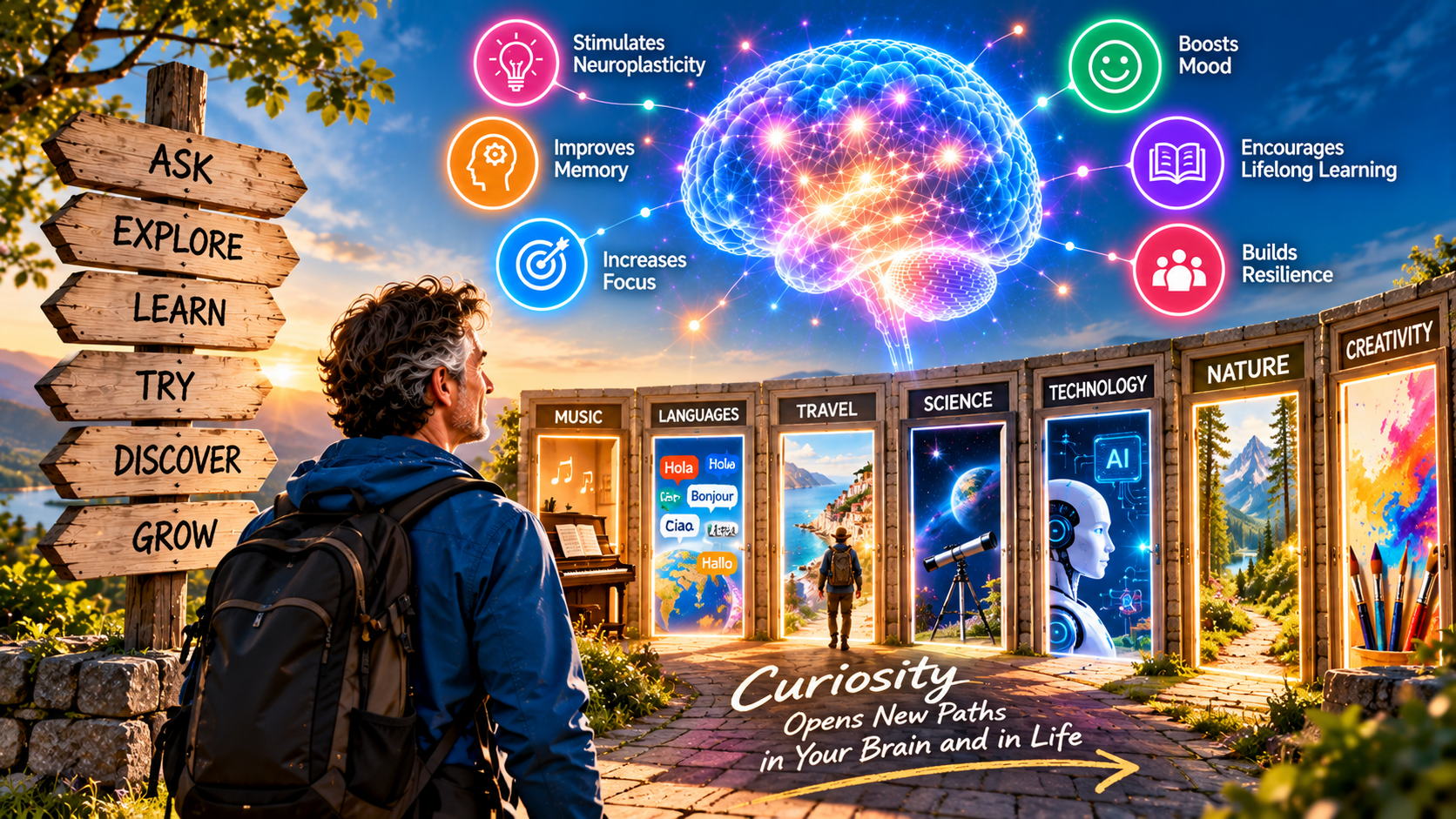
What if one of the greatest strengths you could develop wasn’t intelligence, confidence or even determination, but curiosity?
Think about the last time you became genuinely interested in something.
Perhaps you watched a documentary about a subject you knew very little about.
Maybe you discovered a new piece of technology.
You might have decided to learn a musical instrument, explore an unfamiliar country or ask a question that led you towards an entirely new interest.
Something caught your attention.
You wanted to understand more.
And that desire encouraged you to explore.
That is curiosity.
We often associate curiosity with childhood.
Young children constantly ask questions.
Why is the sky blue?
How do aeroplanes fly?
What happens if I try this?
But as we grow older, something can change.
We become busy.
We develop routines.
We become comfortable with what we already know.
And sometimes, without realising it, we stop asking questions.
Yet neuroscience suggests that curiosity can play an important role in learning, memory and motivation.
It can encourage us to seek information, explore unfamiliar experiences and remain engaged with the world around us.
And because the human brain retains the capacity to learn throughout life, curiosity can remain valuable at any age.
Perhaps one of the best things we can do for our personal development is to remain willing to discover something new.
1. What Is Curiosity?
Curiosity is the desire to acquire information, explore unfamiliar experiences or understand something we do not yet know.
It can appear in different forms.
Sometimes, curiosity is driven by a specific question.
You want to understand how something works.
At other times, it involves exploring simply because an experience seems interesting.
Researchers sometimes distinguish between different types of curiosity, including the desire to resolve uncertainty and the enjoyment of discovering new information.
For example, imagine reading the headline:
“Scientists Discover Something Unexpected About the Human Brain.”
You might immediately want to know what they discovered.
That desire to close a gap in your knowledge can motivate you to continue reading.
Curiosity can also encourage exploration without a particular question in mind.
You might visit a museum, try a new hobby or explore a subject because it captures your imagination.
Both forms can create opportunities for learning.
2. What Happens in Your Brain When You Become Curious?
Curiosity is more than a personality characteristic.
It is associated with activity in brain systems involved in motivation, learning and memory.
Researchers have investigated how curiosity influences the processing and retention of information.
Some studies have found that states of high curiosity are associated with activity in brain regions involved in reward-related processing and memory.
These include parts of the midbrain and the hippocampus.
The hippocampus plays an important role in forming certain types of memory.
Reward-related systems help influence motivation and learning.
These systems interact in complex ways.
One influential study published in Neuron in 2014 found that participants were better able to remember answers to questions that had made them curious.
The researchers also observed relationships between curiosity, activity in reward-related brain regions and memory processes.
This suggests that curiosity can influence how information is learned and remembered.
However, curiosity does not guarantee that everything we encounter will be remembered.
Attention, prior knowledge, repetition and sleep also matter.
Nevertheless, the research highlights something fascinating.
Wanting to know the answer can influence the way we engage with information.
3. The Connection Between Curiosity and Neuroplasticity
Neuroplasticity is the brain’s ability to change its connections, structure and functions in response to experience, learning and other influences.
It is one of the foundations of lifelong learning.
When we explore unfamiliar subjects or practise new skills, neural networks become involved in processing information.
With experience and repetition, these networks can adapt.
Curiosity can help motivate us to engage in the activities that provide opportunities for learning.
For example, someone who becomes interested in photography may begin exploring how cameras work.
They learn about lighting.
They practise composition.
They experiment with different settings.
And gradually, they develop new knowledge and abilities.
The learning itself involves experience-dependent processes associated with neuroplasticity.
Curiosity helps provide the motivation to begin and continue.
It is important not to suggest that curiosity automatically creates new neurons or reverses neurological damage.
But it can encourage the sustained engagement that meaningful learning often requires.
Curiosity opens the door to learning. Practice and experience help us develop what we discover.
4. Why Curious People Often Enjoy Learning
Think about the difference between being forced to learn something and choosing to learn it because you find it fascinating.
The information might be equally challenging.
But your motivation can feel very different.
When we are interested in a subject, we may be more willing to devote attention to it.
We might ask additional questions.
Search for explanations.
Or return to the subject repeatedly.
These behaviours can support learning.
Curiosity can also make the process feel more rewarding.
Instead of viewing unfamiliar information as an obstacle, we may see it as something worth exploring.
This does not mean every learning activity will be enjoyable.
Even subjects we love can involve frustration and difficult practice.
But genuine interest can provide a reason to continue.
For lifelong learning, this is particularly important.
We are often more likely to maintain activities that have personal meaning.
5. Why Curiosity Matters More as We Grow Older
One of the misconceptions surrounding ageing is that learning belongs primarily to younger people.
We sometimes hear people say:
“I’m too old to start that.”
“I wouldn’t understand the technology.”
“I’ve never been good at languages.”
“There’s no point learning something new now.”
But adulthood does not eliminate the brain’s capacity for learning.
Although aspects of learning and memory can change with age, adults can continue developing skills and acquiring knowledge.
Curiosity can encourage us to explore those opportunities.
A person in their sixties might decide to learn photography.
Someone in their seventies may begin studying a foreign language.
Another person might discover an interest in gardening, history or music.
These experiences can provide enjoyment, social connection and a sense of achievement.
Research into cognitive ageing suggests that mentally stimulating activities may be associated with aspects of cognitive wellbeing.
However, no single hobby or learning activity has been proven to prevent dementia.
The value of curiosity should not be reduced to a medical promise.
Learning something new can enrich your life, whether or not it produces measurable improvements in general cognitive performance.
6. What Learning Piano at 54 Taught Me About Curiosity
I started learning to play the piano at 54.
I could have decided that I was too old.
I could have focused on how difficult it might be.
Or I could have convinced myself that learning an instrument was something best left to people who had started as children.
But curiosity encouraged me to explore.
What would it feel like to learn?
Could I develop a skill I had never previously mastered?
What might I discover about myself through the experience?
Learning piano has reminded me that being a beginner is not something to fear.
It is an opportunity.
There are unfamiliar notes.
New movements.
Moments of frustration.
And small achievements that make the effort worthwhile.
I have also found the experience fascinating because it involves memory, attention, coordination and listening.
It is a reminder that learning can remain meaningful long after our formal education has ended.
I don’t need to become a concert pianist for the experience to be valuable.
The enjoyment of learning is enough.
And it all began with curiosity.
7. Why Curiosity Can Help Us Challenge Limiting Beliefs
Many of us carry assumptions about our abilities.
We believe we are not creative.
Not musical.
Not technical.
Or simply not the kind of person who can learn certain skills.
Sometimes, these beliefs are influenced by earlier experiences.
Perhaps we struggled with a subject at school.
Maybe someone criticised our performance.
Or perhaps we compared ourselves with someone who appeared naturally talented.
Over time, these experiences can shape what we believe is possible.
Curiosity encourages us to ask different questions.
Instead of saying:
“I’m not good at this.”
We might ask:
“What would happen if I tried?”
Instead of assuming:
“I could never learn that.”
We might wonder:
“How could I begin?”
These questions do not guarantee success.
But they create opportunities to explore rather than immediately dismiss possibilities.
And sometimes, that change in perspective is enough to encourage us to take the first step.
8. Curiosity and Resilience: Why Questions Matter During Change
Resilience involves responding to challenges, adapting to changing circumstances and finding constructive ways forward.
Curiosity can contribute to this process by encouraging exploration.
When something unexpected happens, we may initially focus on what has gone wrong.
That response is understandable.
But curiosity can sometimes help us consider alternatives.
What has changed?
What information do I need?
What support might be available?
Could there be another way to approach this situation?
These questions can support problem-solving and adaptability.
However, curiosity is not a substitute for emotional support, healthcare or practical assistance.
Some life-changing experiences involve difficulties that cannot be resolved simply by thinking differently.
Resilience also involves recognising limitations and seeking appropriate support.
Curiosity can be one useful part of that broader process.
9. What Living With a Brain Injury Has Taught Me About Curiosity
My lived experience of brain injury has influenced the way I think about learning, resilience and adaptation.
A life-changing experience can alter familiar routines and expectations.
It can raise questions we never imagined needing to ask.
And it can challenge our understanding of what we are capable of doing.
For me, curiosity has become closely connected to my interest in neuroplasticity.
I wanted to understand more about the brain.
How does learning happen?
Why do some abilities change after injury?
What role does rehabilitation play?
How can technology support accessible learning experiences?
These questions have encouraged me to explore neuroscience and develop educational projects.
But I also recognise that curiosity does not remove the difficulties associated with brain injury.
And learning about neuroplasticity does not guarantee neurological recovery.
What curiosity can do is encourage us to seek understanding and remain open to meaningful possibilities.
That is one of the messages I hope to share through Regain the Brain.
10. Why Curiosity Is an Important Leadership Skill
Curiosity is not only valuable for personal development.
It can also play an important role in business leadership.
Organisations operate in environments that are constantly changing.
Technology evolves.
Customer expectations shift.
New competitors emerge.
And familiar approaches can become less effective.
Leaders who assume they already know everything may overlook important information.
Curious leaders are more likely to ask questions.
They may seek different perspectives.
Challenge assumptions.
And explore unfamiliar possibilities.
Imagine a CEO facing a decline in customer satisfaction.
One response might be to assume employees are not working hard enough.
A more curious response might involve investigating the underlying causes.
What are customers experiencing?
Have expectations changed?
Are existing processes creating difficulties?
What do frontline employees know that senior management may have overlooked?
Curiosity can encourage better questions.
And better questions can lead to more informed decisions.
11. Curiosity and Psychological Safety in the Workplace
For curiosity to thrive in an organisation, people need opportunities to ask questions.
Imagine a workplace where employees are embarrassed to admit they don’t understand something.
They may avoid seeking clarification.
Problems can remain hidden.
And opportunities for learning may be lost.
Now imagine an environment where asking questions is encouraged.
Employees feel able to explore unfamiliar ideas.
They can acknowledge uncertainty.
And they are comfortable requesting additional information.
This relates to psychological safety, which involves a shared belief that people can speak up without unnecessary interpersonal fear.
Research has linked psychological safety with team learning behaviours.
Curiosity and psychological safety can complement each other.
When leaders demonstrate that questions are welcome, they can help create conditions in which learning becomes part of the organisational culture.
A leader who asks thoughtful questions may discover opportunities that someone determined to have every answer would overlook.
12. How Technology Can Encourage Curiosity
We live in a time when information is more accessible than ever.
A question that once required a visit to a library can now lead to a wide range of educational resources.
Online courses.
Digital museums.
Language-learning platforms.
Educational videos.
Interactive games.
And artificial intelligence tools.
Technology can help us explore subjects that previously felt inaccessible.
But it is important to approach information critically.
Not everything online is accurate.
AI systems can produce convincing but incorrect explanations.
And the quality of educational resources varies.
Curiosity should therefore be accompanied by critical thinking.
We should ask not only what we can discover, but also whether the information is reliable.
13. Why I Created Regain Arcade and Speak & Rewire
My curiosity about learning and technology has encouraged me to develop projects such as Regain Arcade and Speak & Rewire.
Regain Arcade explores how digital games can provide engaging challenges involving skills such as attention, memory, sequencing and problem-solving.
Speak & Rewire focuses on making language learning enjoyable and accessible.
Both projects reflect my interest in encouraging people to try unfamiliar activities.
They are educational and recreational tools rather than clinically validated neurological treatments.
But they illustrate something I believe is important.
Learning does not always need to feel formal.
Sometimes, a game can introduce someone to a new challenge.
A language lesson can encourage someone to explore another culture.
And an unfamiliar activity can spark an interest that continues long after the first attempt.
That is the power of curiosity.
14. Seven Simple Ways to Become More Curious
If you want to bring more curiosity into your life, here are seven practical ideas.
1. Ask one new question every day
Choose something you don’t understand and explore the answer.
It might involve science, history, technology or everyday life.
2. Try an unfamiliar activity
Cook a new recipe.
Visit somewhere different.
Or explore a hobby you’ve never attempted.
3. Learn a few words in another language
Language learning can introduce you to unfamiliar sounds, expressions and cultures.
4. Listen to people with different experiences
Conversations can reveal perspectives we might otherwise overlook.
5. Read outside your usual interests
If you normally read business books, try history.
If you enjoy fiction, explore a science article.
6. Allow yourself to be a beginner
Don’t expect immediate competence.
Give yourself permission to learn gradually.
7. Follow your interests
When something captures your attention, spend time exploring it.
You never know where a simple question might lead.
15. A Seven-Day Curiosity Challenge
I would like to invite you to try a simple challenge.
For the next seven days, make a conscious effort to explore something unfamiliar.
Day 1: Find the answer to a question you’ve always wondered about.
Day 2: Learn five words in a language you don’t speak.
Day 3: Listen to a podcast or watch a documentary about an unfamiliar subject.
Day 4: Try a new recipe or creative activity.
Day 5: Ask someone about an experience or interest you know little about.
Day 6: Explore a piece of technology you’ve never used before.
Day 7: Reflect on what you discovered and choose something you’d like to continue learning.
The challenge is not designed to improve a particular cognitive score.
It is simply an invitation to explore.
You may discover a new interest.
You may learn something surprising.
Or you may realise that you enjoy being a beginner more than you expected.
16. Why Curiosity Could Be One of Your Greatest Strengths
We often think of strength in terms of what we already possess.
Knowledge.
Experience.
Confidence.
Professional expertise.
But curiosity is different.
It encourages us to recognise what we do not yet know.
It allows us to question assumptions.
It motivates us to explore unfamiliar possibilities.
And it reminds us that learning does not have to end when we reach a particular age.
Curiosity can contribute to personal development, adaptability and meaningful engagement with the world.
It does not eliminate uncertainty.
It does not guarantee success.
And it cannot solve every challenge.
But it can help us remain open to discovery.
In a world that is constantly changing, that openness can be valuable.
Final Thoughts: Never Lose the Desire to Discover
The human brain is extraordinary.
It allows us to learn, remember, imagine and explore.
And throughout life, we have opportunities to develop new knowledge and abilities.
Curiosity is often what encourages us to take advantage of those opportunities.
It can begin with something remarkably simple.
A question.
An unfamiliar word.
A new hobby.
A conversation.
Or the decision to try something we once believed was beyond us.
When I started learning piano at 54, I didn’t know exactly where the experience would lead.
I simply wanted to discover what learning something new might feel like.
And perhaps that is the most important lesson.
We don’t always need to know where an experience will take us before we begin.
Sometimes, curiosity is enough.
You don’t have to know everything.
You just have to remain willing to discover something new.
Because the moment we stop being curious, we may begin overlooking opportunities that could enrich our lives.
And the moment we ask another question, we open the possibility of learning something we didn’t know yesterday.
About Darren Jewell
Darren Jewell is a neuroresilience coach, inspirational speaker and founder of Regain the Brain.
Drawing on his lived experience of brain injury and his passion for neuroplasticity, Darren encourages individuals, leaders and organisations to embrace lifelong learning, develop resilience and remain open to new possibilities.
Through inspirational speaking, coaching and educational projects including Regain Arcade and Speak & Rewire, he shares the importance of curiosity, adaptability and personal development.
Curiosity doesn’t require you to have all the answers. It simply invites you to keep asking questions.
Discover more at www.regainthebrain.com.
If your organisation is looking for an inspirational speaker to explore curiosity, resilience, neuroplasticity and lifelong learning, discover Darren’s speaking and coaching services through Regain the Brain.