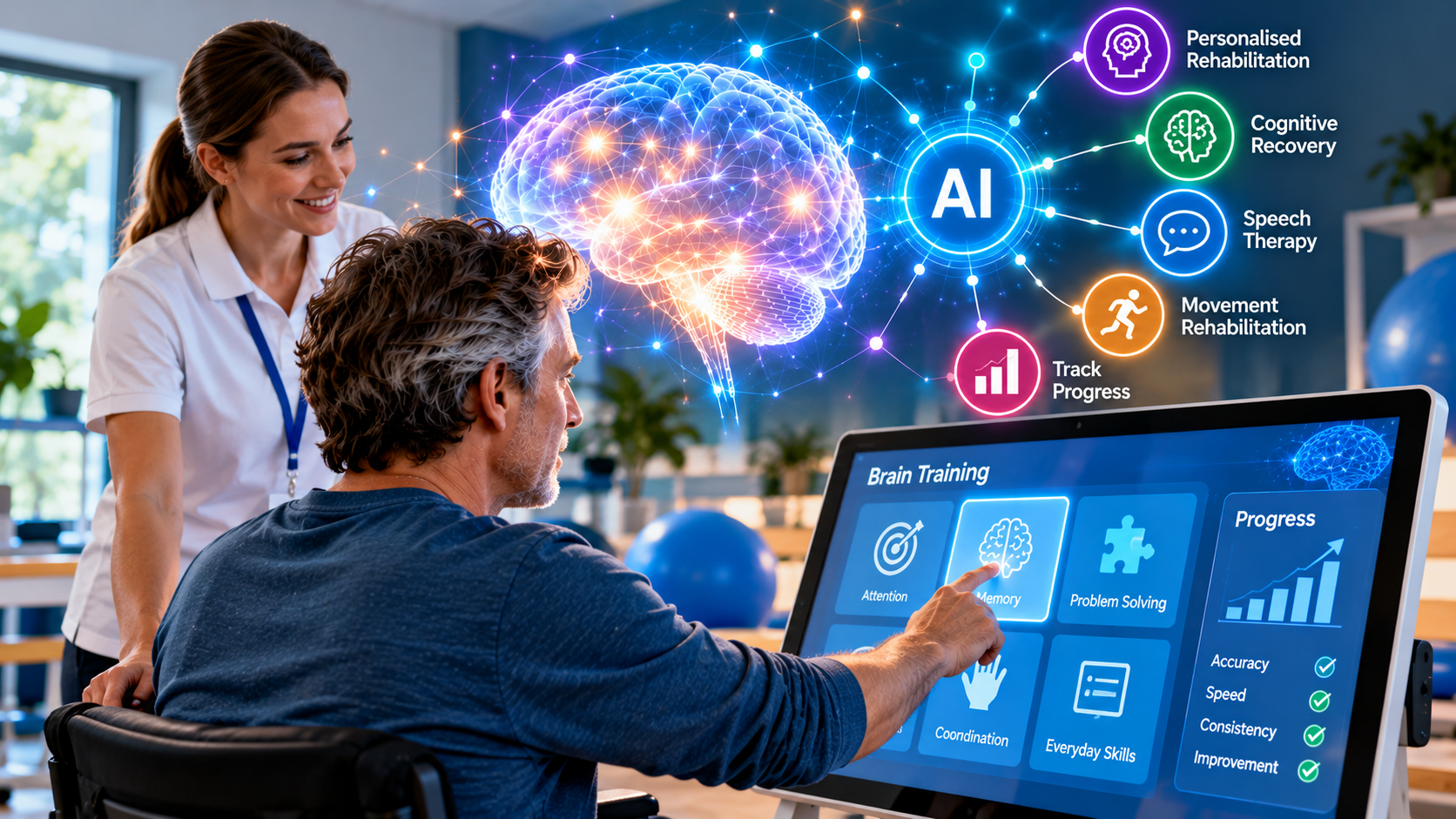
What if artificial intelligence could help people recovering from brain injuries receive rehabilitation that adapts to their individual needs, abilities and progress?
For many people living with an acquired brain injury, rehabilitation can be a long and unpredictable journey.
Some people experience difficulties with memory and concentration. Others face challenges involving speech, movement, emotional regulation or cognitive fatigue.
Recovery is rarely identical for two individuals.
And this presents one of the greatest challenges in neurological rehabilitation: how do we provide support that reflects each person’s changing abilities, circumstances and goals?
Artificial intelligence, commonly known as AI, is beginning to offer some intriguing possibilities.
From personalised rehabilitation exercises and intelligent speech therapy tools to virtual reality and movement analysis, researchers are exploring how AI could support people living with neurological injuries.
But could artificial intelligence genuinely transform brain injury rehabilitation?
And, perhaps more importantly, could it help people regain independence, confidence and quality of life?
Let’s explore what the technology might make possible, where the evidence currently stands and why human expertise must remain central to recovery.
1. Understanding Brain Injury Rehabilitation
An acquired brain injury occurs when damage to the brain develops after birth.
Causes include traumatic brain injury, stroke, infections, oxygen deprivation and other neurological events.
The consequences vary depending on the nature and severity of the injury, the areas of the brain affected and the individual’s circumstances.
Some people experience difficulties with physical movement.
Others may encounter problems with attention, memory, communication, decision-making or emotional regulation.
Fatigue can also become a significant challenge.
Brain injury rehabilitation aims to help individuals improve or maintain abilities, develop compensatory strategies, increase independence and participate in activities that matter to them.
Rehabilitation may involve physiotherapy, occupational therapy, speech and language therapy, neuropsychology and other specialist services.
It is often multidisciplinary because brain injuries can affect several areas of life simultaneously.
One of the difficulties is that rehabilitation needs can change over time.
An activity that is manageable one week may become difficult during a period of increased fatigue.
A person may improve in one area while continuing to experience significant challenges in another.
This is where personalised approaches become particularly important.
And it is one reason researchers are interested in artificial intelligence.
2. What Is Artificial Intelligence in Neurological Rehabilitation?
Artificial intelligence refers to computer systems designed to perform tasks that typically involve aspects of human intelligence.
These can include recognising patterns, analysing information, processing language and generating predictions or recommendations.
In healthcare, AI systems may be developed to assist with tasks such as interpreting medical images, analysing movement or identifying patterns in clinical information.
Within neurological rehabilitation, researchers are exploring how AI could help professionals assess abilities, personalise exercises and monitor aspects of progress.
Imagine a digital rehabilitation programme that adjusts the difficulty of an activity based on a person’s performance.
If the task becomes too demanding, the system could reduce its complexity.
If the person performs consistently well, it might gradually introduce additional challenges.
This type of adaptive technology could help make rehabilitation activities more responsive.
However, it is important to recognise that not every adaptive computer programme uses artificial intelligence.
Some systems simply follow predetermined rules.
True AI-based approaches may use machine learning or other techniques to identify patterns and adapt recommendations.
And although these technologies are promising, many applications remain experimental or require stronger evidence before becoming part of routine clinical care.
3. Personalised Brain Injury Rehabilitation Using AI
One of the most interesting potential benefits of AI is personalisation.
Traditional rehabilitation already involves tailoring treatment to an individual’s needs.
Therapists assess abilities, establish goals and adjust interventions based on progress.
AI could potentially support this process by analysing information from repeated assessments or rehabilitation sessions.
For example, a person practising a computer-based attention task might demonstrate patterns in response speed, accuracy and fatigue.
An appropriately designed system could use those patterns to suggest adjustments.
Someone who finds a task overwhelming might benefit from shorter sessions or simpler instructions.
Another person might be ready for more complex challenges.
The potential advantage is not that AI replaces the therapist.
It is that technology could provide additional information to support clinical decision-making.
But personalisation must involve more than measuring scores.
A person’s goals, emotional wellbeing, daily responsibilities and preferences are also important.
A computer might identify that someone has become faster at completing a particular exercise.
It cannot automatically determine whether that improvement has made a meaningful difference to their everyday life.
That requires understanding the person behind the data.
4. Could AI Help With Memory and Cognitive Rehabilitation?
Memory difficulties are common following some types of brain injury.
People may struggle to remember appointments, follow instructions, retain information or complete activities involving several steps.
Cognitive rehabilitation can include strategies such as memory aids, structured routines and practising relevant skills.
Researchers are exploring how digital technology might support these approaches.
AI-enabled systems could potentially offer personalised reminders, break complicated activities into manageable stages or adjust cognitive exercises based on performance.
Imagine someone preparing a meal after a brain injury.
They may find it difficult to remember the sequence of instructions.
A digital assistant could guide them through the process one step at a time.
It might provide reminders, allow instructions to be repeated or offer alternative formats.
Such technology could potentially support independence.
However, there is an important distinction between improving performance on a computerised memory exercise and improving memory in everyday life.
Research on cognitive training has repeatedly demonstrated that improvements in practised tasks do not always transfer to unrelated activities.
For this reason, AI brain training should not automatically be described as proven cognitive rehabilitation.
The effectiveness of any intervention depends on its design, the person using it and whether meaningful real-world outcomes have been demonstrated.
5. AI and Speech Therapy After Brain Injury
Communication difficulties can have a profound effect on everyday life.
Following some neurological injuries, people may experience aphasia, dysarthria or other speech and language difficulties.
These conditions can affect the ability to understand language, express thoughts or produce speech clearly.
Speech and language therapists play a vital role in assessment and rehabilitation.
Artificial intelligence could potentially provide additional tools.
Speech-recognition technology might help analyse aspects of spoken language.
Digital programmes could offer opportunities to practise words, sounds or communication exercises between therapy sessions.
Some systems may be able to adjust activities according to performance.
For example, a person practising naming everyday objects might receive prompts when they struggle.
The system could record responses and provide information for review by a therapist.
However, speech-recognition technology can perform poorly when someone’s speech differs from the patterns represented in its training data.
This is particularly important for people with neurological speech difficulties.
An inaccurate system could misinterpret responses or provide inappropriate feedback.
AI tools therefore need careful evaluation with the populations they are intended to support.
They should complement, rather than replace, specialist speech and language therapy.
6. How AI Could Support Physical Rehabilitation
Brain injury can affect balance, coordination, strength and movement.
Physiotherapy and occupational therapy may help people work towards meaningful physical goals.
Researchers are investigating how AI could be combined with motion sensors, cameras, wearable devices and robotic rehabilitation systems.
For example, sensors may record movement during a rehabilitation exercise.
Software could analyse aspects of movement quality, timing or range.
This information might help a therapist monitor changes over time.
In some settings, robotic devices can assist with repeated movement practice.
AI-based approaches may eventually help these systems adapt assistance according to the person’s abilities.
Imagine practising an arm movement while a rehabilitation device provides support.
As performance changes, the system might adjust the level of assistance.
This could potentially make certain forms of practice more responsive.
But physical rehabilitation involves safety considerations.
An inappropriate movement, excessive difficulty or inaccurate assessment could cause harm.
Any AI-assisted system used in clinical rehabilitation needs suitable safeguards, professional oversight and evidence of safety and effectiveness.
7. Virtual Reality, Gaming and Artificial Intelligence
One area I find particularly exciting is the combination of gaming, virtual reality and rehabilitation technology.
Virtual reality can create interactive environments in which people practise activities.
For example, a simulated supermarket might allow someone to practise finding items, following a shopping list or navigating an environment.
A virtual kitchen could provide opportunities to work through the steps involved in preparing a meal.
Games might involve visual searching, memory, coordination or problem-solving.
Artificial intelligence could potentially make these experiences more adaptable.
A system might adjust the number of objects, the pace of an activity or the complexity of instructions.
This could help tailor challenges to individual needs.
However, not everyone will find virtual reality comfortable.
Some people experience dizziness, nausea, headaches, visual discomfort or cognitive overload.
These concerns can be especially relevant following neurological injury.
Virtual reality rehabilitation must therefore be carefully matched to the individual.
And although research into game-based and virtual rehabilitation has produced encouraging findings in some areas, the evidence varies considerably.
Enjoyable technology is not automatically effective therapy.
8. The Role of Neuroplasticity in AI-Assisted Rehabilitation
Neuroplasticity is the brain’s ability to change its connections, structure and functions in response to learning, experience and injury.
It is an important concept in neurological rehabilitation.
Following brain injury, neural networks may undergo changes that contribute to recovery or adaptation.
Rehabilitation can support learning and the development of strategies that help people perform meaningful activities.
Repeated practice is often important.
For example, someone relearning a movement may need opportunities to practise that movement in an appropriate and structured way.
AI could potentially help organise and personalise aspects of that practice.
It might identify patterns in performance or suggest when a task should be adjusted.
But AI does not directly guarantee neuroplasticity or neurological recovery.
And neuroplasticity itself does not guarantee that lost abilities can be restored.
Recovery depends on many factors, including the type and severity of injury, the individual and the rehabilitation approach.
The potential value of AI lies in whether it can help deliver safe, effective and meaningful rehabilitation.
Not simply in whether it uses sophisticated technology.
9. Could AI Make Rehabilitation More Accessible?
Access to specialist rehabilitation can be challenging.
Some people face long waiting times.
Others live far from specialist services.
Travel may be difficult because of physical limitations, fatigue or financial circumstances.
Digital rehabilitation technology could potentially help address certain barriers.
For example, a person might use an appropriately prescribed home-based programme between appointments.
A therapist could review information remotely and adjust activities when necessary.
AI might eventually help identify patterns that suggest an activity is becoming too difficult or requires review.
This could make some aspects of rehabilitation more flexible.
However, digital access is not equal.
Some people lack reliable internet connections, suitable devices or confidence using technology.
Others may experience cognitive, visual or motor difficulties that make conventional interfaces challenging.
For AI rehabilitation tools to be genuinely accessible, they need to consider these barriers from the beginning.
Technology should not create a new form of exclusion while attempting to solve an existing problem.
10. Why Accessibility Must Come First
Through my own experience of brain injury, I understand the importance of recognising that people have different abilities and needs.
An activity that appears simple to one person may be extremely demanding for another.
This is why accessibility matters so much when designing digital tools.
For example, someone experiencing cognitive fatigue may benefit from shorter sessions.
A person with visual sensitivity may need reduced animation or brightness.
Someone with memory difficulties may require clear instructions that can be repeated.
A person with limited hand coordination may need alternative controls.
Useful accessibility features might include adjustable difficulty, larger text, simplified navigation, reduced sensory stimulation and flexible timing.
These features can make technology easier to use.
But accessibility also involves respecting the person’s choices.
A system should not pressure someone to continue an activity when they need to rest.
It should not interpret every pause as a failure.
And it should not assume that faster performance is always the most important outcome.
Good rehabilitation technology should adapt to people, rather than expecting people to adapt to the technology.
11. The Importance of Human Connection in Recovery
Artificial intelligence may be able to analyse information quickly.
It may identify patterns that are difficult to recognise manually.
It may eventually support increasingly personalised rehabilitation programmes.
But rehabilitation is about more than data.
It is also about confidence, relationships, motivation and understanding.
A therapist may recognise when someone is frustrated or frightened.
They can discuss concerns, adapt goals and provide emotional support.
Family members and friends can encourage participation and help someone navigate everyday challenges.
These human relationships are an important part of rehabilitation.
AI should not be viewed as a substitute for empathy, professional judgement or personal connection.
The most promising future may involve combining technology with human expertise.
AI could assist with selected tasks while healthcare professionals remain responsible for clinical decisions and person-centred care.
12. The Risks and Limitations of AI in Brain Injury Rehabilitation
Although the potential is exciting, there are several important concerns.
Accuracy: AI systems can make mistakes. Incorrect assessments or recommendations could be harmful in a healthcare setting.
Privacy: Rehabilitation technology may process sensitive medical information. Strong data protection and informed consent are essential.
Bias: Systems trained on unrepresentative data may perform less effectively for certain groups, including people with complex disabilities.
Clinical evidence: A tool that performs well in a laboratory may not deliver meaningful benefits in everyday rehabilitation.
Overreliance: People should not be encouraged to rely on AI-generated advice instead of qualified healthcare professionals.
Accessibility: Technology must be usable by people with different cognitive, physical and sensory needs.
In the UK, some AI-based healthcare products may fall within medical device regulation, depending on their intended purpose.
Developers and healthcare providers need to consider relevant regulatory, safety and data protection requirements.
Innovation should be encouraged, but it must be accompanied by appropriate scrutiny.
13. What Does the Research Tell Us So Far?
Research into artificial intelligence for neurological rehabilitation is developing rapidly.
Investigators are exploring applications involving movement analysis, personalised digital interventions, speech and language technologies, robotic assistance and clinical decision support.
Some early findings are promising.
However, the evidence is not equally strong across all applications.
Many studies involve small groups, different neurological conditions or technologies that have not been tested extensively in routine clinical settings.
Research involving stroke rehabilitation may not automatically apply to traumatic brain injury or other acquired brain injuries.
It is also important to distinguish between technical performance and clinical effectiveness.
An AI system might accurately classify a movement pattern.
That does not necessarily mean it improves independence, quality of life or long-term recovery.
To establish meaningful benefits, researchers need robust clinical studies that examine outcomes important to patients.
The question should not simply be whether AI can perform a task.
It should be whether using AI makes rehabilitation safer, more effective, more accessible or more meaningful.
14. Why This Subject Matters to Me
My interest in artificial intelligence and brain injury rehabilitation is both personal and practical.
Living with a brain injury has shaped my understanding of resilience, adaptation and the importance of recognising individual challenges.
It has also strengthened my interest in neuroplasticity and lifelong learning.
Through Regain the Brain, I want to encourage people to remain curious about what the brain can do and how new approaches might support learning and wellbeing.
I have also been exploring how technology can make cognitive challenges more enjoyable through projects such as Regain Arcade.
The idea behind these games is to provide engaging activities involving skills such as attention, memory, sequencing and problem-solving.
They are not clinically validated rehabilitation treatments.
But developing them has reinforced my interest in accessible digital experiences.
I believe technology should be designed with real people in mind.
Not simply to demonstrate what a computer can do, but to consider what might genuinely help someone participate, learn or enjoy an activity.
For people living with brain injuries, this distinction is particularly important.
15. What Might the Future of AI Rehabilitation Look Like?
Imagine a future in which someone recovering from a brain injury receives a rehabilitation programme tailored to their needs.
Their healthcare team establishes goals based on what matters most to them.
Appropriate digital tools help them practise selected activities between appointments.
The software adjusts tasks within clinically approved limits.
Therapists review progress and make decisions about treatment.
Family members receive guidance on how to provide suitable support.
And the person remains actively involved in choosing their goals.
This is one possible direction for AI-assisted rehabilitation.
But it remains a vision rather than a universal reality.
Many technical, clinical, ethical and practical challenges must be addressed.
The technology will need to demonstrate that it can deliver benefits that matter beyond the computer screen.
If those challenges can be met, AI may become a valuable additional tool in neurological rehabilitation.
Final Thoughts: Technology Should Support Human Potential
Artificial intelligence is changing many areas of society.
Healthcare is no exception.
In brain injury rehabilitation, AI offers possibilities for personalised activities, improved assessment, digital accessibility and support between clinical appointments.
But technology alone is not the answer.
Recovery is complex.
Every person’s circumstances are different.
And meaningful rehabilitation involves far more than completing exercises or improving test scores.
It involves independence, participation, confidence, relationships and quality of life.
My hope is that future innovations will place these human outcomes at the centre of their design.
The real measure of successful AI in brain injury rehabilitation will not be how intelligent the technology becomes.
It will be whether that technology helps people live better lives.
And that is a future worth exploring.
About Darren Jewell
Darren Jewell is a neuroresilience coach, inspirational speaker and founder of Regain the Brain.
Drawing on his lived experience of brain injury and his passion for neuroplasticity, Darren encourages individuals and organisations to embrace lifelong learning, develop resilience and explore new possibilities.
Through Regain the Brain and projects such as Regain Arcade, he is interested in how learning, technology and accessible activities can contribute to more engaging experiences.
Discover more at www.regainthebrain.com.
Medical disclaimer: This article is intended for general educational purposes. AI applications and digital games should not replace assessment, treatment or rehabilitation provided by qualified healthcare professionals.