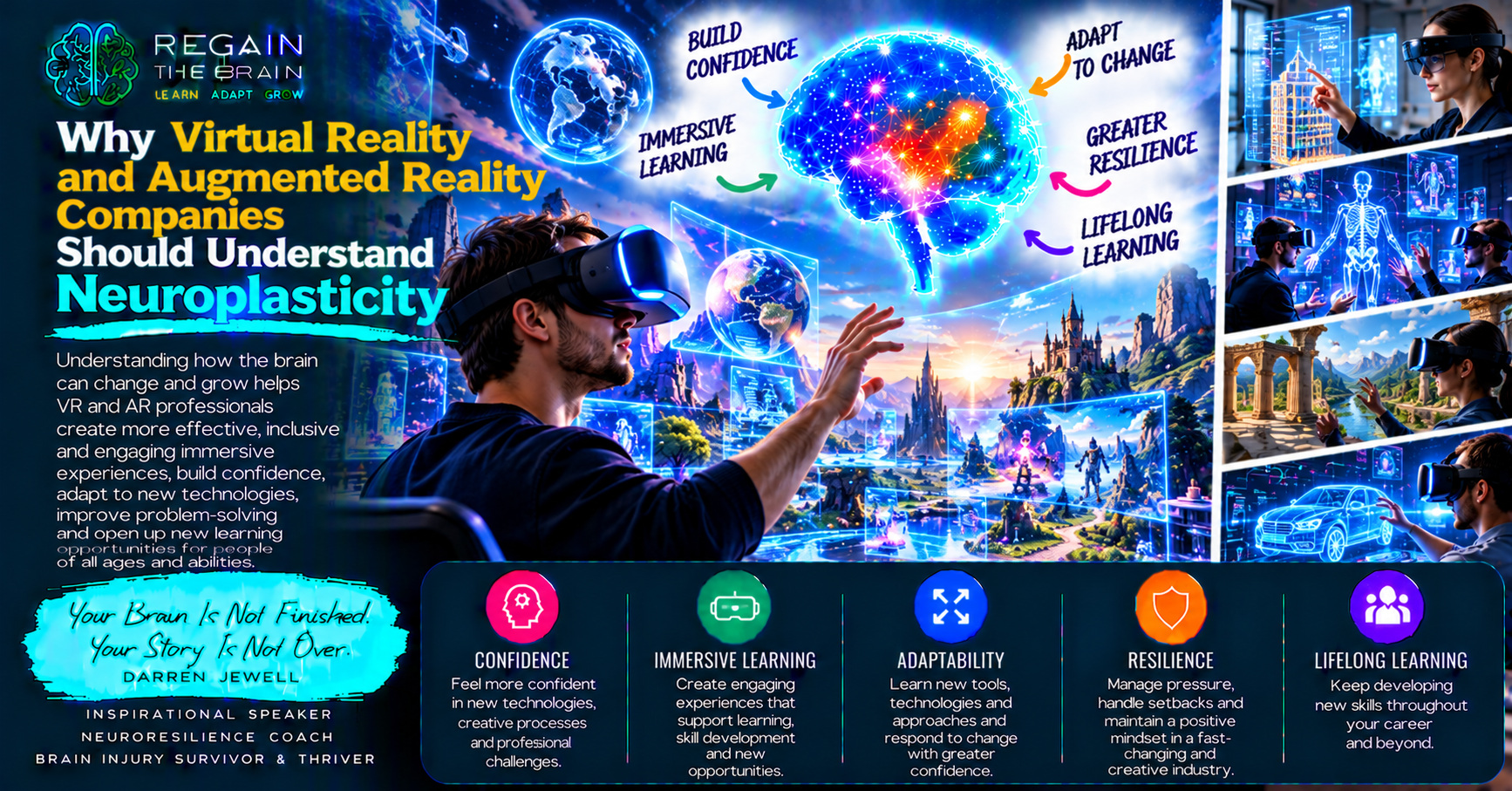
Imagine putting on a virtual reality headset and suddenly finding yourself somewhere completely different. You might be standing inside a spacecraft, exploring a historical city, practising a complicated technical procedure or learning a new skill in an environment that would otherwise be difficult to access. The technology is remarkable. But what fascinates me even more is the human brain experiencing it.
Virtual reality and augmented reality are changing the ways people interact with information, technology and their surroundings.
Virtual reality can place users inside computer-generated environments.
Augmented reality can add digital information to views of the physical world.
Mixed reality can combine aspects of physical and digital interaction.
Together, these technologies are opening up new possibilities for learning, communication, design, entertainment and professional development.
But behind every immersive experience are people.
Software developers.
Designers.
Engineers.
3D artists.
Researchers.
Learning specialists.
Healthcare professionals.
Accessibility experts.
Project managers.
And business leaders.
These professionals work in an industry where technology changes rapidly and unfamiliar challenges are part of everyday life.
They must continually learn.
Adapt.
Experiment.
Solve problems.
And reconsider established approaches.
But I believe there is another subject that deserves greater attention within the immersive technology industry.
Neuroplasticity: the remarkable capacity of the human brain to change through learning and experience.
My name is Darren Jewell. I am a London-based inspirational speaker, NeuroResilience Coach, brain injury survivor and passionate advocate for lifelong learning.
My mission is to make neuroplasticity an everyday word.
And I believe virtual reality and augmented reality companies have an opportunity to introduce this fascinating subject into their leadership, employee development and workplace wellbeing programmes.
1. What Is Neuroplasticity?
Neuroplasticity describes the brain’s ability to change its connections and patterns of activity in response to learning, experience and other biological processes.
Put simply, our brains are not completely fixed.
Throughout adulthood, we retain the capacity to acquire new knowledge, develop skills and adapt to unfamiliar experiences.
When someone learns a language, practises a musical instrument or develops a professional skill, the brain participates in processes that support learning.
With appropriate instruction, practice and feedback, unfamiliar tasks may gradually become more familiar.
However, neuroplasticity does not mean learning is always easy.
It does not guarantee that everyone can achieve identical outcomes.
And it does not mean determination alone can overcome every challenge.
But it provides an important scientific perspective on our continuing capacity to learn.
For virtual reality and augmented reality companies, understanding neuroplasticity can reinforce the importance of lifelong learning and thoughtful educational design.
2. Why Immersive Technology and the Human Brain Are Connected
Virtual reality creates experiences that can feel surprisingly convincing.
A person may know they are standing in a room while visually experiencing an entirely different environment.
They might look down from a virtual building.
Walk through a simulated factory.
Or interact with digital objects that appear to occupy the space around them.
These experiences involve perception, attention, movement and the interpretation of sensory information.
That makes immersive technology an interesting subject for neuroscience research.
Researchers investigate how people perceive virtual environments, learn within them and respond to different forms of interaction.
However, experiencing something in virtual reality does not automatically produce beneficial changes in the brain.
The outcomes depend on the experience, its design, the individual and the purpose for which it is used.
Understanding neuroplasticity can contribute to conversations about learning and experience without turning every immersive application into an unsupported brain-health claim.
The technology creates the environment. The person brings the experience to life.
3. Why VR and AR Companies Depend on Lifelong Learning
Immersive technology is a rapidly developing field.
Headsets evolve.
Software platforms change.
Tracking systems improve.
Development tools become more sophisticated.
And new applications are explored across different industries.
These developments create ongoing learning requirements.
A VR developer may need to understand an unfamiliar development framework.
A 3D artist may learn new modelling tools.
An AR engineer may need to work with different hardware.
A learning designer may need to understand how to create effective immersive training.
Understanding neuroplasticity reinforces the importance of continued professional development.
However, successful technical learning requires appropriate instruction, practical experience, feedback and suitable resources.
Neuroplasticity awareness can complement these activities but cannot replace them.
4. Why Confidence Matters When Entering a Virtual World
For someone who has never used virtual reality, the experience can be intimidating.
A headset may feel unfamiliar.
The controls may be confusing.
The virtual environment may be overwhelming.
And the person may worry about making mistakes.
Some users will feel comfortable immediately.
Others may need time, reassurance and accessible instructions.
The same can be true when people learn unfamiliar skills in everyday life.
Confidence is not always something we possess before beginning.
Sometimes it develops through experience.
I understand this personally.
For approximately half a century, confidence was something I struggled to develop.
Growing up with the consequences of a serious childhood brain injury affected how I viewed myself.
There were many occasions when I questioned my abilities.
But later in life, I began challenging those assumptions.
Learning the piano at 54 became an important part of that journey.
It helped me appreciate that confidence can develop through patience, practice and gradual progress.
Sometimes the first step towards discovering what we can do is being willing to enter unfamiliar territory.
5. My Personal Journey: Discovering New Possibilities After Brain Injury
At just 15 months old, I suffered a serious brain injury after falling from a balcony.
I spent three weeks in a coma.
The consequences of that injury affected my physical abilities, coordination, confidence and many aspects of my life.
Growing up, I experienced challenges that other people did not always understand.
I also experienced bullying, which affected how I viewed myself.
For approximately half a century, confidence was something I struggled to develop.
I often questioned whether I was capable of achieving things that appeared to come naturally to other people.
There were activities I assumed would be too difficult.
There were opportunities I hesitated to pursue.
And there were times when I allowed my doubts to influence my decisions.
But later in life, something began to change.
At 54, I decided to learn to play the piano.
I had to learn to read music.
I had to coordinate my hands.
I had to remember sequences.
And I had to practise movements that initially felt difficult.
There were moments of frustration.
There were occasions when progress seemed painfully slow.
But I continued learning.
Gradually, I began noticing improvements.
And something important happened.
I started reconsidering some of the beliefs I had held about my abilities.
That experience encouraged me to explore neuroplasticity and the science of lifelong learning.
It also inspired me to explore other unfamiliar subjects.
My curiosity has since encouraged me to explore writing, music, technology, language learning and digital development.
I have enjoyed experimenting with interactive learning experiences and creating digital projects.
Some of these projects involve games.
Others involve languages and opportunities to learn unfamiliar skills.
What matters to me is not simply the technology itself.
It is the willingness to explore something that I might once have assumed was beyond my abilities.
That is why immersive technology interests me.
Virtual reality and augmented reality offer new ways of presenting experiences, exploring information and practising certain activities.
I do not claim to be a VR engineer or immersive technology specialist.
Nor do I claim that virtual reality could have reversed my childhood brain injury.
But my personal experiences have taught me the value of remaining curious.
Today, I share my experiences as an inspirational speaker and NeuroResilience Coach.
I believe people deserve opportunities to learn, develop and explore their abilities with appropriate support.
And sometimes, the greatest discovery begins when we question a belief we have held about ourselves.
Your Brain Is Not Finished. Your Story Is Not Over.
6. Why Virtual Reality Can Create New Learning Opportunities
Traditional learning often involves reading, listening, watching demonstrations and practising tasks.
Virtual reality can introduce another possibility.
It can allow learners to interact with simulated environments.
A trainee may explore a virtual workplace.
A student may investigate a three-dimensional scientific model.
An employee may practise a particular procedure.
A learner may experience a situation that would be difficult, expensive or unsafe to recreate in ordinary circumstances.
These experiences can offer useful training opportunities when they are designed appropriately.
However, virtual reality is not automatically more effective than conventional instruction.
Its value depends on the learning objective, instructional design, accessibility, cost and available evidence.
Understanding neuroplasticity can complement conversations about practice and learning.
But effective education requires much more than placing someone inside a headset.
7. Neuroplasticity and Virtual Reality Training
Virtual reality training is being explored and used in a variety of professional settings.
These include manufacturing, healthcare, aviation, engineering and emergency response.
A simulated environment may allow someone to practise certain tasks without exposing them to the same risks as a real-world situation.
However, simulation has limitations.
Virtual environments cannot always reproduce the full complexity of physical equipment, human behaviour or operational conditions.
Learning in VR does not guarantee competence in the real world.
For safety-critical activities, immersive training must be appropriately validated and integrated with established instruction, assessment and practical training.
Understanding neuroplasticity reinforces the value of practice and feedback.
But it cannot replace professional competency standards.
8. Why Augmented Reality Can Support Workplace Learning
Augmented reality can display digital information alongside the physical environment.
For example, an employee might see instructions associated with a piece of equipment.
A technician might access visual guidance.
A trainee might examine a digital model while working with a physical object.
These applications may help make information more accessible in certain circumstances.
However, AR systems can also introduce distractions, inaccuracies or usability problems.
They must be designed and evaluated for their intended purpose.
Understanding neuroplasticity can contribute to conversations about how people learn unfamiliar tasks.
But successful workplace learning also depends on appropriate training, supervision and reliable information.
9. Why Immersive Learning Needs Good Instructional Design
One of the most important questions for VR and AR developers is not simply whether an experience looks impressive.
It is whether the experience achieves its intended purpose.
An immersive training programme should have clear learning objectives.
Users should understand what they are expected to do.
Instructions should be accessible.
Feedback should be meaningful.
And the experience should be evaluated.
A visually spectacular simulation may be entertaining without necessarily improving learning.
Understanding neuroplasticity can reinforce the importance of practice and feedback.
However, instructional design should be informed by relevant educational research and evidence about the specific application.
Immersion can capture attention. Good teaching helps turn an experience into meaningful learning.
10. Why Accessibility Matters in Virtual Reality
Accessibility is one of the most important subjects in immersive technology.
Not everyone experiences virtual environments in the same way.
Some people may have limited mobility.
Others may experience visual or hearing difficulties.
Some may have neurological conditions.
Others may experience motion sickness, dizziness or discomfort when using a headset.
Accessible design can include seated experiences, adjustable movement settings, alternative controls, subtitles, visual alternatives to audio cues and options to reduce sensory intensity.
Developers should also consider whether a non-immersive alternative is appropriate.
Understanding neuroplasticity does not eliminate disability or remove the need for accessibility.
The goal should not be to make everyone experience technology in the same way. It should be to create meaningful opportunities for more people to participate.
11. Neuroplasticity and Rehabilitation Technology
Virtual reality has attracted interest in rehabilitation research.
Researchers and clinicians have investigated immersive and interactive technologies for certain rehabilitation activities.
Depending on the condition and intervention, VR-based approaches may be used to support specific exercises or therapeutic goals.
However, clinical evidence varies considerably.
Not every VR application is a medical treatment.
Not every neurological condition responds in the same way.
And not every person will find immersive technology suitable.
As someone who has lived with the consequences of a serious childhood brain injury, I find this area particularly interesting.
But personal interest should never be confused with clinical expertise.
VR rehabilitation programmes require appropriate professional oversight, individual assessment and evidence relevant to the condition being treated.
Hope is important. So is responsible, evidence-based care.
12. Why Older Adults Should Not Be Excluded from Immersive Technology
Virtual reality and augmented reality are sometimes presented as technologies primarily for younger people.
But curiosity does not belong to one age group.
An older adult may enjoy exploring a virtual museum.
Someone approaching retirement may be interested in immersive travel experiences.
A person who has never used a headset may enjoy learning how it works.
Understanding neuroplasticity can challenge the misconception that learning becomes impossible later in life.
However, older adults may have different accessibility, comfort or health considerations.
Technology should be introduced with appropriate support and realistic expectations.
Virtual reality should not be promoted as a guaranteed way to prevent dementia or age-related cognitive decline.
For many people, the enjoyment of exploring something unfamiliar may be valuable in its own right.
13. Why Workplace Resilience Matters in Immersive Technology Companies
VR and AR companies can operate in demanding environments.
Development projects may involve complex deadlines.
Technical teams may encounter unexpected problems.
Employees may need to respond to changing hardware and software requirements.
Commercial uncertainty can affect projects and employment.
These challenges can influence wellbeing.
Resilience is therefore an important subject.
However, resilience should never mean expecting employees to tolerate excessive workloads, chronic stress or inadequate organisational support.
Genuine workplace resilience requires responsible leadership, realistic expectations, appropriate staffing and access to wellbeing resources.
Understanding neuroplasticity can contribute to conversations about learning and adaptation.
But it is not a substitute for effective organisational support.
14. Why VR and AR Leaders Should Understand Neuroplasticity
Immersive technology leaders face complex responsibilities.
They must coordinate creative and technical teams.
They must manage projects.
They must respond to technological change.
And they must support employees through evolving professional requirements.
Effective leadership requires communication, adaptability and professional judgement.
Understanding neuroplasticity can provide a useful perspective on continued professional development.
Leaders can develop unfamiliar skills through training, experience and constructive feedback.
However, leadership development requires practical application and organisational support.
For VR executives, AR company directors and immersive technology managers, an inspirational presentation about neuroplasticity can encourage reflection on the learning culture they create.
Great leaders do not need to know everything. They need to remain willing to learn.
15. Why Immersive Technology Companies Should Encourage a Growth Mindset
A growth mindset involves recognising that abilities can develop through effective learning strategies, practice, feedback and appropriate support.
This concept can be relevant to VR and AR organisations.
A junior developer may initially struggle with unfamiliar software.
A designer may need additional training.
A technical employee may require support when learning new equipment.
Constructive feedback and appropriate instruction can encourage progress.
However, a growth mindset must never become an excuse for inadequate training, unrealistic expectations or excessive workloads.
Employees need appropriate resources, supervision and clearly defined responsibilities.
For immersive technology companies, growth mindset education can complement existing workforce development programmes.
16. Neuroplasticity and Problem-Solving in VR Development
Virtual reality development involves complex technical challenges.
A headset may not track movement as expected.
A simulated environment may behave unpredictably.
A user interface may be confusing.
A programme may need to accommodate different accessibility requirements.
These challenges require technical expertise, analytical thinking and professional judgement.
Problem-solving skills can develop through appropriate training, experience and feedback.
Understanding neuroplasticity reinforces the value of continued learning.
However, effective problem-solving also requires reliable information, testing, collaboration and appropriate development practices.
For VR and AR companies, neuroplasticity awareness can complement existing professional development programmes.
17. Why Artificial Intelligence and Immersive Technology Are Connected
Artificial intelligence is influencing immersive technology.
AI-based tools may assist with certain development, animation, interaction and content creation tasks.
These technologies create opportunities for innovation.
But they also require employees to understand unfamiliar tools.
A developer may need to evaluate AI-generated content.
A designer may explore new production workflows.
A manager may need to understand the limitations and risks of AI-assisted development.
Understanding neuroplasticity can reinforce the importance of continued learning.
However, AI implementation also raises questions about privacy, intellectual property, reliability and responsible use.
Neuroplasticity awareness can complement digital skills development programmes.
18. Why Learning Through Play Matters
One reason immersive technology interests me is its potential to make certain learning experiences more engaging.
A person may explore a virtual environment.
Experiment with digital objects.
Solve a puzzle.
Or practise a sequence of actions.
These activities can involve attention, memory and problem-solving.
But engagement does not automatically mean effective learning.
And improvements within a game or simulation do not necessarily transfer to unrelated activities.
For me, the value of play also lies in curiosity.
It can encourage people to explore unfamiliar experiences without feeling that every activity must lead to a professional achievement.
Sometimes the willingness to play is also the willingness to learn.
19. Brain Injury Awareness and Immersive Technology
One subject particularly close to my heart is brain injury awareness.
Brain injuries can affect memory, attention, movement, communication, emotional regulation and other aspects of daily life.
The consequences vary considerably between individuals.
Some difficulties may not be immediately visible.
As someone who has lived with the consequences of a serious childhood brain injury, I understand how easily assumptions can be made about another person’s abilities.
Immersive technology companies should consider users with different neurological and accessibility needs.
Some people may benefit from simplified instructions, reduced visual stimulation, alternative controls or shorter sessions.
Others may find particular immersive experiences unsuitable.
Design decisions should be informed by user testing and relevant professional guidance.
My personal experience should not be treated as representative of everyone living with a brain injury.
Sometimes the challenges people face are not the ones we can immediately see.
20. Why VR and AR Companies Should Promote Lifelong Learning
Immersive technology organisations employ people with diverse backgrounds, experiences and abilities.
Developers, designers, engineers, artists, researchers, learning specialists and senior leaders all contribute different expertise.
A workplace culture that values learning can support employees as their responsibilities evolve.
Understanding neuroplasticity can encourage conversations about curiosity, confidence and professional development.
However, successful learning cultures require practical investment in training, mentoring and employee support.
For virtual reality and augmented reality companies, neuroplasticity education can complement existing workforce development strategies.
My mission is to make neuroplasticity an everyday word.
And I believe immersive technology companies can play an interesting role in encouraging conversations about learning throughout life.
21. Why Book an Inspirational Speaker for a VR or AR Industry Event?
Virtual reality companies, augmented reality businesses, immersive technology studios and professional associations organise conferences, leadership meetings, employee development days and workplace wellbeing programmes.
These events provide opportunities to introduce fresh perspectives.
Technical and creative presentations are essential to the industry.
But there is also value in exploring the human experiences behind learning, confidence and personal development.
An inspirational speaker can offer a different perspective through authentic personal storytelling.
My presentations combine lived experience with accessible explanations of neuroplasticity, resilience, confidence and lifelong learning.
I aim to entertain, educate and inform.
Speaking topics can include:
- Neuroplasticity and the science of lifelong learning
- Immersive technology and human learning
- Building confidence through unfamiliar experiences
- Workplace resilience in technology companies
- Growth mindset and professional development
- Accessibility and brain injury awareness
- Leadership and continuous learning
- Challenging limiting beliefs
- Learning new skills later in life
- Curiosity, creativity and personal development
Presentations can be adapted to the objectives of individual VR and AR organisations.
They are designed to complement, not replace, specialist technical training, accessibility expertise or employee wellbeing support.
22. What Could Immersive Technology Professionals Take Away?
My aim is not simply to deliver a motivational presentation that is forgotten when the event finishes.
I want audiences to leave with questions worth exploring.
For example:
What new skill have I avoided because I believe I am not naturally good at it?
How do I respond when technology or creative requirements change?
What assumptions have I made about my own abilities?
Could I approach unfamiliar experiences with greater curiosity?
How could I make learning experiences more accessible to others?
What would I enjoy learning simply for the experience?
These questions can encourage reflection on confidence, adaptability, learning and personal development.
23. Why Choose Darren Jewell as Your Inspirational Speaker?
There are many virtual reality developers, augmented reality specialists and technology experts available to speak at industry conferences.
My contribution is different.
I do not claim to be a VR engineer, AR specialist or neuroscientist.
Instead, I offer a perspective shaped by my experiences of brain injury, low confidence, personal development and discovering new abilities later in life.
I also bring a personal interest in technology and creating interactive learning experiences.
I understand what it feels like to doubt yourself.
I understand the frustration of struggling with unfamiliar tasks.
And I understand the satisfaction of discovering that you are capable of learning something you once considered beyond you.
My journey from childhood brain injury survivor to inspirational speaker and NeuroResilience Coach has strengthened my passion for helping people understand neuroplasticity.
I do not promise that one presentation will transform an immersive technology organisation or guarantee improved learning outcomes, employee wellbeing or commercial performance.
Instead, I aim to introduce ideas that encourage curiosity, reflection and meaningful conversations about lifelong learning.
24. Book Darren Jewell for Your Next Virtual Reality or Augmented Reality Event
Are you a virtual reality company executive, augmented reality business leader, immersive technology studio director, HR professional, Learning & Development manager or technology conference organiser looking for an inspirational speaker for virtual reality and augmented reality companies?
I would welcome the opportunity to discuss how my presentations could complement your organisation’s professional development and employee wellbeing objectives.
Whether you are organising a VR industry conference, AR leadership event, employee development day or corporate wellbeing programme, my aim is to deliver a presentation that encourages people to think differently about learning, resilience and personal growth.
Virtual reality can allow us to experience places we have never visited.
Augmented reality can help us see information in new ways.
Immersive technology can invite us to explore unfamiliar environments and possibilities.
But perhaps one of the most important journeys we can take does not require a headset at all.
It begins when we question an assumption about our own abilities.
When we become willing to learn.
When we allow ourselves to be beginners.
And when we recognise that personal development does not have to end at a particular age.
The technology may change what we see. But learning can change how we see ourselves.
Your Brain Is Not Finished. Your Story Is Not Over.
Darren Jewell
Inspirational Speaker | NeuroResilience Coach | Brain Injury Survivor & Thriver
Visit www.regainthebrain.com to enquire about booking an inspirational speaker for your virtual reality company, augmented reality business or immersive technology event.
#NeuroplasticityAtWork #VirtualReality #AugmentedReality #ImmersiveTechnology #VRTraining #WorkplaceResilience #GrowthMindset #LifelongLearning #InspirationalSpeaker #VRConferenceSpeaker #DarrenJewell #RegainTheBrain