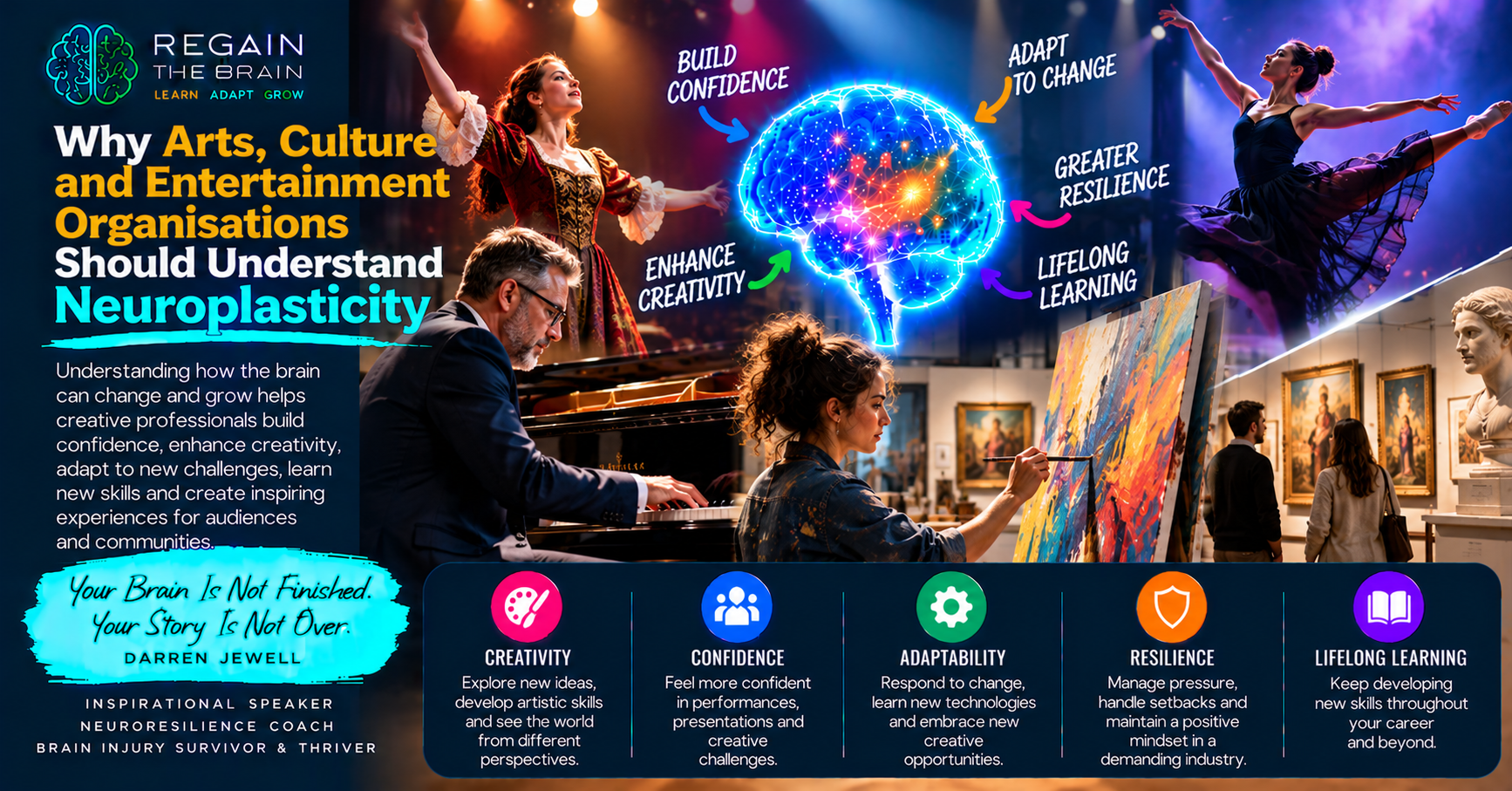
The arts have the power to inspire, educate, entertain and change how we see the world. But what if the people working in arts, culture and entertainment understood more about how the human brain learns, adapts and responds to creative experiences?
Every day, musicians, actors, dancers, artists, museum professionals, theatre employees and entertainment teams create experiences that enrich people’s lives.
They encourage audiences to think differently, explore unfamiliar ideas and discover new perspectives.
Yet behind every musical performance, theatrical production, painting, dance routine and creative project is something remarkable.
The human brain.
Our brains allow us to learn musical instruments, remember scripts, develop movement skills, recognise patterns, interpret artistic experiences and explore new ideas.
And throughout life, our brains retain a capacity to change through learning and experience.
This ability is known as neuroplasticity.
I believe understanding neuroplasticity could introduce an exciting new dimension to employee development, creative education and lifelong learning within arts and cultural organisations.
My name is Darren Jewell. I am a London-based inspirational speaker, NeuroResilience Coach, brain injury survivor and passionate advocate for lifelong learning.
At 54, I decided to learn to play the piano.
That decision changed how I thought about my abilities and encouraged me to explore the science of neuroplasticity.
Today, my mission is to make neuroplasticity an everyday word.
And I believe the arts, culture and entertainment industries have a particularly exciting opportunity to help make that happen.
1. What Is Neuroplasticity and Why Does It Matter in the Arts?
Neuroplasticity describes the brain’s ability to change its connections and patterns of activity in response to learning, experience and other biological processes.
When someone learns a new musical instrument, practises a dance routine or develops an unfamiliar artistic technique, the nervous system is involved in acquiring and refining skills.
Learning can involve changes in how brain networks communicate and how different processes become coordinated.
This is relevant to creative professionals.
A musician learning a new composition, an actor memorising a script or a dancer practising unfamiliar choreography is engaging processes associated with learning, memory and movement.
Understanding neuroplasticity can encourage people to recognise that creative skills can develop through appropriate teaching, practice and experience.
However, neuroplasticity does not guarantee that everyone will develop the same abilities or achieve professional-level performance.
Individual circumstances, opportunities, training and support all influence learning.
For arts organisations, neuroplasticity education can complement existing creative training and professional development programmes.
2. Why Learning Music Is Such an Interesting Example of Neuroplasticity
Music is one of the most fascinating examples of complex human learning.
Playing a musical instrument can involve listening, attention, memory, movement, timing and coordination.
A pianist may need to read musical notation, remember sequences, control finger movements and listen carefully to the sounds being produced.
These activities require different processes to work together.
Research has found associations between musical training and differences in brain structure and function.
Some studies also suggest that musical learning can be associated with changes in neural activity over time.
However, these findings should not be interpreted as proof that learning music automatically improves every aspect of cognition or prevents neurological conditions.
For music schools, orchestras, arts organisations and cultural education providers, neuroplasticity offers a fascinating scientific perspective on learning.
Music does not simply give us something to listen to. Learning to create music can challenge us to develop unfamiliar skills.
3. Why I Started Learning the Piano at 54
For much of my life, confidence was something I struggled to develop.
As a child, I lived with the consequences of a serious brain injury.
The challenges I experienced affected my coordination, physical abilities and self-belief.
For approximately half a century, I questioned many of my abilities.
There were things I assumed I would never be able to do.
Then, at 54, I decided to learn the piano.
I was a complete beginner.
I had to learn to read music.
I had to understand rhythm and timing.
I had to develop coordination between my hands.
And I had to accept that making mistakes was part of learning.
There were moments of frustration.
Sometimes my fingers did not seem to cooperate.
Sometimes a piece of music felt far too difficult.
But gradually, through practice, I began to notice progress.
That experience was personally significant.
It challenged assumptions I had held about myself for decades.
It also encouraged me to explore neuroplasticity and the science of lifelong learning.
I was not trying to become a concert pianist.
I simply wanted to discover whether I could learn something unfamiliar.
Sometimes the greatest reward from learning a musical instrument is not the music itself. It is discovering that you are capable of making progress.
4. Why Arts Organisations Should Encourage Lifelong Learning
Many people associate artistic learning with childhood.
Children attend music lessons.
Young people join drama groups.
Students study art and design.
But creative learning does not have to end when formal education finishes.
Someone may begin painting in their forties.
Another person may join a choir in their fifties.
A retired individual may take up photography in their seventies.
Someone who has never performed on stage may decide to join an amateur theatre group.
These experiences can provide opportunities for learning, social connection, creativity and personal enjoyment.
Understanding neuroplasticity can help challenge the misconception that adults are too old to develop unfamiliar skills.
For theatres, museums, galleries and community arts organisations, this creates opportunities to encourage participation across different age groups.
Creativity does not have a retirement age.
5. My Personal Journey: From Brain Injury Survivor to Inspirational Speaker
At just 15 months old, I suffered a serious brain injury after falling from a balcony.
I spent three weeks in a coma.
The consequences of that injury affected my physical abilities, coordination, confidence and many aspects of my life.
Growing up, I experienced challenges that other people did not always understand.
I also experienced bullying, which affected my self-belief.
For approximately half a century, confidence was something I struggled to develop.
There were many occasions when I questioned whether I was capable of achieving certain things.
But later in life, I began challenging those assumptions.
Learning the piano at 54 became an important part of that journey.
It encouraged me to explore new interests and reconsider what learning could mean in adulthood.
My curiosity has since led me towards writing, music, language learning, technology and the development of digital learning experiences.
I have also explored creating songs in different languages, combining my interest in music with language learning and technology.
Today, I share my experiences as an inspirational speaker and NeuroResilience Coach.
My message is not that everyone can overcome every challenge through determination alone.
It is that people deserve opportunities to explore their abilities with appropriate support and realistic expectations.
I do not claim that learning music reversed my childhood brain injury.
Instead, the experience helped me appreciate that personal development and learning can remain meaningful throughout life.
Your Brain Is Not Finished. Your Story Is Not Over.
6. Neuroplasticity and Creativity: Can We Learn to Become More Creative?
Creativity is often described as a natural talent.
People sometimes say:
“I’m not artistic.”
“I can’t draw.”
“I could never write a song.”
“I’m not creative.”
But creativity involves a range of skills and processes that can develop through learning, practice and experience.
Someone who has never painted may improve their technique through lessons.
A beginner songwriter may develop a better understanding of melody and structure.
An aspiring actor may become more comfortable performing through rehearsal and feedback.
Neuroplasticity provides a scientific perspective on how learning can involve changes in the brain.
However, understanding neuroplasticity does not automatically make someone more creative.
Creative development also depends on opportunities, instruction, experimentation, motivation and individual interests.
For arts organisations, this provides a useful message.
Creativity should not be treated as something reserved exclusively for people who already consider themselves talented.
7. Why Theatre Companies Should Understand Neuroplasticity
Theatre professionals engage in complex learning.
Actors memorise dialogue, interpret characters and coordinate movements.
Directors develop communication and leadership skills.
Technical teams learn unfamiliar equipment and production systems.
Stage managers coordinate multiple responsibilities.
These activities involve attention, memory, communication and professional judgement.
Understanding neuroplasticity can reinforce the importance of continued learning.
For example, an actor may develop greater familiarity with a role through rehearsal.
A technician may become more confident using new production technology through structured training.
A theatre employee may improve public speaking skills through experience and feedback.
However, neuroplasticity awareness should complement rather than replace professional training.
For theatre companies, introducing neuroplasticity into employee development programmes could encourage conversations about learning, confidence and adaptability.
8. Neuroplasticity and Dance: Learning Through Movement
Dance combines music, movement, timing, coordination and memory.
Learning choreography requires people to remember movement sequences and coordinate their bodies.
A beginner may initially struggle to remember the steps.
They may need to concentrate carefully on timing and balance.
With appropriate practice, movements may become more familiar.
This involves motor learning and processes associated with neuroplasticity.
For dance schools and performing arts organisations, understanding these processes can provide a useful educational perspective.
However, physical abilities vary, and dance training should be adapted to individual circumstances.
Learning a new movement can be an achievement in itself, regardless of whether someone ever performs on a professional stage.
9. Why Museums and Galleries Should Introduce Visitors to Neuroplasticity
Museums and art galleries encourage curiosity.
They introduce visitors to history, science, technology, art and unfamiliar perspectives.
A museum exhibition may inspire someone to explore a subject they have never considered before.
An art gallery workshop may encourage a visitor to experiment with unfamiliar creative techniques.
A cultural education programme may help adults develop new knowledge and skills.
These experiences can involve learning and memory.
For museums and galleries, neuroplasticity could become an interesting subject within public education programmes.
Exhibitions and workshops could explore how people learn artistic skills, how memory contributes to creativity and why learning remains possible throughout adulthood.
However, exhibitions should communicate the science accurately and avoid exaggerated claims about brain development.
10. Why Arts and Entertainment Employees Need Workplace Resilience
Creative industries can be demanding.
Performers may experience rejection.
Musicians may face uncertainty about future work.
Theatre employees may work irregular hours.
Production teams may face demanding deadlines.
Freelance creative professionals may experience financial instability.
These challenges can affect confidence and wellbeing.
For arts organisations, workplace resilience and employee wellbeing are important subjects.
However, resilience should never mean expecting employees to tolerate unreasonable workloads, financial insecurity or unhealthy working conditions.
Genuine workplace resilience requires supportive leadership, fair working practices, appropriate resources and access to professional support.
Understanding neuroplasticity can contribute to educational conversations about learning and adaptation.
But it is not a substitute for effective organisational wellbeing policies.
11. Why Creative Professionals Should Embrace Being Beginners
Creative professionals often develop expertise in particular areas.
A musician may spend decades mastering one instrument.
An actor may become highly experienced in a particular style of performance.
An artist may develop a distinctive technique.
But expertise in one field does not prevent someone from learning another.
A pianist might decide to learn guitar.
An actor might explore photography.
A dancer might begin creative writing.
A painter might learn digital animation.
These experiences can provide new perspectives and opportunities for personal development.
Understanding neuroplasticity can reinforce the message that learning remains possible throughout adulthood.
Being an expert in one subject does not mean we have to stop being beginners in others.
12. Neuroplasticity and Learning New Languages Through Music
Music and language both involve listening, timing, memory and the interpretation of sound.
Learning songs in unfamiliar languages can provide opportunities to practise pronunciation, vocabulary and listening.
However, singing in another language does not automatically lead to fluency.
Effective language learning also requires comprehension, appropriate instruction and meaningful practice.
My own interest in music and languages has encouraged me to experiment with creating songs in different languages.
It has also contributed to the development of my language-learning application, Speak & Rewire.
For me, these projects represent the enjoyment of combining different interests.
Music, language and technology may seem like separate subjects.
But exploring them together has encouraged me to continue learning.
For arts and cultural organisations, this demonstrates how creative projects can provide opportunities for interdisciplinary learning.
13. Why Arts Organisations Should Encourage a Growth Mindset
A growth mindset involves recognising that abilities can develop through effective learning strategies, practice, feedback and appropriate support.
This concept can be relevant to creative professionals.
A beginner musician may struggle with rhythm.
An actor may find public speaking challenging.
An artist may feel uncertain about trying an unfamiliar technique.
A dancer may need additional time to learn choreography.
Supportive teaching and constructive feedback can encourage progress.
However, a growth mindset should never become an excuse for unrealistic expectations or excessive pressure.
People need appropriate training, resources and opportunities.
For arts organisations, growth mindset education can complement existing creative development programmes.
14. Neuroplasticity and Confidence in Creative Performance
Performing in front of an audience can be intimidating.
Musicians, actors, dancers and public speakers may experience nerves before performing.
Even experienced professionals can feel anxious.
Confidence may develop through preparation, appropriate practice, supportive feedback and experience.
Understanding neuroplasticity can reinforce the idea that performance-related skills can continue developing.
However, confidence does not eliminate every difficulty, and some people may require additional support.
My own experience of learning the piano helped me appreciate that confidence can develop gradually.
For approximately half a century, I struggled with self-belief.
Learning something unfamiliar in my fifties helped me reconsider assumptions I had held about myself.
Confidence does not always arrive before we begin. Sometimes it grows as we discover what we can learn.
15. Why Arts Leaders Should Understand Neuroplasticity
Arts organisation leaders face complex responsibilities.
They must manage employees, support creative projects, respond to funding pressures and maintain organisational sustainability.
Effective leadership requires communication, adaptability and professional judgement.
Understanding neuroplasticity can provide a useful perspective on continuing professional development.
Leaders can develop unfamiliar skills through training, experience and constructive feedback.
However, leadership development requires practical application and organisational support.
For theatre directors, museum executives, gallery managers and creative business leaders, an inspirational presentation about neuroplasticity can encourage reflection on the learning culture they create.
Great leaders do not need to know everything. They need to remain willing to learn.
16. Brain Injury Awareness and Inclusion in the Arts
One subject particularly close to my heart is brain injury awareness.
Brain injuries can affect memory, attention, movement, communication, emotional regulation and other aspects of daily life.
The consequences vary considerably between individuals.
Some difficulties may not be immediately visible.
As someone who has lived with the consequences of a serious childhood brain injury, I understand how easily assumptions can be made about another person’s abilities.
Arts and cultural organisations have opportunities to create accessible experiences for people with different needs.
This may involve relaxed performances, accessible exhibition information, alternative communication formats or adapted creative workshops.
However, accessibility requires practical action and appropriate professional guidance.
My personal experience should not be treated as representative of everyone living with a brain injury.
An inspirational presentation can complement specialist disability awareness and inclusion training.
Creativity belongs to everyone, and cultural participation should be as accessible as possible.
17. Neuroplasticity and Artificial Intelligence in the Creative Industries
Artificial intelligence is influencing music, visual art, film, theatre production and digital entertainment.
AI-powered tools can assist with editing, design, administrative processes and aspects of content creation.
These developments create new opportunities and challenges.
Creative professionals may need to learn unfamiliar technologies.
Some may welcome these developments.
Others may be concerned about employment, copyright and the future of creative work.
Understanding neuroplasticity can help challenge the assumption that experienced professionals are incapable of learning new digital tools.
However, successful technological adoption requires appropriate training, ethical policies and respect for intellectual property.
For creative organisations, neuroplasticity awareness can complement digital skills development programmes.
18. Why Lifelong Learning Matters Beyond Creative Careers
Learning does not have to be connected to professional success.
It can be something we do simply because we are curious.
Someone may decide to learn the piano without wanting to become a musician.
Another person may begin painting without intending to sell their artwork.
Someone may join a choir because they enjoy singing.
A retired individual may begin writing poetry for the first time.
These experiences can provide enjoyment, social connection and personal satisfaction.
When I began learning the piano at 54, I did not know how important the experience would become to me.
I simply wanted to try something new.
That decision encouraged me to explore neuroplasticity and become more curious about learning.
I believe this message is particularly relevant to arts and cultural organisations.
The value of creativity is not always measured by the finished product. Sometimes it lies in the experience of creating something.
19. Why Arts Organisations Should Promote a Culture of Lifelong Learning
Arts and cultural organisations employ people with diverse backgrounds and professional expertise.
Musicians, actors, artists, curators, technicians, administrators and senior executives all contribute different skills.
A workplace culture that values learning can support employees as their responsibilities evolve.
Understanding neuroplasticity can encourage conversations about curiosity, confidence and professional development.
However, successful learning cultures require practical investment in training, mentoring and employee support.
For arts organisations, neuroplasticity education can complement existing professional development and creative learning programmes.
My mission is to make neuroplasticity an everyday word.
And I believe arts and cultural organisations can play an important role in helping people understand the value of lifelong learning.
20. Why Book an Inspirational Speaker for an Arts or Cultural Event?
Arts, culture and entertainment organisations regularly organise conferences, staff development days, leadership meetings, creative workshops, employee wellbeing events and community education programmes.
These events provide opportunities to introduce fresh perspectives and encourage reflection.
An inspirational speaker can offer something different through authentic personal experience.
My presentations combine storytelling with accessible explanations of neuroplasticity, resilience, confidence and lifelong learning.
I aim to entertain, educate and inform while encouraging audiences to reflect on their own experiences.
Speaking topics can include:
- Neuroplasticity and the science of lifelong learning
- Music, creativity and the learning brain
- Building confidence through creative experiences
- Workplace resilience in arts organisations
- Growth mindset and creative development
- Learning new skills later in life
- Brain injury awareness and invisible disabilities
- Leadership development in creative organisations
- Adapting to artificial intelligence and digital technology
- Encouraging lifelong learning through the arts
Presentations can be adapted to the objectives of individual arts, culture and entertainment organisations.
They are designed to complement existing employee development, creative education and wellbeing programmes.
21. What Could Arts and Entertainment Professionals Take Away?
My aim is not simply to deliver a motivational presentation that is forgotten when the event finishes.
I want audiences to leave with questions worth exploring.
For example:
What creative skill have I avoided because I believe I am not naturally talented?
How do I respond when I make mistakes while learning?
What assumptions have I made about my own abilities?
Could I try an unfamiliar instrument, art form or creative technique?
How could I encourage others to become beginners again?
What would I enjoy learning simply for the experience?
These questions can encourage reflection on confidence, creativity, learning and personal development.
22. Why Choose Darren Jewell as Your Inspirational Speaker?
There are many motivational speakers available for arts conferences and cultural events across the UK.
My approach is shaped by lived experience.
I understand what it means to face challenges that other people may not recognise.
I understand the impact that low confidence can have on someone’s life.
And I understand the satisfaction of discovering new abilities later in life.
My journey from childhood brain injury survivor to inspirational speaker and NeuroResilience Coach has strengthened my passion for helping people understand neuroplasticity.
My personal experience of learning the piano at 54 provides a particularly relevant connection to arts and cultural organisations.
I do not promise that one presentation will transform an arts organisation or guarantee improved creativity, employee wellbeing or commercial performance.
Instead, I aim to introduce ideas that encourage curiosity, reflection and meaningful conversations about learning.
My mission is to make neuroplasticity an everyday word.
And I believe arts and cultural organisations can play an important role in helping people appreciate the value of continued development.
23. Book Darren Jewell for Your Next Arts, Culture or Entertainment Event
Are you a theatre director, museum manager, gallery executive, arts organisation CEO, HR professional, Learning & Development manager or cultural conference organiser looking for an inspirational speaker for arts and cultural organisations?
I would welcome the opportunity to discuss how my presentations could complement your organisation’s employee development, creative learning and wellbeing objectives.
Whether you are organising an arts industry conference, theatre staff development day, museum education event, creative leadership meeting or cultural wellbeing programme, my aim is to deliver a presentation that encourages people to think differently about learning, resilience and personal growth.
Because the people who spend their careers inspiring creativity in others deserve opportunities to recognise their own capacity to learn, adapt and develop.
Your Brain Is Not Finished. Your Story Is Not Over.
Darren Jewell
Inspirational Speaker | NeuroResilience Coach | Brain Injury Survivor & Thriver
Visit www.regainthebrain.com to enquire about booking an inspirational speaker for your arts organisation, cultural institution or entertainment industry event.
#NeuroplasticityAndCreativity #NeuroplasticityInMusic #ArtsEmployeeDevelopment #CreativeIndustryWellbeing #ArtsLeadershipDevelopment #InspirationalSpeakerForArts #CulturalConferenceSpeaker #LifelongLearning #BrainHealthAndCreativity #DarrenJewell #RegainTheBrain