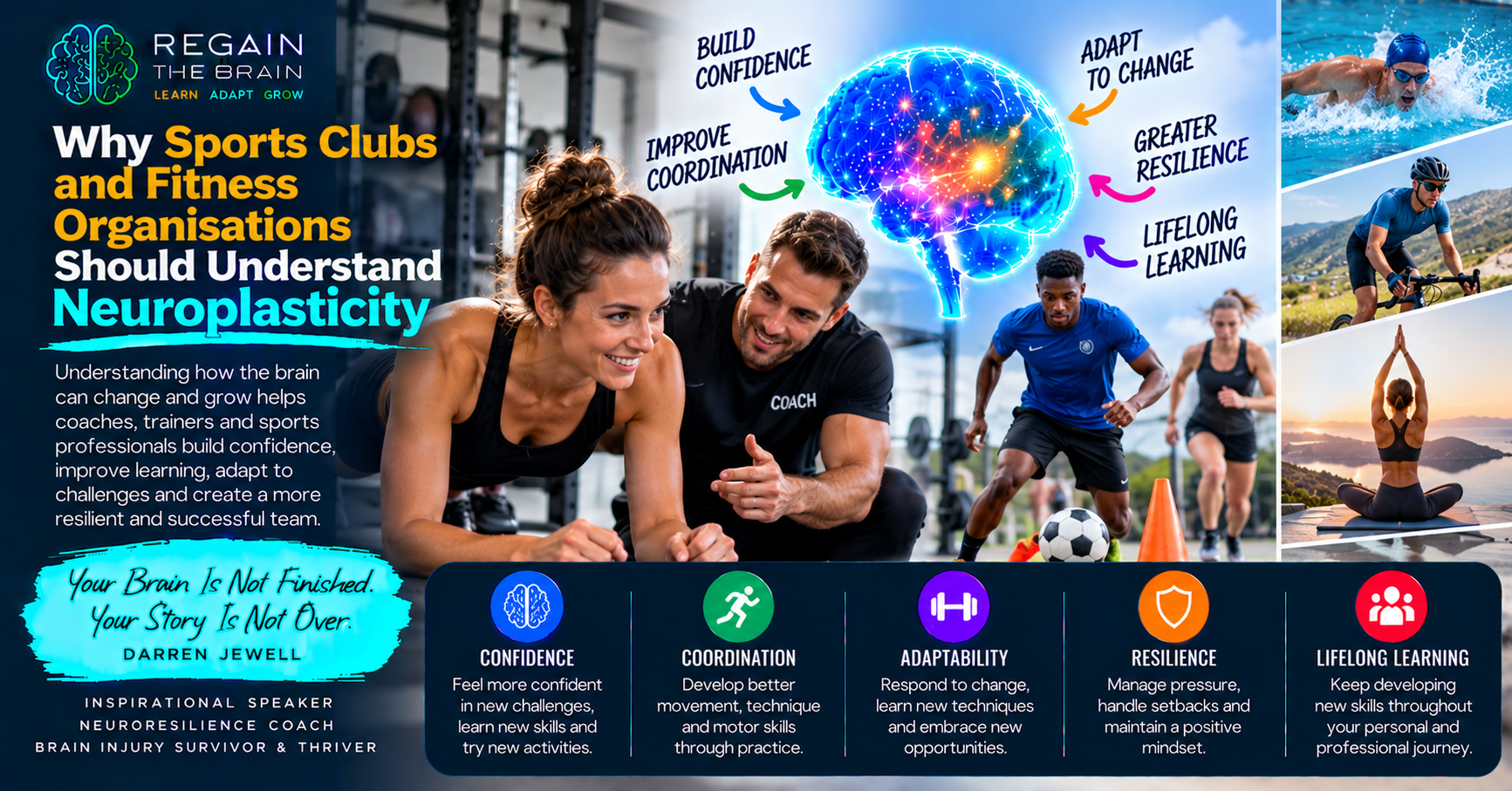
Sports clubs and fitness organisations spend their careers helping people become stronger, develop new skills and achieve goals they once thought were beyond their reach. But how often do they teach their employees, coaches and members about the remarkable ability of the human brain to learn, adapt and change?
When we think about sport and fitness, we naturally think about muscles, strength, stamina, flexibility and physical performance.
But behind every movement, every new technique and every skill we learn is an extraordinary organ.
The human brain.
Whether someone is learning to swim, improving their tennis serve, mastering a new gym exercise or developing better coordination, the brain plays an essential role in learning and controlling movement.
This is where neuroplasticity becomes particularly interesting.
Neuroplasticity describes the brain’s ability to change its connections and patterns of activity in response to learning, experience and other biological processes.
For sports clubs, fitness centres, personal trainers and sports coaches, understanding neuroplasticity can provide a valuable perspective on how people learn physical skills.
But its relevance extends beyond physical performance.
It can also contribute to conversations about confidence, motivation, adaptability, resilience and lifelong learning.
My name is Darren Jewell. I am a London-based inspirational speaker, NeuroResilience Coach, brain injury survivor and passionate advocate for lifelong learning.
My mission is to make neuroplasticity an everyday word.
And I believe sports clubs and fitness organisations have an exciting opportunity to help make that happen.
1. What Is Neuroplasticity and Why Does It Matter in Sport?
Neuroplasticity refers to the brain’s ability to adapt and reorganise aspects of its structure and function in response to experience, learning and other influences.
When we practise a new physical skill, the nervous system is involved in learning how to coordinate the required movements.
Repeated practice, appropriate feedback and experience can contribute to changes in how movements are planned and performed.
Consider someone learning to play tennis.
Initially, they may struggle to coordinate their feet, body position, racket and timing.
The movement may feel awkward.
They may repeatedly miss the ball.
But with appropriate coaching and practice, their movements can become more coordinated and consistent.
This process involves motor learning and changes in the nervous system.
The same principles are relevant to swimming, football, golf, dancing, gymnastics and many other physical activities.
However, neuroplasticity does not guarantee that everyone will achieve the same level of performance.
Individual abilities, health, training quality and physical circumstances all influence outcomes.
For sports coaches and fitness instructors, understanding neuroplasticity can complement established approaches to motor learning and skill development.
2. Why Sports Coaches Should Understand Neuroplasticity
Sports coaching involves much more than demonstrating techniques.
Coaches help people acquire unfamiliar skills, improve existing movements and develop confidence.
A football coach may teach a young player how to control the ball.
A swimming instructor may help an adult overcome uncertainty in the water.
A tennis coach may help someone improve their serving technique.
A personal trainer may introduce a client to unfamiliar exercises.
Each of these activities involves learning.
Understanding neuroplasticity can help coaches appreciate why appropriate repetition, feedback and progressive challenges are important.
However, learning is not simply a matter of repeating the same movement indefinitely.
Effective coaching also requires appropriate instruction, rest, individualisation and attention to physical safety.
For sports organisations, neuroplasticity education for sports coaches can complement existing coaching qualifications and professional development programmes.
A good coach does more than teach a movement. They help someone discover what they may be capable of learning.
3. The Connection Between Physical Activity and Brain Health
Physical activity is associated with a range of benefits for physical and mental health.
Research suggests that regular exercise can support aspects of cognitive function and overall brain health.
Aerobic exercise, resistance training and activities requiring coordination may engage different physiological and cognitive processes.
Exercise can also influence sleep, mood and cardiovascular health, which are relevant to healthy brain function.
However, not every type of exercise produces the same effects, and benefits vary between individuals.
It would be misleading to suggest that a particular fitness programme can guarantee increased intelligence, prevent dementia or reverse neurological conditions.
For gyms and fitness centres, understanding the relationship between physical activity and brain health can provide an additional educational perspective.
It can help members appreciate that movement is not only about appearance or physical performance.
Looking after our bodies can also be an important part of looking after our brains.
4. Why Learning New Physical Skills Matters
There is a difference between repeating a familiar activity and learning an unfamiliar skill.
Both can have value.
But learning something new often requires additional attention, problem-solving and coordination.
Consider an experienced runner who decides to learn ballroom dancing.
Or a regular gym member who begins swimming lessons.
Or someone who has played football for years but decides to try table tennis.
These experiences introduce unfamiliar movement patterns and learning challenges.
They can engage motor learning, attention and memory.
For sports clubs and fitness organisations, offering opportunities to learn different activities can encourage curiosity and continued participation.
However, activities should always be adapted to individual abilities, health and safety requirements.
You do not have to become an expert at something new for the experience of learning to be worthwhile.
5. My Personal Journey: From Brain Injury Survivor to Inspirational Speaker
At just 15 months old, I suffered a serious brain injury after falling from a balcony.
I spent three weeks in a coma.
The consequences of that injury affected my physical abilities, coordination, confidence and many aspects of my life.
Growing up, I experienced challenges that other people did not always understand.
I also experienced bullying, which affected my self-belief.
For approximately half a century, confidence was something I struggled to develop.
There were many occasions when I questioned whether I was capable of achieving certain things.
But later in life, I began challenging those assumptions.
At 54, I decided to learn to play the piano.
It was a completely unfamiliar experience.
I had to learn to read music, coordinate my hands, remember sequences and develop new movements.
One of the challenges involved coordinating my hands.
There were moments when the movements felt difficult and frustrating.
But I continued practising.
Gradually, I began noticing progress.
That experience encouraged me to explore the science of neuroplasticity and reconsider some of the beliefs I had held about my own abilities.
My curiosity has since encouraged me to explore writing, music, language learning, technology and the development of digital learning experiences.
Today, I share my journey as an inspirational speaker and NeuroResilience Coach.
I do not claim that learning the piano reversed my childhood brain injury.
What it did was help me appreciate that learning and personal development can remain meaningful throughout life.
Your Brain Is Not Finished. Your Story Is Not Over.
6. Why Confidence Matters in Sport and Fitness
Confidence plays an important role in participation.
Many people avoid sports or fitness activities because they believe they are not naturally athletic.
Some feel uncomfortable entering a gym.
Others worry about being judged.
An adult may avoid swimming lessons because they never learned as a child.
Someone may hesitate to join a fitness class because they believe everyone else will be more capable.
I understand these feelings.
For much of my life, low confidence influenced what I believed I could attempt.
Learning the piano in my fifties helped me reconsider those assumptions.
For sports coaches and fitness professionals, creating supportive environments can help people approach unfamiliar activities.
Confidence may develop through achievable goals, encouragement, appropriate instruction and gradual progress.
However, confidence should never be confused with physical competence or used to encourage unsafe activities.
Sometimes the greatest achievement is not winning a competition. It is finding the confidence to participate.
7. Neuroplasticity and Motor Skill Learning
Motor learning is the process through which people acquire and refine movement skills.
It involves interactions between the brain, spinal cord, sensory systems and muscles.
When someone learns a new movement, they may initially need to concentrate carefully on each part of the task.
With appropriate practice, some aspects of the movement can become more efficient and automatic.
For example, someone learning to ride a bicycle may initially struggle with balance, steering and pedalling.
Over time, these movements may become better coordinated.
This process involves learning-related changes in the nervous system.
For sports coaches, understanding motor learning can help inform decisions about instruction, feedback and practice.
However, neuroplasticity is only one part of the explanation.
Physical conditioning, biomechanics, fatigue, motivation and individual differences also matter.
8. Why Fitness Organisations Should Encourage Lifelong Learning
Many people associate learning with schools, colleges and universities.
But learning does not end when formal education finishes.
Fitness centres and sports clubs provide opportunities for adults to develop unfamiliar skills.
Someone may begin yoga in their forties.
Another person may learn to swim in their fifties.
A retired individual may take up table tennis in their seventies.
These experiences can provide enjoyment, social interaction and opportunities for personal development.
Understanding neuroplasticity can help challenge the misconception that learning new skills is only for younger people.
However, the pace and nature of learning vary, and activities should be adapted to individual needs.
For fitness organisations, promoting lifelong learning can complement existing programmes designed to encourage participation.
Age does not automatically remove our ability to learn something new.
9. Neuroplasticity and Workplace Resilience in Sports Organisations
Sports and fitness professionals can experience considerable workplace pressure.
Coaches may face demanding performance expectations.
Fitness instructors may work irregular hours.
Sports managers may deal with financial uncertainty.
Employees may experience emotionally challenging situations.
Athletes and coaches may also encounter disappointment when results do not meet expectations.
This makes workplace resilience in sports organisations an important subject.
However, resilience should never mean expecting employees to tolerate unreasonable workloads, abusive behaviour or unhealthy working conditions.
Genuine workplace resilience requires supportive leadership, realistic expectations and appropriate wellbeing resources.
Understanding neuroplasticity can contribute to educational conversations about learning and adaptation.
But it is not a substitute for effective management or mental health support.
10. Why Sports Clubs Should Encourage a Growth Mindset
A growth mindset involves recognising that abilities can develop through effective learning strategies, practice, feedback and appropriate support.
This concept is relevant to sports coaching.
A young footballer may initially struggle with ball control.
An adult learning tennis may find serving difficult.
A new gym member may need time to understand unfamiliar exercises.
Coaches can encourage learners to focus on progress, technique and constructive feedback.
However, a growth mindset should not be used to suggest that everyone can achieve elite sporting performance through effort alone.
Physical characteristics, access to training, health and individual circumstances also influence outcomes.
For sports clubs, growth mindset education can complement responsible coaching practices.
Progress is not always about being better than someone else. Sometimes it is about developing a skill you could not perform before.
11. Why Fitness Instructors Should Understand How People Learn
Fitness instructors work with people who have different levels of experience, confidence and physical ability.
Some clients learn movements quickly.
Others require additional explanation, demonstration or practice.
Understanding learning principles can help instructors provide appropriate support.
For example, breaking a complex movement into manageable stages may help some learners.
Others may benefit from clear demonstrations or constructive feedback.
Neuroplasticity provides background knowledge about the brain’s capacity to learn.
However, effective instruction requires more than neuroscience awareness.
Fitness professionals also need appropriate qualifications, knowledge of biomechanics and an understanding of individual needs.
For gyms and fitness centres, neuroplasticity education can complement existing instructor development programmes.
12. Neuroplasticity and Rehabilitation: Understanding the Limits
Neuroplasticity is relevant to some rehabilitation approaches following neurological injury.
Rehabilitation may involve structured practice, therapy and activities designed to support functional improvement.
However, the effects of rehabilitation vary considerably.
Neuroplasticity does not guarantee recovery.
Nor does it mean that someone can overcome every neurological difficulty through exercise or determination.
As someone who has lived with the consequences of a childhood brain injury, I believe it is important to communicate this distinction.
Sports and fitness professionals should not present general exercise programmes as treatments for brain injuries or neurological conditions.
People requiring rehabilitation should receive advice from appropriately qualified healthcare professionals.
Where suitable, adapted physical activities can complement professionally guided rehabilitation and support participation.
13. Why Sports Organisations Should Promote Inclusive Participation
Not everyone approaches sport and fitness with the same abilities or experiences.
Some people live with physical disabilities.
Others experience neurological conditions, sensory differences or challenges affecting coordination.
Some individuals may lack confidence because of previous negative experiences.
Sports organisations can help by creating welcoming and accessible environments.
This may involve adapted activities, appropriate equipment, accessible facilities and suitably trained staff.
Understanding neuroplasticity can contribute to conversations about learning and individual development.
However, inclusion requires practical action rather than motivational messages alone.
Everyone deserves opportunities to participate, learn and enjoy movement in ways that are appropriate for them.
14. Brain Injury Awareness in Sport and Fitness
One subject particularly close to my heart is brain injury awareness.
Brain injuries can affect memory, attention, movement, communication, emotional regulation and other aspects of daily life.
The consequences vary considerably between individuals.
Some difficulties may not be immediately visible.
As someone who has lived with the consequences of a serious childhood brain injury, I understand how easily assumptions can be made about another person’s abilities.
For sports clubs and fitness organisations, brain injury awareness is especially important.
Sports involving contact or potential head impacts require appropriate concussion prevention and management procedures.
Suspected concussion should be assessed and managed according to relevant medical and sporting guidance.
Understanding neuroplasticity must never be used to minimise the seriousness of head injuries.
My personal experience can contribute to conversations about disability awareness, resilience and inclusion.
However, it should complement rather than replace specialist concussion education and medical training.
Protecting the brain must always come before performance.
15. Why Sports Leaders Should Understand Neuroplasticity
Sports club directors, fitness business owners and leisure managers face complex responsibilities.
They must support employees, manage resources, maintain safety standards and respond to changing customer expectations.
Effective leadership requires communication, adaptability and professional judgement.
Understanding neuroplasticity can provide a useful perspective on continuing professional development.
Leaders can develop unfamiliar skills through training, experience and constructive feedback.
However, leadership development requires practical application and organisational support.
For sports organisations, an inspirational presentation about neuroplasticity can encourage reflection on the learning culture leaders create.
Great leaders do not need to know everything. They need to remain willing to learn.
16. Neuroplasticity and Teamwork in Sport
Team sports depend on communication, coordination and cooperation.
Football, rugby, basketball, hockey and many other sports require players to understand their roles and respond to changing situations.
These skills develop through coaching, experience and appropriate practice.
Learning to work effectively with teammates involves communication, attention and decision-making.
Understanding neuroplasticity provides a scientific perspective on learning and adaptation.
However, successful teamwork also depends on trust, clear responsibilities, coaching quality and team culture.
For sports organisations, neuroplasticity awareness can complement existing team development programmes.
17. Why Learning Something New Can Be More Important Than Winning
Sport is often associated with competition.
Winning matches.
Breaking records.
Achieving personal bests.
These achievements can be rewarding.
But there is another side to sport that deserves attention.
Learning.
A child who learns to ride a bicycle has achieved something meaningful.
An adult who completes their first swimming lesson has taken an important step.
Someone who joins a fitness class despite lacking confidence may have overcome a significant personal barrier.
Not every achievement needs a medal.
Not every improvement needs a trophy.
Sometimes the value lies in the experience itself.
This is a message I believe sports clubs and fitness organisations can share with people of every age.
The courage to begin can be just as meaningful as the ability to succeed.
18. Why Sports Clubs Should Promote Brain Health Education
Sports clubs and fitness organisations are well placed to encourage conversations about healthy lifestyles.
They already educate people about physical activity, nutrition, recovery and exercise.
Introducing accessible information about brain health and neuroplasticity could complement these discussions.
For example, organisations could encourage members to explore unfamiliar activities, develop new skills and remain physically active within their abilities.
However, brain health education should be evidence-based.
It should not promise that particular exercises will prevent dementia, cure neurological conditions or produce guaranteed cognitive improvements.
For sports organisations, neuroplasticity awareness can provide an additional educational perspective while supporting realistic expectations.
19. Why Book an Inspirational Speaker for a Sports or Fitness Event?
Sports clubs and fitness organisations regularly organise conferences, coaching development days, leadership meetings, employee wellbeing events and community programmes.
These events provide opportunities to introduce fresh perspectives and encourage reflection.
An inspirational speaker can offer something different through authentic personal experience.
My presentations combine storytelling with accessible explanations of neuroplasticity, resilience, confidence and lifelong learning.
I aim to entertain, educate and inform while encouraging audiences to reflect on their own experiences.
Speaking topics can include:
- Neuroplasticity and the science of lifelong learning
- Building confidence through learning new skills
- Growth mindset in sport and fitness
- Workplace resilience for sports professionals
- Brain injury awareness and invisible disabilities
- Motor learning and the importance of practice
- Supporting beginners in sport and fitness
- Leadership development in sports organisations
- Inclusive participation and personal development
- Learning new skills later in life
Presentations can be adapted to the objectives of individual sports clubs, fitness businesses and leisure organisations.
They are designed to complement existing coaching education, employee development and wellbeing programmes.
20. What Could Sports and Fitness Professionals Take Away?
My aim is not simply to deliver a motivational presentation that is forgotten when the event finishes.
I want audiences to leave with questions worth exploring.
For example:
How can I encourage someone who believes they are not naturally athletic?
What assumptions have I made about my own abilities?
How can I create an environment where beginners feel welcome?
What new physical or mental skill could I explore?
How can I support people who learn at different speeds?
Could I approach unfamiliar challenges with greater curiosity?
These questions can encourage reflection on confidence, learning, inclusion and personal development.
21. Why Choose Darren Jewell as Your Inspirational Speaker?
There are many motivational speakers available for sports conferences and fitness industry events across the UK.
My approach is shaped by lived experience.
I understand what it means to face challenges that other people may not recognise.
I understand the impact that low confidence can have on someone’s life.
And I understand the satisfaction of discovering new abilities later in life.
My journey from childhood brain injury survivor to inspirational speaker and NeuroResilience Coach has strengthened my passion for helping people understand neuroplasticity.
I do not promise that one presentation will transform a sports club or guarantee improved athletic performance, employee wellbeing or business results.
Instead, I aim to introduce ideas that encourage curiosity, reflection and meaningful conversations about learning.
My mission is to make neuroplasticity an everyday word.
And I believe sports clubs and fitness organisations can play an important role in helping people appreciate the value of continued development.
22. Book Darren Jewell for Your Next Sports or Fitness Industry Event
Are you a sports club director, fitness business owner, gym manager, sports coach, HR professional, Learning & Development manager or sports conference organiser looking for an inspirational speaker for sports clubs and fitness organisations?
I would welcome the opportunity to discuss how my presentations could complement your organisation’s coaching development, employee wellbeing and lifelong learning objectives.
Whether you are organising a sports industry conference, fitness leadership event, coaching development day or community wellbeing programme, my aim is to deliver a presentation that encourages people to think differently about learning, resilience and personal growth.
Because the people who spend their careers helping others develop physical abilities deserve opportunities to understand the remarkable learning potential of the human brain.
Your Brain Is Not Finished. Your Story Is Not Over.
Darren Jewell
Inspirational Speaker | NeuroResilience Coach | Brain Injury Survivor & Thriver
Visit www.regainthebrain.com to enquire about booking an inspirational speaker for your sports club, fitness organisation or leisure industry event.
#NeuroplasticityInSport #SportsCoachDevelopment #FitnessIndustryTraining #BrainHealthAndExercise #SportsClubWellbeing #WorkplaceResilience #InspirationalSpeakerForSports #FitnessConferenceSpeaker #LifelongLearning #DarrenJewell #RegainTheBrain