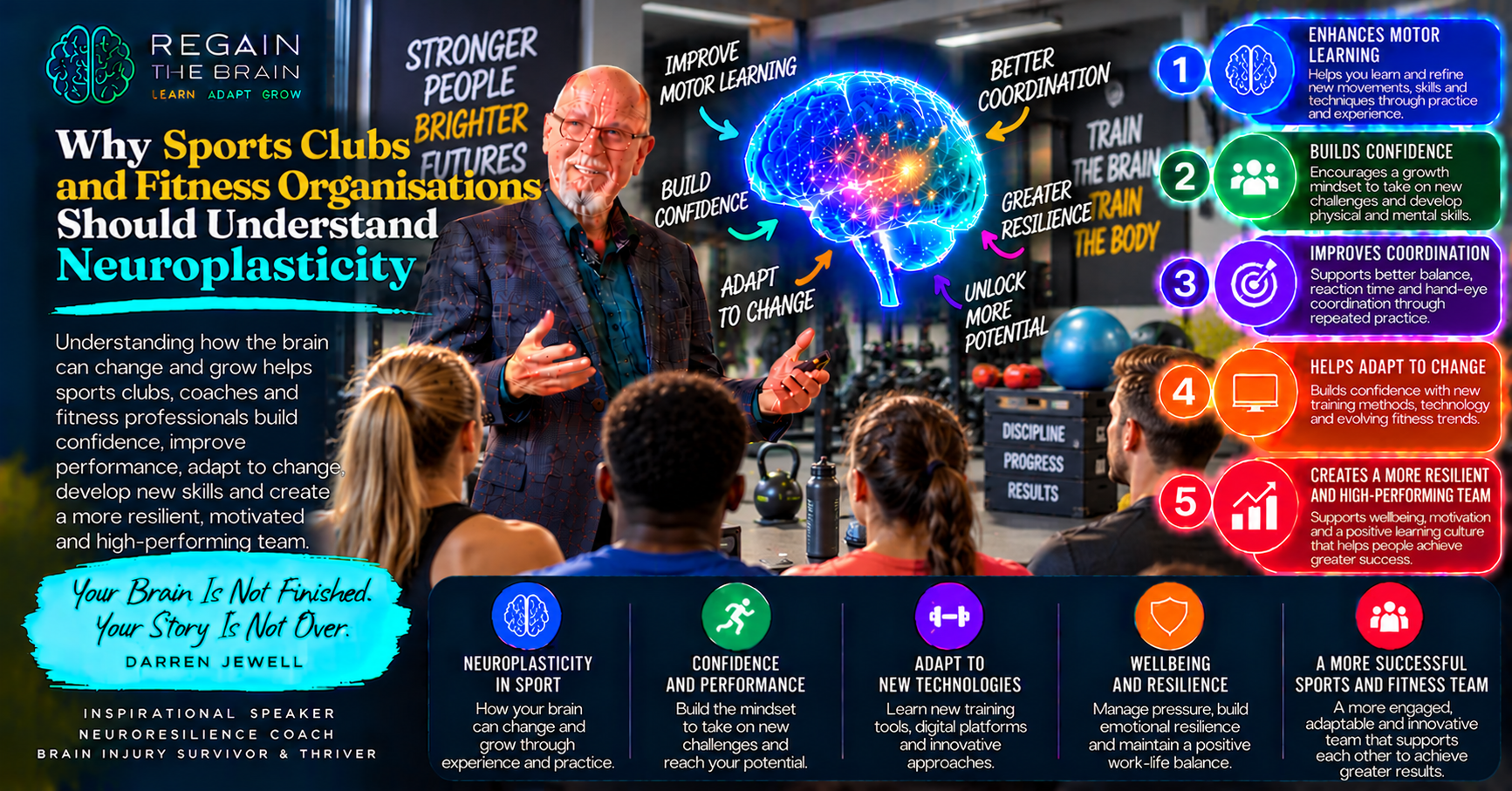
When we think about improving sporting performance, we usually think about training our muscles, developing strength, improving endurance and practising technique. But what about training the brain?
Every movement we make involves the nervous system.
Whether someone is learning to swim, improving their tennis serve, developing balance, practising martial arts or mastering a new exercise routine, the brain plays an essential role.
Yet many people involved in sport and fitness may not fully appreciate how learning and experience can influence the brain throughout life.
This is where neuroplasticity becomes particularly interesting.
Sports clubs, gyms, fitness organisations and coaching professionals spend their careers helping people develop physical abilities.
But understanding the brain’s capacity to adapt could add another dimension to conversations about coaching, learning, confidence and personal development.
My name is Darren Jewell. I am a London-based inspirational speaker, NeuroResilience Coach, brain injury survivor and lifelong learning advocate.
Having lived with the consequences of a serious childhood brain injury, I have developed a personal appreciation of the challenges involved in movement, coordination and learning new physical skills.
Today, I share my experiences to encourage people to explore the science of neuroplasticity and recognise the value of lifelong learning.
My mission is to make neuroplasticity an everyday word.
And I believe the sports and fitness industry is an excellent place to continue that conversation.
1. What Is Neuroplasticity and Why Does It Matter in Sport?
Neuroplasticity is the brain’s ability to change its connections and patterns of activity in response to learning, experience and other biological processes.
When we practise a movement or learn a new physical skill, our nervous system participates in processes associated with motor learning.
Over time, training can influence how movements are planned, coordinated and performed.
This is relevant to almost every sporting activity.
A beginner learning to play tennis must develop hand-eye coordination.
A footballer practising passing techniques must coordinate visual information with movement.
A swimmer learning a new stroke must develop timing, balance and control.
A person beginning Tai Chi must learn sequences of movements while maintaining posture and coordination.
These activities involve complex interactions between the brain, spinal cord, nerves, muscles and sensory systems.
Understanding neuroplasticity provides a useful scientific perspective on how physical skills develop.
However, neuroplasticity does not mean that every physical limitation can be overcome through practice.
Learning and performance also depend on health, individual abilities, physical conditioning, coaching and appropriate support.
For sports clubs and fitness organisations, understanding neuroplasticity can complement existing approaches to training and development.
2. Why Sports Coaches Should Understand the Brain
Sports coaches spend considerable time teaching people new skills.
They demonstrate techniques, observe performance, provide feedback and encourage athletes to practise.
But learning a physical skill involves more than strengthening muscles.
It also involves developing coordination, timing, attention and the ability to respond to information.
Understanding motor learning and neuroplasticity can help coaches appreciate why structured practice, feedback and appropriate progression matter.
For example, a beginner learning a golf swing may initially struggle to coordinate the different movements involved.
A basketball player may need repeated practice to develop a new shooting technique.
A gymnast may require carefully supervised training to learn a complex movement safely.
Coaches can support learning through clear instruction, appropriate feedback and opportunities to practise.
However, simply knowing about neuroplasticity does not automatically make someone a better coach.
Effective coaching also requires technical expertise, safeguarding knowledge, communication skills and an understanding of individual needs.
For sports organisations, neuroplasticity education for sports coaches could complement existing coaching development programmes.
3. Neuroplasticity and Learning New Sporting Skills
Have you ever watched someone attempt a new sporting activity for the first time?
Their movements may initially appear awkward.
They might struggle with timing, balance or coordination.
But with appropriate instruction and practice, many people gradually improve.
This process involves motor learning.
The nervous system adapts as people gain experience with unfamiliar movements.
For example, someone learning to ride a bicycle must coordinate balance, steering and pedalling.
A beginner learning badminton must develop timing and hand-eye coordination.
A person learning a dance routine must remember sequences while coordinating movements.
These experiences demonstrate how complex learning can be.
Understanding neuroplasticity can encourage people to appreciate the value of gradual progress.
Being a beginner does not mean you lack potential. It means you are at the beginning of learning something unfamiliar.
4. My Personal Journey: From Brain Injury Survivor to Inspirational Speaker
At just 15 months old, I suffered a serious brain injury after falling from a balcony.
I spent three weeks in a coma.
The consequences of that injury affected my physical abilities, coordination, confidence and many aspects of my life.
Growing up, I experienced challenges that other people did not always understand.
I also experienced bullying, which affected how I viewed myself.
For approximately half a century, confidence was something I struggled to develop.
There were many occasions when I questioned whether I was capable of achieving certain things.
But later in life, I began challenging those assumptions.
At 54, I decided to learn to play the piano.
Although playing the piano is not a sport, it requires coordination, timing, concentration, memory and controlled movement.
Learning to coordinate my hands was particularly meaningful because of the physical challenges I had experienced following my brain injury.
There were moments when progress seemed frustratingly slow.
But I continued learning.
That experience encouraged me to explore the science of neuroplasticity and helped me reconsider some of the beliefs I had held about my own abilities.
I have also explored activities such as Tai Chi, Qigong, walking, running and physical exercises.
These experiences have reinforced my appreciation of movement, learning and personal development.
Today, I share my story as an inspirational speaker and NeuroResilience Coach.
My message is not that everyone can overcome every physical limitation through determination.
It is that people deserve opportunities to explore their abilities with appropriate support and realistic expectations.
Your Brain Is Not Finished. Your Story Is Not Over.
5. Why Confidence Matters in Sport and Fitness
Confidence can influence how people approach sporting activities.
A beginner entering a gym for the first time may feel intimidated.
Someone returning to exercise after a long break may question their abilities.
A young athlete may worry about making mistakes in front of teammates.
An experienced sportsperson may lose confidence following a disappointing performance.
These experiences can affect motivation and participation.
I understand what it feels like to question your own abilities.
For much of my life, confidence was something I struggled to develop.
Learning unfamiliar skills later in life helped me appreciate that confidence can sometimes develop through experience and gradual progress.
Understanding neuroplasticity can contribute to conversations about learning and skill development.
However, confidence also depends on supportive relationships, appropriate coaching and opportunities to succeed.
Confidence does not always come before we try something new. Sometimes it develops because we were willing to begin.
6. Neuroplasticity, Balance and Coordination
Balance and coordination are important in many sporting activities.
They involve the integration of information from the visual, vestibular and somatosensory systems, together with the control of muscles and movement.
Activities such as Tai Chi, dance, gymnastics and certain forms of exercise can challenge these systems.
With suitable practice, people may improve specific balance and coordination skills.
For me, balance and coordination have particular personal significance because of my childhood brain injury.
Exploring movement-based activities has helped me appreciate the importance of patience and appropriate progression.
However, balance difficulties can have many causes.
Anyone experiencing unexplained balance problems, dizziness or neurological symptoms should seek appropriate medical advice.
For sports clubs and fitness organisations, understanding the relationship between the brain and movement can encourage more informed conversations about training and individual differences.
7. Why Repetition and Practice Matter in Sport
Athletes often spend hours practising particular movements.
A tennis player may practise serving.
A footballer may repeat passing drills.
A golfer may work on putting technique.
A swimmer may practise turns and starts.
Repetition provides opportunities to refine skills, particularly when practice includes appropriate feedback and progression.
Motor learning research also highlights the importance of practice quality, variation and rest.
Simply repeating an incorrect movement indefinitely is not necessarily effective.
For coaches, understanding how skills develop can encourage more thoughtful approaches to training.
Practice matters, but the way we practise matters too.
8. Building Resilience in Sports Teams
Sport involves challenges.
Athletes experience defeats, injuries, selection disappointments and periods when performance does not meet expectations.
Coaches and support staff may face pressure to achieve results.
These experiences make resilience an important subject in sport.
However, resilience should never mean encouraging athletes to ignore injuries, suppress emotional difficulties or train beyond safe limits.
Genuine resilience involves appropriate support, realistic expectations, recovery and constructive approaches to setbacks.
Neuroplasticity can contribute to educational conversations about learning and adaptation.
But it is not a substitute for sports psychology, medical care or appropriate coaching.
For sports clubs organising team development days, an inspirational presentation can encourage reflection on confidence, perseverance and personal development.
9. Neuroplasticity and Injury Rehabilitation
Injury rehabilitation is an important part of sport.
Some injuries involve the nervous system, while others affect muscles, joints, bones or connective tissues.
Recovery processes vary considerably according to the injury and individual circumstances.
Neuroplasticity can play an important role in certain forms of neurological rehabilitation, including aspects of recovery following stroke or brain injury.
Motor learning principles may also inform rehabilitation programmes.
However, not every injury involves the same neurological processes, and recovery cannot be guaranteed.
Rehabilitation should be guided by appropriately qualified healthcare professionals.
As someone who has lived with the consequences of a serious brain injury, I understand the importance of recognising individual differences.
My presentations share lived experience and accessible neuroscience education.
They do not replace medical advice, physiotherapy or specialist rehabilitation.
10. Why Personal Trainers Should Understand Neuroplasticity
Personal trainers regularly help clients learn unfamiliar exercises.
A client may need to develop correct lifting techniques.
Someone beginning resistance training may need time to learn movement patterns.
An older adult may be exploring appropriate exercises to maintain strength and mobility.
These activities involve learning as well as physical conditioning.
Understanding neuroplasticity and motor learning can provide useful background knowledge for fitness professionals.
However, effective personal training also requires exercise science, appropriate qualifications, risk assessment and an understanding of individual health needs.
For gym owners and fitness managers, introducing neuroplasticity awareness into fitness staff development could complement existing professional training.
11. Why Older Adults Should Be Encouraged to Keep Learning Physical Skills
One of the messages I am particularly passionate about is that learning does not have an expiry date.
Many people assume that certain activities are only suitable for younger individuals.
They may believe they are too old to learn a new sport, develop coordination or begin an unfamiliar physical activity.
But adults can continue learning motor skills later in life.
The speed and nature of learning may change with age, and physical limitations must be considered.
However, age alone does not mean that learning must stop.
Appropriate activities may include swimming, dance, Tai Chi, walking programmes or other forms of supervised exercise.
For older adults, the choice of activity should reflect their interests, health and abilities.
When I began learning the piano at 54, I discovered how rewarding it could be to become a beginner again.
I believe the same spirit of curiosity can be encouraged within sport and fitness.
You may not be able to do everything you once did, but that does not mean there is nothing new you can learn.
12. Neuroplasticity and Teamwork in Sport
Team sports require communication, coordination and the ability to respond to changing situations.
Footballers must understand positioning and anticipate movement.
Basketball players must coordinate offensive and defensive strategies.
Rugby players must communicate and make decisions under pressure.
These skills develop through coaching, experience and practice.
Understanding neuroplasticity provides background knowledge about learning and adaptation.
However, successful teamwork also depends on trust, communication, leadership and shared understanding.
For sports clubs, neuroplasticity education can complement wider conversations about team development and continuous learning.
13. Supporting Coaches and Fitness Professionals Through Technological Change
Technology is changing the sports and fitness industry.
Wearable devices, digital training platforms, performance analysis software and artificial intelligence are creating new opportunities.
Coaches and fitness professionals may need to learn unfamiliar systems.
Some will welcome these developments.
Others may feel uncertain about their ability to adapt.
Understanding neuroplasticity can help challenge the assumption that experienced professionals are incapable of learning new technology.
However, successful digital transformation requires appropriate training, accessible systems and responsible use of personal data.
For sports organisations, neuroplasticity awareness can complement professional development by encouraging curiosity and continued learning.
14. Why Lifelong Learning Matters Beyond Sporting Performance
Sport and fitness are not only about competition or physical appearance.
They can also provide opportunities for enjoyment, social connection and personal development.
Learning a new physical activity can introduce people to unfamiliar experiences.
But lifelong learning can extend beyond movement.
It may involve music, languages, creative activities or technology.
When I began learning the piano in my fifties, I was not trying to become a professional musician.
I simply wanted to learn something new.
That decision became an important part of my personal development.
It reminded me that curiosity and learning can remain valuable throughout life.
For athletes, coaches and fitness professionals, this message extends beyond sporting achievement.
You can stop competing professionally without stopping learning.
15. Why Book an Inspirational Speaker for a Sports Club or Fitness Event?
Sports clubs and fitness organisations regularly organise coaching conferences, team development days, staff wellbeing events, leadership meetings and member engagement programmes.
These events provide opportunities to introduce new perspectives and encourage reflection.
An inspirational speaker can offer something different through authentic personal experience.
My presentations combine storytelling with accessible explanations of neuroplasticity, resilience, confidence and lifelong learning.
I aim to entertain, educate and inform while encouraging audiences to reflect on their own experiences.
Speaking topics can include:
- Neuroplasticity and motor learning
- Confidence and learning new physical skills
- Resilience in sport and fitness
- The relationship between the brain and movement
- Balance, coordination and personal development
- Brain injury awareness and invisible disabilities
- Lifelong learning and active ageing
- Growth mindset in sports coaching
- Supporting athletes through setbacks
- Learning unfamiliar skills later in life
Presentations can be adapted to the objectives of individual sports organisations.
They are designed to complement existing coaching education, professional development and wellbeing programmes.
16. What Could Sports and Fitness Professionals Take Away?
My aim is not simply to deliver a motivational presentation that is forgotten when the event finishes.
I want audiences to leave with questions worth exploring.
For example:
What new physical skill have I avoided because I believe I am too old or incapable of learning it?
How do I respond when progress is slower than expected?
What assumptions have I made about my own abilities?
Could I approach unfamiliar activities with greater curiosity?
How could I support someone who is struggling to learn a new movement?
What would I enjoy learning outside my usual sporting activities?
These questions can encourage reflection on confidence, learning and personal development.
17. Why Choose Darren Jewell as Your Inspirational Speaker?
There are many motivational speakers available for sports conferences and fitness events across the UK.
My approach is shaped by lived experience.
I understand what it means to face physical challenges that other people may not recognise.
I understand the impact that low confidence can have on someone’s life.
And I understand the satisfaction of discovering new abilities later in life.
My journey from childhood brain injury survivor to inspirational speaker and NeuroResilience Coach has strengthened my passion for helping people understand neuroplasticity.
I do not promise that one presentation will improve athletic performance or guarantee sporting success.
Instead, I aim to introduce ideas that encourage curiosity, reflection and meaningful conversations about learning.
My mission is to make neuroplasticity an everyday word.
And I believe sports clubs and fitness organisations can play an important role in helping people appreciate the value of continued learning.
18. Book Darren Jewell for Your Next Sports or Fitness Industry Event
Are you a sports club director, gym owner, fitness manager, sports coach, HR professional or conference organiser looking for an inspirational speaker for sports teams and fitness professionals?
I would welcome the opportunity to discuss how my presentations could complement your organisation’s coaching development, employee wellbeing and lifelong learning objectives.
Whether you are organising a sports conference, fitness industry event, team development day, coaching seminar or workplace wellbeing session, my aim is to deliver a presentation that encourages people to think differently about learning, resilience and personal growth.
Because the people who spend their careers training bodies deserve opportunities to understand the remarkable learning potential of the brain.
Your Brain Is Not Finished. Your Story Is Not Over.
Darren Jewell
Inspirational Speaker | NeuroResilience Coach | Brain Injury Survivor & Thriver
Visit www.regainthebrain.com to enquire about booking an inspirational speaker for your sports club, fitness organisation or coaching event.
#NeuroplasticityInSport #SportsCoachingDevelopment #BrainAndMovement #FitnessStaffTraining #SportsTeamResilience #MotorLearning #InspirationalSpeakerForSports #SportsConferenceSpeaker #ActiveAgeing #LifelongLearning #DarrenJewell #RegainTheBrain