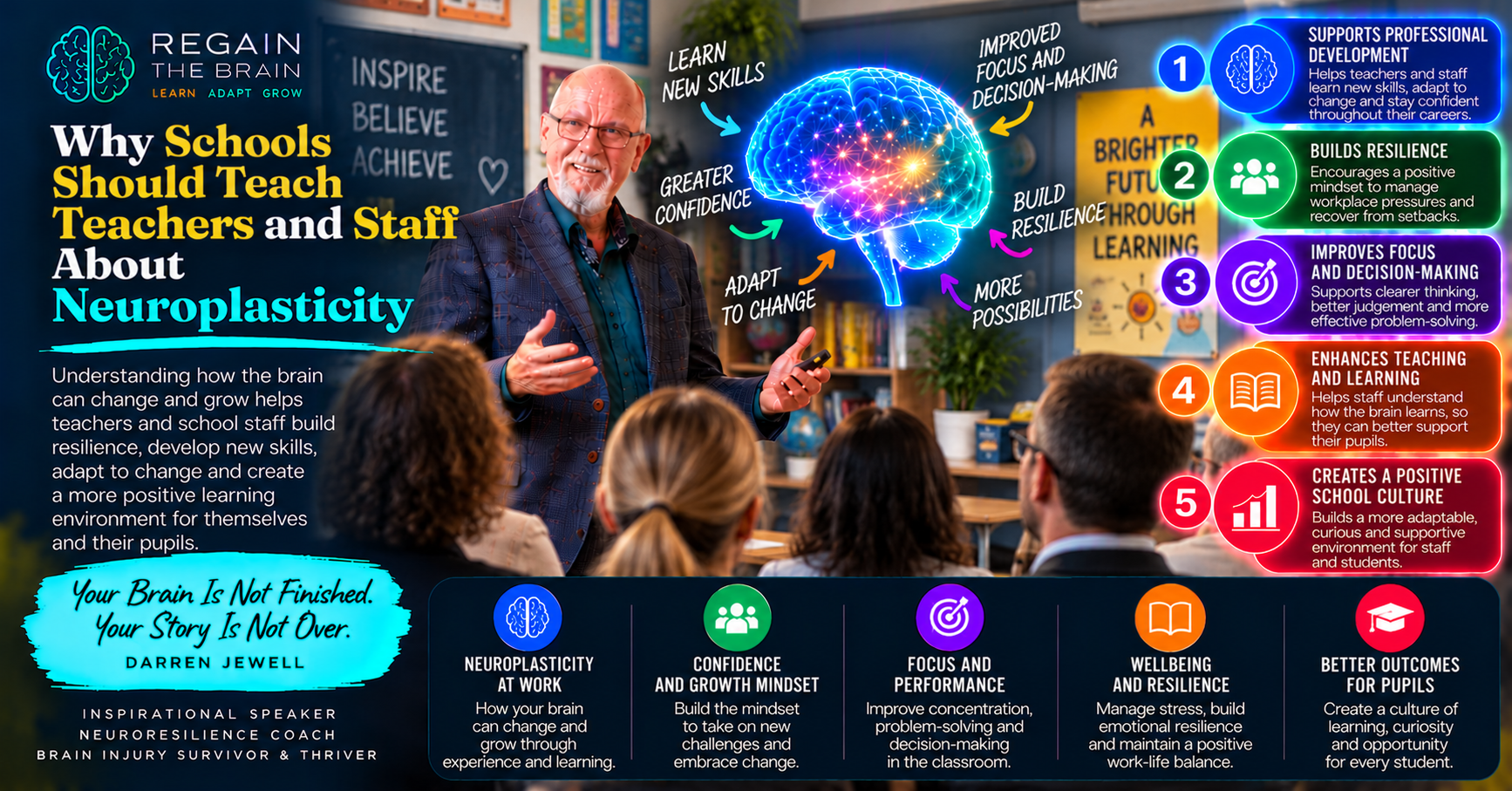
What if one of the most valuable professional development opportunities a school could offer its teachers and staff was a better understanding of how their own brains learn, adapt and change?
Every day, teachers encourage children to learn something new, overcome difficulties, develop confidence and discover abilities they may not have realised they possessed.
But how often are teachers themselves given the opportunity to explore the science behind learning?
How often do school leaders introduce their staff to neuroplasticity, the brain’s remarkable ability to adapt and change throughout life?
My name is Darren Jewell. I am a London-based inspirational speaker, NeuroResilience Coach, brain injury survivor and passionate advocate for lifelong learning.
I believe neuroplasticity in education deserves greater attention, not only in the classroom but also in teacher training, school staff development and leadership programmes.
Understanding how the brain learns could change the way educators think about their own professional growth, the challenges their pupils face and the importance of remaining curious throughout their careers.
1. What Is Neuroplasticity and Why Does It Matter in Education?
Neuroplasticity is the brain’s ability to change its connections and patterns of activity in response to learning, experience and other biological processes.
For many years, scientists believed that the adult brain was considerably less adaptable than we now understand it to be.
Research has demonstrated that the brain retains the capacity for plasticity throughout life, although the nature and extent of that plasticity vary with age, health, experience and individual circumstances.
For teachers, this is an important concept.
Every time we learn an unfamiliar skill, practise retrieving information or develop a different approach to solving a problem, we engage processes involving learning and memory.
Neuroplasticity helps explain how experience can influence the brain.
However, understanding neuroplasticity does not mean that everyone learns at the same speed or that effort alone can overcome every learning difficulty.
Effective teaching, appropriate support, feedback and individual circumstances all matter.
The important message for educators is that learning is a lifelong process, not something that ends when formal education finishes.
2. Supporting Teacher Professional Development Through Neuroplasticity
Teachers are expected to continue developing throughout their careers.
New educational technologies, changes to the curriculum, safeguarding requirements and evolving teaching approaches all create demands for professional learning.
Yet experienced teachers may sometimes feel uncertain about adapting to unfamiliar systems or methods.
Understanding neuroplasticity can help challenge the assumption that learning new skills becomes impossible as we grow older.
It can also encourage teachers to recognise the importance of deliberate practice, constructive feedback and continued professional development.
For school leaders planning teacher CPD sessions, INSET days or staff training events, neuroplasticity provides an engaging subject that connects neuroscience with everyday educational practice.
An introduction to the science of learning can encourage teachers to reflect on their own development while reinforcing the importance of evidence-informed teaching.
3. Encouraging a Growth Mindset Among Teachers and School Staff
Growth mindset is a familiar concept in many schools.
It encourages people to recognise that abilities can develop through learning, effective strategies, feedback and appropriate support.
However, growth mindset should not be reduced to telling someone to try harder.
Teachers and pupils need suitable resources, guidance and realistic opportunities to improve.
Understanding neuroplasticity can provide a useful scientific perspective on why learning and experience matter.
Consider a teacher who has always felt uncomfortable using technology.
They may believe they are simply not a technical person.
But with effective training, time and opportunities to practise, they may gradually develop greater competence and confidence.
A similar principle applies to public speaking, leadership, communication and many other professional skills.
For school leaders, encouraging a growth mindset in education begins with creating an environment where staff feel supported to learn.
4. Building Teacher Resilience Without Ignoring Workplace Pressures
Teaching can be an enormously rewarding profession.
It can also be demanding.
Workload pressures, challenging situations, changing expectations and the emotional responsibilities of supporting pupils can affect staff wellbeing.
This is why teacher resilience and school staff wellbeing deserve serious attention.
However, resilience should never mean expecting teachers to tolerate unreasonable workloads or ignore their own mental health.
Genuine resilience involves recognising challenges, accessing support, developing appropriate coping strategies and working within healthy organisational environments.
Neuroplasticity can contribute to discussions about learning, adaptation and developing skills.
But understanding brain science is not a substitute for manageable workloads, supportive leadership or professional wellbeing services.
As an inspirational speaker on resilience and neuroplasticity, I encourage audiences to explore personal development while recognising the importance of the support available around them.
5. Why My Personal Brain Injury Story Is Relevant to Teachers
At just 15 months old, I suffered a serious brain injury after falling from a balcony.
I spent three weeks in a coma.
The consequences of that injury affected my physical abilities, confidence and experiences throughout childhood and adulthood.
Growing up, I faced difficulties that sometimes made me feel different from other children.
I also experienced bullying.
For approximately half a century, I struggled with confidence and questioned my own abilities.
Looking back, I often wonder how differently I might have viewed myself if I had understood more about the brain’s capacity for learning and adaptation.
I cannot know whether that knowledge would have changed my childhood experiences.
But I do know that understanding neuroplasticity has changed the way I think about learning today.
In my fifties, I decided to learn to play the piano.
It was not easy.
Learning to read music, coordinate my hands, remember sequences and develop unfamiliar movements required patience and repeated practice.
There were moments of frustration and occasions when progress felt painfully slow.
But I continued learning.
That experience encouraged me to explore neuroscience more deeply and strengthened my belief in the value of becoming a beginner again.
Today, I share my experiences to encourage educators to consider the influence their words, expectations and support can have on a young person’s confidence.
A child who struggles today should not automatically be made to feel that their future abilities have already been decided.
6. Helping Teachers Understand Learning Differences and Invisible Disabilities
Every classroom contains pupils with different strengths, needs and experiences.
Some children learn quickly in particular subjects while requiring additional support in others.
Others may live with neurological conditions, disabilities or difficulties that are not immediately visible.
My experience of growing up with a brain injury has given me a personal perspective on the importance of understanding individual differences.
Teaching staff benefit from recognising that learning is not identical for everyone.
Neuroplasticity can contribute to this understanding, but it must not be used to suggest that neurological differences can simply be trained away.
For SENCOs, inclusion leads and school leadership teams, conversations about brain injury and neuroplasticity can complement wider professional development around disability awareness and inclusive education.
The goal is to encourage empathy, informed expectations and appropriate support.
7. Why School Leaders Should Encourage Lifelong Learning
Teachers spend their professional lives encouraging other people to learn.
But educators also deserve opportunities to develop interests and abilities beyond their existing expertise.
Learning a musical instrument, studying a language, exploring technology or developing creative skills can provide rewarding experiences.
In my own life, beginning piano lessons in my fifties became much more than learning music.
It reminded me of the importance of curiosity, persistence and being willing to make mistakes.
I believe this is a valuable message for teachers.
When educators remain curious about their own learning, they can bring personal experience of being a beginner into their conversations with pupils.
They understand the frustration of unfamiliar tasks, the importance of encouragement and the satisfaction of gradual progress.
Teachers do not have to know everything. They can continue discovering new things alongside the people they teach.
8. Neuroplasticity and Educational Leadership
Headteachers and senior leadership teams play an important role in shaping school culture.
A positive learning environment is not only about what happens in classrooms.
It is also about how staff are supported, how professional development is approached and how mistakes are handled.
School leaders who encourage continuous learning can help create an environment where employees feel able to ask questions and develop new skills.
Understanding neuroplasticity can contribute to leadership discussions about adaptability, professional growth and learning throughout a career.
However, creating a strong learning culture requires practical action.
Staff need time, resources, feedback and psychological safety, not simply motivational messages.
For headteachers and academy trust leaders, an inspirational presentation about neuroplasticity can introduce useful conversations that complement wider school improvement initiatives.
9. Why Book a Neuroplasticity Speaker for a School INSET Day?
INSET days and professional development events provide opportunities for school staff to step away from their everyday routines and explore new ideas.
An inspirational speaker can introduce a different perspective through authentic personal experience.
My presentations combine storytelling with accessible explanations of neuroplasticity, resilience and lifelong learning.
I aim to entertain, educate and inform while encouraging audiences to reflect on their own experiences.
Topics can include:
- Understanding neuroplasticity and the science of learning
- Building confidence and a growth mindset
- Teacher resilience and staff wellbeing
- Brain injury awareness and invisible disabilities
- Supporting a positive school learning culture
- Lifelong learning and professional development
- Adapting to change and developing new skills
- Why being a beginner again can be valuable
These presentations can be adapted to the objectives and needs of individual schools.
They are intended to complement evidence-informed professional development rather than replace specialist teacher training.
10. What Could Teachers Take Away From My Presentation?
When a school books an inspirational speaker, the experience should offer more than a moment of motivation.
I want teachers and school staff to leave with ideas they can reflect on and explore.
My presentations encourage audiences to consider:
Their own learning: What new skill have they avoided because they believe they are incapable of developing it?
Their confidence: How might preparation, practice and appropriate support help them approach unfamiliar challenges?
Their pupils: How can they encourage realistic confidence without overlooking individual learning needs?
Their colleagues: How can they contribute to a school culture where people feel comfortable asking questions and learning from mistakes?
Their future: What might they still enjoy learning, regardless of their age or experience?
Sometimes, one question can encourage someone to think differently about their possibilities.
11. Why Choose Darren Jewell as Your Inspirational School Speaker?
There are many motivational speakers available for schools in London and across the UK.
What makes my approach personal is that I speak from lived experience.
I understand what it feels like to struggle with confidence.
I understand what it means to face challenges that other people may not fully recognise.
And I understand the satisfaction of discovering new abilities later in life.
My journey from childhood brain injury survivor to inspirational speaker and NeuroResilience Coach has shaped my passion for learning.
I do not promise that neuroplasticity can overcome every challenge.
Instead, I encourage audiences to recognise the possibilities that continued learning, effective support and curiosity can create.
My mission is to make neuroplasticity an everyday word.
And I believe teachers and school staff have an important role to play in helping that happen.
12. Book Darren Jewell for Your Next School Staff Development Event
Are you a headteacher, deputy headteacher, academy trust leader, SENCO or school professional development coordinator looking for an inspirational speaker for teachers or a school INSET day?
I would welcome the opportunity to discuss how my personal story and presentations about neuroplasticity, resilience, confidence and lifelong learning could contribute to your event.
Whether you are organising a teacher CPD session, staff wellbeing day, school leadership conference or educational development event, my aim is to deliver a presentation that encourages meaningful reflection and conversation.
Because the people who spend their lives helping others learn deserve to be reminded that their own learning journey is far from finished.
Your Brain Is Not Finished. Your Story Is Not Over.
Darren Jewell
Inspirational Speaker | NeuroResilience Coach | Brain Injury Survivor & Thriver
Visit www.regainthebrain.com to enquire about booking an inspirational speaker for your school.
#NeuroplasticityInEducation #TeacherProfessionalDevelopment #InspirationalSpeakerForTeachers #SchoolINSETDaySpeaker #TeacherResilience #SchoolStaffWellbeing #GrowthMindsetInEducation #TeacherCPD #InspirationalSpeakerLondon #LifelongLearning #DarrenJewell #RegainTheBrain